Stuff from Way Back #26: Image Is Everything


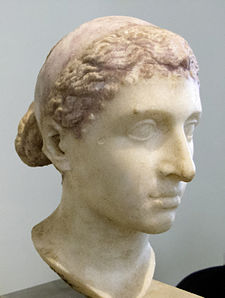
In 31 BC Octavian (Gaius Julius Caesar Octavianus), grand-nephew and posthumously adopted son of Julius Caesar, defeated Marcus Antonius and Cleopatra VII at the battle of Actium, ending the Roman Republic’s period of civil war.  Most of the people on the planet have likely heard of Antony and Cleopatra, but who has ever heard of Octavian?  The irony is that the romantic and celebrated couple are relatively unimportant figures when compared to the colorless Octavian.  They were simply another set of leading players during the last century of the Republic, while Octavian might be considered the most important individual in the entire sweep of Roman history.


By the middle of the second century BC the Roman Empire had been established, at least in the sense that there remained no power in the Mediterranean world that could seriously challenge Roman authority.  At the same time, however, the pressing need for reform in the state and military ran up against an all-powerful Senatorial class that had become corrupted and self-interested and resistant to even the smallest changes in the status quo.  The result was the Roman Revolution, which in the period from 133 to 30 BC saw the almost four hundred year old Republic gradually collapse into civil war and military dictatorship.  Ironically, the Republic was already dead when the dictator Lucius Cornelius Sulla restored and strengthened the traditional Senatorial government in 83-81 BC and then retired from politics.  Putting the pieces back together again was no longer possible, and Sulla himself provided a role model for future ambitious men.  The second fifty years of the Revolution was dominated not by the Senate but by powerful men and their armies, resulting in two full blown civil wars: Caesar against Pompeius Magnus (49-48 BC), and Octavian against Antony and Cleopatra (32-30 BC).

 Loser
Loser

Loser

Loser


When the 33 year old Octavian returned to Rome in 29 BC, he faced a task that might make the battle against the happy couple seem easy.  The Republic was dead, and as the immediately failure of the Sullan Restoration had demonstrated, it could not be revived.  With some small alterations the machinery of the Republican government was essentially that of the 5th century BC city-state fighting for its life in central Italy, and in the long run it was politically and administratively incapable of running an empire.  Enjoying the complete support of the military, Octavian could establish a blatant dictatorship, as his grand-uncle did, and allow Rome to face a return to civil strife when he died.  As one of Rome’s greatest statesmen, however, what he wanted was to manage the inevitable transition from oligarchic republic to autocracy in a way that would create a stable and lasting governmental structure.  In doing this he would become a second Romulus, virtually re-founding Rome.

Winner and Princeps

Winner and Princeps


While he almost certainly began with a basic idea of what he wanted to do, the realization of that conception would involve much trial and error, and the process would be accompanied by the first real national propaganda campaign in history.  He realized, unlike any before him, that in the public and political sphere image was everything, that the reality could be more easily ignored and accepted if it looked like something else.  The reality was to be a military autocracy; the image was to be the Republic restored.  And it actually worked.  His creation, the Principate, would maintain a stable and prosperous empire for the next two hundred and fifty years and allow a declining Rome to stagger on for another century or so.


The basic problem was to maintain control of the military (which was finally fully professionalized), without looking like a military dictator, and he needed to find Republican precedents for all his arrangements.  He also needed to give the hitherto ruling elites, the Senatorial class, a real role to play in the new government without surrendering the ultimate power in the state.  This was tricky business.


The campaign began in January of 27 BC when with great fanfare he gave up all his illegal powers, declaring the restoration of the Republic.  The Senate, in part cowed by the obvious loyalty of the army to the son of Caesar, in part grateful and supportive of establishing a stable government, then proceeded in the following years to vote all those powers back to him.  He realized early on that continually holding one of the two annual consulships – the supreme office that provided imperium, the power to command troops – would not work.  Not only was this contrary to old Republican tradition and reminiscent of the years of the Revolution, but it also limited the ultimate political prize and administrative training ground that the consulship provided to the Senate.  Instead, by votes of the citizen assembly and the Senate he accumulated and exercised all the powers associated with the consulship and other state offices without actually having to hold any of them, thus being freed from the limited tenure of the actual office.  He subsequently held the consulship only on special occasions.  There was no office of emperor.  He was ostensibly a private citizen, but one possessing a vast amount of power.
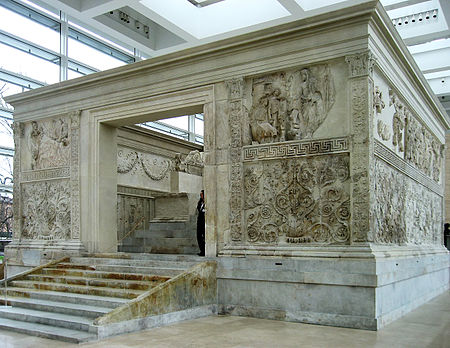
Augustan propaganda: the Altar of Peace

Augustan propaganda: the Altar of Peace

Augustan propaganda: the Deeds of the Divine Augustus

Augustan propaganda: the Deeds of the Divine Augustus


The major support of his authority was a special grant of proconsular imperium over certain provinces designated as “imperial”: initially the Gauls, the Spains and Syria.  These would be governed by legates chosen by him, while the remaining provinces, designated as “senatorial,” would be governed as they were in the Republic, by Senators who had just completed their terms as consuls or praetors (the imperium-granting office just below the consulship).  He also had the authority to interfere in the senatorial provinces if necessary and to move provinces from one category to the other.


This arrangement provided a way to control the army without actually being a supreme commander, which would be very un-Republican and redolent of the civil wars.  The imperial provinces were precisely those where the bulk of the military was stationed, thus providing Octavian with indirect command of the legions.  Grants of proconsular authority dated back to the early days of the Republic, but the only precedents for proconsular power on this scale were found in the Revolution and thus not very good.  But it could not be avoided: he absolutely required “legal” control of the military or Rome would slide back into civil strife.  Consequently, the confirmation of this power, first for ten years and then for life, was done quietly.  Incidentally, governance of the imperial provinces was generally of a higher quality than in the senatorial.


The other significant power granted him for life was the tribunician authority, which provided him all the powers wielded by the tribunes of the people.  These powers were really not that important to him, but the grant was very significant in terms of image.  The tribunate was an ancient office, created back in the fifth century BC, during the political struggles between the commoners, Plebians, and the aristocrats, Patricians.  The original mandate of the ten tribunes was to defend Plebians from hostile actions of the Patricians, and consequently Octavian could showcase this authority to demonstrate his position as a defender of the Roman people.


Supplementing his legal powers was his unmatchable auctoritas.  Auctoritas, “influence,” came with dignitas, “prestige,” the quality associated with an individual who had served Rome in some capacity.  In the grand days of the early and middle Republic it was dignitas that Senators competed for, rather than wealth and power, though dignitas did bring a form of power with its accompanying auctoritas.  (Yes, for almost four hundred years the majority of the Roman Senate actually thought first of Rome rather than themselves.)  The man (or men) recognized to be covered with the most dignitas would be styled princeps senatus, the First or Dean of the Senate.  Prestige of course brings political influence in any system, but for the Romans it was a much more real and compelling power.  And Octavian, who had literally saved the Roman state and restored order and prosperity, had a measure of dignitas unparalleled in Roman history.  He had become the princeps romani, the First Citizen of Rome.  Romans would listen to his advice.


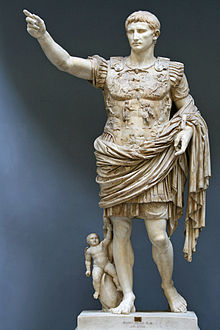
Rome had become a military based autocracy, but there was no actual office of autocrat, no emperor, inasmuch as that would hardly look republican.  There was instead a Princeps and thus the early empire (27 BC – 235 AD) is known as the Principate.  Octavian took the more impressive name of Augustus and became in effect the second founder of Rome and its first emperor.  To the Roman people he was Princeps, to the army he was Imperator and to the provincials he was king and the center of the imperial cult of Roma et Augustus.  In the year 2 BC, acting on the proposal of Valerius Messalla, who had fought against him at Philippi, the Senate named Augustus pater patriae, the father of his country.
Pater Patriae

Pater Patriae


The Roman people were delighted with the Principate.  There was peace and growing prosperity, and in any case libertas, the Roman concept of freedom, had for them never meant any political participation beyond attending assemblies and voting according to Senatorial advice.  The Equestrians, the traditionally apolitical business interests, were of course more concerned with stability and prosperity than forms of government.


It was the Senatorial families, the former ruling elite, that were Augustus’ real concern as a potential source of trouble.  So he made them partners in the new order, both to give them something to do and to reconcile them to the Principate.  He actual had no choice: he could not govern the empire without the pool of administrative talent that was the Senate.  They were of course junior partners, but while the Princeps was the ultimate power, the Senate administered the state and through its ex-officials the empire.  They could still compete for offices and honors, for dignitas, but now in the shadow of the Princeps, who worked to keep that shadow as small as possible.  He showed the Senate respect and listened to its advice, and with imperial patronage he aided the political careers of members of the old families, especially those who had been against him.  And the whole thing looked like the Republic.  In fact, Rome was still in theory a constitutional state, inasmuch as it was the Senate, representing the Roman people, that voted the Princeps his power.  Image is everything.


Augustus succeeded in his establishment of a military dictatorship for a number of reasons.  The Roman world was tired of instability and war; they had just emerged from a century of struggle and two recent civil wars.  There was no one left alive who knew the Republic as anything but disorder and strife.  There were no rivals left.  The Senatorial oligarchy had been drained, and all the powerful men were now loyal to Augustus.  And there was the Principate.  Anyone with any intelligence knew the restoration of the Republic was a sham and that Augustus was the absolute ruler of Rome, but the Senate had no choice but to accept it.  The legions were completely devoted to the son of the now divine Julius Caesar, so that while there might be conspiracies, there could be no real threat to the Princeps.  Besides, he gave them a real role in the governance of the state and left them with all the trappings of power, while he maintained a low profile.  He made it as easy as he could for the former rulers of Rome to swallow the bitter pill of autocracy.


Finally, he lived long enough, dying on 19 August 14 AD at the age of 76.  Some forty years of power had allowed him not only to construct the Principate but also to wean it from dependency on his guiding hand.  Power passed more or less smoothly to his adopted son Tiberius.


There were of course weaknesses in the structure of the Principate.  It was after all an autocracy and thus faced the age old problem: what do you do when you get a bad autocrat?  Augustus hoped that each Princeps would select and train the best candidate and gradually associate him in power, but autocracies almost inevitably become dynastic, even in the Democratic People’s Republic of Korea.  This was virtually guaranteed in the case of the Principate since for the foreseeable future the Princps must be a Julian in order to secure the loyalty of the army.


The other problem was that the autocracy was based on the military, thus presenting the danger that the army would sooner or later involve itself in the making and breaking of emperors.  The remarkable thing about the Principate is that it took so long for the legions to actually do this.  When Nero, the last Julio-Claudian, died in 68 AD, several army commanders converged on Rome, and after a brief and limited conflict Titus Flavius Vespasianus became Princeps in 69 AD, establishing a new dynasty, the Flavians.  The legions then retired to their camps and did not get directly involved in the political arena again until the death of Lucius Aurelius Commodus in 192 AD.  There was another brief but more widespread civil war to select the next ruler, Lucius Septimius Severus, in 193 AD.  The army was subsequently favored but not pampered by the Severans and remained loyal to the empire.  It is only with the outbreak of the Anarchy (235-285 AD) that the military loses that sense of duty and becomes corrupted and interested only in itself and thus a major force in the ultimate collapse of the empire.


Augustus probably foresaw these problems, but what else could he do?  In the last century before Christ the Roman Republic was irretrievably dead, and the only option was an autocracy.  And the only real base of power for that autocracy was the military.  Given the circumstances and the evolution of Rome in the last century of the Republic, a military dictatorship had become unavoidable.  But it is hard to see anyone else who could have come even close to facilitating that transition and preserving Rome’s future as well as Gaius Julius Caesar Octavianus.  Few men have made history on that scale.
Stuff from Way Back #25: Athens in Vietnam

(This is a fairly long piece about a war most people have never heard of, but there is a wonderful lesson of history here.  For more on the sophists see Stuff from Way Back #20.  The dates are BC.)


“Now we can see it clearly – like the light at the end of a tunnel.”

General Henri Navarre

commander of the French forces at Dien Bien Phu

History can often be hauntingly familiar, even across the 2500 year divide that separates classical Athens from America in the second half of the twentieth century.  A case in point is the catastrophic Peloponnesian War (431-404) between the Athenian Empire and the Spartan controlled Peloponnesian League, a conflict that to a great extent ruined the Greek world.


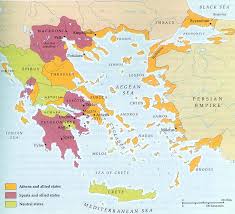
The Athenian Empire was naval based, taking in virtually all the island and coastal city-states of the Aegean, and constituted a wealthy trading block.  Though progressive and inclined to support democratic governments, Athens nevertheless maintained tight control over her “allies,” taxing them to pay for her powerful fleet (and the beautiful buildings upon the Acropolis).  Encompassing most of the rest of the Greek states, the so-called Peloponnesian League was land based and included most of the Peloponnesus and central Greece.  It was dominated, but not absolutely controlled by Sparta, which supplied the semi-professional core of the huge army, some 35,000 heavy infantry, that the League could field.  Sparta was the most reactionary state in Greece, and her small citizen body of perhaps 8000 was supported by an immense number of unfree serfs (helots).  Semi-socialist and nominally democratic, Spartan society was essentially authoritarian, and she favored oligarchic governments.

A divided Greece

A divided Greece

Athens began the war with immense advantages.  Her control of the sea was virtually absolute, which meant that the enemy was going to have a hell of time just getting at her and her allies.  The completion of the long walls linking the city with the port of Piraeus had turned Athens into a kind of artificial island, rendering her immune to the traditional strategy of laying waste the enemy’s territory and forcing them to come out and fight.  Offensively, the navy provided the Athenians with a big edge in rapid troop deployment and threatened the Peloponnesians with surprise raids on their coastal areas.  Athens also had unprecedented economic resources from her imperial income and her trade and went into the conflict with something unheard of in Greece: a  financial  reserve.  And finally there was the open and democratic nature of Athenian society, which had already made her preeminent in human resources, out-producing other cities in leadership, talent and imagination.


The Peloponnesians had but a single advantage over the Athenians – they were overwhelmingly powerful on land.  In every other respect they were hurting.  Any fleet they might scrape together would be dramatically outnumbered and out-rowed (the main pool of skilled rowers was within the Athenian empire), and the alliance was financially unprepared to launch and maintain many more ships.  And under the leadership of the Spartans, who did not even use coined money, that financial picture was not likely to change in the near future.  A further big disadvantage for the Peloponnesians: Spartan leadership.  A system geared to the status quo and limited mental horizons only rarely produces leaders of more than plodding ability, and Sparta’s traditional insularity and policy-bending paranoia about the helots might also be expected to hamper the war effort.  But blinding many to these serious weaknesses was the centuries old Spartan reputation as the alpha male of Greece, and there was widespread belief that ships and money and newfangled ideas would not save Athens from the juggernaut of the Spartan led Peloponnesian levy.


Pericles, the Athenian leader, knew better, and he intended to fight a new kind of war, one for which only Athens was in any way prepared – a war of attrition.  He was concerned simply with the preservation of Athenian interests, not the utter defeat of Sparta, which meant that Athens could achieve her victory by remaining on the defensive.  This he proposed to do by evacuating the population to the Athens-Piraeus fortress and temporarily abandoning Attica, the territory controlled by the city, whenever the Peloponnesians invaded.  Supplied from the sea, Athens could theoretically hold out indefinitely, while the fleet conducted raids on the enemy coasts to remind them of the price of war.  Pericles figured that after a few years of spending their summers in Attica and accomplishing nothing most of the Peloponnesians would lose whatever little interest they had in the first place, and the war would fizzle to an end.

Pericles aka "Old Squill Head"

Pericles aka “Old Squill Head”

Would the plan have worked?  Probably.  In the first several years of the war the Peloponnesian levy ravaged Attica and absolutely nothing happened.  Meanwhile, the Athenian fleet conducted hit and run operations against the coastal towns of the Peloponnesus, and it is hard to see how Sparta could sustain interest, especially among her already unenthusiastic allies, in a war that was making no real headway and bringing Athenian raids down on their territory.  Athens had even survived the devastating “plague” of 430 (probably epidemic typhus or cholera), which had carried off as much as a quarter of the city’s population.


But we will never know, because in 429 Pericles died from the contagion, and without his restraining hand Athens’ strength, her democracy, gradually became her downfall.  The cautious defensive strategy steadily evolved into an offensive one, and the goal of the war became the defeat of Sparta and the expansion of the empire.  This would have been dangerous enough, but the democracy itself began to undermine the war effort.  The traditional political leadership had been provided by the annually elected board of ten “generals,” so called because they were the men who actually led Athenian forces if needed; Pericles had been reelected to the board for thirty years.  The war now produced a new kind of politician, the demagogues, men of mostly limited abilities who wielded power not by holding office but by manipulating the citizen assembly, which in the unlimited democracy of Athens was the ultimate seat of power and could not be challenged.  They rode to  power on their rhetorical abilities and by advocating a war of conquest.  This led to a growing number of bad decisions and ill-considered strategies and created threatening divisions in Athenian society, as the increasingly radical democracy struggled to manage a people becoming intoxicated with their own power.


The first phase of the conflict, from 431 to 421, saw a steady departure from Pericles’ defensive strategy after his death.  In 425 the Athenians almost accidentally captured a unit of Spartans, which lead to peace overtures from Sparta, but the Athenians went on a roll and launched a land campaign in central Greece, a complete reversal of Pericles’ policy.  It was a disastrous failure and was followed by the loss of Amphipolis, an utterly vital city on the north Aegean shore.  Athens was ready for peace.


The Peace of Nicias, signed in 421, had about as much chance of success as the Munich agreement of AD 1938, and in 418 an Athenian supported coalition in the Peloponnesus was defeated by Sparta.  Meanwhile, a war-weary Athens was becoming more and more divided.  The older generation in particular was getting fed up, while the younger was increasingly enthusiastic for more military adventures.  The hawks got the upper hand, and in 415 a huge force was sent to Sicily to attack Syracuse and seize the entire island, an act of incredible imperial hubris.  Primarily because of divided leadership, a result of the political situation at home, the expedition failed, and in 413 it and a large relief force were essentially annihilated.  The Spartans decided to reopen the war and invaded Attica that same year, beginning the second phase of the war, from 413 to 404.


All hell broke loose for Athens.  In 412 her allies began revolting in droves, and even worse, Sparta signed an alliance with the Persia Empire, which meant money for a Peloponnesian fleet, which meant in turn a spread of the revolt and a threat to the security of Athens itself.  Back home extremist conservatives launched a coup in 411, setting up a narrow oligarchy of 400 and driving the Athenians to the brink of a civil war.  Athens was now at war with virtually everyone in the Greek world, including herself, but the people were not about to give in.  The democracy was restored in 410, and by 407 the Athenian position in the Aegean had been almost fully restored.  But the Athenians seemed bent on self-destruction, and in the next several years they turned down several peace offers from Sparta.  In 405 they lost their last fleet and were forced to surrender in 404, losing all their possessions, their walls and even their democratic government.


The Athenian democracy had failed.  Despite an immense superiority in resources and talent Athens had found herself unable to put an end to the war and after twenty-seven years of struggle had lost everything.  How could this happen?  For Thucydides, the Athenian historian of the war, the answer is clear.  The way of life fostered by the democracy was a source of powerful forces, but it took a capable leader to control and direct these forces, to restrain the people and channel their energies towards realistic ends.  Pericles was of course this kind of leader, able and patriotic, and Athens’ misfortune was that after his death the democracy found no one who combined these two qualities.  The prosecution of the war, the foreign policy of the state became more and more a reflection of internal politics, as Athens became the prey of the demagogues.  Time and again the Athenians passed up opportunities to end the conflict as winners in order to try instead for a vastly greater victory.  And time and again these attempts to grasp more were ruined not by the strength of the enemy, but by the Athenians themselves, as the political feuding created dangerous cracks in the democracy.  This domestic disunity was bad enough, leading ultimately to oligarchic revolution, but the cracks also showed themselves in the conduct of the war, in divided leadership of campaigns, inadequate support of expeditions and sudden reversals of policy.

Thucydides

Thucydides

I am inclined to agree with Thucydides.  Athens in the second half of the fifth century was simply under too much stress and faced with too many temptations to survive without the restraining hand of a leader like Pericles.  And it was clearly a question only of guidance, for the democracy – the common people who voted every important policy decision – constantly showed itself to be perhaps the most aware and able body politic in history.  It was after all Athens that lost the war, not Sparta that won it.  Their own worst enemy, the Athenians bounced back again and again after each new disaster, revealing the nature of the human resources shaped by a democratic society.   The Athenians and their experiences in the Peloponnesian War are a powerful testament to both the weaknesses and strengths of democratic government.


While suffering the political difficulties, the Athenian democracy also underwent during the war a moral crisis, which was both cause and result of the political trials.  This was the period when the radical sophists, extremist political thinkers, were attacking the democracy and its egalitarian notions.  Instead of the people they would see as rulers those who were by nature suited to rule – the “superior men” – and in place of the democracy they would have a narrow oligarchy.  Well, after the disasters of the latter part of the war people began to listen to these characters.  Reasonable and moderate men were losing faith in the democracy and becoming more attentive to these characters at the other end of the political spectrum.  Germany in the twenties and thirties saw a similar development, as moderate middle class Germans reacted to the perceived failures of the Weimar government and the threat from the left by paying greater heed to the far right.


The ideas of these sophists on the nature of justice – that might made right – fit perfectly with the growing will to power and empire among the Athenians.  As the war continued the means slowly became the end for the Athenian people, as demagogic factionalism and the temptations of power combined to drive them to extremes.  Pericles’ simple defense of the empire was forgotten, and victory gradually became instead the grasping of more, the expansion of power and the total defeat of Sparta.  Rather than what they might bring, success and power themselves became the real goal of the Athenians.  At the same time the continuation of the war produced among the Athenians a growing sense of frustration because of their seeming inability to bring it to an end.  When they were losing, the quality and strength of their national character compelled them to fight their way back, and when they were winning, that same character seduced them into reaching for more.  Athens had the power and the resources to carry on the war, even after a disaster like Sicily, but she could not stop it.  And this frustration further aggravated the problem, driving the Athenian people to seek even more urgently that light at the end of the tunnel, that final victory that would solve all their problems.  It might be fair to label the response of Athens to this frustration, her continued and amplified operations of war, as acts of collective hysteria.  This is the tragedy of a people being destroyed by their own greatness.


All of these things – the political turmoil, the frustrations, the national hysteria – were accompanied, perhaps inevitably, by a steady moral disintegration.  As the war dragged on there was a growing loss of respect for authority and the moral traditions of the community, indications of a loss of faith in the society as a whole.  The war certainly contributed to this moral breakdown, especially through the psychic conditions – the uncertainties, the alternating hopes and fears, the frustrations – it imposed on the Athenians, but the far more important cause was sophism.  Part of the impact of sophistic skepticism was the general erosion of accepted tradition and its authority.  If, as the sophists said, man-made law is all relative anyway, why necessarily accept that of your fathers?  Their values and standards of behavior may not be pertinent to your situation, and perhaps you should look instead to your own definitions.  This of course can be mighty dangerous for the social fabric.


Finally, there is an aspect of the Athenian moral crisis that should be familiar to late twentieth century America – the development of something like a generation gap.  Athenian society during the Peloponnesian War gave rise to what appears to be the first serious challenge of one generation by another in history.  As with America in the sixties it was precisely the young, primarily young aristocrats, who were the focal point of the moral crisis in Athens, although their reaction was hardly one of protesting the war and using controlled substances.  In fact it was generally the younger generation who were in favor of greater imperialist adventures.  But Athenian youth of the period of the Peloponnesian War were like many young Americans of the Vietnam era in that the morality of their fathers, the inherited ethos of the society, was not necessarily valid for them.  The extent of this challenge should not be exaggerated, being apparently essentially limited to aristocratic youth, but it did exist.


A generation gap had never occurred before this for the simple reason that only now had the ascendancy of the state and the individual so undermined the strength of the family that the ties binding one generation to the next had been loosened.  With the stage thus set by the general social development of the Greek state conditions particular to Athens then prompted the generational challenge.  First of all there was the democracy, which itself involved a certain rejection of tradition.  The egalitarianism that was fundamental to democratic society eroded the authority of parents, of the previous generation, by stressing the importance of the individual and the equality of all.  As an eighteen year old Athenian male, you are a full political person, with a vote in the assembly equal to that of your father, and in the assembly you might even become more influential than he.  So why should you then obey him when the two of you differ back at home?  Political freedom is not conducive to the passive acceptance of traditional authority.


Nor is an emphasis on reason, which only naturally tends to devalue authority based on tradition, and the growing respect for reason in fifth century Athens was causing many to question and sometimes reject traditional values.  The focus of this was of course the sophists, whose rationalism was especially zeroed in on an attack on tradition.  It was not just their hostility to tradition, but also the simple fact that they existed, breaking the monopoly parents had held in the education of the younger generation.  It is hardly surprising that the Baby Boom generation that was the first to seriously challenge traditional American values was also the first to go to college in massive numbers.  Reason and doubt are deadly to knowledge based only on faith and acceptance.


The final factor contributing to this generational phenomenon was the social and political failure of the democracy during the war and the loss of faith in the established order that it incurred.  We need only to look five decades into our own past to see the effect of such a failure on the young of society.


(An additional note: included in the ranks of the neocons, who played an instrumental role in leading the United States into its pointless and costly war with Iraq, are at least two classical historians, and it is said that Thucydides’ history of the Peloponnesian War is a sort of bible for them.  Apparently they neglected to read the chapters on the Sicilian expedition.)

Worst Legislator Who Actually Has a Brain Award

(This piece is self-indulgent and motivated solely by disgust. Next week I will endeavor to do something of interest to all.)


There would appear to be few members of the United States Congress for whom the good of the country is their primary concern. Rather, being reelected comes first, which means soliciting huge amounts of money, which is hardly likely to be handed over without some promise of a payback in the form of legislation. This is tacit and apparently acceptable corruption. Adding to the abysmal quality of our legislators is the recent appearance of Republican extremists, such as Sen. Ted Cruz, who are willing to threaten the welfare of the nation if they do not get their way. There are also growing numbers of anti-science ignoramuses, such as Rep. Paul Broun, who wish to make legislative decisions on the basis of beliefs plainly contradicted by fact. That men like Cruz and Broun are complete buffoons does not seem to bother their constituents, perhaps because they represent southern states.

 
There are indeed many disgusting individuals in Congress who seem to be doing their best to injure the country, whether from self-interest, extremist ideology or simple stupidity, but my pick for the Worst Legislator Who Actually Has a Brain Award is Rep. Ileana Ros-Lehtinen of Florida’s 27th congressional district, which includes Dade county. She is an American of Cuban extraction, who has served in the House of Representatives continuously since 1989. She is best known as Israel’s woman in Congress, a significant distinction given that most all of Congress is inclined to give the Jewish state unqualified support, but she is also an enthusiastic supporter of the security state that America is turning into.

Israeli agent

Israeli agent

 
Ros-Lehtinen’s legislative activities on the domestic front suggest a person who might be comfortable with the Stalin administration. It must be said, however, that her positions on social legislation are not extremist, but rather simply conservative. She supported the Defense of Marriage Act, an implicit anti-gay stance, but later became a champion of gay rights, presumably because her eldest child turned out to be transgender. (There seems to be a lot of this going around among conservatives who discover they have gay or lesbian children.) She singlehandedly scuttled the International Protecting Girls by Preventing Child Marriage Act, concerned that funds might be used for abortions. She opposes stem cell research and any estate tax and supports drilling in the Arctic National Wild Life Refuge. She supported the disastrous Bush tax cuts and opposes the Peace Corps, although it is not at all clear why.

 
These are standard conservative positions, and while they are increasingly out of step with the majority of Americans, they are not extreme or particularly detrimental to the country. The same cannot be said for her positions regarding the emerging security state. She supported the Military Commissions Act, which was created to provide a replacement for the Combatant Status Review Tribunals, which were declared unconstitutional by the Supreme Court. Besides circumventing the Geneva Convention this act was so worded that an American citizen could be denied habeas corpus, for which it was also declared unconstitutional. She has advocated that the Patriot Act, which was passed by an intimidated Congress in response to a (bogus) state of war, become permanent. This would make what were presumably temporary and extreme measures, to wit, dramatic increases in the power of the Presidency and the security services, permanent fixtures of the federal government. That legal scholars have seriously questioned the constitutionality of many of the provisions of the Patriot Act is apparently unimportant. One is reminded of the emergency Enabling Act of 1933, which also gave the executive enhanced power and became permanent, establishing the basis for the dictatorship of Adolf Hitler.

 
In the area of foreign policy Ros-Lehtinen is, in my opinion, seriously misguided and is injuring American interests abroad. She of course voted for the utter catastrophe that was the Iraq war, but then again, virtually everyone did, abandoning rationality for the satisfaction of revenge – against anyone. Whether the target was actually culpable was unimportant, as Ros-Lehtinen boldly declared: “Whether or not there is a direct link to the World Trade Center does not mean that Iraq is not meritorious of shedding blood. The common link is that they hate America.” Now, that is a reasoned policy. Of course, no hawk can ignore domestic politics, and having declared that harsher penalties should be imposed on Libya, she balked at the NATO airstrikes, presumably because they were initiated by a Democratic President: “I am concerned that the President has yet to clearly define for the American people what vital United States security interests he believes are currently at stake in Libya.” It seems there is no problem that President Bush failed to do this in the case of Iraq.

 
Born in Cuba and living in south Florida, Ros-Lehtinen is understandably, if not rationally, an extremist when it comes to the communist left-over in the Caribbean. The half century embargo of Cuba is probably the most obviously failed policy ever implemented by the United State. It has not brought about regime change, and indeed communist Cuba has already survived the Soviet Union by a quarter century. The major impact has been the impoverishment of the island and the complete absence of the sort of interaction that might soften or even change the regime. Inasmuch as Cuba is a threat to no one, and certainly not the United States, continued support of this failed embargo can only be understood in terms of emotion and revenge. Ros-Lehtinen is Cuban and represents a district that is packed with Cubans, many old enough to have fled when the revolution took place. In fact, it would seem that the continuation of this now silly embargo is due to the fact that as a Presidential candidate, if you oppose it, you lose south Florida, and if you lose south Florida, you lose Florida, and if you lose Florida, you lose the election. This may not be true, but politicians think it is.

 
When Obama dared to shake the hand of Raúl Castro at the Nelson Mandela funeral, Ros-Lehtinen exploded with rage, ranting about exchanging greetings with this bloody dictator. Well, Castro is indeed a dictator, there are political prisoners in his jails and Cubans enjoy very few freedoms, but the guy is a lightweight on the authoritarian stage. I have not heard her or other anti-Castro zealots complain about China, which is at least nominally communist and certainly more bloody. They still have a gulag, they have shot people in the streets and they are methodically turning Tibet into a Chinese province, yet the policy here is engagement. Incidentally, in their fulsome praise of Mandela American politicians and media had virtually nothing to say about Mandela’s close relationship with Castro and Arafat.

 
Ros-Lehtinen has of course worked against every attempt to end the embargo and open a dialogue with the Cuban government and tried to block President Carter’s visit to Cuba in 2002. This is of course all stupid but hardly radical, but she has clearly revealed her extremism. She defended Veletin Hernández, who was convicted of murdering a Cuban who advocated talking to Cuba, and she worked to obtain a pardon for Orlando Bosch, who was convicted of terrorism and is suspected of complicity in the bombing of a Cuban airliner that killed 73 people. She has publically advocated assassinating Fidel Castro and apparently anyone else she deems an oppressor. Most rational people would consider defending convicted murderers and supporting the assassination of foreign heads of state to be extremist.

 
But it is Ros-Lehtinen’s unqualified support for the state of Israel that seems most inimical to American interests and is certainly for me the most disgusting part of her political activity. She has authored a seemingly endless stream of bills seeking to tie the United States financially and militarily even more closely to Israel and impose more restrictions on the Palestinians. Any criticism of Israel, even if rooted in established American policy, will bring an immediate condemnation from her. When the State Department expressed concern about growing Israeli settlement activity in Palestine, she demanded that the administration stop such attacks on our ally, even though the United States has opposed the settlements for decades and they are blatant violations of well-established international law.

 
She opposes American support for the Palestinian Authority and any agency that works with the Palestinians, even if the work is simply humanitarian aid. The Palestinian Authority certainly has its problems, but it is the recognized government of Palestine and the only authority that can engage in negotiations with Israel (pointless though they may be). The fifty year old United Nations Relief and Works Agency for Palestine Refugees in the Near East has been frequently accused of malfeasance, generally by Israel and its supporters, who oppose any public discussion of the conditions in the occupied territories, but many of the accusations have been shown to be groundless. In any case, while there are likely problems associated with UNRWA’s operations, most of its work has been manifestly humanitarian. She has also attempted to deny American funds to any UN agency that recognizes Palestine as a state, no matter how important that organization’s efforts are in helping distressed people. A major source of her campaign financing comes from Irving Moskowitz, a notorious supporter of the settlement program and annexation of East Jerusalem and the West Bank.

Irving the Bag Man

Irving the Bag Man

 
Regardless of how one estimates the value of Israel as a US ally, Ros-Lehtinen is clearly an extremist when it comes to the Israelis. She has defended Israel when it violates international law (not that international covenants mean anything to America anymore), but more seriously, she has rushed to Israel’s defense even when it is blatantly opposing established American policy, embarrassing us and undermining our own national interests. While most politicians are terrified of angering Israel and its American organizations, this crosses the line into anti-Americanism, of putting the interests of a foreign state above our own.

 
One wonders why. As a radical opponent of the Castro regime, you would think she would feel some sympathy for the Palestinians, who under the Israeli occupation are suffering a more oppressive regime than even the Cubans. Is it Moskowitz’s money? Is it her Jewish constituents? Is it some deep-seated hatred of the Palestinians? What could bring her to be essentially the agent of the Israeli government in Congress? Who knows? Congress is filled with a lot of strange and loathsome people.

Stuff from All the Way Back: Tribalism


Tribalism in one form or another has been the bane of humanity, a curse that predates agriculture and civilization yet remains a major cause of human misery millennia later.  It ultimately revolves around fear of the other, the stranger, the unknown, and it is rooted in ignorance and supported by the conforming pressures of the group.  It provides a mechanism for directing anger and hatred away from the group and justifies violence against others.  It allows one to engage in and even be rewarded for behaviors deemed immoral within the bounds of the tribe.  It plays to the worst aspects of the human psyche.


In its earliest incarnation tribalism’s defining bond was kinship, and the group’s particular identity, what separated the tribe from the rest of the world, was based on blood.  The tribe was perceived, with real justification, as an extended family, an idea buttressed by the general recourse to marriage within the group.  With the advent of agriculture and settled communities the idea of kinship persisted as the defining bond, though now supplemented by a sense of locality: “This is our place.”  The birth of urban civilization and the territorial state undermined traditional tribalism by creating communities too large to understand in terms of kinship, though kinship groups in the form of wealthy families could still compete for control.


Imagined kinship was one solution for tribalism in an urban setting.  The polis (“city-state”) society of classical Greece excelled in this.  Because of the extreme competitiveness and narcissism of the Greeks, each polis wished to assert its unique identity in a sea of Greekness, and one result of this was to see the polis community as an extended family.  Consequently, every polis understood its populace to be descended form a common ancestor, who was the founder of the state, and thus was created a kind of urban tribalism based on a largely imagined kinship.  And one unfortunate result of this competitiveness and tribalism was the endless inter-city warfare that ultimately destroyed classical society.


The emergence of the nation state allowed a sort of tribalism on a grand scale – “my country right or wrong” – but this stretches the meaning of the word a bit too far.  No, tribalism on the grand scale is facilitated by religion, specifically the Abrahamic religions.  A (theoretically) unchangeable system of absolute beliefs and values granted and defended by an infallible deity certainly provides an environment conducive to the sort of group mentality traditionally associated with primitive tribalism.  That the religion supplies a unique and absolute understanding of the world and god and behavior makes the non-believer the “other” in a way simple differences in custom and language never could.  Those outside the group are not simply different in their behaviors; they are completely wrong, since they have no knowledge of the actual truth and the real god.  From this it is a short step to educating them, even forcibly, or considering them to be the enemy, who should perhaps be destroyed.


Thus a quite real tribalism that has no need of kinship ties and involves millions.  And with it, holy war and violence involving whole populations.  Jews against idol worshipping pagans, Christians against pagans and Muslims, Muslims against infidels and even within the separate faiths, Catholics against Protestants, and Sunnis against Shiites.  The south Slavs are a wonderful example of religion-based tribalism taken to the extreme.  The Croats and Serbs have common ancestors and constitute an ethnic group, they speak a common language (though using different scripts), and apart from religion enjoy a more or less common culture.  But the Croats are Catholic and the Serbs are Orthodox, and this has meant centuries of hatred and violence and a tribalism that cannot now be escaped, despite the waning influence of religion in Europe.


And real clan/ethnic-based tribalism continues to haunt the developing world, especially Africa and the more remote regions of south Asia, where the existing states are unable to replace tribal loyalties with allegiance to as greater political entity.  Neither Hutus nor Tutsis are Ruwandans; they are Hutus and Tutsis.  Or more recently, the people of the new state of South Sudan are not Sudanese; they are Dinka, Toposa, Shilluk, Bari or anyone of the some sixty ethnic groups that make up the population.  The Dinka and Nuer are now headlining in a growing civil war.


There is, however, a new tribalism available to those who seek the sense of belonging and group strength and want an “other” to vilify but lack a kinship/ethnic/religious group of their own.  This tribalism is moreover generally harmless and requires group-think and irrationality only on special occasions.  I speak of sports fandom.  Well, it is not completely new: the chariot races of Rome and Byzantium produced specific groups of fans, who might resort to violence, especially in Constantinople, where there was frequently city-wide rioting between the fan factions.  There is still some violence associated with sports tribalism, particularly among soccer fans, but this modern tribalism is essentially harmless.

Totem of the Forty-Niner Tribe

Totem of the Forty-Niner Tribe


My personal tribe is that of the San Francisco Forty-Niners, a professional American football team, and membership allows me to enjoy most of the characteristics associated with the more traditional varieties.  First, I am part of this tribe for the same reason that most people throughout history have found themselves in a certain tribe: I was born into it.  In fact, not only was I born in San Francisco but in the same year that the team was, which establishes an even stronger bond.

A proud member of the tribe

A proud member of the tribe


As with virtually all tribal organizations, display is of extreme importance, especially during ceremonial occasions, such as pre-game tailgating.  The tribe has its own colors and emblems, which serve to identify a member when he is in the general population.  They may be proudly shown, whether on clothing or the walls of the home or wherever.  For the central event of the tribe, the game, the body and hair might serve as mechanisms for tribal display.  Some, like myself, will even have the tribal totem tattooed on the body.


The game is the core ceremony of the tribe and Sunday is the sacred day of all National Football League tribes.  American football is particularly well suited to serve as a basis for tribalism since the game itself revolves around ritual warfare.  The players are the elite warriors of the tribe, seeking to bring glory to the tribe and gain honor by humiliating the outsider, the other.  In a great choreographed dance of sham battle they struggle to penetrate the defenses of the enemy and seize his territory by “taking it to the house.”  The ritual killing of the enemy leader, “sacking the quarterback,” is a particular moment of glory.  From the sidelines of the conflict the elders dispatch stratagems to the team, while the gods, the owners, look down from their well-stocked metaphorical mountaintops.

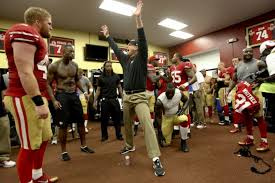
Chief Elder performs a ritual dance in the holy-of-holies

Chief Elder performs a ritual dance in the holy-of-holies

Our leading warrior

Our leading warrior

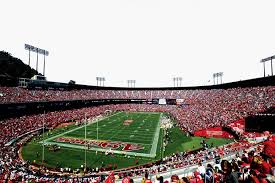
Last game in our ancient house

Last game in our ancient house


The home stadium, “our house,” is of course the central locale for tribal celebration, but tribe members scattered across the continent gather at local shrines, the sports bars.  There they can display ceremonial dress and tribal totems and generally give voice to the glories and superiority of their clan, all while drinking beer, the soma of all football-based tribes.  It is a time for ritualistic behaviors, such as the universal gesture of exultation and tribal bonding, slapping the upraised hand of a fellow celebrant.  Knowing they are my brothers in the tribe, I have hand-slapped strangers whom I would attempt to avoid on the street. There are of course prayers and chants, which, as in traditional tribalism, need not have anything to do with reality: “We’re number one!” or “Road to the Superbowl!’  The origins of some of these ritual practices, like the barking and bone waving of the Cleveland Browns tribe, are known only to tribe members.


When your tribe is winning, there is exultation, affirmations of joy – “Yes!” – and hand-bonding.  The ritual taunting increases and you remind your enemies of the epic heroes and great deeds of your tribe, in my case immortals such as Joe Montana and Jerry Rice and of course the “Catch,” known to all to mark the beginning of the Forty-Niner Era.  Should your people be facing defeat there are mechanisms to cope.  There is the comfort of the group, your tribal mates, who know and share your grief and join in the ritualistic chanting: “We’re still number one!”  You explain the “stab in the back,” the incompetent officials and bad penalty calls that unfairly doomed your cause.  You always stand with your tribe.

Tribal Immortals

Tribal Immortals

The  Catch

The Catch


Meanwhile, my tribe, triumphant in the bitter cold of Green Bay, travels this Sunday to New Orleans to crush the Saints and listen to the lamentations of their women.  Unless we’re stabbed in the back.