Stuff from Way Back #19: All Hail the (Greek) Phallos

Virtually overnight the western world, including even parts of Latin America, has come to accept homosexuality, and the major issue is no longer tolerance but the public and legal status of a homosexual marriage.  On the other hand, there is central Africa, where practicing homosexuality can mean death, and the hypocritical Islamic (mostly Arab) world, where homosexuality is typically a crime but often engaged in because of the extreme sexual segregation, especially in the Gulf states.  And of course Russia has now enthusiastically embraced homophobia, hardly surprising in a county where the majority of the population is still coming to terms with the nineteenth century.


This sort of serious hostility towards homosexuality is yet another gift of the No-Fun God, who declares such behavior unnatural and an abomination, and prior to the arrival of the Christians (and outside Judea) attitudes were very different.  While there are exceptions, most non-Abrahamic societies have tolerated or in some cases even accommodated homosexuality in their social and religious values.  The Greeks are an excellent example, and ironic, since Greek values and ideas are at the heart of the western tradition, while their sexual practices were vehemently rejected by the religion that affixed itself to that tradition.


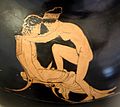
Because of deep-seated hostility in the Christian west to such practices, Greek homosexuality traditionally received little or no attention in the standard histories, and when it did, the account was typically distorted by the moral prejudices of the author.  Otherwise competent scholars turned a blind eye to the evidence of widespread homosexuality, including the so obvious and explicit scenes found on pottery.  (The Greeks depicted every sort of activity on their pots.)  Only recently has classical studies turned to serious investigation of Greek sexuality, much of which investigation is unfortunately marred by new prejudices.


It should be noted right off that if modern terminology is to be used, Greek society was not homosexual, but rather bisexual.  Homosexuality may be defined as the more or less exclusive sexual preference for members of the same sex and must be considered some sort of biological aberration (no offspring can be produced) affecting a minority in every society.  Bisexuality is the willingness to entertain sexual partners of either gender and would appear to be in large measure a socially determined trait, unless we assume that the Greeks were somehow physiologically different from other people.  Thus, while there was surely the usual homosexual minority, many urban Greeks, especially those of high social status, were apparently bisexual, seeking different things from the different sexes.  In fact, to judge from the large numbers of female prostitutes and evidence such as the successful sex strike launched by the Athenian women in Aristophanes’ Lysistrata, heterosexual relations were very important to Greek men.


Using modern terminology is in any case a dangerous practice, since there is the risk of also projecting into the past modern concepts that have a different or no meaning in ancient society.  The terms “heterosexual” and “homosexual,” which are little more than a century old, are valid classifications for Greece only in the most superficial sense, that is, labeling a single different-sex or same-sex act.  As more general characterizations they are useless because they group behaviors that the Greeks considered very different, the sex of the partner, for example, being almost a trivial concern compared to the all-important issue of social status.  Dominance and issues of penetration and receptivity were frequently of far greater importance than gender, and certain areas of Greek society might be more appropriately described as phallocratic rather than heterosexual or homosexual, though this term as well is too restrictive and potentially misleading.


Why ancient Greece – or at least the upper levels of its urban population  – should have been one of the very few openly bisexual societies in history, certainly in the West, is not perfectly clear.  The origins of male homosexuality were seen by the Greeks in the sexual segregation of the military societies of the Dorians (the second wave of Greek-speaking invaders from the north, c. late 13th to early 11th centuries), and Plato in fact blames the Spartans and Cretans, who were Dorians, for spreading the practice.  But while Plato may be reflecting an opinion generally held in Greece during the classical period, that opinion is not necessarily true, and there is no hard evidence for the diffusion of Dorian practices through the rest of Greek society.  It is true, however, that the overwhelming male orientation of polis (city-state) society, which resulted in a sort of sexual segregation, can probably be traced back to the warrior communities of the early Dark Age, which resulted from the Dorian invasions.  The warrior hosts disappeared, but because of the endless intercity warfare, the polis was in many ways also a warrior society, and the absolute dominance of males continued.


The pertinent fact here is that outside of childbearing everything that mattered in the polis was in the hands of males, which meant in turn that outside of heterosexual relations everything that was of any concern to a Greek male involved other males.  With very few exceptions women were completely uneducated and uninvolved in anything beyond the household and the odd cultic practice, and consequently, for meaningful companionship and a relationship with any intellectual content whatsoever a male normally had to turn to another male.  Male relationships thus filled a basic social need.  This situation of course does not necessarily lead to open homosexuality and did not in most other similar societies.  Further, while it is perfectly clear that extreme sexual segregation inevitably leads to some degree of homosexual behavior (look at any prison population), it generally does not lead to open, socially acceptable homosexuality.


Why then the Greeks?  An entirely satisfactory explanation is elusive, and I can only suggest a few reasons.  First, the relatively high level of social and intellectual freedom in Greek society, due in part to the open nature of the constitutional polis and in part to the fragmentation of Greece into hundreds of separate political units, which encouraged some small measure of diversity.  This resulted in a social atmosphere more conducive to change and acceptance of different practices.  This is not to suggest that Greek society was wildly progressive – it certainly was not, even in the heady days of change in the sixth century – but rather that the polis was at least marginally more inclined to accept nontraditional behaviors than the average pre-modern society.  Much more important, the Greeks had no inherited prohibition of homosexuality, no command from god that erotic experiences between persons of the same sex were wrong, which would allow the homosexuality inevitably practiced in secret in sexually segregated societies to come out into the open.  Finally, because sex was viewed as an important expression of status and citizenship, social position became much more important than the actual gender of the partner, producing an environment more open to sex between males.  In short, the male dominance and sexual segregation fosters the bisexuality, and the relative social freedom and lack of any serious religious prohibition brings it out of the closet.


But let us not misunderstand Greek sexuality and think simply of cheap thrills and bathhouse promiscuity.  Obviously, there were those who engaged in casual sex, especially with slaves and male prostitutes, but a serious relationship involving free males was bounded by a strict set of rules, and behavior that publicly violated those rules was socially unacceptable and sometimes criminal.  An acceptable pairing involved an older male, the erastēs, who was the active partner, and a younger male, the erōmenos, who played a passive role.  The erōmenos could not be too young, less than about twelve, and there would be talk if he were still playing the passive role much beyond the age of fifteen or sixteen (“when the beard was grown”).  The pair could not openly engage in oral or anal sex, because that would compel the erōmenos to play a subordinate, female role and not only bring shame upon him, but also injure his future status as a citizen.  Personal physical inviolability was one of the hallmarks of citizenship, and penetration of a male would place him in the category of slave and woman.  The kinaidos, the man who allowed himself to be so used, was the negation of everything represented by the hoplite, the heavy infantryman who defended the polis: manliness, citizenship and dominant status.  Indeed, the worst insult you could deliver to a man was to call him euryprōktos, “wide-assed.”  The acceptable practice was intercrural copulation, in which the erastēs, facing his partner, thrust his penis between his thighs, thus avoiding penetration.


Such at least was the social ideal, and some men maintained lofty attitudes regarding their liaisons, emphasizing the educational aspect of the relationship and their responsibility for the development of their erōmenoi as men and citizens.  There is some truth to this, inasmuch as Greek society (excepting Sparta) had no formal educational apparatus and the continued absence of the urban father from the household may have strained the relationship between father and son, but this must not be exaggerated.  The evidence suggests that sexual attraction to and pleasure with adolescent males was the common motivation and that penetration was frequently practiced, for all that one never spoke of it in public.  The Romans, incidentally, shared these attitudes, though unlike the Greeks they considered citizen youths out of bounds, and the distinction between penetrating men (permitted for virile males) and being penetrated by men (definitely not permitted) is still made among males in some Mediterranean and Latin American societies.

Greek honesty concerning homosexual behavior was only a single facet of their incredibly open attitude about human sexuality in general.  Sex, and in fact body functions in general, rather than being a taboo subject were a source of great amusement, as is readily obvious from Aristophanes and from Greek pottery (the stuff hidden away by Christian museum curators).  Aristophanes’ comedies were at heart social and political satire, the highest form of comic expression, but that satire was wrapped in humor that a modern audience would find obscene and puerile – jokes about farting, penis size and suchlike.  But the Athenian audience loved it, and these were people who had just sat through and enjoyed several tragedies; the modern equivalent might be several Ingmar Bergman movies followed by some mixture of Redd Foxx and the Three Stooges.


Free of any divine commandments to the contrary, the Greeks were able to develop a more open attitude about human sexuality, and I suspect their society was all the more psychologically healthy for it.  The Greeks were far more willing than most civilized peoples to recognize the inner nature of the human animal and squarely face what this meant in terms of human needs and behavior.


Finally, a popular Greek “pottery joke.”  There were traditional shapes for wine cups, and one was similar, though smaller, to the common chamber pot.  A picture of a woman peeing was painted on the inside bottom of this type of cup, and when the imbiber (inevitably male) finished his drink, he suddenly discovered the squatting woman and got the joke.  Yes, these are the same people who discovered democracy and philosophy, and yes, they would have found dribble glasses and whoopee cushions completely hilarious.
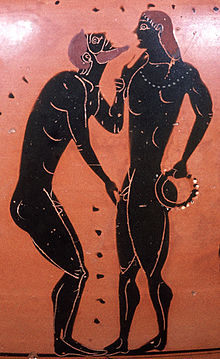
 

When men were men
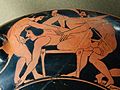
When men were men

Hey, it's Greek art

Hey, it’s Greek art

And women were women

And women were women


Stuff from Way Back #17: The Beloved Land

Egypt used to be a much happier place, even while under an authoritarian government that makes Mubarak and Morsi look like progressive leaders.  This was of course when the world was young, very young.  Egyptian civilization formally begins c. 3100 BC with the 1st Dynasty and the unification of Upper and Lower Egypt, which means Egypt came in second to Sumer (far southern Iraq) in the “Birth of Civilization” sweep stakes.  Ironically, though both were river valley civilizations that had emerged because of generally similar factors, because of their very different local environments they were completely different in their attitudes and understanding of the universe.

Menes (Narmer), the first Pharaoh, unites Egypt

Menes (Narmer), the first Pharaoh, unites Egypt

The Nile valley, which essentially defined ancient Egypt, was a grand place to live.  The river, with its incredibly regular ebb and flood that rejuvenated the soil every year, produced a large and extremely dependable food supply.  The security of the land was for thirteen hundred years guaranteed by physical barriers – the Mediterranean to the north, Sinai and deserts to the east, the river cataracts and difficult terrain to the south and desert wastes to the west.  There was virtually no weather, and excepting the rhythms of day and night, the rotating stars and the rise and fall of the Nile, the land was unchanging.  It was the Beloved Land.

The result of this environment was perhaps the most positive view of the world ever entertained by a society.  The universe was inherently good and just, a status guaranteed by the gods of the Two Lands.  Indeed, the harmony and order of the land was further secured by the presence of heaven on earth in the form of the Pharaoh, the continually reincarnated Horus.  The head of state was quite literally a god, and the state itself was a part of nature.  Life was so good that except for the god-king the afterlife was seen simply as a continuation of the one on earth.  Heaven and earth were so tightly bound that they were seen as a whole, and the peasant working his fields shared an essence common to both his animals and the gods.

And this never changed.  There were only three inescapable, non-periodic changes in the Egyptian universe: creation and the birth and death of an individual; all other non-reoccurring change was either so trivial or so slow that it could be ignored.  The exact Egyptian understanding of birth is unclear, but it could be minimized as a natural extension of the mother.  Death was tougher since there was a quite obvious change when the individual died, but this was explained as a sort of shift rather than an absolute change.  The essence of the person simply shifted to the afterlife, where in a world identical to the one he had left he would carry on with his business, be it farming, trading, building, administering or whatever.  That bodies buried in the desert fringe naturally mummified instead of rotting helped support this belief.

Creation was thus left as the one non-periodic change of any significance.  Consequently, as the universe was at the moment of creation, so it would be for all time.  And unlike the creation myths of the Asian and Aegean societies the Egyptian account involved no struggle.  It began, as in the Sumero-Babylonia system, with a watery chaos (these are hydraulic societies, after all), but the world was created peacefully, Ptah (or Atum) spitting out or ejaculating the first gods, who then continued the process through sexual reproduction.  In the universal mythic thought of the pre-Greek world these deities, though envisioned in human form, were actually manifestations of the natural phenomena with which they were associated, and thus the world was created.

By way of contrast, the Sumero-Babylonian account of creation involved struggle, as Enlil (or Marduk) battled and defeated Tiamat, the personification of chaos, and thus established the ordered world.  But unlike the permanent Egyptian cosmos the Sumero-Babylonian world required constant attention, lest it collapse back into chaos.  The difference was the environment.  The Tigris and Euphrates were wild rivers, which could flood or dry up the fields, and there were violent storms and periodic droughts.  The Sumerian city-states were constantly at war with one another, and barbarians from the Syrian deserts and Zagros mountains plundered the land.  Life was very uncertain, and disaster, natural and human, constantly threatened.  The afterlife consisted of a grim underworld, to which everyone went.  Pessimism reigned in the lands of the two rivers.

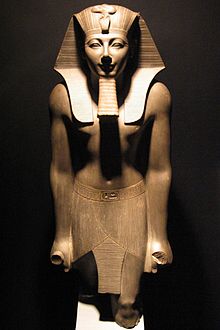
The negative result of the secure and unchanging life of Old and Middle Kingdom Egypt (c. 3100-1800 BC) was an unchanging culture.  Because of the focus on the eternal, the canons of Egyptian art and to a lesser degree literature were frozen at the beginning of her history, and a statue of the Pharaoh from the early second millennium is virtually identical to one from the late first millennium.  From the 1st Dynasty to the 18th Egypt essentially produced nothing new.  Creativity and progress require a certain level of struggle and tension, and Egypt was simply too content.

Thutmose III, creator of the empire

Thutmose III, creator of the empire

When her splendid isolation came to end with the Hyksos invasion and domination of the delta c. 1800 BC, Egypt was ill-equipped to deal with the sudden intrusion and rule of non-Egyptians and the arrival of new ideas.  The collapse and troubles of the First Intermediate Period (c. 2200-2050 BC) were an internal affair and could be accommodated by the traditional culture, while the Second Intermediate Period (c. 1800-1550 BC), initiated by the arrival of the Hyksos could not.  The kings of the 18th Dynasty drove out the invaders and restored a united Egypt, but it would never be the same.  The experience of the Hyksos seriously injured the self-confidence and optimism of the older days.

And Egypt was allowed no rest, as the impulse that drove out the Hyksos carried her into Syria-Palestine, where she stayed (New Kingdom or Empire c. 1550-1085 BC) and began a long struggle with the Hittite Empire in Anatolia.  New ideas and peoples poured into the Two Lands, preventing any return to the old ways and attitudes.  Tending to its Asian empire, the New Kingdom was too involved in the world, too nervous for eternity.  The god-king, leading the armies north, was no longer the distant majestic figure of the Old and Middle Kingdoms, but more human – and ephemeral.  The increasingly weak kings of the 20th Dynasty fell more and more under the growing power of the Temple of Amon-Re, as Egypt began the slide into impotence and ultimately foreign domination.  In the wisdom literature of the New Kingdom: silence and submission emerge as the leading virtues of the wise man.  Insecurity and outright fear enter Egyptian religion, and the once virtually automatic passage into the next world becomes a trial.  A good heart is no longer enough; the deceased must be armed with special prayers and magic, like the Book of the Dead, to overcome the new obstacles.

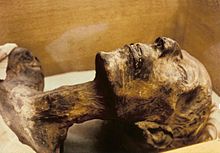
Ramses today

Ramses today

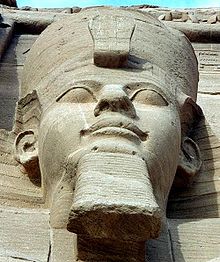
Ramses II, PR genius of the New Kingdom

Ramses II, PR genius of the New Kingdom

By the beginning of the first millennium Egypt had disintegrated into a collection of independent principalities, and in the seventh century the Assyrians, the “wolf in the fold,” captured the Beloved Land.  The ancient culture of the society lived on, but under a succession of imperial rulers: the Babylonians, the Persians, the Greeks and the Romans.  The three thousand year old religious beliefs could survive in the polytheist societies of Egypt’s conquerors, but in late antiquity Christianity began to seriously erode them, at least in the urban areas.  The final extinction of ancient Egypt, however, did not come until the seventh century AD, when the Arabs arrived with their particularly nasty version of the No Fun God and created modern Egypt.

Until the arrival of serious tourism Muslim Egypt has had very little regard for its glorious past, stripping away the finer stone of the ancient monuments to build mosques, as the Christians were doing in Europe.  The last two centuries have seen a rebirth of interest in the Beloved Land, but even now extremists want to destroy the remaining art in the name of their primitive aniconic god.  All things considered, better to live under the Temple of Amon-Re than the Muslim Brotherhood.

Stuff from Way Back #16: Moses and the Exodus (screenplay by King Josiah)

(The Preface of my novel mentioned that the Exodus is now in serious doubt.  Here is a fuller presentation of the arguments.)

Nothing is known about the historical Moses, and even his existence is now seriously doubted.  The stories about him found in Philo, Jospehus and the Midrash and Talmud have long been recognized as secondary and unhistorical, and our sole “primary” source for the leader of the Exodus is the Old Testament, which is itself derivative.  The first five books of the Bible, called the Pentateuch or Torah, are manifestly not historical documents, but rather the final version of a tradition that constantly revised stories handed down through perhaps thirty generations.  Like Homer’s Iliad, most of the Old Testament is oral history that was subsequently written down, though unlike the Iliad and the Odyssey, whose texts were thus frozen, the books of the Bible continued to be revised and edited.

Biblical scholars have discerned four major “authors” or strands interwoven in the text of the Pentateuch: the Yahwist, the Elohist, the Priestly and the Deuteronomist; and these sources were themselves assembled and edited into the finished product by a group of compilers, collectively known as the Redactor.  The oldest of these sources, the Yahwist, is dated to the tenth century BC, already two to three centuries after the putative date of the Exodus, and the editing of the texts continued into the sixth and fifth centuries BC and later; even as late as the time of Jesus there still existed no accepted canon for the Hebrew texts that made up the Biblical tradition.  And to this day the tiny Jewish community of Samaritans, the survivors of the northern Jewish state of Israel, possesses a Torah different from that of mainstream Judaism, the product of the southern state of Judah.

The books of the Pentateuch, once ascribed to Moses himself, almost certainly contain no real history.  They comprise instead collections of folk tales, wisdom and cultural information gradually assembled over the centuries into the often incoherent and inconsistent narrative that has come to be accepted as the early history of Israel.   Oral tradition is notoriously unreliable as a mechanism for preserving an historical narrative, since whatever the accuracy of the original account that account will inevitably be modified with each subsequent telling, as old material is forgotten or reshaped by the bard’s own environment.  As such, the facts and history were very malleable.  All the major figures of the Patriarchal period, such as Abraham, were most probably local heroes or cult figures, whose stories were modified and woven into the developing tapestry of a Hebrew national history as those localities came under the control of the west Semitic tribes that had accepted Yahweh.  A few, like Joseph, might be vague reflections of actual historical characters, but none of the exploits attributed to these figures can be accepted as historical fact.  Further, these stories were constantly revised by later editors, who reworked them according to the ideas, institutions and events contemporary to their own environments.  The figure of Moses’ brother, Aaron, for example, was added to the Exodus story much later by the Priestly source to emphasize the dignity and importance of the priesthood, which was frequently at odds with the prophets, who traced their line back to Moses.

A prominent problem with oral history is that the fish will always get bigger with each retelling.  Exodus and Numbers, for example, record that there were 600,000 men following Moses; that would make the Hebrew force more than half the estimated population of New Kingdom Egypt.  But the exaggerations and physical impossibilities recorded in the Biblical narrative are, ironically, not that serious a problem.  The supernatural will naturally and obviously permeate an account of an ancient people redefining their relationship with their deity, and the Bible is after all considered by believers to be divinely inspired.  This has led many to examine the miracles, such as the plagues sent by Yahweh, in terms of natural phenomenon that have been exaggerated and distorted by oral transmission.  This approach has worked well in many instances – the Nile did occasionally turn red and did produce plagues of frogs – and not so well in others – the death of the Egyptian first born can hardly be explained in rational terms.  But this can all be discarded by the non-believer, who need not buy into the alleged miracles.

Obvious mythic stories may also be identified without undermining the basic fact of the flight from Egypt.  For example, the tale of the important infant being set adrift in a basket on a river and then rescued to fulfill his destiny was a common one in antiquity: Romulus and Remus were floated on the Tiber and Sargon of Akkad on the Euphrates.  The same may be said of passages that conflict with the nature of Egyptian society.  The Pharaoh, as an example, was a god incarnate, and even the more humanized god king of the New Kingdom was not about to give audiences to the unimportant, especially not despised Bedouins.  The foreigners erecting Pharaoh’s buildings is the Delta were for the most part not chattel slaves but conscript labor, and there is little reason to believe that the Egyptians, who built border forts in the east to keep not just invading armies but also Canaanite migrants out of the Delta, would dispatch an army after a clutch of them leaving Egypt.  And it is even harder to understand – without divine intervention – how they were able to escape Pharaoh’s professional troops.

None of these contradictions and exaggerations, typical of oral tradition, need injure the historicity of some sort of Exodus, any more than the Iliad, Odyssey and Aeneid negate the fact that Troy actually was sacked by Greeks.  That there is an Exodus story in fact suggests a real event, since such epic tales were rarely, if ever, made from whole cloth, and partly for this reason Biblical scholars who have otherwise dismissed the Torah as ahistorical accept the Exodus, despite a complete lack of non-Biblical evidence.  (There is the victory stele of Merneptah, erected in 1207 BC, which in a list of enemies smashed in Canaan names “Israel,” using glyphs that generally indicate a nomadic people rather than a place.  This is the earliest appearance of the term Israel in an historical context, but exactly who these people are is completely unclear, and in any case nothing is said of their origins.)

The lack of any mention of the Exodus by one of the most serious record-keeping societies in pre-modern history might of course be attributed to the vagaries of time and destruction or to its insignificance in the affairs of Egypt.  But the archaeological record – or the lack of it – is more difficult to explain away, especially when the remains support an alternate history.  For the Exodus itself there are two archaeological difficulties.  First, while there are indeed royal granaries in Tjeku, almost universally accepted as the site of the Biblical Pithom, they date to a period later than the thirteenth century BC.  This problem might be dealt with, though unconvincingly, by pushing the date of the Exodus forward or assuming another location for Pithom, but the second difficulty admits to no apparent solution.  According to the Bible, before moving into Canaan the Hebrews sojourned at Kadesh (or Kadesh-barnea or Enmishpat), which is now identified with Ain el-Qudeirat, a substantial oasis in northern Sinai, on the Egyptian side of the frontier with modern Israel.  There are pottery remains from the Middle Bronze Age, far too early for dating the Exodus, and there are a series of forts, erected by the united Monarchy and Judah and dating from the tenth to the sixth centuries BC.  There are no remains from the centuries in which the Exodus might be dated and no signs of a substantial group of people settling in the oasis.

The real Moses?

The real Moses?

More compelling, however, are the results of four decades of excavation in the West Bank, the heart of ancient Judah and Samaria.  Scholars have long considered the Biblical account of the Conquest inadequate: how could a ragged group of refugees with their families in tow so easily conquer central Palestine and establish a strong and viable state and the dominance of Yahwism in less than a generation?   There were also already suspicions about the towns allegedly conquered by Joshua and company, and it is now accepted that most of them were later insertions in the narrative.  Many, like Jericho, simply did not exist at the time of the Conquest, and many places supposedly destroyed by the newcomers in fact fell during the Catastrophe, which changed the face of the eastern Mediterranean a century later.  More ominous, the towns given to the tribe of Judah by Joshua are identical to the frontier towns of seventh century BC Judah, and indeed, the campaigns of Joshua make more sense in the later environment, specifically the reign of King Josiah (639-609 BC) of Judah, than five hundred years earlier.

What the modern archaeological surveys have revealed is the essential lack of any evidence for the historical narrative presented in Joshua, Judges, Samuel and the earlier parts of Kings.  Instead, the pattern of the settlements in the highlands of Judea and Samaria show three successive waves of settlement from the east: first in the period 3500-2200 BC, then 2000-1550 BC and finally 1150-900 BC.  The intervals between these periods witnessed dramatic collapses of population with most of the settlement sites being deserted.  The material cultures of these settlements are roughly similar and, hardly surprising, on a much smaller and cruder scale than depicted in the Bible or actually found in the Canaanite towns in the western lowlands.  Even the largest villages contained only a few hundred people and had no public buildings of any sort and virtually no luxury items.  Little evidence of serious record keeping and even cult activities has been found and certainly no evidence of Yahwism.

The most likely understanding of this archaeological landscape makes the Hebrews indigenous to the region, a conclusion that dovetails with the absence of any evidence for the Exodus account.  The settlers appear to be primarily pastoralists from the Jordan valley and beyond, and in fact the earliest remains of each incursion are in the eastern fringes of the highlands and reveal dwellings arranged in oval patterns, certainly reflections of the oval arrangement of tents in a Bedouin encampment.  While local climate change during these two and half millennia may have played some small role, the real impetus behind the changes in population was the condition of the cities and villages in the coastal plain.  Pure animal husbandry requires some contact with farming villages in order to acquire certain goods, such as metal tools, and grain to supplement the meat and dairy diet.  If this is not available from traditional farmers, the pastoralists themselves must become more seriously involved in agriculture, which will ultimately lead to more sedentary communities and permanent settlements.  Once the grain surpluses and trading networks revive, old nomadic traditions and the agriculturally unrewarding nature of the highlands drive the populations back to pastoralism, and settlements begin to vanish.  This sort of relationship between farmer and Bedouin has been documented from antiquity to the present.

The settlement and de-settlement patterns in Judea and Samaria do indeed appear to match the history of the higher cultures to the west.  The second interval of settled population collapse (1550-1150 BC) occurred during the period of Egyptian rule, when agriculture flourished and the surpluses allowed highland settlements to be abandoned in favor of pastoralism.  When that stability and security, and consequently the trading network, vanished in the Catastrophe of the twelfth century BC, a final wave of settlement building resulted, producing some 250 sites.  Because the Catastrophe had vaporized the Hittite Empire to the north and turned Egypt into a weakling, until the approach of the Neo-Assyrian Empire in the ninth century BC there was no imperial power looming over Palestine, and tiny communities in the central highlands were able to develop and coalesce into an actual state – Israel.  Or perhaps two states – Israel and Judah – since the Biblical account of a single state fracturing into two cannot be trusted.

Thus, the people who became the Hebrews were indigenous to Palestine; they were in fact Canaanites.  So, from where comes the story of the Exodus and the Conquest?  Given the identity between the towns associated with Joshua and those with King Josiah and the recognition that Judges is part of what is called the Deuteronomist History, compiled in the time of Josiah, one can surmise that the epic tales of early Israel were fabricated in the late seventh century BC to support and in a sense sanctify the policies of Josiah, who might be identified as a latter day Joshua.  This was also the time of the Twenty-sixth (Saite) Dynasty, the last gasp of Egyptian power, when for a final time the Pharaohs nosed into Palestine.  This resurgent Egypt, a reminder of the glorious days of the Eighteenth and Nineteenth Dynasties, put the Two Lands back into the big picture being assembled in Jerusalem, allowing old tales of desert wanderings, forgotten conflicts and migrations in and out of the Delta to be woven into a new narrative of Hebrew origins useful to Josiah and his associates in their plans to “recreate” a unified and purified Israel.

King Josiah gets the first reviews.

King Josiah gets the first reviews.

Details found in the Torah in fact fit the seventh century BC far better than the thirteenth.  The kings of the Saite Dynasty were indeed erecting new buildings in the Delta, including Pithom, the Egyptian names in the Joseph story were more popular at this time and in Exodus the unnamed (!) Pharaoh seems to see Palestine as a threat rather than part of the Egyptian empire.  To the east, Kadesh, so prominent in the Exodus, is now the site of a Judean fort, and Edom, whose king refuses the Hebrews passage, only became a state in the seventh century.  It may be that these late details cover an ancient story of departure from Egypt, but they certainly show that the material was being rewritten and do add to the evidence for a seventh century origin for the Exodus and Conquest.

That the Old Testament is a sacred text for millions of Hebrews, Christians and Muslims ought not to obscure this historical reality of its composition and nature.  The early books of the Bible are clearly not history, and the details in them simply cannot bear the weight of the conclusions that have been laid upon them.  Trying, for example, to locate Mt. Sinai is an utterly futile exercise, since all the textual clues date from a later age that itself had not the vaguest idea where Sinai was, and the very existence of the mountain is now doubted by most scholars.  Most important, the god portrayed in the Pentateuch is a historical mishmash, revealing elements of the primitive henotheistic tribal deity of the age of Moses, the institutionalized national god of the states of Israel and Judah and the more perfectly monotheistic universal lord of the later prophets.  From this hodgepodge of stories and images of god the believers, ancient and modern, (and Hollywood) have taken what they will, inevitably creating a Moses and an Exodus that reflect the society and values of the interpreter, rather than what might conceivably have actually existed some three thousand years ago.  Moses and his god are a work in progress, constantly being reinvented, from the time of King Josiah to that of Cecil B. De Mille.

Stuff from Way Back #15: These Christians Are Really Annoying

(Three weeks ago I posted a piece on Albert Göring, who was being considered for inclusion in the Israeli Righteous Among the Nations for his work in rescuing Jews. Apparently he did not make it, presumably because of a rumor of a Jewish father, which would make him ineligible, and Israel avoids the embarrassment of having Reichsmarschall Göring’s brother among the honored.)

The Roman persecution of Christians is a well-known episode in the history of the religion, but inasmuch as these events occurred almost two millennia ago, there is no longer a Roman Empire and the Church was the winner, one might expect that some distortion has crept into the popular narrative. And it has, primarily because few people have any real knowledge of the Empire beyond what Christianity and Hollywood have suggested and even fewer understand the nature of traditional Roman religion. As a result a key fact has been lost: so long as you observed Roman tradition the state did not give a damn what gods you worshipped (at least until the state became Christian).

At first of course Rome did not even notice the new cult. Those with any knowledge of Judaea assumed it was yet another Jewish heresy, doomed to disappear, as in fact the sect of Christian Jews did. As the adherents of the new faith spread and multiplied, it was popular dislike that first caught the attention of the authorities. Like the Jews, Christians were monotheists, compelled by their beliefs to deny the existence of other gods, and they were doing this in a society that was completely polytheist. Polytheist societies are generally tolerant when it comes to religion, even in states with a religious establishment supporting a divinely connected kingship, as in the Sumerian city-states and Egypt. Inasmuch as deities were typically personifications of natural phenomenon, it was easy to identify gods across cultural lines, and in any case no one (excepting perhaps Akhenaten) was about to deny the existence of other gods and certainly not resort to violence in order to teach others a lesson.

Into this world come the Christians, telling their neighbors that the gods of their fathers do not exist and that they are wasting their time worshipping idols. Of course the Jews had been doing this for quite a while, but apart from small communities in some of the cities of the Empire, they were essentially a phenomenon localized in Judaea, and in any case they did not proselytize. Early Christians were in fact confused with Jews, but as their numbers grew, people realized this was something new – and very annoying. And if modern evangelicals are any indication, these early Christians likely often displayed a holier-than-thou attitude; they had the good news after all.

There was also a feeling that for all their professed love these people actually hated mankind. The first generation or so of Christians believed that the Christ would be returning soon, perhaps in their lifetimes, and there was consequently talk of what would happen then. And if Revelations is the guide, it would be unmitigated horror, suffering and death for non-believers, which was of course virtually all of humanity. There were also rumors of strange and disgusting rites, such as incest and cannibalism, the sort of things that are said of the despised and alien throughout history. Natural disasters and unexplained misfortunes were blamed on them. The Christians were strangers in a strange land and initially played the same role of the “other” that the Jews would play in medieval and modern Europe.

Capping it all off was the growing suspicion that they were disloyal as well as obnoxious. The traditional religion of Greece and Rome was primarily civic in nature, concerned with the cohesion and well-being of the community, and as such, it was closely connected to the idea of the state. The sacrifices and rituals were communal, designed to keep the community in the right relationship with heaven, and in the case of Rome this led to the emergence of priesthoods, such as the Pontifex Maximus, that were actually state offices. The holders of these positions were not “priests” in the familiar sense of the word, that is, representatives of a centralized church, as the priests of the temple of Amon-Re or the Catholic Church. Their job was not to intercede for or counsel the individual, but to conduct the rituals necessary for the survival and prosperity of the community.

As a result, honoring Jupiter Best and Greatest and his colleagues was more of a social act than a religious one, declaring ones good standing as a member of the community. If the worshipper had other more personal concerns regarding heaven, he would turn to gods more pertinent to his situation, especially traditional local deities among the provincials. As with most things, Rome had always had a laissez faire attitude regarding non-Roman religions, so long as there was no threat to public order and morals, such as led the Senate to ban certain Bacchanalian rites in 186 BC. She was even ready to tolerate an extremely intolerant religion, Judaism, because it was essentially local and no threat to the state. Nevertheless, denying the existence of the Olympic gods was in fact directly assaulting one of the foundations of the state and endangering the well-being of the society.

Even so, Christianity might have gone unnoticed were it not for the fact that they quickly became almost universally unpopular, even hated, and their vociferous rejection of the Roman gods struck people as disloyal. Constantly claiming that their god was their only true “king” and master also did not sit well in an autocratic society, and the ideas of their founder/prophet regarding the poor and the rich were absolutely revolutionary in a world always dominated by the propertied classes. So, there was in fact public disorder in the form of anti-Christian riots, which the authorities were compelled to deal with. All the evidence indicates that the Roman government was completely aware of the essentially innocent nature of the new religion, but Roman officials were hardly likely to defend an unpopular minority in the face of overwhelming public displeasure.

Apart from their refusal to pay even lip service to the imperial cults, there was actually a legal problem for the new church. Since the time of Augustus (27 BC-AD 14), the first emperor, new clubs and associations were prohibited unless they were specifically granted imperial approval. The reason was clear: private associations could easily harbor conspiracies against the state (as they did during the collapse of the Republic), and autocrats tend to be very sensitive about this issue. And here was a new and offensive cult spreading throughout the cities of the Empire.
As it happened, the Empire was mellow about the whole issue, and generally confronted the issue only when it could not be avoided because of public clamor. This was certainly the case under Trajan (98-117), who when asked what to do with Christians by his governor in Bithynia, Pliny the Younger, instructed him not to search them out but only act when it was unavoidable. The typical procedure was to require the Christian to make a token sacrifice, a pinch of incense, to an imperial cult, generally that of Roma et Augustus. For the authorities this was far more a pledge of allegiance than a religious act; perform this one act and you would get your “ticket,” your libellus, and could go home and worship whatever gods you pleased. Of course, for a Christian this was apostasy, and though many took the plunge, many did not, which baffled the Romans, who could not fathom such religious fanaticism.

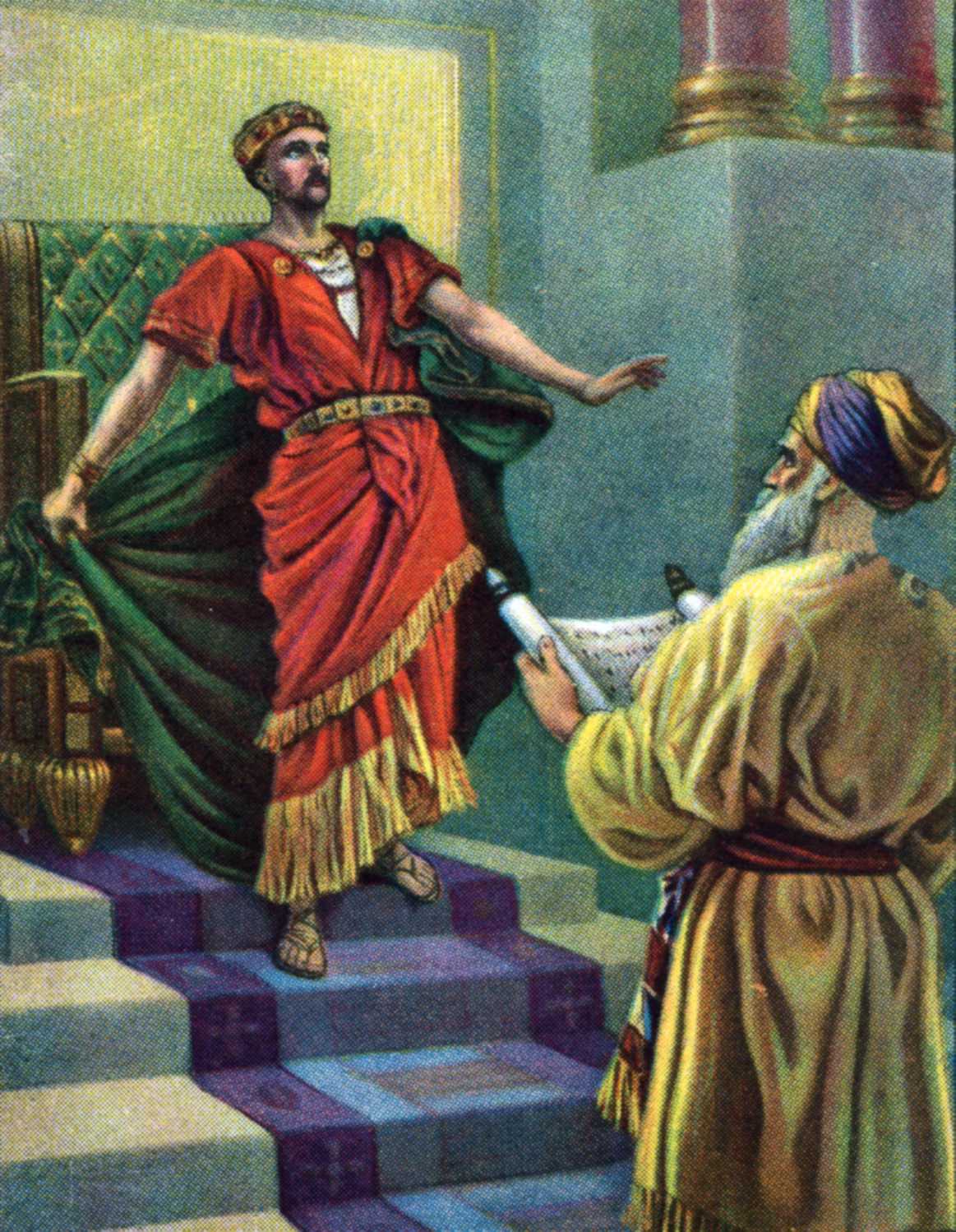
Decius: "Smoke 'em"

Decius: “Smoke ’em”

The result of all this was that violence against Christians was for two centuries limited to popular outbursts, such as blaming Christians for the fire in 64 (encouraged by Nero), and the odd official currying favor with the locals. Not until the third century was there an actual persecution in the sense of the central government taking Empire-wide action against the religion, and this would come during the Anarchy (235-285), a fifty year long civil war that essentially killed the Empire, even though it would stagger on for another century or so. During his short reign Decius (249-251) required that all Christians be put to the test and imprisoned if they refused, and this was repeated, with more severe penalties, by Valerian (253-60) in 257-258. Both of these men were ruling during a period of widespread instability coupled with serious barbarian invasions and internal military revolts and were desperately attempting to restore loyalty to the state. An obvious target was the Christian community, which was now highly organized and blatant in its rejection of the state religion, which now included deified emperors.

Diocletian (285-305) ended the Anarchy, but the Empire would never again come close to the stability and economic well-being it enjoyed before 235, and the history of the Late Empire was one of military autocracy alternating with periods of civil war. In 304 Diocletian launched the last anti-Christian crusade, destroying churches and sacred books and imprisoning priests, but it ended with his abdication the following year and seems to have petered out because of lack of popular support. His ultimate successor, Constantine the Great (305-337), legalized Christianity with the Edicts of Toleration (311-313), and with his conversion it became the official religion of the Roman Empire.

Valerian: "Crush 'em"

Valerian: “Crush ’em”

And then the real persecutions begin, as the government implements a continuous policy of crushing polytheism and eliminating the pagani (“rural folk”), so called because the old cults hung on the longest in the rural areas. Unlike those carried out against the Christians this persecution was moved by nothing other than simple religious intolerance.

Diocletian: "Eat 'em"

Diocletian: “Eat ’em”

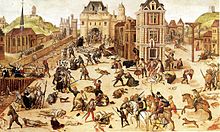
In the end Christians themselves would slaughter tens of thousands more Christians than the Roman Empire ever did.

Paris 1572 - Christians killing Christians

Paris 1572 – Christians killing Christians

Stuff from Way Back #14: The New God on the Block

(In keeping with the season I present a brief historical (leaving any deities out of it) understanding of exactly why Christianity was so damn successful.  Next week I will deal with the other question: what exactly was the reaction of the Roman government and why, a topic that has been seriously distorted because, well, the Empire no longer exists and Christianity does.)

Christianity is clearly a fusion of east and west, being a sort of religious hybrid produced by the intersection of Hebrew monotheism and the Greek mystery cult brought on by several hundred years of Greek control of Palestine. To some degree it is also a mix of oriental mysticism and Greek rationalism, inasmuch as the basic beliefs were later influenced by Stoicism and neo-Platonism. In essence, the Jews supplied the idea of the sole, ethical creator god, disconnected from the natural world, while the Greeks, through their mystery religion, contributed the notion of the dying and resurrected god. Paul and his associates made the new religion palatable for the world outside Judaea by stripping it of unappealing Jewish ritual, such as circumcision and dietary laws, and Greek rationalism then proceeded to refine the understanding of the godhead.

First of all, Christianity shared the ideas that had made the mystery cults so popular in Greece and later the Roman Empire. Traditional Greek and Roman religion was essentially civic in nature, primarily serving the community and devoid of any personal or inspirational quality. The mystery religion, which came in a variety of specific cults, did not deny the traditional gods but rather focused in on a single or tiny group of deities, providing the worshipper with a more personal and intimate relationship with divinity. The cults also involved emotional initiations and revealed knowledge, known only to the initiates, who gained in the cult at least a measure of equality with their richer and more powerful brethren. Christianity had no secrets but it rested on revealed knowledge and also offered a sense of special community within its ranks. Most all the mystery cults revolved around the central figure of a god or human who either literally or figuratively dies and is resurrected, thus providing an analogue of hope for the worshipper facing the inevitability of death. Further, the cults promised some reward, initially in this life, but by the end of the fifth century BC evidence appears suggesting the idea of judgment and reward in another life.

Christianity offered all these things but was something more than just another mystery religion. The Christian god was not just some Olympic retread, but the god of love, completely absorbed in those he had created. His death and resurrection was not simply some mythic event that had nothing to do with humanity beyond providing a message of hope. Rather, he became human and died specifically for humanity, a divine sacrifice that reveals an entirely novel concept of god. He was the god of all – rich, poor, slaves, free, men, women – something that was not always true of polytheist deities; for example, Mithraism, far and away the most popular cult in the Empire, was open only to men. And Christianity (at least until a powerful church emerged) cost nothing but commitment, while the polytheist religions required sometimes costly sacrifices, such as the bathing in bull’s blood incumbent on Mithraists.

Above all, this new god may have been open to everyone, but he definitely had a bias towards the poor and downtrodden. The rich and powerful had always had the edge in spiritual affairs, whether in the quality of their gifts or in outright control of the mechanisms of the religion. For the first time in history there was a god who favored the meek and chided the wealthy, and of course the vast majority of the in habitants of the Empire fit into the former category. This must have made for immense drawing power.

The religion also quickly developed the primitive ideas of judgment in the mystery cults into a full-blown system of reward and punishment in the next life and firmly rooted the judgment in the moral code inherited from Judaism. Obviously, promise of a better life in the next world is going to turn the heads of those whose life in this one is not that great, and while Christianity is born into an imperial society that constituted one of the more comfortable periods in history, in a few centuries life in the Roman Empire was going to become very unpleasant for most of its subjects. Now, the reward and punishment was based on the observance of a fairly strict ethical code, which might be expected to turn away potential converts. Most of us can get through life without committing homicide or adultery, but the thought crimes are very tough; “Thou shall not covet thy neighbor’s wife” is after all a rule even Jimmy Carter violated. But most people want a moral structure provided for them, and the basic rules provided by Christianity struck a favorable chord precisely because they were good rules. The Ten Commandments are the Ten Commandments because they proclaim the basic laws absolutely necessary for a stable society.

So the demanding moral code was likely also an attraction of the new religion, which was offering reward in the afterlife for behavior that virtually all normal humans consider good and proper. On the other hand, not even a Mother Teresa could keep all these rules all the time, and what made the whole system feasible for the average Joe was the loophole: forgiveness. Were it not for the mechanism of contrition and forgiveness, the new religion would be making impossible demands and simply not work.

Extremely important in the triumph of Christianity is the simple fact that it happened in history. The core event of the religion, the death and resurrection of the god, did not take place in some distant mythic past, as in the mystery cults, but right there in the Roman province of Judaea during the reign of Tiberius (14-37). The first apostles of the new god had actually been there, first hand witnesses of the essential events of the religion. They heard the sermons and saw the miracles and the crucifiction, and some claimed experience of the resurrection itself. This gave the religion an impetus unmatched by the old belief systems.

Additionally, though it may have played something of a negative role in the spread, the exclusiveness of the monotheistic religion certainly helped preserve it intact. Syncretism, the identifying and combining of gods across cultural lines, was an inevitable component of polytheism and produced religious hybrids, such as the cult of Isis and Serapis. This simply could not happen to Christianity – at least in any serious way – because there were no other gods. This would produce a religious fanaticism unknown in antiquity outside the Hebrews, and that fanaticism presumably helped a bit. These were people who were willing to die for their god, and that kind of commitment surely had to impress potential adherents.

Finally, there is the element of coincidence: the charismatic preacher was born at the height of the Roman Empire.  Without this huge area of political stability and easy communications the new religion would very likely not have been anything more than another eastern cult.  Two centruies earlier Rome was only beginning to nose into the eastern Mediterranean, and it is not all clear that the new religion, which would be perceived as a heresy by the Jews, would have survived the religiously reactionary Hasmonean kingdom.  Two centuries later and the religion would almost certainly not have the time to spread and develop its infrastructure before the western Empire collapsed.  It might survive in the east, but the conversion of the barbarian tribes becomes more problematic, and what would the history of the west be like without the Church to carry civilization through the Dark Ages?

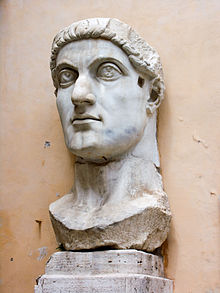
"In hoc signo, Baby!"

“In hoc signo, Baby!”

Such are the reasons for the initial survival and spread of Christianity, but the final triumph and emergence of the new creed as the exclusive religion of the western world owed less to its nature than to political developments. Because of popular hostility and ultimately government obstruction (tune in next week), by the beginning of the fourth century Christians constituted perhaps only ten percent of the population, but for seemingly cynical political reasons Constantine the Great (sole emperor 324-337) embraced the religion. One might question the conviction of Constantine, who converted only on his deathbed, but the imperial family became Christian, and after Constantine every emperor but one (Julian the Apostate) was a member of the faith, thus making Christianity a powerful force in the government of the Empire. With the power of the sate behind it Christianity began a rapid expansion, as polytheists were subject to greater and greater persecution.

The collapse of the western Empire in the fifth century guaranteed the complete supremacy of Christianity, as the Church, now the only surviving governing structure in the west, emerged as a kind of international corporation manipulating the emerging barbarian kingdoms. The conversion of the Germanic tribes, especially the
Franks, resulted in a new warrior Christianity, which spelled doom for the surviving polytheists of Europe. The Prince of Peace had finally triumphed, albeit with a sword in his hand.

Stuff from Way Back #9: Olympics

          Once again the Olympics are upon us, as London hosts the quadrennial city-bankrupting festival that every city nevertheless craves.  Of course, now it is not just the expense of building new venues that will likely go unused after the event, but also the cost of providing security in a world descending into paranoid madness over the issue of terrorism.  A British warship come up the Thames to London, surface-to-air missiles on the roofs of apartment houses and with the failure of the contracted security firm more British military personnel than are currently fighting in Afghanistan.  You might guess that the Armada or Luftwaffe is heading towards the city.

On the other hand, since the site is London and not Beijing or Moscow or Riyadh there are no boycotts or protests to disturb the celebration of sport (and sports equipment) and no voices decrying the “politicizing” of the Olympics.  And the Cold War is over, which means no ideologically motivated second guessing of East Block gymnastic judges and no East German women with mustaches and bulges between their legs, always a favorite of the post-war games. Nationalism and patriotic tribalism are of course alive and well, but mobs chanting “USA! USA!” and individual athletes being absorbed into the national herd is not considered inappropriately political.  You may trumpet the superiority of your country; just don’t criticize it.

Is this not how it should be?  Pure sport (well, except for the nationalism), and amateur athletes (except for the professionals) competing simply for honor (except for the product endorsements).  According to Baron Pierre de Coubertin, founder of the modern Olympics: “The important thing in the Olympic Games is not to win but to take part, just as the most important thing in life is not the triumph but the struggle.”  Fine sentiments indeed, except that they have nothing whatsoever to do with the Greeks and the ancient games.

The strongest component of the Greek character was agōn, the need to compete or struggle, and this drive manifested itself in every aspect of their society, from sporting events and dramatic contests to constant political upheaval and warfare.  Unlike the Romans, the Greeks were definitely not team players, and even sex was viewed as a kind of competition, with a winner and a loser.  One result of this urge to competition was the fragmentation of Greece into hundreds of independent and narcissistic little political units, the city-states.  All life revolved around the city-state community, and you were not so much a Greek as you were an Athenian or a Theban or a Corinthian, willing to do almost anything to demonstrate the superiority of your city.

Since everything you did reflected upon your city, everything you did had a political aspect, and sport was no exception.  The original Olympics were consequently highly politicized, more so than their modern successors, and places like Argos and Chios had discovered the public relations value of athletic triumphs long before Berlin or Beijing.  And as far as lionizing our sports figures goes, how many mothers now pray to Jim Thorpe or Wilma Rudolph to cure a sick child?

Ancient Olympians were also hardly the disinterested amateurs of de Coubertin and Avery Brundage.  By the last quarter of the fifth century BC professional athletes were already dominating the games, which were rapidly evolving into pure spectator sport.  Competitors were financially supported by wealthy individuals or the cities themselves, and it became a common (and frequently derided) practice for a city to hire a successful athlete from another city, in effect a ringer, to compete as one of their own citizens and enhance their “medal count.”

But even before the emergence of the professionals the Olympics fell considerably short of de Coubertin’s dream of pure sport.  Amateur athletes expected serious financial gain from their victories, and although the big festivals at Olympia, Nemea, Delphi and Isthmia granted only wreaths, those victors could expect substantial material rewards from their cities.  Money, valuable goods, tax breaks, public support and even political preferences awaited the winners, all of which calls to mind the “amateur” Olympians of the former East Block countries, with their cars, apartments and special access to western goods.

Far more accurately than de Coubertin, Coach Vince Lombardi captured the attitude of the Greek athlete: “Winning isn’t everything; it’s the only thing.”  Greek society had little sympathy for life’s losers or those who tried their best and failed.  There was no second and third place, and losing brought dishonor and even public disgrace.  Consider the epitaph of Agathos Daimon, buried at Olympia: “He died here, boxing in the stadium, having prayed to Zeus for the crown or for death.  Aged 35.  Farewell.”

For all the pressure to win, however, we know of remarkably few instances of cheating in the thousand year history of the games.  For one thing, given the relative simplicity of the events and the lack of our modern pharmacopoeia, it was not that easy to cheat in the athletic competitions, though bribing judges in the more subjective artistic events was certainly possible.  More important, though, was the fact that the Olympic games were first and foremost a religious festival, honoring the god Zeus, and cheating meant that an angry deity would sooner or later be on your case.

In practice the ancient games were more politicized than their modern counterparts, and were it not for the fact that the classical world did not have a consumer market economy, they would almost certainly have been as commercialized.  Souvenirs were in fact sold, and had the Greeks discovered marketing, their businessmen would certainly have vied for the right to sell the official tunic or kylix or whatever of the Olympics.  Even the discoverers of rationalism and builders of the Parthenon could indulge in bad taste.

The modern games have left de Coubertin behind and now more closely approach the spirit of the ancient Olympics, celebrating victory and gain rather than simple participation and effort.  Only in their universalism can the modern Olympics claim to be something greater than the original.  The classical games were limited to able-bodied males (the Greeks would find our Special Olympics an obscene joke) and until the Romans took over, Greeks.  On the other hand, the Greeks considered anyone who did not speak Greek to be a barbarian, so why bother?

Stuff About Way Back: An Example of Scholarly Crapola

(If anyone is still visiting this site, be aware the lack of new posts is due to a compulsion to work on something scholarly.  So, I provide you with an example of this crap, an appendix that I just completed.  This is the life blood of classical scholarship.  Why some of the Greek came through and the rest turned into gibberish and why the footnote arabic numerals become Roman numerals, I have no idea.)

APPENDIX 6: THE TOPOGRAPHY AND ARCHAEOLOGY OF MARATHON

            The plain of Marathon stretches about six miles along a slightly curving SW-NE axis, averaging about two miles in width between the heights and the sea.[i]  The tectonically active plain is bounded and well defined on the west, north and east by rocky, scrub-covered hills of schist and marble – Aphorismos (1555 ft), Kotroni (771 ft), Stavrokoraki (1043 ft) and Drakonera (794 ft) – that rise fairly abruptly and steeply.  To the southwest Mt. Agrieliki climbs to 1827 feet on extremely steep slopes, which are presently covered with small trees at the lower levels, and its eastern foot falls about a kilometer from the coast, forming the southern entrance to the plain.  A side valley containing the town of Marathona extends northwest between Kotroni and Stavrokoraki, and a smaller valley, the Avalona, runs parallel to it on the west side of Kotroni.  At the western extremity of the plain Agrieliki, Aphorismos and Kotroni form a sort of recess in which the village of Vrana is located.  Typical of coastal Greece, the plain itself consists of alluvial fans and has in the last twenty-five hundred years risen about ten feet due to sediments brought down from the interior.[ii]  Construction and the planting of trees have dramatically changed the appearance of the central and southwestern parts of the plain in just the last forty years, but inasmuch as the Greeks were able to form up their phalanx and none of the sources mentions any impediments, it may be assumed that in antiquity the plain was primarily planted in grain and there was only a scattering of trees.[iii]

Kynosoura (164 ft), a steep-sided spur of Drakonera, juts south into the sea for about a mile and a half, forming a protective weather barrier for the northern part of the bay and especially sheltering the Schoenia, a sandy beach running southwest from the promontory for two miles.  The beach rises gently to a belt of pine woods, behind which is the Great Marsh, which once covered perhaps two-thirds of the northeastern half of the plain and extended to the coast south of the Schoenia.  At the eastern fringe of the marsh, hard up against the spur that becomes the Kynosoura promontory, is a small salt lake, which drains into the sea.[iv]  There was until 1934, when it was drained, a smaller marsh, the Brexiza, in the southern entrance to the plain, but unlike the Great Marsh it is not described by Pausanias and classical remains all but prove that it did not exist in antiquity.[v]  The coast of the plain is for the most part formed of a shelving beach with shallow waters, but the southern reaches tend to be more rocky and uneven, especially when contrasted with the Schoenia.[vi]

Prominent in the middle of the plain is the Charadra, a winter torrent or arroyo that issues from the hills above Oinoe, a village northwest of Kotroni, and flows through the valley between Kotroni and Stavrokoraki, cutting two deep channels through Plasi to the sea.  Though dry most of the year, the gullies present a formidable obstacle, the banks being as high as twenty feet in places.  A smaller torrent, the Rapendosa, descends from the hills between Agrieliki and Aphorismos and disappears about a third of the way across the plain.  A torrent such as the Charadra will certainly not follow the same course for two and a half millennia, and in any case the central part of the plain appears to have risen about ten feet since antiquity, for the most part because of material brought down from the hills by these torrents.[vii]  It is thus impossible to determine exactly where the gullies ran at the time of the battle or whether they existed at all, but since neither Herodotus nor Pausanias makes any mention of this terrain feature, it is safe to say that if it did exist, it had no impact on the battle.  The plain is well watered, two fault lines producing a number of springs, the principal ones being at Oinoe, Vrana, the eastern foot of Agrieliki (“Mati”) and at Kato Souli, between the eastern base of Stavrokoraki and the Great Marsh (“Megalo Mati” or “Makaria”).  Wells are found all over the plain, providing most of the water for the region today, and Pausanias says there was fresh water flowing out of the Great Marsh.[viii]

Of the villages/demes of the Marathonian tetropolis three have been more or less securely located: Oinoe at the site of the modern village of that name, Trikorynthos at Kato Souli and Probalinthos at the eastern base of Agrieliki north of the Brexiza marsh (less securely).  The site of Marathonitself is still disputed, but the scant archaeological evidence now points to a spot near the coast amidst the channels of the Charadra.[ix]  There were in the fifth century three routes leading from Athens into the Marathon plain.  The main road, apparently suitable for carts, ran for some twenty-six miles from Athens via Pallene to the area of the Soros and then continued northeast across the plain and on to Rhamnous.  A second road led northeast from Athens to Kephisia, where it split into two paths, one passing through modern Stamata and Oinoe and on into the plain through the Avalona valley, the other heading through modern Dionysos and descending to Vrana through the gorge of the Rapendosa.  Each of these routes is a bit more than twenty-three miles long, and both become fairly rough and steep tracks through wooded areas once they enter the hills around Marathon.[x]

Rising above the southern plain, approximately a mile northeast of the foot of Agrieliki and a half mile northwest from the coast, is the Soros, a thirty foot high artificial mound that is generally accepted as the burial place of the Athenians who fell in the battle.[xi]  About four miles west of the Soros, at the site of the Marathon museum in Vrana, is a cluster of seven middle and late Helladic tumuli, and about 300 feet northeast of these lies a seventh mound, dated to the early fifth century.  Within this tomb were found the remains of one juvenile and ten adult males, leading a few scholars to conclude that this is the tomb of the Plataeans mentioned by Pausanias.[xii]  This identification is almost certainly incorrect, however.  Pausanias’ catalogue of sights at Marathon proceeds in a more or less direct line northeasterly from the Soros to the stone “stables” of the Persian horse, and placing the Plataean tomb, which is mentioned immediately after that of the Athenians, at Vrana represents a three mile detour from this route.  Further, the battle centered on the Soros, and it is difficult to see why the Plataean dead would be carried all the way to Vrana rather than being interred in the vicinity of the Athenians, where all could be conveniently visited and honored.[xiii]  The tomb contents also argue against the identification: a mix of burial styles, the presence of a boy, very poor grave gifts and a single crude inscription in Attic lettering on an unworked stone.[xiv]  It is far more likely that a low mound observed near the Soros in the nineteenth century marks the spot of the Plataean burial.[xv]

Following his notice of graves of the Athenians and Plataeans Pausanius mentions a monument to Miltiades and a trophy of white marble.[xvi]  About 650 yards north of the Soros are the foundations of a tower (“Pyrgos”), possibly medieval, which according to nineteenth century travelers incorporated large blocks of white marble, now all gone.  About a mile and a half to the northeast of these ruins, near the present church of Panagia Mesosporitissa, are the remains of another tower, also sporting ancient marble, including column drums and an Ionic capital.  The two towers are likely to mark the approximate sites of the ancient monuments from which the marble was pilfered, since in the first case Leake observed actual marble foundations and in the second the number and size of the blocks argues against being moved any great distance. That these are the remains of the Miltiades monument and the battle trophy is a tempting conclusion since the fragments indicate monuments rather than buildings or enclosures and one would expect the Miltiades memorial to be in the vicinity of the burials.[xvii]

The last battle-related item Pausanias mentions before describing the Makaria spring and the Marsh are the Persian dead, whose burial place he could not find.  He was, however, informed by the Athenians that they had been thrown into a trench, and in the nineteenth century von Eschenburg found in the area off the western edge of the Marsh huge quantities of bones (“viele Hunderte von Todten”), seemingly buried in a haphazard manner.[xviii]

The Persian fleet certainly anchored along the Schoenia.  This section of the coast was the most amenable to the mooring of ships, and the Kynosoura promontory protected the anchorage from the dangerous northeast winds.  Inasmuch as vessels were apparently beached only for protection or maintenance, the ships would have been anchored right at the water’s edge, sterns facing inland.  Assuming no more than 300 vessels and no more than thirty feet of beach space per vessel (approximately the width of a trireme with oars extended), the fleet could be moored in a single line along the Schoenia, providing for the most convenient unloading and loading and for the quickest departure.[xix]  This anchorage provided immediate access to the region of the Great Marsh and the most likely site of the Persian camp, the deme of Trikorynthos.  Herodotus does not mention a Persian camp, as he does in the case of Plataea and Mykale, but inasmuch as the area around the Schoenia could not comfortably accommodate 50,000 or more men for several days there must have been a separate encampment, at least for the army.[xx]  A camp on the plain immediately west of the marsh is possible, but the area to the north, bounded by the hills of Stavrokoraki and Drakonera and the marsh itself, offered excellent protection against attack and controlled the road to Rhamnous.  Water was more plentiful in this locale, especially from the Makaria spring, and here the marsh was apparently deeper, remaining green longer into the autumn and thus providing more fodder for the horses.[xxi]  And though it is barely evidence, Pausanias in fact identifies some excavations and marks in the hills beyond the marsh as the “stables” of Artaphernes’ horse and the marks from his tent.[xxii]

More problematic has been the location of the Greek camp.  Herodotus says that upon arriving at Marathonthe Athenians established their camp “in the precinct of Herakles,”[xxiii]  without however providing any indication where that might have been.  In his eighth Pythian ode Pindar says the games of Herakles were held “in a/the nook/corner of Marathon,” but he may simply mean that Marathon was a corner or nook of Attica.[xxiv]  In the 1930s an inscription containing regulations for games at the Herakleion was found just north of the Brexiza marsh, but even the finder of the stone, Soteriades, believed it had wandered, especially since it had been refaced.[xxv]  Further, there was some evidence that the area near the marsh had been sacred to Athena Hellotis.[xxvi]  He pointed instead to the Vrana valley, near the chapel of St. Demetrios, where he discovered what he believed to be the early 5th century remains of a sacred enclosure, which he identified as the Herakleion, noting that St. Demetrios would be an understandable successor to the pagan hero.[xxvii]  Possessing springs, providing a secure position and covering both the main road along the coast and the back roads through Kephisia, the Vrana location, which is in fact in a sort of “nook,” was subsequently accepted by many, if not most writers, as the site of the Athenian camp.[xxviii]

This all changed with the discovery in 1972 of a dedication to Herakles, this stone found incorporated in a Roman building in the area of the Brexiza marsh.  Certainly, two inscriptions regarding Herakles are very compelling, and this relatively narrow area between Agrieliki and the sea might well be described as a “nook or “corner” of Marathon.  A camp here makes military sense, and the location fits perfectly the epithet the dedicatory inscription assigns to Herakles – “at the gate” – and the statement in one of the Marathon epigrams that the Athenians were “before the gates.”[xxix]  While certainty is a commodity in very short supply at Marathon, the Athenian camp may now be fairly securely located at the southern entrance to the plain, and Herodotus’ account must be reconciled with this location.[xxx]


[i] A brief survey of the archaeology of the Marathon area and a list of the attendant literature up to 1988 can be found in Travlos 1988, 216-21.

[ii] Higgins & Higgins 1996, 33; Pritchett 1960, 156-57; see further note 7.  The sea level of the Aegean also appears to have risen about 10 feet; see Pritchett 1959, 255-56.

[iii] Nep. Milt. 5.3: arbores multis locis errant rarae; Caspari 1926, 103 (followed by How & Wells 1912, II, 112) believes the Greek center was weakened in order to accommodate trees and vines, but fear of being outflanked was a far more compelling reason; see .  The plain was relatively free of trees when observed by Frazer at the end of the nineteenth century; Frazer 1898, 433.

[iv] Woods: Aesch. Eleg. 3: Maraqw&nion a!lsoj; Paus. 1.14.5: to_ Maraqw~ni a!lsoj; marsh: Paus. 1.32.7: li&mnh ta_ polla_ e(lw&dhj.  Recent geophysical examination suggests that the marsh was once a lake and before that a lagoon, and in an unpublished study Richard Dunn concludes that in 490 it was in fact a lake.  Pausanias describes it as a “mostly marshy lake,” but that is over 600 years after the battle.  On the other hand, he describes the Persian fugitives blundering into the marsh and suffering great casualties, which seems very unlikely were it simply a lake with marshy fringes.  It is also unlikely that the channel connecting the marsh/lake to the sea was used by the Persian ships, assuming it was even navigable.  Marsh would make the mooring and unloading of the vessels more difficult, and the ease with which almost all the ships escaped makes more sense were they on the beach; see also note 16.  There is also evidence that the northern part of the shoreline was further inland and the souther further out in 490.  On the marsh and coast see Kretnz 117, 214-15 and the map 155.

[v] Soteriades 1935, 120-21; Pritchett 1960, 152-54, 1965, 83-84; Themelis 1974, 239-41; Petrakos 1995, 68-86; Hammond 1973, 186-87 believes there was a marsh in antiquity because of the powerful springs in the area and because of scholia on Pindar claiming that Athena Hellotis was so named because of the marsh at Marathon, but the rise in the sea level better explains the emergence of a marsh and the scholia are extremely vague (e0n, peri&, pro_j) on the spatial location of the marsh to Marathon, which itself could be the deme, the town or the whole tetropolis.  The stone attesting to a temenos of Athena was in fact found near the chapel of St. Demetrios, a mile and half north of the Brexisa (Vanderpool 1966b, 319-20), and the scholiast may simply be wrong, Hellotis with its double lambda deriving instead from Hellotia, a daughter of Timander.

[vi] See the admiralty chart in Hammond 1973, 218.

[vii] Burn 1966, 161-62 believes there was no Charadra in antiquity because deforestation of the surrounding hills had not yet occurred, but flashfloods in the area were already proverbial: Demon FGH 327 F 8 (= Strabo 8.6.16, Zen. 5.29, Suda s.v.): Oi0nai=oi th_n xara&dran.  In 1828 Leake (see his map in Hammond 1973, 183) observed the two torrents following roughly the same courses they do today, and Soteriades 1935, 132-33 concluded the Charadra followed the same course in antiquity.  But in the 1960s Pritchett confirmed the earlier reports of Staes that the level of the plain at the Soros had risen some ten feet, and this together with the sherd deposits around the torrent convinced him and two separate geologists that the present course of the torrent is not that of 490; a map made in 1792 in fact shows the Charadra following a different course; Pritchett 1960, 141-42, 156-57, 1969, 6.

[viii] Paus. 1.32.6; Pritchett 1965, 84-85; Petrakos 1995, 52-55.  The depth of the water table, presently as little as 23 feet near the Brexiza marsh, increases as one moves inland towards Stavrokoraki, where it is now some 65 feet; though certainty is impossible because of the tectonic activity in the area, the water table was probably higher in antiquity, before another twenty-five hundred years of alluviation.

[ix] Placing Marathon near Plasi fits the order Probalinthos – Marathon – Trykorinthos given by Strabo 9.1.22, which traces demes north along the coast.  The archaeological literature on the demes is extensive; see Travlos 1988, 220-21; the most recent and/or pertinent: Pritchett 1960, 149-52, 1965, 83-88, 1969, 1-11; Vanderpool 1966b, 319-22; Marinatos 1970a, 5-9, 1972, 6-7; Themelis 1974, 229-35, 239-42; Traill 1986, 146-48.  Petrakos 1995, 1-2 suggests that there was no village of Marathon but rather houses scattered about the plain, but such would constitute a big exception in Pausanias’ itinerary.

[x] In 1996 I could not find the head of the Oinoe trail, but did climb the Rapendosa track for about a half mile; it was extremely steep and rough.  A description of the tracks can be found in Frazer 1898, 441-42.  The excellent road observed between Stamata and Marathona by Clarke in 1801 cannot be earlier than the late fifth century; Ober 1982, 457-58.

[xi] Paus. 1.29.4, 32.3 is clearly referring to this tomb.  Schliemann 1884, 85-88 believed it to be prehistoric, but the excavations of Staes confirmed the date of 490; see esp. Staes 1893, 46-63; Hammond 1973, 172-78.  Pausanias describes only a grave (τάφς) with stone slabs (στh=λαι) inscribed with the names of the dead, which slabs G. Spyropoulos has claimed to have recently found in the villa of Herodes Atticus in the Peloponnesus.  He consequentlty suggests that it was Herodes who erected the mound when he purloined the inscriptions of the Marathon dead, which is barely possible since Pausanias would have passed through Marathon before AD 174 and Herodes died in 177; report in Αρχαιολογία Archaeology Newsroom 8 May 2009; the book mentioned in the report, Die Architektur der Villa des Herodes Atticus zu Eva/Loukou, can not be located and is perhaps classified.

[xii] Paus. 1.32.3; Marinatos 1970a, 9-28, 1970b, 155-66, 1970c, 351-66; Hammond 1973, 197-98; Burn 91-92.

[xiii] Pritchett 1985, 129.

[xiv] See esp. Welwei 1979, 101-6, who suggests these might be the remains of scouts who were surprised and killed by the Persians; Themelis 1974, 244 believes they are normal local burials despite the absence of any females.

[xv] Clarke 1818, 27-28; Leake 1841, 101; Pritchett 1985, 128.

[xvi] Paus. 1.32.4-5.


[xvii] Miltiades monument: Leake 1841, 101; trophy: Vanderpool 1966a.


[xviii] Paus. 1.32.5: o1rugma.  Von Eschenburg 1886, 10.


[xix] That the Stoa Poikile paintings (Paus. 1.15.3) show Persians fleeing into the marsh between illustrations of the battle and the fighting at the ships places the fleet at the Schoenia.  On mooring the ships see Harrison 1999, 168-71; Whitehead 1993, 95-98; Herod. 6.107.2 says the ships were “moored” or “anchored”: ta_j ne&aj o#rmize.  Herod. 6.114.1 shows a Persian ship stern-first, and the fact that the fleet got away so quickly suggests stern-first mooring.  The Brescia sarcophagus, thought to reproduce the scenes in the Stoa Poilile, shows ships moored stern-first; see Vanderpool 1966a, pl. 35.

[xx] Following a suggestion of Macan 1895, II, 244, n. 8, van der Veer 1982, 398-99 believes there was no Persian camp.

[xxi] Most modern authors place the camp around Trykorynthos, but some have it west of the marsh: Macan 1895, II, 244-45; Munro 1926, 242; Schachermeyr 1951, 18-19; Vanderpool 1966b, 323; et. al.; Shrimpton 1980, 30-31 curiously places it near the Soros.  Shrimpton 1980, 31, n. 23 argues that the pasturage available at the marsh would be dangerous to horses fed on hay and grain, but surely the Persian horse-handlers would approach this change in feeding very carefully, and in any case Trykorinthos provided easy access to water and better security after dark.  See Frazer 1898, 432 for a description of the marsh before it was drained.

[xxii] Paus. 1.32.7; Frazer 1898, 432 observed “niche-like excavations” on Stavrokoraki; Leake 1841, 96 found a “small cavern” on Drakonera.  Since the Persians are unlikely to have engaged in excavating rock, it is likely the story of the stables and tent later attached themselves to one or the other of these formations.

[xxiii] Herod. 6.108.1: e0n teme/nei+  9Hrakleo/v.

[xxv] IG i.3 3 (=SEG x.2): hερακλείο[ισι]; see Vanderpool 1942, 329-37, 1966b, 322-23, 1984.

[xxvi] See note 5.

[xxvii] Soteriades 1935.

[xxviii]  Including me: Berthold 1976-1977, 88-91; some of the others: How & Wells II, 109; Delbrück 1920, 54; Munro 1926,  241-42; Maurice 1932, 21; Pritchett 138-40; Burn 243; Hammond 189-90; Billows 208, who apparently did not get the memo on the second inscription.

[xxix]IG i.3 1015bis: ερακλεῖ…τὸμ Πυλίοις ἀνέθεκε ερακ[λ ˘ ˘ ¯ ˘ ˘ ¯ ˘]; see Marinatos 1972, 6; Kamanoudes 1978, 237-42; esp Matthaiou 2003, 190-94.  IG i.3 503/4: αἰχμὲν / στε̑σαμ πρόσθε πυλο̑ν; see Matthaiou 2003, 194-97.

[xxx] Virtually everyone now accepts the location at the entrance: e.g., Burn 1977, 90-91; van der Veer 1982, 96-97; Evans 292; Lazenby 54-56; Krentz 118-21.


Stuff from Way Back #8: Got Any Scythian Gold, Man?

Herodotus of Halicarnassus, for a time in the 5th century BC an inhabitant of Athens, is generally considered the Father of History, inasmuch as his work is the first extant history (from ἱστορία – inquiry).  The theme of his work is the Persian invasion of Greece in 490 and 480-479, but he leads up to those wars with an exhaustive examination of the Persian Empire and the lands and peoples in and around it.  One of those peoples is the Scythians, a collection of barbarian tribes inhabiting a broad swathe of land from the Danube basin to the southern steppe, and they apparently had a hauntingly familiar custom.

 Moreover it is said that other trees have been discovered by them which yield fruit of such a kind that when they have assembled together in companies in the same place and lighted a fire, they sit round in a circle and throw some of it into the fire, and they smell the fruit which is thrown on, as it burns, and are intoxicated by the scent as the Hellenes are with wine, and when more of the fruit is thrown on they become more intoxicated, until at last they rise up to dance and begin to sing. (1.202.2)

The Scythians then take the seed of this hemp and creep under the felt coverings, and then they throw the seed upon the stones which have been heated red-hot: and it burns like incense and produces a vapour so thick that no vapour-bath in Hellas would surpass it: and the Scythians being delighted with the vapour-bath howl like wolves. (4.75.1)

(trans. G.C. Macaulay)

Well, what do we have here?  In the first passage he refers to “trees” and “fruit” and in the second “hemp” and “seeds,” but the similar descriptions of ingestion and result make it almost certain that the same botanical is being described in both.  And for anyone of a certain age the identity of that botanical is immediately apparent, a conclusion clinched by the Greek word translated as “hemp” – cannabis (κάνναβις).

What we have here is the first account of dope-smoking in western literature and yet another reminder that the classics contain some very cool stuff.

Stuff From Way Back # 6: Jesus And the Gods

The Judaic roots
of Christianity are universally recognized: the idea of the one personal
creator god who is the embodiment of the Good.
But there is the other important facet of Christianity, the concept of
the dying and resurrected god, and that ironically comes straight out of Greek
polytheism.

The inherited religion of the Greek
Archaic Age (c.750-479 BC) was that embodied in the works of Homer and Hesiod,
the world of the Olympic gods.  These
deities were perfectly anthropomorphic, differing from their mortal worshippers
in only two respects: they did not die and they wielded immense power.  Otherwise, they were perfectly human,
manifesting all the flaws and foibles of humanity and thus singularly
ill-equipped to serve as ethical role models for Greek society.  As a result, the Greeks possessed a religion
that allowed them the leeway to discover rationalism and humanism and thus
ultimately marginalize their belief system, at least for some.

The seventh and sixth
centuries were tough times for the average Greek, and men who find no justice
on earth inevitably look to heaven. But the inherited Olympic faith, primarily
a communal or civic religion, was devoid of any real inspirational quality, any
serious spiritual element that allowed the troubled suppliant to find emotional
solace. Zeus was essentially not concerned with the equitable dispensation of
justice, and as an evolving society attempted unconsciously to moralize the
Olympians, grim times only produced a grim vision of a supernatural world filled
with threats.  But men require some hope,
and as the years rolled by, these same needs and desires stirred the
development of an alternative religious form, the mystery cult.

Elements of these cults
appear to go back to prehistory, but it was the pressures of the Archaic Age
and the discovery of the individual that fostered their growth.  The cults varied in their content, but they
shared certain characteristics and all of them provided the worshipper an
intense and personal emotional experience generally missing from the civic
religion.  They focused on a single or
small group of gods, offering a more intimate involvement, and the participant
would undergo some sort of initiation (telein or myein, hence
“mystery”), which would ultimately lead him to the central mysteries of the
cult, in theory unknown to outsiders.  As
the continued popularity of fraternal organizations and secret societies
demonstrates, initiation and secrecy, which create special bonds and a sense of
elevated status for the group, are always a good draw.

The cults also revolved
around sex and most importantly the issue of death, the fear of which the cult
hoped to dispel with its rites.  The cult
of Dionysus (or Bacchus) offered temporary release from pain and suffering
through ecstatic possession, but the other important Greek mysteries, the
Eleusinian, Orphic and the later Hellenistic cult of Isis and Serapis,
possessed as central figures gods who died and were resurrected, either
literally or metaphorically, thus confronting the initiate with the terror of
death and the hope of rebirth.  It
appears that at first the cults thought in terms of a rebirth in this world,
that is, entering into a better life, but there is evidence that by the end of
the fifth century reward in the next life was expected.  Some sort of judgment based on the
individual’s behavior was involved, an element generally missing from the
everyone-goes-there underworlds of the Olympic and pre-classical religions.

In the constantly changing
and anxiety-filled world of post-Alexander Greece
the mystery cults grew in popularity, partly because of their salvationist
inclinations and partly because the old civic religion was so closely tied to
the declining polis (“city-state”) society.  In the new Greek-dominated eastern Mediterranean,
the cosmopolis (“world polis”), Hellenic culture, including its
religious forms, rubbed shoulders with non-Greek ideas, including the ancient
religious practices of the Hebrews.  This
sometimes led to friction and violence, such as the Maccabbean revolt, but in
the end produced a sort of hybrid religion, Christianity.  The idea of the dying and resurrected god, so
critical to Christianity, had played no important role in the Near Eastern
religious traditions, and while the new faith may have developed a fresh
understanding of death and rebirth, one linked to the rigorous moral code of
Judaism, the notion of the suffering god appears nevertheless to come straight
out of the Greek experience.

Stuff from Way Back #5: Hannibal: The Sunset Years

"Die, Roman scum!"

Most everyone has heard of Hannibal Barca and his
exploits against the Romans during the Second Punic War (218-201 BC).  Undefeated in Italy, he fought his last engagement in 202 at Zama in
North Africa, where P. Cornelius Scipio Africanus gained the distinction
of being the only man to defeat him in battle.
Not quite.  There was also Eudamus
the Rhodian.

By the terms of the peace treaty that was signed in 201 Carthage was stripped of her possessions and reduced to being a
Roman client, her independence and political importance at an end.  Her commercial activities certainly did not
cease and she was able to pay her annual war
indemnity to Rome, but a corrupt and oppressive oligarchic government
began to exploit the people, who at last turned to Hannibal.  In 196 he was
chosen suffete, one of the two annually elected chief magistrates of the
Carthaginian republic.  Under his
leadership the popular assembly broke the back of oligarchic power, and Hannibal attended to the finances of the state, so improving matters
that in 191 Carthage offered to pay off the remaining forty years of
reparation payments in one lump sum.

Loved by the people, Hannibal nevertheless had in the dispossessed oligarchs a block
of powerful enemies, who in turn had influential friends in Rome.  Prominent among
these friends was M. Porcius Cato, a rival of Scipio and a man soon to be consumed
with an almost hysterical fear and loathing of Carthage.  Acting on
behalf of the anti-Barcid oligarchs, Cato claimed that Hannibal was conspiring with the Seleucid king Antiochus  III, with whom Rome was gradually sliding towards war.  In 195 a commission was sent to Carthage to complain, and Hannibal, suspecting what the outcome would be, fled east to Tyre, the mother city of Carthage.  He then moved on
to Antioch, the Seleucid capital, and thence to Ephesus, where he found the king.  A frightened Carthaginian government
meanwhile formally exiled him.

The arrival of Rome’s worst nightmare at the Seleucid court only worsened
the deteriorating situation in the east, and in 192 the Aetolians captured the
key port of Demetrias and convinced Antiochus to strike now by sending an
army to the Balkan peninsula.  Hannibal is said to have urged the king to give him ten thousand
infantry and one thousand cavalry, with which he would stir up Carthage and then invade Italy.  But it is difficult
to believe that Hannibal could possibly imagine assaulting Italy with such a meager force, and more likely he suggested
simply that an attempt be made to arouse Carthage, a plan that would fit better with Antiochus’ apparent more
limited goal of asserting his equality as a Mediterranean power by rebuffing Rome in the Balkans.
These limited war aims, potential jealousy and discontent among the his
generals and the reluctance of Greek troops to serve under a “barbarian”
probably explain why Antiochus made such little use of the great captain.  In fact, Hannibal’s sole command in the war was a naval squadron.

When Antiochus was booted out of Greece in 191, the naval war heated up, and later in the year
the king sent Hannibal to Phoenicia to collect reinforcements for the main Seleucid fleet
at Ephesus.  It is hard to
avoid the impression that Hannibal
was sent simply to give him something to do, and the king probably did not
expect that Hannibal would actually be fighting a naval engagement on his
own.  But in the summer of the following
year as he was bringing his ships north, he ran into a Rhodian squadron sent to
block him off Side on the Anatolian shore.
Hannibal formed a line perpendicular to the shore and awaited the
Rhodian attack.

The Rhodian force was inferior in numbers, but the skill
of Rhodian sailors was legendary, while the Phoenician crews were unused to the
heavier warships Antiochus had ordered built after his taste of Roman boarding
tactics the previous year.  Actually, as
the battle opened, the Rhodian admiral, Eudamus, hardly displayed great
skill.   Because of a poor deployment and resulting
confusion, he found  himself engaging the
enemy left, commanded by Hannibal,
with only five ships.  But the Rhodians
quickly sorted themselves out, and superior seamanship began to tell as Rhodian
ramming tactics punched hole after hole in the Seleucid line.  Hannibal’s right and center were soon in serious trouble, and
ships from the victorious Rhodian left were able to speed to the rescue of
Eudamus.  With the battle now clearly
lost, Hannibal began to retire and was followed by the rest of his
fleet, more than half his ships having
been disabled.

Hannibal had been defeated in a serious engagement for only the
second time in his life. The battle of Side was a relatively small-scale affair,
but it did prevent the linkup of the two Seleucid fleets, and control of the
sea was decisively lost a month later at the battle of Myonnesus.  The war ended in early 189 with
Antiochus’  defeat at Magnesia in Asia Minor, at which battle Hannibal
does not seem to have been present, probably for the reasons mentioned earlier
and perhaps because Antiochus was overconfident.  The peace settlement included a demand for
the surrender of the Carthaginian, but the Romans, probably influenced by
Scipio Africanus, who was with the Roman delegation, took no real action.  Hannibal escaped first to Gortyn on Crete
and then on to King Artaxias I of Armenia.

The last stage of Hannibal’s military career took place under King Prusias I of Bithynia on the Black
Sea coast.  Sometime around 186 Prusias began a war with
his major Anatolian rival and loyal client of Rome, Eumenes II of Pergamum, but all that survives of this war is a naval
anecdote.  Pressed by a numerically
superior Pergamene fleet, Hannibal
defeated them by hurling aboard the enemy ships pots filled with poisonous
snakes, causing panic among the crews. The war became a stalemate, and both
kings appealed to Rome, which in 183 sent T. Quinctius Flamininus to settle
the war.

Whether on instructions from the Senate or his own
initiative, Flamininus demanded from Prusias the surrender of Hannibal.  Seeking to
avoid violating at least the letter of the law of hospitality, Prusias left it
to the Romans to capture the Carthaginian themselves, and they surrounded his
house with troops.  Discovering that
every exit was guarded, Hannibal
committed suicide by taking poison.  At
the end, according to Livy and Plutarch, he proclaimed “Let us relieve the
Roman people of their long anxiety, since they find it tedious to wait for the
death of an old man.”

One of the greatest captains in history was dead,
needlessly, at the age of sixty-three. Ironically, his old rival Scipio
Africanus died in the same year, himself an exile from his mother city.  And thirty-seven years later Carthage would follow its most famous son into extinction, also
at the hands of Rome.