Herr Wachtmeister, Wo Ist der Dom?

I was out of town, so I am plugging in a piece I wrote for an anthology of articles on German studies.  This will be boring for most of you, but the German speakers should find it amusing.)


Stray Notes From the Periphery of German Studies

Let me make it clear immediately that I am not now nor ever have been seriously engaged in German Studies, most certainly not as a scholar. I am a classical historian, and German has for me essentially been simply a tool in my examination of antiquity. But one can hardly study the German language without being exposed to some degree to German literature and culture, and I have in any case long been in love with things German. The intent of this piece, then, is not a sober march through some aspect of German Studies but rather a somewhat less than serious meandering about the edges of die Deutschkunde.

 
I was born in 1946, so my earliest association with German culture came in the movie theater and the schoolyard, where I was hardly exposed to its loftier aspects. Post-war Hollywood of course portrayed Germans as sinister people and incompetent soldiers, but neither that nor the vague awareness that some horrible things had been done could dampen the enthusiasm of young American boys for the trappings of the Third Reich. Militarism is always a draw for young males, and these particular militarists had especially sharp uniforms, great parades and a very cool iconography (swastikas, deaths heads, runes, etc.). Sieg Heils and Hitler salutes and the odd ditty learned from Uncle Mac (“Hitler has only got one ball…”) were consequently part of the recess repertoire, and making it even more attractive was our knowledge that for some reason this sort of thing really annoyed adults. “But Mom, didn’t they fight the evil commie Russians?”

 
When I entered high school and was required to choose a foreign language, there was absolutely no question. French and Spanish were the languages of wimpy second-raters, and why in the world would anyone want to study a useless tongue like Latin (an ironic assessment given what I ended up doing for a living)? No, German was the cool language, if only because it conjured up images of the Wehrmacht, and in any case I knew it was also the language of science, and that was where I was headed. I thus found myself, along with many of my brainy (or nerdy) friends, in Jens Shurk’s first year German class, where we quickly discovered from our new dictionaries that the teacher’s name was seemingly an anglicized version of Schurke! And so my career of insufficient respect for authority began, literally auf deutsch in this instance.

 
In four years with Herr Shurk I went through all of Zeydel’s A Basic Course in German, published in 1951, which meant that to a good extent it was illustrated with photos of a Germany that no longer existed and seemed in any case to have no history between 1930 and 1945. The German in the second half of the book was printed in Fraktur, which certainly looked cool but seemed of limited use to a student who had no idea that he would be reading nineteenth century German historians. Zeydel was an uninspiring book of the Ich bin Walter, du bist Marie variety (and did not list coolness as one of its reasons for studying German), but just learning German was a heady enough experience, and Shurk, who had been stationed in Germany and married a German woman, soon began exposing me to perspectives on German culture that extended beyond Teutonic knights and the Third Reich. Most important for me was Richard Wagner, the operas of whom Shurk, a true Wagner freak, played in class under the somewhat specious pretext that they were in German. I wonder about the linguistic value of this practice, given the frequently bizarre nature of Wagner’s German, but while the other students were passing notes or dozing off I was beginning a lifelong love affair with die Zukunftsmusik. The poetry of Christian Morgenstern, the other delightful discovery out of high school German, was a pleasure gained only through laborious translating; the Ring could be absorbed directly into the bloodstream. And it has provided for the effortless acquisition of poetic German handy for all occasions, such as the announcement of a pregnancy – den hersten Helden der Welt hegst du, o Weib, im schirmenden Schoss – or a query about the style of one’s eggs – weiche, Wotan, weiche!

still in print 60 years later

still in print 60 years later

The Shurkjahre provided me with a basic grounding in German and a growing appreciation for the more noble aspects of the Kultur, but for all the club meetings, class discussions, German dinners and movies, actually speaking German remained elusive, as did the legendary Sprachgefühl that Shurk promised would one day descend upon us like a blessing from on high. The opportunity to learn actually to talk the talk came in college, where despite abandoning science as a vocation I continued with German (advanced placement!) as a minor to my ultimate degree in ancient history. This provided a broader and deeper exposure to German literature, which ranged from the tedious (Mann) through the cool (Borchert) to the wonderfully absurd (Dürrenmatt). The down side to this great reading, of course, was that it was in a bloody foreign language, though my concurrent study of Greek and Latin increasingly made German seem a language of stark simplicity.

 
Far more important was the opportunity to attend Stanford-in-Germany, easily the best thing Stanford University provided me (apart from the piece of paper that got me the piece of paper that got me my faculty appointment). In June 1964 I left California for the first time, heading with some eighty other students for sixth months of classes at the Stanford branch campus in the village of Beutelsbach outside Stuttgart, which has subsequently swallowed it. Actually, the “campus” was ensconced in the Landgut Burg, perched on a hill above Beutelsbach, to which we could descend like visiting nobility in order to observe their quaint ways and try their rustic dishes, like Zwiebelkuchen and Spätzle. And their ways did strike a group of American eighteen to twenty year olds as quaint. This was 1964 and Germany and Europe were not yet completely awash in American culture and goods, and consequently one instantly felt he was in a foreign country rather that a German language version of the United States. This was especially so for peer conscious college students with their serious concern for what was hip and now. There were of course the vanishing traces of an older and more rural Europe – the resealable ceramic-capped beer bottles, the unshaven legs and armpits, the smell of the Misthaufen, horse-drawn vehicles – but what struck us most was our young German counterparts, who were in our arrogant estimation most definitely not hip and now. Their dress, their rock ’n’ roll and their dancing, the things that really mattered, were all several years out of date (eastern Europe was like a trip into the fifties), which convinced us more than anything else that these people were provincials, an irony that I can now appreciate.
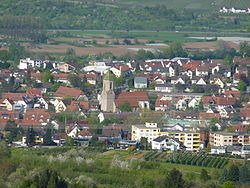
Beutelsbach

Beutelsbach

Landgut Burg

Landgut Burg

Zwiebelkuchen

Zwiebelkuchen

Certainly not provincial at all in our underage eyes was the eminently sensible European attitude towards alcohol, which suggested that if you were old enough to vote and be drafted, you were old enough to drink. This resulted in an initial period of frequent inebriation, but the novelty wore off soon enough for most of us. There was a Ratskeller right bellow the classroom, but most preferred the experience of drinking in a foreign language and enjoying that almost unique German institution, the Gasthaus. Climbing back up to the Burg after a bout of Stein-lifting not being to my taste, I frequented the Gaststätte Hirsch in Eichelsberg, where under the tutelage of Hermann the Wirt and his wife I learned a great deal of the Volksbrauch, at least when it came to swilling beer. On a couple of occasions Hermann (whom we called ihr because of his size) brought a bottle of American whiskey after closing and crushed the cap, an indication that this was likely to end up a Kotzenabend. As I said, the periphery of German Studies.

 
At the Burg we had classes four days a week. We were divided into five groups by level of German, and since I had so much in high school I was put in Gruppe A, also known as the Wunderkinder, which included several native speakers. The seminars were consequently conducted entirely in German, which meant initially that for the first time in my life I did not have much to say. The other classes, economics and German philosophy, were taught in English, though the English of the German professor who taught the latter was certainly novel. Among other things he constantly spoke of “three-angles” and often began by saying “From begin on…” We never had the heart to correct him. It was, incidentally, in that class that I first read a non-mathematical book that I simply could not understand, Husserl’s Cartesian Meditations. Consider the following sentence: “The universal Apriori pertaining to a transcendental ego as such is an eidetic form, which contains an infinity of forms, an infinity of apriori types of actualities and potentialities of life, along with the objects constitutable in a life as objects actually existing.” You said it, Edmund!

 
But the whole point of the program was to get one off the campus into the bosom of Germany and its culture, so we were more than encouraged to travel on those three day weekends. My first trip was with some students who had a car and we visited Munich (with many jokes on the way about Ausfahrt and Einfahrt), where I had the exquisite opportunity to use a stock phrase from Zeydel that had been a constant joke back in high school German. We could not find the cathedral we wanted to visit, and I thus approached a policeman and asked “Herr Wachtmeister, wo ist der Dom?” That was truly a verweile doch moment for me. I subsequently traveled alone, hitchhiking, in order to pump up my German, and this did the trick, since as is clear from what I did for a living, I really like to talk. The flubs were part of the fun, as when I was telling one of the Dienstmädchen, Helga (die ewige Weiblichkeit zieht uns hinan – und hinein, especially when you are eighteen), about World War I ace Rudolf von Berthold: Er hat vierundvierzig Flugzeuge geschissen. An incredible accomplishment, when you think about it.

Rudolf von Berthold

Rudolf von Berthold

Not everyone spoke the German I was familiar with, however, inasmuch as regional dialects were still running strong. We certainly struggled to comprehend schwäbisch, though it was soon discovered that one could fake speaking it by adding –le to the ends of sundry words: Grüβ Gottle! (Much later I learned the reply and was able to use it in the Himalaya when a German hiker greeted me with Grüβ Gott: Wenn ich Ihn sehe!) I had frequent conversations with an old man who seemed always to be leaning out his window when I visited Beutelsbach, and I don’t think I ever understood a tenth of what he was saying. And schwäbisch was nothing compared to Schwyzerdütsch. One weekend I visited the departed Helga in St. Moritz, and the locals might have been speaking an entirely alien language. In fact, some of them were. I happened to be in one of the very few places where they spoke Romansch, apparently a vestige of Latin and the Roman Empire. I wonder about a country that can not decide what its national language is. My conversational ability nevertheless developed steadily, and after a couple of months I suddenly realized that I was sometimes speaking German without thinking about it, that I had developed some instinctive sense of what was correct and what was not. I even began to notice grammatical mistakes made by native speakers. The legendary Sprachgefühl had come upon me!

 
The entire group took field trips. Paris was certainly fun, but Prague was much more beautiful and certainly more interesting. This was Warsaw Pact territory, our ostensible enemy, though that hardly seemed the case with all the Czechs I met, and as a workers’ paradise everything was so cheap that many mothers, including mine, got that European crystal they had been dreaming about. On the other hand, one of the students later tried to smuggle a Czech friend to the west in his car and for two years got see the Czech penal system up close and personal. Easily the most exiting trip was to West Berlin. This was the front line of the Cold War, and the juvenile enthusiasm we had demonstrated in Stuttgart, Paris and even Prague was suddenly tempered in sight of the wall, which had gone up only three years earlier. There is something about tanks and soldiers with assault rifles that takes the fun out of stealing street signs. A showcase for the west and capitalism, West Berlin was like a city on amphetamines, wired up day and night and ablaze with neon and a terrific place for young Americans who couldn’t get into a night club back home. For me of course this was also the capital of the Second and Third Reichs, a place that oozed history, and I spent a lot of time imagining the Red Army advancing on the Tiergarten or the final events in the Führerbunker. Well, perhaps not as much time as I spent watching the girls on the Kudamm.

 
East Berlin was in some sense also a showcase – for the failure of socialism. There were, amazingly, still blocks of rubble from the war, and a notable absence of many sorts of goods in the stores. But the people, even some of the Vopos, were friendly, and on my first trip over I was invited to a family dinner, though they did ask if I might bring some fresh fruit when I came. When I returned that evening, a female border agent on the east side of Checkpoint Charlie looked at my bag of oranges and asked in all seriousness: “Haben Sie eine Pistole versteckt?” Visions of Rosa Klebb in my head, I stammered out a nein and watched a huge grin appear on her face. Here was an evil commie functionary with a sense of humor, something, as I discovered on later travels, that was conspicuously absent from American customs officials. For convenience I normally passed through Checkpoint Charlie, but in order to experience what ordinary Germans endured I once crossed through Bahnhof Friedrichstraβe and had one of the more unforgettable moments of my life. I got separated from my friends and had to wait an hour on the east side for them. The sun had already set, and sitting outside on a bench, I saw a squad of perhaps a dozen Vopos marching down the darkening street. Watching them in their black uniforms with their jackboots kicking up in the goosestep, I was suddenly transported into the past. All that was missing were the swastikas. Heavy stuff for an historically inclined eighteen year old.

 Bahnhof Friedrichstraβe in the day

Bahnhof Friedrichstraβe in the day

The grandest single moment of the entire half year in Germany, however, came on my pilgrimage to Bayreuth. I arrived on the day of the last performance of that year’s Festspiel, but knowing that tickets had been sold out since before Wagner’s death, I expected only to see the Festspielhaus, Haus Wahnfried and the graves of the Master and Cosima. But for the hell of it I went to the ticket office, and a ticket had come back! There were four people ahead of me, but for one reason or another they turned it down, and I realized that I was about to see (for about $15) Götterdämmerung at Bayreuth. Eat your Herz out, Jens Shurk! From then until the opera began I was floating several feet above the ground, watching the opera jet setters in their sometimes antique formal wear while they watched me in my not so formal wear. The production was by Wolfgang rather than Wieland Wagner and thus not that great, but who cared? I was in a box right next to the one Wagner and Mad Ludwig had sat in, and at the end of the performance the actual grandsons of the vile genius appeared on the stage. The ovation went on for the better part of an hour, and my hands were sore from clapping and my voice hoarse from yelling. I expect that I am the only person ever to have yelled “Bitchin’!” in the Festspielhaus.

the holy of holies

the holy of holies

Before I departed Germany in December for the Kindermädchenstaat I stayed a week with a German family in Schorndorf, a whole new experience in Haushaltskultur. I knew Germans did far more handshaking than we, but I was astounded to witness the children in the family shake hands with their parents before retiring for the night and upon greeting them in the morning. My guess is that this custom has evaporated as Germany has evolved – unfortunately – into a less formal society in the last three decades. Also enlightening was a trip with one of the boys in the family to his Gymnasium, where he studied a curriculum that would baffle many of the undergraduates in an American university. His English teacher was delighted to have a native speaker in the class and had me read the text they were preparing. Perhaps not so surprising to me after a half year in Germany, I was periodically interrupted by the instructor, who would point out “That is the way they say it in America. Here is the way it should be pronounced.” And I had thought I spoke standard, non-dialectical English.

 
My time in Germany in 1964 was clearly the high point of my tenuous association with German Studies, but I did visit the Vaterland again. In 1979 a sort of circle was completed as I traveled to Germany (and other countries) in the company of Herr Shurk, who thus had the opportunity to hear one of his former students actually speak passable German. In return I got to meet his wife’s family in Mainz (Gel!), including her father, a former Gauleiter (cleared during the denazification) now in his eighties. My historian’s heart was of course excited – a living relic of the Hitler government – but he was disinclined to talk about the old days. Less lofty, perhaps, was my return in 1984 with my brother, whose German was at the Bier gut! level. The Burg was now a sort of convention center, the Stanford-in-Germany program having expired from lack of student interest, yet another sign of the decline of higher education in the United States. In Munich I insisted we visit the Hofbräuhaus, since I had been there exactly twenty years earlier to the month and every beer drinker should stop in at least once in his life. Just an hour or so in the afternoon for nostalgia purposes; we staggered out after midnight, so schön ist’s im Hofbräuhaus!

 
Meanwhile, German had for me become less the language of literature and beer halls and more the Gelehrtensprache, as I obtained a doctorate in classical history. The language I had as an adolescent thought useful for science turned out to be along with my mother tongue the most useful for studying antiquity. It was after all the Germans who invented “scientific” history (“wie es eigentlich gewesen ist”) in the nineteenth century, better to examine the classical world they had fallen in love with in the eighteenth. Moreover, German can be just perfect for the nitpicking so dear to scholars, especially those in Classical Studies. Was the Peloponnesian League a Staatenbund or a Bundesstaat? This sort of elegance is impossible in English. It is hardly surprising that the most monumental work in classical history, at least in terms of size, is in German: Pauly, Wissowa, & Kroll, Real-Encyclopädie der klassischen Altertumswissenschaft. This was a project that lasted longer than the Second and Third Reichs combined.

 
My conversational ability has gone dormant in recent years, requiring a one or two week dip in a German-speaking environment to revive, and I have not returned to Germany in twenty years. But I have of late spent a lot of time in Greece, and German has frequently stood in for my non-existent modern Greek, since there are so many middle-aged Greeks (and Italians and Turks) who speak German from their days as Gastarbeiter. Besides, Germans and Austrians have the tourist Euros to spend, which more than compensates for any hard feelings left over from the forties, and many shops and restaurants sprechen Deutsch. Indeed, every summer there is a mini-Indo-European invasion, as Germans, dragging their Wohnwagen behind their Benzes, stream into the Adriatic and Aegean, seeking the sun and bargains. And if you fly into Athens, you pass through an airport built and for the next thirty years owned by the Germans.

 
Here in Albuquerque, the land of Karl May, my dance about the fringes of German Studies is maintained through my friendship with Peter Pabisch and Fritz Cocron, a Dolmetscher on the Ostfront (more living history) and possibly the only Wehrmacht veteran ever to be decorated by the Polish government. Our conversations are for the most part in English, but snatches of German nevertheless slip past my lips on occasion and Sprachgefühl appears with me still, ready to be awakened by a sojourn in Germany.

 
Mein Sinn ist in Griechenland, aber mein Herz bleibt immer in Deutschland.

A Just Peace

(The current Israeli-Palestinian peace talks engineered by Secretary of State John Kerry reminded me of similar negotiations that took place some seventy years ago.)

In a deal brokered by the American Secretary of State the German Chancellor today announced that Minister for Foreign Affairs Joachim von Ribbentrop would be traveling to Warsaw in an attempt to revive the peace process with Poland, which has been occupied by German troops since the 1939 war. Chancellor Hitler repeated his commitment to the “two state solution” but cautioned that “minor adjustments” would have to be made to the pre-1939 frontiers.
The Chancellor insisted that there be no preconditions for the talks, a clear attempt to circumvent the question of the Polish Right of Return. “Everything is on the table,” said Ribbentrop, noted for his earlier arrangement of a peace agreement with the Soviet Union. “We are willing to discuss every issue, even the difficult ones, in order to secure a just and lasting peace that will provide for the security of both the German Reich and the Polish people. We will settle for nothing less.”
Ribbentrop’s enthusiasm and optimism is, however, not shared by some observers. “There are simply too many serious problems that the Poles have shown no inclination to address,” explained Governor-General Hans Frank, who is opposed to the “two state solution” because it would eliminate the Reich-supported Governorate General, which he administers. “Our construction projects in the Governorate General have produced jobs for Poles and raised their standard of living in areas such as Treblinka, Sobibor, Majdanek and Belżec.”
A particularly thorny issue is the German settlement program. It is estimated that there are some two million Germans living in the occupied territories, two thirds of them brought in as new settlers. The remaining third are pre-war inhabitants rescued from Polish terrorism. The settlements are widely considered a violation of international law, particularly the fourth Hague Convention, but the Reich contends that Poland has never really been a defined national state and consequently international conventions are not applicable.
The creation of a Polish state would pose a serious problem for these Volksgenossen. Remaining in their homes would result in their being an oppressed minority, especially considering the primitive nature of Polish society and culture, which naturally views Germans with envy and hatred. But most would resist leaving their homes and land, which could only lead to violence, especially since the Poles have less regard for life than the Germans and other civilized peoples.
The case is also made that most of the territory claimed by the Poles is in fact German. The issue of West Prussia and Posen is of course clear to everyone: this obviously German territory was stolen from the Reich by the Versailles Treaty and must be returned. More controversial is the land that comprises central Poland. While this area has not been part of the modern German state, it was once German territory, as evidence by the large number of Germans living their prior to the 1939 war. It was inhabited by Germans as long ago as the third century, when the area was controlled by Vandals, Goths, Burgundians and other groups that made up “Germania,” which stretched from the Rhine to beyond the Vistula.
This is, however, an extreme view, and the Chancellor has indicated a willingness to make concessions to the Poles, such as granting them Warsaw and Lodz. In return the Poles must publically recognize the existence of the Reich as a “German” state. Any new Polish state would of course be demilitarized, and the Reich would maintain control of key strategic areas, such as the Vistula River. Such measures would be necessary to protect the Reich from any attacks emanating from Polish territory.
The Chancellor meanwhile commented on the current situation, denying emphatically that the condition in the Governorate General could be characterized as “apartheid.” He pointed out that the areas and roads restricted to Germans are solely for the purpose of protecting the population from Polish terrorism, and he explained how these measures also helped protect the Poles, who could be hurt by the high speed roads and unfamiliar machinery.
Finally, Chancellor Hitler addressed the recent bombing of Cracow. “Terrorists throwing rocks at German citizens cannot be allowed to go unpunished or the violence will only spread. If the casualties in Cracow seem disproportionately large, it is of course because the terrorist criminals were using innocent civilians as human shields.” He also noted that indefinite detention is in complete accordance with the laws of the Reich, as is the use of moderate physical pressure in obtaining information that could well save lives, both Polish and German. “We are not barbarians!”

Polish terrorist

Polish terrorist

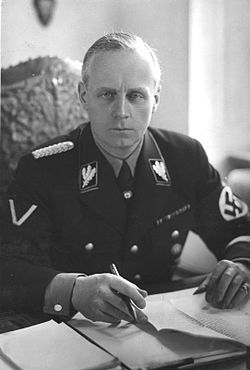
Ambassador Ribbentrop

Ambassador Ribbentrop

Polish negotiator

Polish negotiator

Funny Money

(Medical stuff has caused me to miss the last post and abbreviate this one.  [I would like conservative free-market privatized health care advocates to spend three hours in an emergency room.]  I present a variety of unusual bank notes.  The images could be better, but removing all the bills from their frames was too much work.)

We start with inflated notes.  (For the greatest inflation ever see the earlier post The Sad History of the Hungarian Pengo.)

Most of you have probably seen the classic Zimbabwe bill.

This is one of the last notes printed by the collapsing Yugoslavian government.

This one is from the short-lived country of Serbia Krajina, which consisted of the Serbian parts of Croatia that seceded in 1991; it was reincorporated into Croatia in 1995.

Here are some notes issued by Germany during the acute inflation of the twenties, not by the state but by the railway system.

Also from this period, Notgeld (“emergency money”) issued by the city of Gotha for local use.

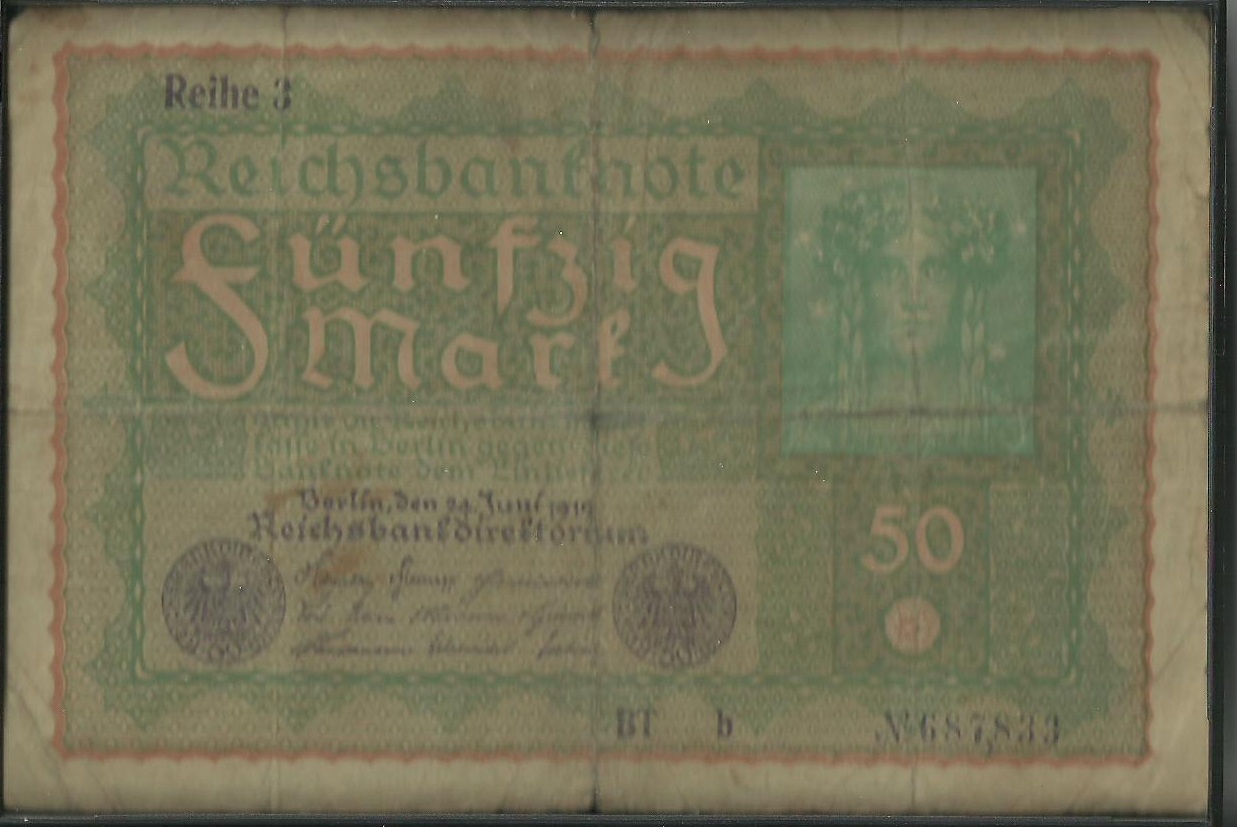
Here is the earliest bill issued by the Weimar Republic – 1919; it still has the imperial eagles of the Second Reich.

More “German” money from the Third Reich.  The top bill is for the puppet state of Serbia, the bottom is for the puppet state of Bohemia and Moravia (the remains of Czechoslovakia).

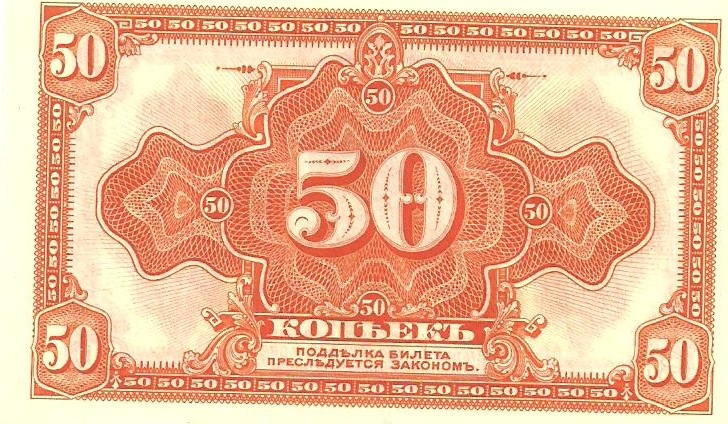
Moving east, we encounter money issued by a couple of very brief authorities.  From the nightmare of the Russian Civil War (1917-1922) notes printed by the two major White powers.  The first is from Kolchak’s Siberian army; 50 kopeks, not much.  He ended up dead.

The scond bill is more impressive, issued by the Don Cossack Military Government  in the south, but a 10,000 ruble bill does not suggest widespread confidence.  Denikin and Wrangel and their friends also ended up dead.


And more emphemeral money, these from the State of Chihuahua during Mexican Revolution (1910-1920).  The two men portrayed on these 1914 notes, Mexican President Madero and Chihuahua Governor Gonzales, had both been assassinated the previous year.


And finally, the last issue of the Khadafi government in 2009, the famous “Jack Benny” bill.

And It’s One, Two, Three, What Are We Fighting For?

Even what little information about the situation in Afghanistan that dribbles out of our increasingly coy and entertainment-oriented media suggests, at least to a reasonable and non-politically warped person, that things are not going all that well for the freedom-loving saviors from the West.  Our soldiers continue to be blown up in areas declared secure, and well organized strikes take place in Kabul itself.  More telling, the number of attacks on “NATO” troops (this is clearly an American war) by members of the Afghan military and security forces we are training is increasing.  Reports of Afghan officials departing the country with suitcases full of money abound, and the “democracy” we are building charges rape victims with adultery.  And the word is that the Pentagon and White House are annoyed with the pessimistic reports coming out of the CIA, reports which are of course classified.

Well, suspicions are confirmed by an intelligence report leaked in Germany, where Berlin is painting the same rosy picture as Washington, Chancellor Merkel having as much political capital as President Obama invested in a war that has precious little to do with American security and absolutely nothing to do with German interests.  Germany’s foreign intelligence agency, the Bundesnachrichtendienst, has issued a report on the situation in Afghanistan and the prognosis for the next two years, and though it is marked “classified/confidential” because it so at odds with what both the German and American governments are saying, it has been leaked.

Both governments are claiming that no more combat troops will be needed after 2014, only trainers for the Afghan army, which of course is killing Americans on a regular basis now.  According to the BNDreport, at least 35,000 troops will be required to stabilize the country, and “stabilize” hardly suggests creating a state that can stand alone.  The analysis also found no evidence that the Taliban is willing to enter serious negotiations, especially with the government in Kabul, and is just biding its time.

Afghan President Karzai is the target of particular criticism.  His main goal appears to be maintaining power, not just for himself but also his family: he is positioning his brother to succeed him as president.  His government is thoroughly corrupt, and despite assurances by himself and by Washington he has implemented no reforms, nor is there any evidence that he intends to.  He is certainly willing to deal with the Taliban in order to secure his position, which hardly sounds promising for Afghan women.  But the US must defend him as the democratic reformer, since abandoning him would be an admission of a failure that has cost us a trillion dollars and the lives of more than 2000 soldiers.

Of course none of this is surprising for anyone familiar with Afghan society, which has not changed since the British – and probably Alexander – were there.
The “country” is occupied by several ethnic groups that share a tradition of mutual hostility, and corruption and nepotism are ingrained in Afghan society.  The Afghanis are accustomed to rule by petty kings, tribal leaders and warlords, and it is questionable whether democracy could work even were the country not facing the Taliban and sundry religious whackos coming out of Waziristan.  Even a cursory knowledge of Afghan history would have strongly suggested that attempting anything more than bombing the Taliban and supporting a friendly warlord was complete folly, but the Congress and the White House, motivated by political considerations, have traditionally paid little or no attention to the actual experts in the State Department.  You would think that the British at least would know better, which they probably do, but when Washington speaks Europe must listen.

The prosecution of this war has become positively surreal.  A growing majority of Americans us want to leave immediately, and the vast majority of the citizens of our NATO allies never supported the war in the first place.  The Afghanis, while traditionally hospitable to guests, are also traditionally hostile to foreign soldiers in their land, and they practice a religion that requires conduct seemingly impossible for westerners to adhere to.  We are allied with and provide huge amounts of money to Pakistan, whose people hate us more and more and whose intelligence service is actually aiding the people we are fighting.  And as a breeding ground for international Islamic terrorism Pakistan now leads the world, although the ideological underpinning, Wahhabism, emanates from Saudi Arabia, another of our friends and one of the most oppressive countries on earth.  Finally, while the Taliban government sheltered international terrorists, for which reason we blew them away, they had no real grudge against the US.  They probably do now.

So why are we still there?  Primarily, I suspect, because no politician will ever admit the failure of a policy he is associated with, and everyone was associated with this clearly failed policy of turning Aghanistan into a democratic civilized nation.  But also because neither party, especially those wimpy Democrats, wants to look weak on terrorism (it used to be communism), even though most Americans could not care less, especially since they appear to have forgotten the war altogether.  A true leader in the government could easily make the case that not only is this war an incredible waste of lives and money, but it also actually damages our security by squandering military resources and producing new jihadis by the thousands.  But when was the last time you saw a serious leader among our political class?  Besides, our politicians are all dependent upon big money, which includes the people who make immense profits feeding Mars.

So, for two more years Americans and others will continue to die in some god-forsaken place that has nothing to do with our security and where everyone hates us.  And all because politicians in Washington are afraid of being castigated, not by the voters but by the other party.  Vietnam is beginning to seem like a sensible war:

And it’s one, two, three
What are we fighting for?
Don’t ask me, I don’t give a damn,
Next stop’s Afghanistan.

Grass Roots on Israel

Nobel Laureate author Günter Grass has just published a short poem entitled “What Must Be Said,” in which he accuses Israel, with its undeclared stockpile of nuclear weapons and constant threat of attacking Iran, of being the real threat to peace in the Middle East.  The poem is hardly likely to enter the corpus of great literature, but in it Grass makes valid points that must in fact be made and has stirred a discussion – at least in Germany – that has been constantly avoided.

Granted, Grass has undermined his position and unnecessarily provided material for his critics by suggesting that Israel is poised to launch a nuclear strike that would destroy the Iranian people, something Tel Aviv is not likely to consider doing.  Even the ever-compliant United States would (I hope) bristle at the use of a nuclear weapon, and in any case in the highly unlikely event that Israel’s incredibly powerful conventional defenses were inadequate, the US would be obliged to step in.

Nevertheless, Grass’ basic point is certainly correct: the only Middle Eastern nation west of Pakistan possessing nuclear weapons is Israel, which has never even been asked to sign the Non-Proliferation Treaty, let alone accept inspection of its facilities.  This bit of grand hypocrisy is hardly surprising, given that America and to a lesser extent Europe have historically granted the Jewish state a blanket dispensation when it comes to accepted international law and behavior.

Critics are screaming at the barest suggestion that Iran may be the victim here, but this is perhaps not as outrageous as it first appears, certainly not from the Iranian point of view.  The West overthrew their democratically elected government in 1923, imposed the utterly ruthless Shah, occupied the country during World War II, created and supported a militarily powerful Israel and encouraged Saddam Hussein in his decade-long war against them.  And now, because of the interests of Israel and the Sunni oil barons, America has declared its (albeit reluctant) willingness to engage in a war of aggression because Iran might be working on nuclear weapons and might have one in a few years.  For all that Iran is controlled by a collection of ideological numbskulls there is at least an aura of victimhood, and certainly no rational person could ever consider imperial Israel a victim.

For the obvious reason of its Nazi past criticism of Israel is very infrequent in Germany.  (Because of domestic politics it is also very infrequent in America, but the utterings of a European author typically do not stir the interest of the self-absorbed American media.)  Clearly, the atrocities of the Third Reich neither justify bad behavior on the part of Israel nor require reasonable Germans to be silent, but as Grass predicts in the poem, any criticism of Israel will result immediately in the accusation of anti-Semitism, which is exactly what happened.

Criticizing Israel is of course no more anti-Semitic than criticizing Germany is anti-German, and Israeli citizens in fact do it every day (only to be branded “self-loathing”).  But so great is western guilt and Zionist influence that it is now generally accepted that gainsaying Israel is in fact anti-Semitic; the latest edition of Webster’s does offer as the second definition of “anti-Semitism” criticizing Israel.  So, one does so at one’s own risk.

Sundry Germans, particularly newspaper columnists, immediately jumped on Grass as an anti-Semite, especially the Jewish writer Henryk Broder, who described the novelist as “the prototype of the educated anti-Semite,” in part for labeling the appropriation of Palestinian land as a criminal act (which of course it is by established international law).  As can easily be imagined, the extreme right-wing government in Tel Aviv promptly branded Grass an unrepentant Nazi, and Interior Minister Eli Yeshai barred the author from ever entering Israel, a petty measure already taken against others, such as linguist Noam Chomsky and Nobel Peace Laureate Mairead Maquire, who dared criticize Israel.  (In 2001 there were calls, unsuccessful, to do the same to Daniel Barenboim, who had the temerity to conduct a piece by Richard Wagner; these people are off the deep end.)  To their credit even some German politicians condemned this fit of Israeli pique.

Grass has on numerous occasions demonstrated himself to be something of a jerk, but he is undeniably a world-class novelist and certainly no ignoramus.  Whether or not one agrees with his appreciation of Israel and its nuclear arsenal, he has clearly made a valid point about the danger of criticizing the Jewish state, a point most Germans apparently agree with.  And a point amply demonstrated by the reaction of Israel, which once again has chosen to erect a wall rather than confront rationally those who dare object to its actions, whether they be Palestinian farmers or German authors.

What must be said

Why have I kept silent, held back so long,

on something openly practised in

war games, at the end of which those of us

who survive will at best be footnotes?
It’s the alleged right to a first strike

that could destroy an Iranian people

subjugated by a loudmouth

and gathered in organized rallies,

because an atom bomb may be being

developed within his arc of power.

Yet why do I hesitate to name

that other land in which

for years – although kept secret –

a growing nuclear power has existed

beyond supervision or verification,

subject to no inspection of any kind?

This general silence on the facts,

before which my own silence has bowed,

seems to me a troubling, enforced lie,

leading to a likely punishment

the moment it’s broken:

the verdict “Anti-semitism” falls easily.

But now that my own country,

brought in time after time

for questioning about its own crimes,

profound and beyond compare,

has delivered yet another submarine to Israel,

(in what is purely a business transaction,

though glibly declared an act of reparation)

whose speciality consists in its ability

to direct nuclear warheads toward

an area in which not a single atom bomb

has yet been proved to exist, its feared

existence proof enough, I’ll say what must be said.

But why have I kept silent till now?

Because I thought my own origins,

tarnished by a stain that can never be removed,

meant I could not expect Israel, a land

to which I am, and always will be, attached,

to accept this open declaration of the truth.

Why only now, grown old,

and with what ink remains, do I say:

Israel’s atomic power endangers

an already fragile world peace?

Because what must be said

may be too late tomorrow;

and because – burdened enough as Germans –

we may be providing material for a crime

that is foreseeable, so that our complicity

will not be expunged by any

of the usual excuses.

And granted: I’ve broken my silence

because I’m sick of the West’s hypocrisy;

and I hope too that many may be freed

from their silence, may demand

that those responsible for the open danger

we face renounce the use of force,

may insist that the governments of

both Iran and Israel allow an international authority

free and open inspection of

the nuclear potential and capability of both.

No other course offers help

to Israelis and Palestinians alike,

to all those living side by side in enmity

in this region occupied by illusions,

and ultimately, to all of us.

Günter Grass

(Translated by Breon Mitchell)

Hypocritically We Stand: UNESCO, Palestine and America

Once again Israel’s
iron grip on American foreign policy in the Middle East
has been vividly demonstrated, and once again the United
States has humiliated itself in the eyes of
the world.

On October 31 UNESCO, the United
Nations Educational, Scientific and Cultural Organization, voted overwhelmingly
to grant Palestine full membership
in the organization.  Of the 173 nations
voting 107 voted in favor, 14 voted against and 52 abstained.  Among those voting against the resolution
were the United States,
Canada, Germany
and Holland, while Italy
and Britain
abstained.  David Killion the US
ambassador to UNESCO, called the initiative “counterproductive” and
certain to “harm negotiations,” though he did not explain how.  The apparently aptly named Israeli ambassador,
Nimrod Barkan, called the vote a tragedy, also neglecting to explain why that
is so.

Israel’s
loudest voice in the US Congress, Rep. Ileana Ros-Lehtinen, demanded
immediately that the government honor two petty and now obsolete laws passed in
the nineties and cut off the US
contribution to UNESCO.  As a result
UNESCO has now lost 22% of its $653 million budget.  Ros-Lehtinen, incidentally, has over her
career received $203,240 from pro-Israeli PACS.
It is apparently not just Wall Street that has been buying American
politicians.

While there are many legitimate
reasons to criticize the UN, since the major reforms of UNESCO in the last
decade the agency has received only praise for its work around the world.  Even former Rep. Tom Lantos, another staunch defender
of Israel and a
Holocaust survivor, spoke highly of the organization.  The recent reforms seem to have eliminated
the waste and corruption and transformed the agency from a sometime anti-American
platform to an arm of the UN that is actually focused on its mandated duties.  These include decades of cooperation with the
Palestinians building the cultural and educational infrastructure in the Occupied
Territories and attempting to
protect historically and culturally important sites around the planet.  Ironically, UNESCO has been working with the US
in developing Afghanistan,
particularly in the area of education.

In 1984 President Reagan took the US
out of UNESCO because of concerns that the organization was a mouthpiece for
the communists, but President Bush rejoined it in 2003, a demonstration of the
impact of the reforms.  Israel, on the
other hand, was booted out of the agency in 1974 for the damage being done in
its excavations on the
Temple Mount, but was reinstated in 1977 when the US threatened to withhold $40
billion in contributions.  In 2010 UNESCO
complaints about the Israeli destruction of Palestinian historical sites caused
Israel to
suspend cooperation with the organization, the Israeli foreign minister suggesting that the complaints were
part of a Palestinian scheme to discredit Israel.

Solely because of domestic political
concerns – criticize Israel
and you do not get reelected – the US
relationship with Israel
has become the “passionate attachment” that George Washington warned
against in his Farewell Address.  Continuing
and unqualified support for the Jewish state despite their increasingly
outrageous behavior and the violation of every international covenant we have signed
has seriously tarnished America’s image not just in the Arab world but around
the globe and marked us as the hypocrites that we have become.  As an example, we maintain that for some
unexplained reasons Palestine being a member of UNESCO would hinder the peace negotiations
(that have achieved nothing in the last twenty years), yet we say little and do
absolutely nothing about Israel’s continued construction of settlements in conquered
territory, a clear violation of international law and a recognized and real hindrance
to negotiations.  Even Germany,
whose relations with Israel
are for obvious reasons very delicate, is considering holding up the sale of
submarines to Israel
because of their plan to build more settlements in Arab Jerusalem.

Ironically, our credibility has
suffered even more under President Obama, whose election brought the
expectation of an at least somewhat more balanced policy in the region.  He is probably sympathetic to the plight of
the Palestinians and certainly despises Prime Minister Netanyahu, but he of
course desires to be reelected and for all his beautiful speeches he has done absolutely
nothing and has silently suffered constant insults from our “ally.”  Well, in this instance he can claim his hands
were tied by laws passed by the Congress, but not too loudly.

I am mightily ashamed of my country,
as are many caring Israelis about theirs.