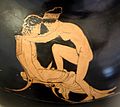
Stuff from Way Back #19: All Hail the (Greek) Phallos

Virtually overnight the western world, including even parts of Latin America, has come to accept homosexuality, and the major issue is no longer tolerance but the public and legal status of a homosexual marriage.  On the other hand, there is central Africa, where practicing homosexuality can mean death, and the hypocritical Islamic (mostly Arab) world, where homosexuality is typically a crime but often engaged in because of the extreme sexual segregation, especially in the Gulf states.  And of course Russia has now enthusiastically embraced homophobia, hardly surprising in a county where the majority of the population is still coming to terms with the nineteenth century.


This sort of serious hostility towards homosexuality is yet another gift of the No-Fun God, who declares such behavior unnatural and an abomination, and prior to the arrival of the Christians (and outside Judea) attitudes were very different.  While there are exceptions, most non-Abrahamic societies have tolerated or in some cases even accommodated homosexuality in their social and religious values.  The Greeks are an excellent example, and ironic, since Greek values and ideas are at the heart of the western tradition, while their sexual practices were vehemently rejected by the religion that affixed itself to that tradition.


Because of deep-seated hostility in the Christian west to such practices, Greek homosexuality traditionally received little or no attention in the standard histories, and when it did, the account was typically distorted by the moral prejudices of the author.  Otherwise competent scholars turned a blind eye to the evidence of widespread homosexuality, including the so obvious and explicit scenes found on pottery.  (The Greeks depicted every sort of activity on their pots.)  Only recently has classical studies turned to serious investigation of Greek sexuality, much of which investigation is unfortunately marred by new prejudices.


It should be noted right off that if modern terminology is to be used, Greek society was not homosexual, but rather bisexual.  Homosexuality may be defined as the more or less exclusive sexual preference for members of the same sex and must be considered some sort of biological aberration (no offspring can be produced) affecting a minority in every society.  Bisexuality is the willingness to entertain sexual partners of either gender and would appear to be in large measure a socially determined trait, unless we assume that the Greeks were somehow physiologically different from other people.  Thus, while there was surely the usual homosexual minority, many urban Greeks, especially those of high social status, were apparently bisexual, seeking different things from the different sexes.  In fact, to judge from the large numbers of female prostitutes and evidence such as the successful sex strike launched by the Athenian women in Aristophanes’ Lysistrata, heterosexual relations were very important to Greek men.


Using modern terminology is in any case a dangerous practice, since there is the risk of also projecting into the past modern concepts that have a different or no meaning in ancient society.  The terms “heterosexual” and “homosexual,” which are little more than a century old, are valid classifications for Greece only in the most superficial sense, that is, labeling a single different-sex or same-sex act.  As more general characterizations they are useless because they group behaviors that the Greeks considered very different, the sex of the partner, for example, being almost a trivial concern compared to the all-important issue of social status.  Dominance and issues of penetration and receptivity were frequently of far greater importance than gender, and certain areas of Greek society might be more appropriately described as phallocratic rather than heterosexual or homosexual, though this term as well is too restrictive and potentially misleading.


Why ancient Greece – or at least the upper levels of its urban population  – should have been one of the very few openly bisexual societies in history, certainly in the West, is not perfectly clear.  The origins of male homosexuality were seen by the Greeks in the sexual segregation of the military societies of the Dorians (the second wave of Greek-speaking invaders from the north, c. late 13th to early 11th centuries), and Plato in fact blames the Spartans and Cretans, who were Dorians, for spreading the practice.  But while Plato may be reflecting an opinion generally held in Greece during the classical period, that opinion is not necessarily true, and there is no hard evidence for the diffusion of Dorian practices through the rest of Greek society.  It is true, however, that the overwhelming male orientation of polis (city-state) society, which resulted in a sort of sexual segregation, can probably be traced back to the warrior communities of the early Dark Age, which resulted from the Dorian invasions.  The warrior hosts disappeared, but because of the endless intercity warfare, the polis was in many ways also a warrior society, and the absolute dominance of males continued.


The pertinent fact here is that outside of childbearing everything that mattered in the polis was in the hands of males, which meant in turn that outside of heterosexual relations everything that was of any concern to a Greek male involved other males.  With very few exceptions women were completely uneducated and uninvolved in anything beyond the household and the odd cultic practice, and consequently, for meaningful companionship and a relationship with any intellectual content whatsoever a male normally had to turn to another male.  Male relationships thus filled a basic social need.  This situation of course does not necessarily lead to open homosexuality and did not in most other similar societies.  Further, while it is perfectly clear that extreme sexual segregation inevitably leads to some degree of homosexual behavior (look at any prison population), it generally does not lead to open, socially acceptable homosexuality.


Why then the Greeks?  An entirely satisfactory explanation is elusive, and I can only suggest a few reasons.  First, the relatively high level of social and intellectual freedom in Greek society, due in part to the open nature of the constitutional polis and in part to the fragmentation of Greece into hundreds of separate political units, which encouraged some small measure of diversity.  This resulted in a social atmosphere more conducive to change and acceptance of different practices.  This is not to suggest that Greek society was wildly progressive – it certainly was not, even in the heady days of change in the sixth century – but rather that the polis was at least marginally more inclined to accept nontraditional behaviors than the average pre-modern society.  Much more important, the Greeks had no inherited prohibition of homosexuality, no command from god that erotic experiences between persons of the same sex were wrong, which would allow the homosexuality inevitably practiced in secret in sexually segregated societies to come out into the open.  Finally, because sex was viewed as an important expression of status and citizenship, social position became much more important than the actual gender of the partner, producing an environment more open to sex between males.  In short, the male dominance and sexual segregation fosters the bisexuality, and the relative social freedom and lack of any serious religious prohibition brings it out of the closet.


But let us not misunderstand Greek sexuality and think simply of cheap thrills and bathhouse promiscuity.  Obviously, there were those who engaged in casual sex, especially with slaves and male prostitutes, but a serious relationship involving free males was bounded by a strict set of rules, and behavior that publicly violated those rules was socially unacceptable and sometimes criminal.  An acceptable pairing involved an older male, the erastēs, who was the active partner, and a younger male, the erōmenos, who played a passive role.  The erōmenos could not be too young, less than about twelve, and there would be talk if he were still playing the passive role much beyond the age of fifteen or sixteen (“when the beard was grown”).  The pair could not openly engage in oral or anal sex, because that would compel the erōmenos to play a subordinate, female role and not only bring shame upon him, but also injure his future status as a citizen.  Personal physical inviolability was one of the hallmarks of citizenship, and penetration of a male would place him in the category of slave and woman.  The kinaidos, the man who allowed himself to be so used, was the negation of everything represented by the hoplite, the heavy infantryman who defended the polis: manliness, citizenship and dominant status.  Indeed, the worst insult you could deliver to a man was to call him euryprōktos, “wide-assed.”  The acceptable practice was intercrural copulation, in which the erastēs, facing his partner, thrust his penis between his thighs, thus avoiding penetration.


Such at least was the social ideal, and some men maintained lofty attitudes regarding their liaisons, emphasizing the educational aspect of the relationship and their responsibility for the development of their erōmenoi as men and citizens.  There is some truth to this, inasmuch as Greek society (excepting Sparta) had no formal educational apparatus and the continued absence of the urban father from the household may have strained the relationship between father and son, but this must not be exaggerated.  The evidence suggests that sexual attraction to and pleasure with adolescent males was the common motivation and that penetration was frequently practiced, for all that one never spoke of it in public.  The Romans, incidentally, shared these attitudes, though unlike the Greeks they considered citizen youths out of bounds, and the distinction between penetrating men (permitted for virile males) and being penetrated by men (definitely not permitted) is still made among males in some Mediterranean and Latin American societies.

Greek honesty concerning homosexual behavior was only a single facet of their incredibly open attitude about human sexuality in general.  Sex, and in fact body functions in general, rather than being a taboo subject were a source of great amusement, as is readily obvious from Aristophanes and from Greek pottery (the stuff hidden away by Christian museum curators).  Aristophanes’ comedies were at heart social and political satire, the highest form of comic expression, but that satire was wrapped in humor that a modern audience would find obscene and puerile – jokes about farting, penis size and suchlike.  But the Athenian audience loved it, and these were people who had just sat through and enjoyed several tragedies; the modern equivalent might be several Ingmar Bergman movies followed by some mixture of Redd Foxx and the Three Stooges.


Free of any divine commandments to the contrary, the Greeks were able to develop a more open attitude about human sexuality, and I suspect their society was all the more psychologically healthy for it.  The Greeks were far more willing than most civilized peoples to recognize the inner nature of the human animal and squarely face what this meant in terms of human needs and behavior.


Finally, a popular Greek “pottery joke.”  There were traditional shapes for wine cups, and one was similar, though smaller, to the common chamber pot.  A picture of a woman peeing was painted on the inside bottom of this type of cup, and when the imbiber (inevitably male) finished his drink, he suddenly discovered the squatting woman and got the joke.  Yes, these are the same people who discovered democracy and philosophy, and yes, they would have found dribble glasses and whoopee cushions completely hilarious.
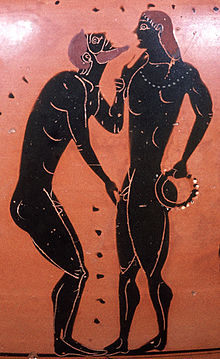
 

When men were men
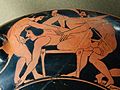
When men were men

Hey, it's Greek art

Hey, it’s Greek art

And women were women

And women were women


Stuff from Way Back #11: Exactly Why the Greeks Were Great

(I have no more completed Moses chapters; there were enough “likes” that I will persevere.  My apologies for posting the ancient Olympics piece twice.  If you like the following, read my Greek history Dare To Struggle, Dare To Win.)


It has been a traditional proposition in the West, one to which most intelligent people will pay immediate lip service, that ancient Greece was great and vitally important to the history of the human race. But why? Few, including many in classical studies, it seems, can provide any sort of substantial answer to this question. Vaguely gesturing towards the Parthenon and mentioning such things as democracy and Euripides and Plato, as most would do, barely hints at the reason for the greatness of Greece. Other cultures have after all created beauty and nurtured great intellects. Other peoples have exercised far more power over far wider areas than the Greeks. In terms of extent and longevity Roman society, which ultimately captured Greece, must certainly be deemed greater. What is it about the Greeks?
What makes the Greeks great, and uniquely so, is the discovery of the basic concepts utterly necessary to a mature society, whatever its cultural character. They are: constitutionalism, the notion that law is at the foundation of the social organization and that the people, not kings and gods, are the source of authority; rationalism, the will to doubt and to examine the universe according to logic and evidence, rather than faith and fantasy; and humanism, the conviction that man, rather than god, is at the center of things, that he is what is most important in our world. And with humanism comes a fourth idea, that of the individual, this curious notion that the individual human being has a value and a dignity quite apart from the group and the gods.
Constitutionalism has to do with the nature of authority in the community. In the pre-Greek societies of the ancient Near East the operative idea behind the kingship – and thus behind the whole concept of authority in the state – was that the power exercised by the king came from above, from the gods. With this notion, a society will never get beyond monarchy in its political development, and the kingship will likely have theocratic overtones, as is most obvious in the case of the Egyptian god-king.  What the Greeks entertained was precisely the opposite notion, that the power first wielded by their petty kings came from below, from the community, upon whose behalf, at least in theory, they ruled. This is the root idea of constitutionalism: the authority exercised by the state, whatever form the state takes, derives from the people. This concept simply did not exist in any of the oriental societies, where authority derived from heaven.
Now, this idea is hardly unique to the Greeks or to the Indo-European linguistic family to which they belong. Rather, it appears to be common to primitive and especially hunting-gathering tribal societies, in which the hunter-warrior host creates a sort of elective kingship in order to enhance its efficiency and that informal kingship tends to become hereditary, though insecurely so. The idea just seems to get lost as those societies settle and develop agriculture, and in only two places does it survive and mature to the point of influencing other societies: Greece and Italy.
The first Greek speakers certainly brought the idea with them when they entered the Balkan peninsula around 2000 BC, part of the great migration of Indo-European peoples from the north, but it could not survive in an Aegean world already dominated by the high culture of Minoan Crete. Mycenaean Greece (c. 1600 – 1200 BC) is consequently little different in its ideas and institutions from its oriental predecessors. But all this was swept away in the late thirteenth and twelfth centuries by a new Indo-European invasion, which obliterated the Hittite empire in Anatolia, tipped New Kingdom Egypt into a nose dive towards oblivion and sent another wave of Greeks, the Dorians, into the Balkans, where they vaporized Mycenaean civilization.
Greece was plunged into the Dark Age (c. 1200 – 750), but the new arrivals were free to develop their society without foreign influence. From the evidence of Homer, the later Macedonian kingship and the German tribes observed by the Romans, that society was initially made up of crude, isolated agricultural communities, each typically ruled by a chief or petty king, whose rule is based upon his control of a warrior host and is hereditary only to the extent that he who inherits can rule. The warrior aristocracy retain their tradition of assembling to hear and advise the king and most important, they understand themselves to be the source of his authority. Because of the unsettled conditions and warrior values, land has been temporarily replaced by herds and flocks and movable goods as the primary form of wealth.
As conditions stabilized and these communities grew, pressure on the king mounted, while the warrior aristocracy began to lose its heroic ideals and melt into agriculture. Land was meanwhile reemerging as the primary form of wealth, and the most important families were creating a new aristocracy, one whose power base was more familiar, the ownership of land. While the warrior aristocracy disappeared, however, their tradition of gathering to advise the king did not, and their informal assembly increasingly became a gathering of ordinary citizens.
Finally, in the close environment of the proto-polis (city-state) the new landed nobility rapidly developed a consciousness of their own power, and the poor obsolete warrior leaders began to disappear. Remember, the Greek kingship was not protected by the gods and their officials on earth, as in the Near Eastern societies, where abolishing monarchy would literally mean assaulting the natural order of things in the universe. Nor was there any strong institution or long tradition behind these rulers, as there was behind the kings of Babylon or Egypt. It appears the process was generally peaceful, as the monarchs were gradually stripped of their powers, until the office was no more than a limited tenure magistracy or disappeared altogether. At the same time, the need for the aristocrats to formulate rules for the sharing of the deposed king’s power led to more precise definitions of law and thus the development of the one-time warrior assembly into an actual legislative body.
By the middle of the eighth century the kingship has generally disappeared from Greece, which is already a tremendous achievement, since from the birth of civilization some two thousand years earlier monarchy had been the inevitable rule. Now, in the Balkan peninsula we find hundreds of little republics, possessing the basic machinery of constitutional government: each was governed by elected, limited term magistrates, and each had a citizen assembly that was the source of political authority and actually passed the laws. Of course, this political apparatus was oppressively controlled by the landed aristocracies of birth, but the fact is, it was there. And embedded in the very fabric of the young polis were the ideas that would form the essentials of constitutionalism and distinguish the matured polis.
Most important is the concept of the individual in society as “citizen” rather than “subject,” that is, the notion that the authority exercised by the state comes from below, from the people. One aspect of this bedrock concept is the universality of law, the idea that all members of the community, including the rulers, are equally subject to the law, because the community is the authority behind the law, regardless of who actually makes it. Egypt, for example, produces no law codes because it needs none; all regulations will come from heaven, through the mouth of Pharaoh. Another obvious derivative is the basic democratic idea: those in authority are in some manner responsive to the will of the citizen body, because it is from that citizen body that they derive their authority. And being incubated within the idea of man as “citizen” is the notion of man the individual.
Constitutionalism found its maturity in the Archaic Age (c. 750 – 500 BC), as the rapid growth of commerce and manufacture produced growing pressure on the old aristocracies by creating in Greek society centers of economic power that were outside their circles. At the same time the arrival of a middling class allowed the emergence of citizen armies of heavy infantry, which led almost immediately to the toppling of the birth aristocracies, as ambitious individuals rode the social discontent and new hoplite armies to power in the seventh and sixth centuries. The Age of Tyrants was over by the end of the sixth century, but it accelerated the process of moving from access to political power based on birth to access based on wealth, and thereafter the standard for the polis was one of matured constitutional government, in the form of oligarchies of wealth and democracies of various sorts.
The Archaic Age also witnessed the other world class breakthroughs, the discovery of rationalism and humanism, and it is during these centuries that the individual first walks the earth. To a great degree these towering discoveries in sixth century Ionia (the Aegean coast of Anatolia) were a matter of the right combination of things coming together in the right place at the right time. Certainly, the most important factor was the nature of the inherited Olympic religion, which the Ionian scientists ultimately spurned. The key fact here was the absence of a church, of an institutionalized religion with an ideology and a priest class to defend that ideology. This had already played an important role in Greek constitutional development, since it allowed the polis to avoid the invariable pattern found in the Near Eastern societies: the fusion or at least mutual support of the secular and religious authorities in defense of the political and intellectual status quo.
The tenets of Greek polytheism were very fluid and permitted almost complete intellectual freedom. There were no holy books or stultifying dogma and no powerful organization to enforce beliefs and threaten the thinker with the stake. “Amateurs,” like the late eighth century poet Hesiod, were consequently free to speculate on questions, such as the origins of the universe, that were normally reserved for the “professionals” of the priesthood. Organized religions have invariably slowed intellectual progress, for god requires belief without doubt, and doubt is vital to the discovery of truth.
Further, in contrast to the religions of the Near East the Greeks held that the Olympic gods did not create the universe, that men and gods were both subordinate to the fact of its existence. This permitted – and perhaps encouraged – speculation about its origins in terms other than divinities and personalities, which constitute the causative coin of mythopoeism. The world view of the Near Eastern societies was mythopoeic, or “myth-making,” a belief system in which the universe is completely animate and every natural phenomenon is the manifestation of a will or personality. Mythic thinking eschews generalization, is unconcerned with logic and consistency and cannot understand natural causation, since inanimate matter and impersonal forces simply do not exist. Like everyone else the Greeks first viewed the world mythically, but with their belief that the universe preceded the gods they had a leg up in the process of breaking free of the restraining bonds of mythic thought. And non-mythic propositions about the nature of the universe invite further examination and question because they are not protected by the sacred inviolability of myth.
A second important factor was the simple existence of the Greek cities in Ionia, where they formed a kind of east-west interface with the older oriental cultures. This not only brought access to the accumulated ideas and data of the eastern societies, but more important it also provided obvious and unavoidable cultural contrasts. You did not have to walk many miles inland from Miletus before you came upon communities that were definitely not Greek and that had far different customs, values and social organization. Fortunately, there are some who do not immediately assume these strangers must be wrong but face such a challenge by questioning the absolute validity of their own institutions, by wondering if perhaps such things are all relative after all. And thus some men were led to the first stages of skepticism, which is absolutely fundamental to scientific inquiry, for if you are content and do not doubt, there is no spur to intellectual progress. The Egyptians provide the perfect example: because of their benign and isolated environment, they immediately developed a self-satisfying, all-encompassing view of a positive and unchanging universe, in which everything was understood, and the price paid for the psychological contentment engendered by this was fifteen hundred years without progress of any kind.
Like the Egyptians and most people everywhere, the Greeks of course assumed that their ways were best, and the development of their society was accompanied by a growing conviction that Greek culture was simply better than anything the rest of the world had to offer. But one important component of this culture was the Ionian tradition of skepticism and examination, which made the Greeks, and subsequent western civilization, generally more receptive to outside ideas and less xenophobic than most. Again, in virtual cultural isolation for a millennium and a half, Egypt was so unreceptive to non-Egyptian ideas that they shattered the confidence and hope of the society when new ideas poured in as a result of the Hyksos occupation and New Kingdom imperialism.
Also because of the east-west interface, which put them on the cutting edge of the Archaic Age economic boom, the Ionian cities rapidly achieved a high level of material prosperity, which freed more men for purely intellectual pursuits. The existence of a leisure class is of course not a sufficient condition for the birth of rationalism; every civilization since Sumer had possessed a leisure class of some size, but none had produced rationalism. It is, however, a necessary condition, since men who do not have time just to think will not think new thoughts.
A final and extremely important factor was the material progress being achieved by the Greeks, especially in the sixth century. Archaic Age Greece was one of those very rare moments before the modern world when real change was apparent in a man’s lifetime, as the Greeks began to make great advances in the arts and engineering and in general mastery over the environment. Especially important in these developments were the new political hardballers, the tyrants, who could provide far more efficient government than the aristocrats ever could and who were everywhere inclined to feats of engineering.
Because of these achievements, because of the inescapable fact that life and society were not just discernibly changing, but also generally improving, the Greeks were becoming infected with a totally new idea – that of progress. For the first time in the history of the planet men were looking forward, rather than back to some golden heroic age. Every other society in the ancient Mediterranean had believed that if things were changing at all, they were only getting worse, and the Egyptians did not even have a real concept of non-periodic change and the passage of time. True, the Hebrews looked forward, but only to the arrival of a messiah; they had no concept of progress. The Greeks too had a vision of an earlier golden age, but that was now giving way to the astounding notion that things were getting better.
And these achievements were the accomplishments of men, not gods. Men were taking pride in human accomplishment and discovering that man, not god, was the most proper object of human attention, that human society and the individual human being had their own intrinsic dignity and worth. Indeed, the fact that the Olympic gods were so perfectly anthropomorphic, differing from men only in their immortality and immense power, made them completely unsuitable role models, compelling the Greeks to look to themselves for their moral values. Humanism was being born. In the mid-sixth century the Ionian scientist Xenophanes summed it all up in a single statement, one that would have been utterly impossible in any of the societies that preceded the Greeks: “The gods did not reveal to men all things from the beginning, but men, through their own search, find in the course of time that which is better.”
The result of all these factors was the birth of Greek rationalism and the real genesis of science and philosophy. The Ionian philosopher-scientists asked “why” concerning the world and its phenomena and sought to make consistent and logical generalizations about nature. And unlike any before them they did so from simple curiosity, from the plain desire to understand. The Near Eastern societies had developed a considerable body of scientific knowledge, but they had done so in the service of religion or practical needs and in a context of mythic thought. The engineering skills of the Egyptians, for example, followed upon the desire to build more elaborate temples and tombs, and the astronomical data of the Babylonians were collected in order better to read the will of the gods. And whatever the motives, the mythopoeism of these societies prevented them from turning their accumulation of data into true science. Now, for the first time in any significant numbers men were studying the world around them simply to understand it and were realizing that through such understanding the human condition could be improved.
The new skepticism was particularly focused on the religious traditions, and Ionian scientists were breaking the last mythic bonds by concentrating their attention on impersonal forces and natural causation in their examination of the cosmos. Hecataeus proclaimed the inherited Greek myths to be absurd, and Xenophanes made the astounding declaration that the gods were mere inflations of the mortal image, something most humans still cannot accept. Perhaps the most profound change was in the concept of man himself. In the religions of all the pre-classical societies man was a special creation of the gods, fashioned essentially to serve them and their designs. The Greeks now dared suggest that man was part of the animal kingdom, evolved, according to Anaximander, from lower creatures, but at the same time they boldly asserted that he did indeed occupy a special place, not because of any particular relationship with god, but because of his mind.
Constitutionalism, rationalism, humanism, the individual, these are the gifts the Greeks bear. Other societies have caught glimpses of these vital ideas, but nowhere else are they so confidently pursued and nowhere else do they have such an extensive influence beyond the society that discovered them, making classical Greece the most important society that has existed. Among the most precious, and dangerous, treasures of the human race, these ideas are the greatness of Greece

Stuff from Way Back #10: A Circle in the Sand

On the eve of the Second Punic War in 218 BC the Roman Republic was essentially an Italian power, controlling the peninsula south of the Po valley and the islands of Sicily, Sardinia and Corsica.  In just thirty years Rome then defeated the only other powers in the Mediterranean world that could possible challenge her: Carthage (Second Punic War 218-201), Antigonid Macedon (Second Macedonian War 200-196) and the vast Seleucid Empire (War with Antiochus 192-188).  While Rome still directly controlled very little territory outside Italy and the islands as provinces – the Senate preferred an hegemonic approach – the empire was completely established by 188 in the sense that there was no one left who could even remotely threaten Rome.  Turning clients into provinces would occupy the next couple of centuries.  Just how powerful Rome was by 188 is illustrated by a single incident, one that did not in fact involve any show of force.

After the death of Alexander III (the Great) in 323 his empire collapsed as his lieutenants fought over the spoils for the next for the next half century.  This was the Age of the Successors, and the virtually endless war of the period produced the three major powers of the Hellenistic world, all of them Greco-Macedonian monarchies defended by almost exclusively Greco-Macedonian armies.  The descendants of Antigonus the One-Eyed managed to capture the Macedonian homeland, replacing the now defunct Temenid dynasty of Alexander with the Antigonid dynasty.  Another young officer, Ptolemy son of Lagos, seized Egypt and established the Ptolemaic or Lagid dynasty, the last member of which was the famous Cleopatra VII.  The Asian territory, stretching from the Mediterranean to India, fell to Seleucus, after whom the Seleucid dynasty would be named.

For most of the third century these three states existed in a precarious balance of power, two periodically joining against the third when it seemed to be growing too strong.  Consequently, while there was constant scheming and wars of expansion, the three monarchies continued to exist into the second century.  By the end of the third century, however, Egypt had become a weakling under a series of poor kings and was the priority target of the Seleucids.  Actually, Egypt had always been a target of the Seleucids, and in the course of the third century the two powers had fought five wars over control of Syria-Palestine, a critical strategic area for both states.

The day of reckoning was delayed by Roman involvement in the east, which led to the defeat of Antiochus III (the Great) in 188 and the loss Asia Minor, his most valuable territory.  He died in 187 and was succeeded by his son Seleucus IV Philopator, who was assassinated in 178 and followed by his brother Antiochus IV Epiphanes of biblical fame.  In 170 Eulaeus and Lenaeus, ministers of the underage Ptolemy VI Philometor, prepared for an invasion of Palestine, now under Seleucid control, but were thwarted by Antiochus, who in 169 captured Memphis and Ptolemy himself and had himself proclaimed king of Egypt.  But the population of Alexandria named Ptolemy’s brother king as Ptolemy VII and fortified the city so well that Antiochus retired from Egypt, leaving Ptolemy VI to duke it out with his sibling.  The hoped for fratricidal war of attrition did not occur, however, and the brothers reconciled, leading Antiochus to invade once again in 168.  He easily reached Alexandria and began preparing a siege, when a Roman embassy showed up.

Antiochus was well aware of Roman strength and had followed his father and brother in going out of his way to maintain friendly relations with the Republic.  He knew the Romans were disinclined to see the Seleucid empire expand, but at this time Rome was involved in the Third Macedonian War (171-168) against Perseus, destined to be the last king of Macedon.  There was no doubt of the outcome, but Antiochus presumably believed that Egypt was outside the Roman strategic horizon and that his excellent relations with the Republic would lead them to accept a fait accompli.

The Roman embassy, led by the former consul C. Popillius Laenas, met Antiochus at his headquarters outside Alexandria.  Popillius handed the king a letter from the Senate, a note that said something to the effect that the Senate and the Roman People felt it was in the best interests of everyone for Antiochus to return to Asia and leave the Ptolemaic monarchy intact.  The king asked for time to consider the “request.”  Popillius responded by using his walking stick to draw in the sand a circle around Antiochus and asked him to give his response before he left the circle.  Antiochus, ruler of more territory than Rome, at the head of a victorious army and about to achieve what his family had dreamed of for a century, gathered his forces and marched back to Syria.  So powerful had Rome become.

Stuff from Way Back #9: Olympics

          Once again the Olympics are upon us, as London hosts the quadrennial city-bankrupting festival that every city nevertheless craves.  Of course, now it is not just the expense of building new venues that will likely go unused after the event, but also the cost of providing security in a world descending into paranoid madness over the issue of terrorism.  A British warship come up the Thames to London, surface-to-air missiles on the roofs of apartment houses and with the failure of the contracted security firm more British military personnel than are currently fighting in Afghanistan.  You might guess that the Armada or Luftwaffe is heading towards the city.

On the other hand, since the site is London and not Beijing or Moscow or Riyadh there are no boycotts or protests to disturb the celebration of sport (and sports equipment) and no voices decrying the “politicizing” of the Olympics.  And the Cold War is over, which means no ideologically motivated second guessing of East Block gymnastic judges and no East German women with mustaches and bulges between their legs, always a favorite of the post-war games. Nationalism and patriotic tribalism are of course alive and well, but mobs chanting “USA! USA!” and individual athletes being absorbed into the national herd is not considered inappropriately political.  You may trumpet the superiority of your country; just don’t criticize it.

Is this not how it should be?  Pure sport (well, except for the nationalism), and amateur athletes (except for the professionals) competing simply for honor (except for the product endorsements).  According to Baron Pierre de Coubertin, founder of the modern Olympics: “The important thing in the Olympic Games is not to win but to take part, just as the most important thing in life is not the triumph but the struggle.”  Fine sentiments indeed, except that they have nothing whatsoever to do with the Greeks and the ancient games.

The strongest component of the Greek character was agōn, the need to compete or struggle, and this drive manifested itself in every aspect of their society, from sporting events and dramatic contests to constant political upheaval and warfare.  Unlike the Romans, the Greeks were definitely not team players, and even sex was viewed as a kind of competition, with a winner and a loser.  One result of this urge to competition was the fragmentation of Greece into hundreds of independent and narcissistic little political units, the city-states.  All life revolved around the city-state community, and you were not so much a Greek as you were an Athenian or a Theban or a Corinthian, willing to do almost anything to demonstrate the superiority of your city.

Since everything you did reflected upon your city, everything you did had a political aspect, and sport was no exception.  The original Olympics were consequently highly politicized, more so than their modern successors, and places like Argos and Chios had discovered the public relations value of athletic triumphs long before Berlin or Beijing.  And as far as lionizing our sports figures goes, how many mothers now pray to Jim Thorpe or Wilma Rudolph to cure a sick child?

Ancient Olympians were also hardly the disinterested amateurs of de Coubertin and Avery Brundage.  By the last quarter of the fifth century BC professional athletes were already dominating the games, which were rapidly evolving into pure spectator sport.  Competitors were financially supported by wealthy individuals or the cities themselves, and it became a common (and frequently derided) practice for a city to hire a successful athlete from another city, in effect a ringer, to compete as one of their own citizens and enhance their “medal count.”

But even before the emergence of the professionals the Olympics fell considerably short of de Coubertin’s dream of pure sport.  Amateur athletes expected serious financial gain from their victories, and although the big festivals at Olympia, Nemea, Delphi and Isthmia granted only wreaths, those victors could expect substantial material rewards from their cities.  Money, valuable goods, tax breaks, public support and even political preferences awaited the winners, all of which calls to mind the “amateur” Olympians of the former East Block countries, with their cars, apartments and special access to western goods.

Far more accurately than de Coubertin, Coach Vince Lombardi captured the attitude of the Greek athlete: “Winning isn’t everything; it’s the only thing.”  Greek society had little sympathy for life’s losers or those who tried their best and failed.  There was no second and third place, and losing brought dishonor and even public disgrace.  Consider the epitaph of Agathos Daimon, buried at Olympia: “He died here, boxing in the stadium, having prayed to Zeus for the crown or for death.  Aged 35.  Farewell.”

For all the pressure to win, however, we know of remarkably few instances of cheating in the thousand year history of the games.  For one thing, given the relative simplicity of the events and the lack of our modern pharmacopoeia, it was not that easy to cheat in the athletic competitions, though bribing judges in the more subjective artistic events was certainly possible.  More important, though, was the fact that the Olympic games were first and foremost a religious festival, honoring the god Zeus, and cheating meant that an angry deity would sooner or later be on your case.

In practice the ancient games were more politicized than their modern counterparts, and were it not for the fact that the classical world did not have a consumer market economy, they would almost certainly have been as commercialized.  Souvenirs were in fact sold, and had the Greeks discovered marketing, their businessmen would certainly have vied for the right to sell the official tunic or kylix or whatever of the Olympics.  Even the discoverers of rationalism and builders of the Parthenon could indulge in bad taste.

The modern games have left de Coubertin behind and now more closely approach the spirit of the ancient Olympics, celebrating victory and gain rather than simple participation and effort.  Only in their universalism can the modern Olympics claim to be something greater than the original.  The classical games were limited to able-bodied males (the Greeks would find our Special Olympics an obscene joke) and until the Romans took over, Greeks.  On the other hand, the Greeks considered anyone who did not speak Greek to be a barbarian, so why bother?

Our Desert Shepherd God

One constantly hears of the importance of the “Judeo-Christian tradition” to Western society and values.  Apparently Islam, which is clearly also part of the Abrahamic family, does not count, perhaps because it is so obviously at odds with the values touted in the West.  Yet apart from the fact that the West has been essentially Christian, with a smattering of Jews, it is not exactly clear how Judeo-Christian ideas are so important to modern society.

The two religions certainly espouse basic social values common to virtually all of humanity – homicide, theft, adultery, etc. are bad and family, compassion, charity, etc. are good – and they at least suggest that law and justice are vital to a well-organized society.  But does not the classical tradition also support all these values and do so within a context of rationalism, eliminating the need for any god?  Further, the Greco-Roman legacy lays the foundation for scientific enquiry and the democratic state, emphasizing a rule of law disconnected from any sort of faith.  The mainstream versions of the three Abrahamic religions ultimately accommodated, at least to some degree, rationalism and constitutional government, but this evolution took a very long time and segments of these faiths are still hostile to such Western notions.  Yahweh/God/Allah is manifestly not a democratic figure and has required unthinking acceptance of his words.

Inasmuch as they are rooted in faith rather than reason all religions are inherently silly to one degree or another, but the believer will of course only see the silliness in the other guy’s religion, especially if it is not Abrahamic.  There are, to be sure, differences in what might be called sophistication: god as a first principle behind the universe is more sophisticated than god as a personal savior requiring certain ethical behavior, which is in turn more sophisticated than god as nature spirit requiring offerings and ritual behavior.  But no matter how primitive or sophisticated all religions require a suspension of reason, and consequently Athena springing full grown from the brow of Zeus is inherently no more unreasonable than Jesus being born of a virgin mother or a Buddhist being reborn as a bug.  In fact, it is easier to make sense of the utterly anthropomorphic Olympic gods, who act just as humans do, than of the Abrahamic deity, who demands often strange behavior and proclaims his love of humanity while loosing all manner of evils upon us.

The many flocks of Abraham are of course generally oblivious to such considerations and display an arrogance possible only for a monotheist, dismissing poor benighted polytheists (the term “pagan” – “those of the countryside” – carries the contempt) as ignorant fools who cannot see how obviously false and man-made their gods are.  Ironically, the historical and cultural roots of the Abrahamic god, particularly in his Christian and Muslim incarnations, are quite evident, as obvious as the environmental origins of any weather god or fertility goddess.

The invisible tribal god of the people who would become the Hebrews readily betrays his local and west-Semitic character, particularly in his often bizarre prohibitions and punishments, many of which are common to other deities in
Syria-Palestine at the time.  Despite centuries of redactions the early books of the Old Testament still reveal signs of the polytheist and mythic past of the Judge of Nations, the creation of one time semi-nomadic stock herders.  This nameless desert shepherd god shares the original henotheistic nature possessed by many of his Canaanite colleagues, and only because of the understandable historical circumstances that detached him from nature and made him the sole god in the universe does he escape the scrap heap of religion to which they were ultimately consigned.  He becomes the ethical deity, but remains encrusted with the ritual and animal sacrifice of his early days.

His next incarnation comes out of the conjunction of a number of religious and historical factors that are found in Judea in the first century AD.  Because of the return of the Babylonian exiles, who had preserved his ancient character, and the successful nationalist revolt of the Maccabees, which helped stem the tide of Hellenism, Yahweh survived intact in a rapidly changing world.  The centuries old tradition of religious activists – the prophets – challenging the authority of a wealthy and corrupt priesthood allied with the state continued with the appearance of a charismatic preacher from Galilee.  As a heretic and potential revolutionary the popular Jesus would have to die, and his execution was approved by a Roman governor interested in maintaining order and keeping the propertied classes happy.

But because of the Greeks the story did not finish there, and Jesus did not simply join the line of martyrs for the Mosaic god.  The Hellenic wave that washed over Judea in the wake of Alexander brought with it a new religious form, the mystery cult, at the heart of which was a new idea of deity, the dying and resurrected god.  Jesus could thus live on, united with his divine father and divine spirit in a new version of the sole god, one more concerned with the downtrodden rather than the powerful, with forgiveness rather than punishment.  This was the Prince of Peace rather than the Lord of Hosts, Yahweh with a smiling face – and in a questionable three pack edition.

And the timing was perfect, which is of course why a new major religion emerged from this amalgam of ideas.  The Roman Empire allowed for the easy and rapid spread of the Christian god into the most distant corners of the Mediterranean and western Europe, and that Empire was packed with people ready to hear about the first truly poor man’s god, who preferred the powerless and offered a reward in the next life.  Facilitating all this was Saul/Paul of Tarsus, who striped the new creed of all the intimidating dietary and ritual practices of traditional Judaism.  The one ethical god was now available to the uncircumcised.

Some six hundred years later the third and seemingly final model of the god of Moses appeared, essentially the work of a single individual.  Growing up in the polytheist and socially retarded society of Red Sea Arabia, Mohammed did not have to create an Arabic supreme being from scratch but could draw upon the ideas of the Jews and Christians found in Medina.  Fully reflecting the primitive and semi-Bedouin environment, the resulting deity was a return to the more west-Semitic Jewish version, a Lord of Battles suitable for the constantly warring tribes.  Even more aniconic than his Hebrew predecessor, Allah was the ultimate desert shepherd god, who would carry his barbarian adherents to world power.

Yahweh/God/Allah is now worshipped by more than half the people on the planet, quite an achievement for a deity who started out as the tribal god of a tiny group of semi-nomadic herders.  And while he has undoubtedly satisfied the spiritual needs of millions upon millions of humans and has certainly inspired incredible art, he has equally clearly brought untold misery into the world.  Polytheists are almost relentlessly religiously tolerant (extremist Hindus only demonstrate what happens when you share a country with Arab Muslims), but monotheism introduced humanity to religious arrogance, holy war and baptism by the sword.  Two millennia after Christ and fifteen hundred years after Mohammed the world is still plagued with religious bigotry and violence and hostility towards rationalism.

Even worse, this is the no-fun god, enshrining the puritanical and narrow-minded attitudes of his herding and Bedouin progenitors and the uneducated and rural masses that underpin his worship.  Human sexuality, an inescapable element of our being, is suppressed and considered virtually an evil necessity, and the human body, celebrated by the high civilizations of Greece and India, has become an object of shame.  Islam carries the travesty even further, prohibiting alcohol, the chosen drug of the human race and the solace of millions, while its more extreme adherents seek to remove all the most colorful elements from the tapestry of life.  How is that sex and drink have fallen into the same category as theft and murder?

Suppose that priestly Judaism had disappeared under the impact of Hellenism or that the Galilean preacher had never appeared.  The educated elites in the classical world were already abandoning polytheism for a more unitary understanding of god, a divine principle rather than a personal savior.  How would that have played out without the intervention of Christianity and Islam?  In the midst of all its polytheist beliefs Hinduism has produced for the educated a more unitary notion of deity.  It is far too much to believe that humanity would have moved away from religion altogether, but the absence of the desert shepherd god would likely have resulted in a more pleasant history for the race.

Stuff About Way Back: An Example of Scholarly Crapola

(If anyone is still visiting this site, be aware the lack of new posts is due to a compulsion to work on something scholarly.  So, I provide you with an example of this crap, an appendix that I just completed.  This is the life blood of classical scholarship.  Why some of the Greek came through and the rest turned into gibberish and why the footnote arabic numerals become Roman numerals, I have no idea.)

APPENDIX 6: THE TOPOGRAPHY AND ARCHAEOLOGY OF MARATHON

            The plain of Marathon stretches about six miles along a slightly curving SW-NE axis, averaging about two miles in width between the heights and the sea.[i]  The tectonically active plain is bounded and well defined on the west, north and east by rocky, scrub-covered hills of schist and marble – Aphorismos (1555 ft), Kotroni (771 ft), Stavrokoraki (1043 ft) and Drakonera (794 ft) – that rise fairly abruptly and steeply.  To the southwest Mt. Agrieliki climbs to 1827 feet on extremely steep slopes, which are presently covered with small trees at the lower levels, and its eastern foot falls about a kilometer from the coast, forming the southern entrance to the plain.  A side valley containing the town of Marathona extends northwest between Kotroni and Stavrokoraki, and a smaller valley, the Avalona, runs parallel to it on the west side of Kotroni.  At the western extremity of the plain Agrieliki, Aphorismos and Kotroni form a sort of recess in which the village of Vrana is located.  Typical of coastal Greece, the plain itself consists of alluvial fans and has in the last twenty-five hundred years risen about ten feet due to sediments brought down from the interior.[ii]  Construction and the planting of trees have dramatically changed the appearance of the central and southwestern parts of the plain in just the last forty years, but inasmuch as the Greeks were able to form up their phalanx and none of the sources mentions any impediments, it may be assumed that in antiquity the plain was primarily planted in grain and there was only a scattering of trees.[iii]

Kynosoura (164 ft), a steep-sided spur of Drakonera, juts south into the sea for about a mile and a half, forming a protective weather barrier for the northern part of the bay and especially sheltering the Schoenia, a sandy beach running southwest from the promontory for two miles.  The beach rises gently to a belt of pine woods, behind which is the Great Marsh, which once covered perhaps two-thirds of the northeastern half of the plain and extended to the coast south of the Schoenia.  At the eastern fringe of the marsh, hard up against the spur that becomes the Kynosoura promontory, is a small salt lake, which drains into the sea.[iv]  There was until 1934, when it was drained, a smaller marsh, the Brexiza, in the southern entrance to the plain, but unlike the Great Marsh it is not described by Pausanias and classical remains all but prove that it did not exist in antiquity.[v]  The coast of the plain is for the most part formed of a shelving beach with shallow waters, but the southern reaches tend to be more rocky and uneven, especially when contrasted with the Schoenia.[vi]

Prominent in the middle of the plain is the Charadra, a winter torrent or arroyo that issues from the hills above Oinoe, a village northwest of Kotroni, and flows through the valley between Kotroni and Stavrokoraki, cutting two deep channels through Plasi to the sea.  Though dry most of the year, the gullies present a formidable obstacle, the banks being as high as twenty feet in places.  A smaller torrent, the Rapendosa, descends from the hills between Agrieliki and Aphorismos and disappears about a third of the way across the plain.  A torrent such as the Charadra will certainly not follow the same course for two and a half millennia, and in any case the central part of the plain appears to have risen about ten feet since antiquity, for the most part because of material brought down from the hills by these torrents.[vii]  It is thus impossible to determine exactly where the gullies ran at the time of the battle or whether they existed at all, but since neither Herodotus nor Pausanias makes any mention of this terrain feature, it is safe to say that if it did exist, it had no impact on the battle.  The plain is well watered, two fault lines producing a number of springs, the principal ones being at Oinoe, Vrana, the eastern foot of Agrieliki (“Mati”) and at Kato Souli, between the eastern base of Stavrokoraki and the Great Marsh (“Megalo Mati” or “Makaria”).  Wells are found all over the plain, providing most of the water for the region today, and Pausanias says there was fresh water flowing out of the Great Marsh.[viii]

Of the villages/demes of the Marathonian tetropolis three have been more or less securely located: Oinoe at the site of the modern village of that name, Trikorynthos at Kato Souli and Probalinthos at the eastern base of Agrieliki north of the Brexiza marsh (less securely).  The site of Marathonitself is still disputed, but the scant archaeological evidence now points to a spot near the coast amidst the channels of the Charadra.[ix]  There were in the fifth century three routes leading from Athens into the Marathon plain.  The main road, apparently suitable for carts, ran for some twenty-six miles from Athens via Pallene to the area of the Soros and then continued northeast across the plain and on to Rhamnous.  A second road led northeast from Athens to Kephisia, where it split into two paths, one passing through modern Stamata and Oinoe and on into the plain through the Avalona valley, the other heading through modern Dionysos and descending to Vrana through the gorge of the Rapendosa.  Each of these routes is a bit more than twenty-three miles long, and both become fairly rough and steep tracks through wooded areas once they enter the hills around Marathon.[x]

Rising above the southern plain, approximately a mile northeast of the foot of Agrieliki and a half mile northwest from the coast, is the Soros, a thirty foot high artificial mound that is generally accepted as the burial place of the Athenians who fell in the battle.[xi]  About four miles west of the Soros, at the site of the Marathon museum in Vrana, is a cluster of seven middle and late Helladic tumuli, and about 300 feet northeast of these lies a seventh mound, dated to the early fifth century.  Within this tomb were found the remains of one juvenile and ten adult males, leading a few scholars to conclude that this is the tomb of the Plataeans mentioned by Pausanias.[xii]  This identification is almost certainly incorrect, however.  Pausanias’ catalogue of sights at Marathon proceeds in a more or less direct line northeasterly from the Soros to the stone “stables” of the Persian horse, and placing the Plataean tomb, which is mentioned immediately after that of the Athenians, at Vrana represents a three mile detour from this route.  Further, the battle centered on the Soros, and it is difficult to see why the Plataean dead would be carried all the way to Vrana rather than being interred in the vicinity of the Athenians, where all could be conveniently visited and honored.[xiii]  The tomb contents also argue against the identification: a mix of burial styles, the presence of a boy, very poor grave gifts and a single crude inscription in Attic lettering on an unworked stone.[xiv]  It is far more likely that a low mound observed near the Soros in the nineteenth century marks the spot of the Plataean burial.[xv]

Following his notice of graves of the Athenians and Plataeans Pausanius mentions a monument to Miltiades and a trophy of white marble.[xvi]  About 650 yards north of the Soros are the foundations of a tower (“Pyrgos”), possibly medieval, which according to nineteenth century travelers incorporated large blocks of white marble, now all gone.  About a mile and a half to the northeast of these ruins, near the present church of Panagia Mesosporitissa, are the remains of another tower, also sporting ancient marble, including column drums and an Ionic capital.  The two towers are likely to mark the approximate sites of the ancient monuments from which the marble was pilfered, since in the first case Leake observed actual marble foundations and in the second the number and size of the blocks argues against being moved any great distance. That these are the remains of the Miltiades monument and the battle trophy is a tempting conclusion since the fragments indicate monuments rather than buildings or enclosures and one would expect the Miltiades memorial to be in the vicinity of the burials.[xvii]

The last battle-related item Pausanias mentions before describing the Makaria spring and the Marsh are the Persian dead, whose burial place he could not find.  He was, however, informed by the Athenians that they had been thrown into a trench, and in the nineteenth century von Eschenburg found in the area off the western edge of the Marsh huge quantities of bones (“viele Hunderte von Todten”), seemingly buried in a haphazard manner.[xviii]

The Persian fleet certainly anchored along the Schoenia.  This section of the coast was the most amenable to the mooring of ships, and the Kynosoura promontory protected the anchorage from the dangerous northeast winds.  Inasmuch as vessels were apparently beached only for protection or maintenance, the ships would have been anchored right at the water’s edge, sterns facing inland.  Assuming no more than 300 vessels and no more than thirty feet of beach space per vessel (approximately the width of a trireme with oars extended), the fleet could be moored in a single line along the Schoenia, providing for the most convenient unloading and loading and for the quickest departure.[xix]  This anchorage provided immediate access to the region of the Great Marsh and the most likely site of the Persian camp, the deme of Trikorynthos.  Herodotus does not mention a Persian camp, as he does in the case of Plataea and Mykale, but inasmuch as the area around the Schoenia could not comfortably accommodate 50,000 or more men for several days there must have been a separate encampment, at least for the army.[xx]  A camp on the plain immediately west of the marsh is possible, but the area to the north, bounded by the hills of Stavrokoraki and Drakonera and the marsh itself, offered excellent protection against attack and controlled the road to Rhamnous.  Water was more plentiful in this locale, especially from the Makaria spring, and here the marsh was apparently deeper, remaining green longer into the autumn and thus providing more fodder for the horses.[xxi]  And though it is barely evidence, Pausanias in fact identifies some excavations and marks in the hills beyond the marsh as the “stables” of Artaphernes’ horse and the marks from his tent.[xxii]

More problematic has been the location of the Greek camp.  Herodotus says that upon arriving at Marathonthe Athenians established their camp “in the precinct of Herakles,”[xxiii]  without however providing any indication where that might have been.  In his eighth Pythian ode Pindar says the games of Herakles were held “in a/the nook/corner of Marathon,” but he may simply mean that Marathon was a corner or nook of Attica.[xxiv]  In the 1930s an inscription containing regulations for games at the Herakleion was found just north of the Brexiza marsh, but even the finder of the stone, Soteriades, believed it had wandered, especially since it had been refaced.[xxv]  Further, there was some evidence that the area near the marsh had been sacred to Athena Hellotis.[xxvi]  He pointed instead to the Vrana valley, near the chapel of St. Demetrios, where he discovered what he believed to be the early 5th century remains of a sacred enclosure, which he identified as the Herakleion, noting that St. Demetrios would be an understandable successor to the pagan hero.[xxvii]  Possessing springs, providing a secure position and covering both the main road along the coast and the back roads through Kephisia, the Vrana location, which is in fact in a sort of “nook,” was subsequently accepted by many, if not most writers, as the site of the Athenian camp.[xxviii]

This all changed with the discovery in 1972 of a dedication to Herakles, this stone found incorporated in a Roman building in the area of the Brexiza marsh.  Certainly, two inscriptions regarding Herakles are very compelling, and this relatively narrow area between Agrieliki and the sea might well be described as a “nook or “corner” of Marathon.  A camp here makes military sense, and the location fits perfectly the epithet the dedicatory inscription assigns to Herakles – “at the gate” – and the statement in one of the Marathon epigrams that the Athenians were “before the gates.”[xxix]  While certainty is a commodity in very short supply at Marathon, the Athenian camp may now be fairly securely located at the southern entrance to the plain, and Herodotus’ account must be reconciled with this location.[xxx]


[i] A brief survey of the archaeology of the Marathon area and a list of the attendant literature up to 1988 can be found in Travlos 1988, 216-21.

[ii] Higgins & Higgins 1996, 33; Pritchett 1960, 156-57; see further note 7.  The sea level of the Aegean also appears to have risen about 10 feet; see Pritchett 1959, 255-56.

[iii] Nep. Milt. 5.3: arbores multis locis errant rarae; Caspari 1926, 103 (followed by How & Wells 1912, II, 112) believes the Greek center was weakened in order to accommodate trees and vines, but fear of being outflanked was a far more compelling reason; see .  The plain was relatively free of trees when observed by Frazer at the end of the nineteenth century; Frazer 1898, 433.

[iv] Woods: Aesch. Eleg. 3: Maraqw&nion a!lsoj; Paus. 1.14.5: to_ Maraqw~ni a!lsoj; marsh: Paus. 1.32.7: li&mnh ta_ polla_ e(lw&dhj.  Recent geophysical examination suggests that the marsh was once a lake and before that a lagoon, and in an unpublished study Richard Dunn concludes that in 490 it was in fact a lake.  Pausanias describes it as a “mostly marshy lake,” but that is over 600 years after the battle.  On the other hand, he describes the Persian fugitives blundering into the marsh and suffering great casualties, which seems very unlikely were it simply a lake with marshy fringes.  It is also unlikely that the channel connecting the marsh/lake to the sea was used by the Persian ships, assuming it was even navigable.  Marsh would make the mooring and unloading of the vessels more difficult, and the ease with which almost all the ships escaped makes more sense were they on the beach; see also note 16.  There is also evidence that the northern part of the shoreline was further inland and the souther further out in 490.  On the marsh and coast see Kretnz 117, 214-15 and the map 155.

[v] Soteriades 1935, 120-21; Pritchett 1960, 152-54, 1965, 83-84; Themelis 1974, 239-41; Petrakos 1995, 68-86; Hammond 1973, 186-87 believes there was a marsh in antiquity because of the powerful springs in the area and because of scholia on Pindar claiming that Athena Hellotis was so named because of the marsh at Marathon, but the rise in the sea level better explains the emergence of a marsh and the scholia are extremely vague (e0n, peri&, pro_j) on the spatial location of the marsh to Marathon, which itself could be the deme, the town or the whole tetropolis.  The stone attesting to a temenos of Athena was in fact found near the chapel of St. Demetrios, a mile and half north of the Brexisa (Vanderpool 1966b, 319-20), and the scholiast may simply be wrong, Hellotis with its double lambda deriving instead from Hellotia, a daughter of Timander.

[vi] See the admiralty chart in Hammond 1973, 218.

[vii] Burn 1966, 161-62 believes there was no Charadra in antiquity because deforestation of the surrounding hills had not yet occurred, but flashfloods in the area were already proverbial: Demon FGH 327 F 8 (= Strabo 8.6.16, Zen. 5.29, Suda s.v.): Oi0nai=oi th_n xara&dran.  In 1828 Leake (see his map in Hammond 1973, 183) observed the two torrents following roughly the same courses they do today, and Soteriades 1935, 132-33 concluded the Charadra followed the same course in antiquity.  But in the 1960s Pritchett confirmed the earlier reports of Staes that the level of the plain at the Soros had risen some ten feet, and this together with the sherd deposits around the torrent convinced him and two separate geologists that the present course of the torrent is not that of 490; a map made in 1792 in fact shows the Charadra following a different course; Pritchett 1960, 141-42, 156-57, 1969, 6.

[viii] Paus. 1.32.6; Pritchett 1965, 84-85; Petrakos 1995, 52-55.  The depth of the water table, presently as little as 23 feet near the Brexiza marsh, increases as one moves inland towards Stavrokoraki, where it is now some 65 feet; though certainty is impossible because of the tectonic activity in the area, the water table was probably higher in antiquity, before another twenty-five hundred years of alluviation.

[ix] Placing Marathon near Plasi fits the order Probalinthos – Marathon – Trykorinthos given by Strabo 9.1.22, which traces demes north along the coast.  The archaeological literature on the demes is extensive; see Travlos 1988, 220-21; the most recent and/or pertinent: Pritchett 1960, 149-52, 1965, 83-88, 1969, 1-11; Vanderpool 1966b, 319-22; Marinatos 1970a, 5-9, 1972, 6-7; Themelis 1974, 229-35, 239-42; Traill 1986, 146-48.  Petrakos 1995, 1-2 suggests that there was no village of Marathon but rather houses scattered about the plain, but such would constitute a big exception in Pausanias’ itinerary.

[x] In 1996 I could not find the head of the Oinoe trail, but did climb the Rapendosa track for about a half mile; it was extremely steep and rough.  A description of the tracks can be found in Frazer 1898, 441-42.  The excellent road observed between Stamata and Marathona by Clarke in 1801 cannot be earlier than the late fifth century; Ober 1982, 457-58.

[xi] Paus. 1.29.4, 32.3 is clearly referring to this tomb.  Schliemann 1884, 85-88 believed it to be prehistoric, but the excavations of Staes confirmed the date of 490; see esp. Staes 1893, 46-63; Hammond 1973, 172-78.  Pausanias describes only a grave (τάφς) with stone slabs (στh=λαι) inscribed with the names of the dead, which slabs G. Spyropoulos has claimed to have recently found in the villa of Herodes Atticus in the Peloponnesus.  He consequentlty suggests that it was Herodes who erected the mound when he purloined the inscriptions of the Marathon dead, which is barely possible since Pausanias would have passed through Marathon before AD 174 and Herodes died in 177; report in Αρχαιολογία Archaeology Newsroom 8 May 2009; the book mentioned in the report, Die Architektur der Villa des Herodes Atticus zu Eva/Loukou, can not be located and is perhaps classified.

[xii] Paus. 1.32.3; Marinatos 1970a, 9-28, 1970b, 155-66, 1970c, 351-66; Hammond 1973, 197-98; Burn 91-92.

[xiii] Pritchett 1985, 129.

[xiv] See esp. Welwei 1979, 101-6, who suggests these might be the remains of scouts who were surprised and killed by the Persians; Themelis 1974, 244 believes they are normal local burials despite the absence of any females.

[xv] Clarke 1818, 27-28; Leake 1841, 101; Pritchett 1985, 128.

[xvi] Paus. 1.32.4-5.


[xvii] Miltiades monument: Leake 1841, 101; trophy: Vanderpool 1966a.


[xviii] Paus. 1.32.5: o1rugma.  Von Eschenburg 1886, 10.


[xix] That the Stoa Poikile paintings (Paus. 1.15.3) show Persians fleeing into the marsh between illustrations of the battle and the fighting at the ships places the fleet at the Schoenia.  On mooring the ships see Harrison 1999, 168-71; Whitehead 1993, 95-98; Herod. 6.107.2 says the ships were “moored” or “anchored”: ta_j ne&aj o#rmize.  Herod. 6.114.1 shows a Persian ship stern-first, and the fact that the fleet got away so quickly suggests stern-first mooring.  The Brescia sarcophagus, thought to reproduce the scenes in the Stoa Poilile, shows ships moored stern-first; see Vanderpool 1966a, pl. 35.

[xx] Following a suggestion of Macan 1895, II, 244, n. 8, van der Veer 1982, 398-99 believes there was no Persian camp.

[xxi] Most modern authors place the camp around Trykorynthos, but some have it west of the marsh: Macan 1895, II, 244-45; Munro 1926, 242; Schachermeyr 1951, 18-19; Vanderpool 1966b, 323; et. al.; Shrimpton 1980, 30-31 curiously places it near the Soros.  Shrimpton 1980, 31, n. 23 argues that the pasturage available at the marsh would be dangerous to horses fed on hay and grain, but surely the Persian horse-handlers would approach this change in feeding very carefully, and in any case Trykorinthos provided easy access to water and better security after dark.  See Frazer 1898, 432 for a description of the marsh before it was drained.

[xxii] Paus. 1.32.7; Frazer 1898, 432 observed “niche-like excavations” on Stavrokoraki; Leake 1841, 96 found a “small cavern” on Drakonera.  Since the Persians are unlikely to have engaged in excavating rock, it is likely the story of the stables and tent later attached themselves to one or the other of these formations.

[xxiii] Herod. 6.108.1: e0n teme/nei+  9Hrakleo/v.

[xxv] IG i.3 3 (=SEG x.2): hερακλείο[ισι]; see Vanderpool 1942, 329-37, 1966b, 322-23, 1984.

[xxvi] See note 5.

[xxvii] Soteriades 1935.

[xxviii]  Including me: Berthold 1976-1977, 88-91; some of the others: How & Wells II, 109; Delbrück 1920, 54; Munro 1926,  241-42; Maurice 1932, 21; Pritchett 138-40; Burn 243; Hammond 189-90; Billows 208, who apparently did not get the memo on the second inscription.

[xxix]IG i.3 1015bis: ερακλεῖ…τὸμ Πυλίοις ἀνέθεκε ερακ[λ ˘ ˘ ¯ ˘ ˘ ¯ ˘]; see Marinatos 1972, 6; Kamanoudes 1978, 237-42; esp Matthaiou 2003, 190-94.  IG i.3 503/4: αἰχμὲν / στε̑σαμ πρόσθε πυλο̑ν; see Matthaiou 2003, 194-97.

[xxx] Virtually everyone now accepts the location at the entrance: e.g., Burn 1977, 90-91; van der Veer 1982, 96-97; Evans 292; Lazenby 54-56; Krentz 118-21.


Stuff from Way Back #8: Got Any Scythian Gold, Man?

Herodotus of Halicarnassus, for a time in the 5th century BC an inhabitant of Athens, is generally considered the Father of History, inasmuch as his work is the first extant history (from ἱστορία – inquiry).  The theme of his work is the Persian invasion of Greece in 490 and 480-479, but he leads up to those wars with an exhaustive examination of the Persian Empire and the lands and peoples in and around it.  One of those peoples is the Scythians, a collection of barbarian tribes inhabiting a broad swathe of land from the Danube basin to the southern steppe, and they apparently had a hauntingly familiar custom.

 Moreover it is said that other trees have been discovered by them which yield fruit of such a kind that when they have assembled together in companies in the same place and lighted a fire, they sit round in a circle and throw some of it into the fire, and they smell the fruit which is thrown on, as it burns, and are intoxicated by the scent as the Hellenes are with wine, and when more of the fruit is thrown on they become more intoxicated, until at last they rise up to dance and begin to sing. (1.202.2)

The Scythians then take the seed of this hemp and creep under the felt coverings, and then they throw the seed upon the stones which have been heated red-hot: and it burns like incense and produces a vapour so thick that no vapour-bath in Hellas would surpass it: and the Scythians being delighted with the vapour-bath howl like wolves. (4.75.1)

(trans. G.C. Macaulay)

Well, what do we have here?  In the first passage he refers to “trees” and “fruit” and in the second “hemp” and “seeds,” but the similar descriptions of ingestion and result make it almost certain that the same botanical is being described in both.  And for anyone of a certain age the identity of that botanical is immediately apparent, a conclusion clinched by the Greek word translated as “hemp” – cannabis (κάνναβις).

What we have here is the first account of dope-smoking in western literature and yet another reminder that the classics contain some very cool stuff.

Stuff from Way Back #7: Flip the Avis

(NOTE: These posts are not appearing as frequently as I would like because of time spent on my book and because they occassionally – as with this post – take a lot of time in research.)

(This piece was prompted by bird flippage observed in the Super Bowl halftime show.)

Extending the middle finger as an insulting gesture – “giving the finger,” “flipping the bird” – seems as American as apple pie, but in fact it has a long history, stretching at least as far back as the Greeks.  This is hardly surprising since all humans have hands with five digits and half of them have a penis, and it seems likely the obvious phallic symbolism of sticking up the middle digit would occur to any culture.

Conquer this, Caesar!

             In Aristophanes’ (c.455-386 BC) comedy Clouds (l. 1023) Right Logic refers to someone as filled with καταπυγοσύνης  – “unnatural lust” in polite academic language, more accurately “desire for anal sex.”  In his Onomasticon (2.184) Iulius Pollus (2nd cent. AD) says that in Attic Greek καταπύγονα, another form of the word, specifically meant a gesture with the middle finger, which dovetails nicely with the use in Aristophanes.  Elsewhere in Clouds (ll. 649-654) Aristophanes puns on the word δάκτυλος, which can mean both “dactylic,” a Greek poetic rhythm, and “finger,” and while it is not explicit, the joke only makes sense if Strepsiades is referring to his johnson when he says “this,” which suggests that his earlier finger reference is to the middle finger.  In Peace (l. 549) Aristophanes uses the verb σκιμαλίζω – “jeer at,” “flout” – but the scholiast on this line adds “to hold up the middle finger.”

And on to the Romans.  In Latin the expression is quite clear: digitus impudicus or digitus infamis may stand in for digitus medius.  One of Martial’s (AD c.40-c.101) epigrams (6.70.5) sports the line: Ostendet digitum, sed impudicum, which is pretty much Latin for “flip the bird.”  In his Life of the Divine Augustus (45.4) Suetonius (AD c.70-c.130) relates that the emperor banished from Italy the actor Pylades because demonstrasset digito at a spectator who was hissing him.  Since simply pointing at a member of the audience was hardly a crime, the digitus used could only have been the infamis – the middle finger.  Also frequently cited is Suetonius’ Life of Caligula (56.2), where the emperor insults a member of the Praetorian guard by offering his hand to kiss, formatam commotamque in obscaenum modum, but this means “formed and moved in an obscene fashion,” which could indicated all sorts of things.

And you thought classics was boring!  Well, it certainly used to be a lot more stuffy, and early translations of Aristophanes, whose plays are filled with stuff modern society considers obscene, featured a great deal of mistranslation in the quest to keep the classics pristine and edifying.  Earlier editions of the Loeb Classical Library, a favorite with students because they feature Latin or Greek on one page and the translation on the facing page, often had a sequence of pages with no translation at all, an indicator that these were indeed the good parts.  In fact the Romans and especially the Greeks were nowhere near as prudish as we with our No Fun God and found human sexuality and bodily functions a huge source of humor.

So, the next time you flip somebody off remember that you are continuing a proud tradition that goes back more than two millennia.

Stuff From Way Back # 6: Jesus And the Gods

The Judaic roots
of Christianity are universally recognized: the idea of the one personal
creator god who is the embodiment of the Good.
But there is the other important facet of Christianity, the concept of
the dying and resurrected god, and that ironically comes straight out of Greek
polytheism.

The inherited religion of the Greek
Archaic Age (c.750-479 BC) was that embodied in the works of Homer and Hesiod,
the world of the Olympic gods.  These
deities were perfectly anthropomorphic, differing from their mortal worshippers
in only two respects: they did not die and they wielded immense power.  Otherwise, they were perfectly human,
manifesting all the flaws and foibles of humanity and thus singularly
ill-equipped to serve as ethical role models for Greek society.  As a result, the Greeks possessed a religion
that allowed them the leeway to discover rationalism and humanism and thus
ultimately marginalize their belief system, at least for some.

The seventh and sixth
centuries were tough times for the average Greek, and men who find no justice
on earth inevitably look to heaven. But the inherited Olympic faith, primarily
a communal or civic religion, was devoid of any real inspirational quality, any
serious spiritual element that allowed the troubled suppliant to find emotional
solace. Zeus was essentially not concerned with the equitable dispensation of
justice, and as an evolving society attempted unconsciously to moralize the
Olympians, grim times only produced a grim vision of a supernatural world filled
with threats.  But men require some hope,
and as the years rolled by, these same needs and desires stirred the
development of an alternative religious form, the mystery cult.

Elements of these cults
appear to go back to prehistory, but it was the pressures of the Archaic Age
and the discovery of the individual that fostered their growth.  The cults varied in their content, but they
shared certain characteristics and all of them provided the worshipper an
intense and personal emotional experience generally missing from the civic
religion.  They focused on a single or
small group of gods, offering a more intimate involvement, and the participant
would undergo some sort of initiation (telein or myein, hence
“mystery”), which would ultimately lead him to the central mysteries of the
cult, in theory unknown to outsiders.  As
the continued popularity of fraternal organizations and secret societies
demonstrates, initiation and secrecy, which create special bonds and a sense of
elevated status for the group, are always a good draw.

The cults also revolved
around sex and most importantly the issue of death, the fear of which the cult
hoped to dispel with its rites.  The cult
of Dionysus (or Bacchus) offered temporary release from pain and suffering
through ecstatic possession, but the other important Greek mysteries, the
Eleusinian, Orphic and the later Hellenistic cult of Isis and Serapis,
possessed as central figures gods who died and were resurrected, either
literally or metaphorically, thus confronting the initiate with the terror of
death and the hope of rebirth.  It
appears that at first the cults thought in terms of a rebirth in this world,
that is, entering into a better life, but there is evidence that by the end of
the fifth century reward in the next life was expected.  Some sort of judgment based on the
individual’s behavior was involved, an element generally missing from the
everyone-goes-there underworlds of the Olympic and pre-classical religions.

In the constantly changing
and anxiety-filled world of post-Alexander Greece
the mystery cults grew in popularity, partly because of their salvationist
inclinations and partly because the old civic religion was so closely tied to
the declining polis (“city-state”) society.  In the new Greek-dominated eastern Mediterranean,
the cosmopolis (“world polis”), Hellenic culture, including its
religious forms, rubbed shoulders with non-Greek ideas, including the ancient
religious practices of the Hebrews.  This
sometimes led to friction and violence, such as the Maccabbean revolt, but in
the end produced a sort of hybrid religion, Christianity.  The idea of the dying and resurrected god, so
critical to Christianity, had played no important role in the Near Eastern
religious traditions, and while the new faith may have developed a fresh
understanding of death and rebirth, one linked to the rigorous moral code of
Judaism, the notion of the suffering god appears nevertheless to come straight
out of the Greek experience.

Stuff from Way Back #4: Olympic Games

The
founder of the modern Olympics, Baron Pierre de Coubertin, summed up the ideal
of the games in a well-known statement: “The  important thing in the Olympic Games is not
to win but to take part, just as the most important thing in life is not the
triumph but the struggle.  The essential
thing is not to have conquered but to have fought well.”  This is a fine sentiment, central to our
notions of amateur athletics, sportsmanship and the Olympics, but it in fact
has about as much to do with the Greeks and the original games as modern
timepieces and computer-designed equipment.

Very
few societies have valued individual athletic competition as much as the
Greeks, and the reason is easy to find: competition was at the heart of the polis
(“city-state”, plur. poleis) society.  Agōn, the need to struggle, to compete,
was far and away the strongest component of the Greek character and manifested
itself in every aspect of their life, from sporting events to drama contests to
constant political upheaval.  Even sex
was viewed as a competition, in which there was a male winner and a female
loser.

One
of the results of this irresistible urge to competition was the fragmentation
of Greece into hundreds of independent and narcissistic little political units, the
poleis, which warred endlessly with one another.  All life revolved around the highly
politicized polis community, which provided the Greek with his primary
identity.  You were an Athenian or a
Corinthian or a Theban, not a Greek, and you would willingly go to war and even
cooperate with foreign powers, like the Persians, to demonstrate the
superiority of your city.  Everything you
did reflected upon the city, which in turn meant that everything you did had a
political aspect.

Sport
was no exception to this, and the ancient Olympic games were consequently
highly politicized, probably more so than their modern successors.  Long before Berlin and Moscow and Washington, places like Epidauros and Chios and Argos had discovered the public relations value of athletic triumphs, and as
national heroes and political symbols, ancient Olympic victors fell short of
their twentieth century counterparts only in their lack of flags in which to
wrap themselves.  And as far as lionizing
our sports figures goes, how many mothers now pray to Wilma Rudolph or Greg
Louganis to cure a sick child?

The
ancient Olympians were also manifestly not the disinterested amateurs who
figured so prominently in the vision of de Coubertin, Avery Brundage and other
leaders of the modern movement.  By the
last quarter of the fifth century BC professionals were already dominating the
games, which were rapidly evolving into pure spectator sport.  These were men who devoted all their time to
athletic training, increasingly for a single event, either living off their
winnings or supported by an individual or even a city, which expected to reap
glory and gain from their victories.  In
fact, a common (and frequently derided) practice was for a city to employ
ringers, paying a successful athlete (and even granting him the jealously
guarded citizenship) to compete as one of their own and thus enhance its
“medal count.”

Even
before the emergence of these professionals, however, the Olympics fell
considerably short of de Coubertin’s dream of pure sport.  The competitors were indeed amateurs, but
hardly in it just for the thrill of competition: they expected serious material
gain from their victories.  Most contests
offered valuable prizes, and although the great festivals at Olympia, Nemea, Delphi and Isthmia provided only wreaths, those victors could expect
substantial material awards from their cities.
Since classical civilization failed to discover the key concept of
product endorsement, these awards came in the form of money, valuable goods,
tax breaks, public support and even political preferences, all of which
immediately calls to mind the “amateur” Olympians of the former East
Block countries, with their cars, apartments and special access to western
goods.

It
is also clear from the ancient evidence that Greek athletes were less inclined
to de Coubertin’s noble idea than to Coach Lombardi’s famous dictum:
“Winning isn’t everything; it’s the only thing.”  Greek society had little sympathy for life’s
losers or for those who tried their best and failed, and consequently while
winning meant honor, adulation and material reward, losing brought dishonor and
even public disgrace.  Consider the
epitaph of the athlete Agathos Daimon, buried at Olympia: “He died here, boxing in the stadium, having prayed to Zeus for
the crown or for death.  Aged 35.
Farewell.”

For
all the pressure to win, however, we know of remarkably few instances of
cheating in the thousand year history of the ancient games.  The major reason for this is undoubtedly the
fact that the Olympic games were first and foremost a religious festival, one
that honored Zeus, the chief god in the Greek pantheon.  Cheating thus meant not only the risk of
discovery and censure by a committee of officials, but also the certainty that
an angry Zeus would sooner or later be on your case.

In
practice the ancient Olympic games were clearly more like the modern variety
than all those who complain about politicization and commercialization realize.
True, the ancient games were not marketed like the modern ones, but that is
only because the classical world did not have a mass market economy.  If they had, I am convinced Greek businessmen
would have vied for the right to sell the official tunic or kylix or whatever
of the Olympics and would very likely have surpassed us in bad taste.

In
spirit, however, the Greek Olympics were equally clearly different from ours,
celebrating victory and gain rather than simple participation and effort.  They also lacked the universalism of the
modern games, being limited to able-bodied males (the Greeks would find our
Special Olympics an obscene joke) and until the Romans took over, Greeks.  The Greek games may have involved less hype
and hypocrisy, but the internationalism of the modern Olympics takes them a
step towards something greater than those quadrennial competitions held in Elis
some two millennia ago.