Stuff from Way Back #3: Row, Row, Row Your Boat

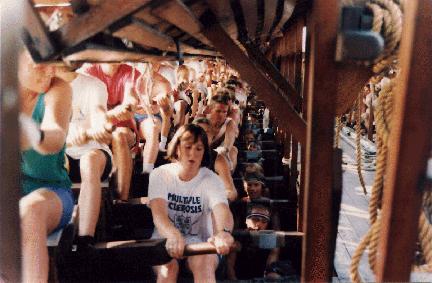
Sardines in the tin

Many people have acquired much of their knowledge of history
from Hollywood, obviously a dubious
source.  This is especially true
regarding antiquity, an area of history generally poorly known and understood,
even by many historians, and apart from the Bible (another dubious source) the
movies have been the major font of information about the ancient world for
many.  Unfortunately, more often than not
that information is wrong.

Perhaps the
most pervasive historical myth promulgated by tinsel town is that of the galley
slave, Charlton Heston chained at his oar, rowing to the beat of a drum and the
crack of a whip in a Roman galley.  This
made for great cinema in
Ben Hur
, but it is in fact complete nonsense.  Galley slaves were a feature of the Italian
and Turkish navies of the Renaissance era, but by then Mediterranean warship
architecture had changed greatly from antiquity and facilitated the use of
slaves.  The navies of Persia,
Greece, Rome and Carthage were rowed by free
men, who were paid for their efforts.

The primary
warship of the Greeks before the death of Alexander was the trireme, the
fastest significant human-powered vessel ever produced.  The trireme was tiny, more a racing scull
than a ship: 120 to 135 feet in length, 10 to 13 feet wide amidships (18 with
the outrigger) and a draught of only 3 to 4 feet.  Into this space were packed a crew of perhaps
a dozen sailors and 170 rowers, arranged in three banks in the hull.  With an underwater ram protruding from the
bows the trireme itself was the weapon, though those with less naval skill, like the Macedonians and the Romans, could use closing and boarding tactics instead of ramming. Cheap to build, the
vessel was fragile, unseaworthy, lacking in cargo space and expensive to
maintain. It was a precision instrument,
sacrificing everything for speed.

Such a
vessel can not be rowed by untrained slaves.
In the 1980s the Greeks and British built the first trireme since the Roman
Empire, the Olympias, and found that a crew of college
students (including some with sculling experience) needed to be trained for
weeks just to be able to row slowly in a straight line. With so many rowers in such a small space
coordination must be absolutely perfect or the oars, which come in three sizes
and enter the water at different angles, will be instantly fouled. To perform any maneuvers – turning sharply,
changing speeds, backing water – the crew must be very well trained, and that
training could clearly mean the difference between life and death in a
battle. And while being chained to the
ship is a great motivation to keep the ship afloat, the history of warfare has
constantly demonstrated that positive inducements are far better motivators
than fear.

Incidentally,
forget the guy pounding time with a drum.
That sort of low frequency sound is drowned out by the noise of the
oars, and the Olympias used whistles, which is what the sources
mention. In fact, forget everything
about the Ben Hur fleet. The
standard warship of the Roman Republic,
the quinquerime, was heavier, slightly broader and stood higher out of the
water, but this was still a far cry from the roomy vessel served by Judah
ben Hur. 300 rowers in three banks (some
oars had two men) filled the hull of the quinquereme, leaving room for a central
gangway but certainly none for some overseer to crack a whip. Further, during the Empire the standard vessels
were much smaller than a quinquereme, the major occupation of the imperial
fleet being pirate chasing.

Finally,
these are delicate vessels, certainly the smaller trireme. So light is the ship that a few men walking
about the deck could upset the trim enough that oars would miss the water or
strike too deeply, leading to immediate fouling. In fact, the Athenians manned the decks of
their triremes with javelineers who could throw from a seated position. The quinquereme provided a much more stable
platform for marines and even mounted ballistae (giant crossbows), but the
notion of a sea-borne catapult, as in Ben Hur, is still a stretch. Try hitting anything with a catapult mounted
on a lifeboat.

The Content of a Liberal Education

Easy read summary for administrators and legislators.

The content of a liberal education is that which teaches you to think.


            The foundation idea of a liberal
education goes back to the medieval university, which was in turn heavily
influenced by classical notions about the educated man.  The content of that education will of course
no longer do, since the early university existed in an intellectual environment
dominated by Christian theology and an uncritical acceptance of classical ideas
(at least those that did not conflict with the Church).  Both held the university in the confining
grip of truth based on unquestioned and unquestionable authority, that of the
ancients and that of the true faith.  In
addition to limiting academic freedom this fact of late medieval life created a
basic curriculum that overemphasized some subjects, such as theology, and
neglected others, such as the natural sciences.
Fortunately, the decline of the Church and the rise of modern science,
which broke the spell of the ancients, ultimately undermined the idea of
authority-based truth, and the curriculum of the modern university has expanded
into every conceivable area.

A modern liberal education has two
essential components.  The first of these
is the clutch of intellectual skills necessary for any intelligent interaction
with the world and the acquisition of further knowledge.  The most basic of these tools, the ability to
read and write, to calculate and to solve simple problems, are acquired in the
process of primary education, though the sad state of American public education
can no longer guarantee this.  A liberal
education should build on these skills and develop further the individual’s
ability to read analytically and critically and write clearly and
persuasively.  It should train him how to
examine and approach logically any sort of problem or situation and how to
argue and defend a proposition, whether in speech or in writing.  In a word, a liberal education ought to teach
one to think.  If the university did
nothing more than this, its existence would be more than justified.

The individual who can think,
analyze and communicate is equipped to continue learning on his own, but a
proper liberal education will also provide a second component: a broad basis of
general knowledge that will give the student a leg up, as it were, in his
further education.  The emphasis here is
on the broad and general, the acquisition of the information and ideas
necessary for a basic understanding of how the world, both natural and human,
works.  From this one can easily proceed
to a deeper understanding of any specific aspect of the nature of things.

A liberal education thus requires a
grounding in both the sciences and the humanities.  In the case of the sciences, the goal is not
a detailed knowledge of any particular science, but rather an understanding of
what the various sciences deal with, the important questions to which they seek
answers and the general principles upon which they operate.  More important than an expertise in any
specific scientific field is a thorough understanding of science itself,
what it is and what it is not and how it functions.  Such an understanding of science and the
fundamental principles behind our universe will allow the educated individual
to recognize and counter the pseudo-science, fantasy and general irrationality
that constantly threaten to overwhelm the human race.

A similar goal is sought in the
humanities, that is, a broad understanding of the human condition in all its
aspects.  Such an understanding requires
some exposure to and basic familiarity with history, religion, philosophy, the
political and social sciences and the arts.
Again, the point is not to acquire knowledge in depth, but rather to
gain a general understanding of these fields, particularly as tools for
understanding the individual and society and making reasoned judgments about
them.

Especially important in this regard
are history and literature, both of which provide direct access to the human
experience and thus contribute immediately to an understanding of
ourselves.  Engaging in these disciplines
will not only reveal the tremendous variety found in human society, but in
doing so will also illuminate the general human condition.  To study the Greeks or Zulus or Chinese is
simply to study ourselves from another perspective; to read the literature of Russia
or India or Brazil
is to see ourselves through different cultural eyes.

For
the American university student study of the history and literature of western
civilization ought to be the starting point for this examination of human
culture.  This western tradition
comprises the values, perspectives and methodologies that have shaped our own
society and thus has the most direct relevance to an understanding of
ourselves, who are products of that society, regardless of superficial ethnic
differences.  It is necessary to
comprehend the forces that shaped one’s own point of view before examining that
of others.  And for good or for ill
western culture and its ideas have had and will continue to have a dramatic
impact on the rest of humanity, making a study of the west a vital component of
the liberal education of every individual, irrespective of his cultural
origins.

A broad understanding of ourselves
and the world about us and the ability to think analytically and communicate
clearly, these are the goals of a liberal education.  While not filling any specific workplace
niches, a general education of this sort possesses a social utility far more
important than that of any professional training.  Common sense and the evidence of history
demonstrate that the greater the portion of the citizenry that is generally
educated, the better the society is able to solve its problems, employ its
resources and improve its material and intellectual circumstances.  Such is especially the case in a democratic
state, which regularly asks its citizens to render political judgments, and it
was the discoverers of urban-centered democracy, the Greeks, who first realized
that a general education was a basis for civic virtue, that a general education
was in fact a political education.

In the modern world of course
political education has increasingly come to mean simply political
indoctrination, which has rarely, if ever, been a benefit to any society.  A proper political education instead consists
of a general understanding of society and history and the intellectual tools to
employ that understanding in shaping the political environment.  Such is obviously not popular with
governments and politicians of any stripe, since a liberally educated society
is the most resistant to political oppression, the least likely to be taken in
by appeals to emotion rather than reason.
Democracy in particular rises and falls with the education of its
electorate, and the ignorant voter is an easy target for demagoguery and
sloganeering, for the fear mongers and feel-good politicians.  Recent American history amply demonstrates
the serious danger posed by an uneducated electorate.

A final note about a liberal
education: it is work.  While learning
can be generally interesting and often fun, it still requires discipline and
effort.  Learning demands mental
exercise, memorization and practice.
Interaction and dialogue are a vital part of education, but at its root
learning is a solitary occupation of reading, writing and most important,
thinking.