Thugs, Missiles and the Beefcake Czar

(There are currently two important events unfolding, the downing of the airliner by Russian supported thugs and the Israeli invasion of Gaza.  The first is far more important to the US, and I simply cannot think and write rationally about Gaza at this moment.  I keep thinking about the German liquidation of the Warsaw ghetto, which is an outrageous analogy, though there are some disgusting and disturbing similarities.)


While the details are still lacking because of the inability of the inspectors to enter the crash area fully, it has become clear that the plane was shot down by Russian supported Ukrainian separatists using Russian supplied equipment.  It is also clear that Russian dictator Vladimir Putin bears great responsibility for the deaths of almost three hundred innocents and is seemingly unwilling to take any action whatsoever to reign in his terrorists, who are now reported to have bragged about their crime.  (I want to say that any person anywhere found wearing a mask and carrying an assault rifle should be immediately shot, but then I would be descending to their level.)

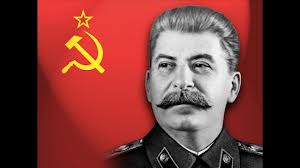
The Beefcake Czar

The Beefcake Czar


What is the problem with the Russians, who are presenting an increasingly good impersonation of an uncivilized and barbarous country that happens to possess nuclear weapons?  Why is this society so addicted to autocratic government and content to live in the nineteenth century?  With the possible exception of the Stalin era I have only a superficial knowledge of Russian history, but it is still possible to suggest some answers, some of which are probably wrong (and any Russian historian reading this will likely groan).


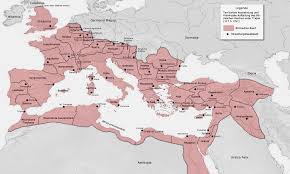
Unlike Europe, Russia inherited virtually nothing from classical antiquity but the eastern version of Christianity, and their model civilization was the Byzantine Empire, a thoroughly autocratic society in which church and state were completely fused.  The post-classical West on the other hand began its evolution with a church that for all its later efforts to dominate secular rulers was distinctly separate, having developed its own governing structure parallel to that of the Roman Empire.  That structure also provided barbarian Europe with some measure of administrative competency, which was completely absent from the infant Russian state. Europe also inherited a sizable body of literature and art produced by a high civilization, and the remains of the Empire included a long-lasting network of roads and other useful infrastructure.


Further, the Roman Empire had laid the foundation of a common European culture, which was not significantly disturbed by outside forces, and Europe’s wars were mostly among European societies.  The Norsemen could be absorbed, and the Arabs could be repulsed.  Earlier Russian history is characterized by constant assault and domination by steppe barbarians, inimical to settled and urban society and not easily repulsed.  Warfare in feudal Europe revolved around horsemen, but they were only the elite component of armies, and the evolving weaponry of infantry helped drive innovation and societies sophisticated enough to produce the necessary new military technologies.  There were foot soldiers in the east, but the armies were overwhelmingly mounted, and the technology of mounted warfare had been pretty much perfected.  And who can live centuries in the shadow of the Mongols and not be brutalized to some degree?

Russian role model

Russian role model

In the West feudalism helped limit the power of the monarch and produce some tradition of resistance, and although absolutist kings appear in the early modern period, that tradition spurred the emergence of deliberative bodies that could and in some places did prevent and undermine the absolute authority of the king.  In Kievan Rus’, Muscovy and other states that ultimately became Russia the boyar was a sort of parallel to the medieval knight and they might form a deliberative body, a Duma, but their power gradually eroded in the face of the growing authority of the Czar.  Why this happens is not clear to me, but the result is that by the modern period the Czar is the absolute, unchallengeable ruler, his authority, like that of the Byzantine emperor, derived from god.  In the West the growth of trade and industry produced a third powerful player and a challenge to the existing power centers of church and state, while in Russia commerce remained subservient to the authority of the church-supported state, perhaps because the absolutism of the Czar was already so advanced.


Russian culture seems also to support a xenophobia more deeply rooted than in the west, perhaps because of the absence of the classical influences embodied in the literature of Europe and perhaps because of the constant assaults from the steppe.  Whatever the cause, this made modern Russia suspicious and hostile to the ideas and innovations coming from western Europe, and despite a Peter or a Catherine Russia lagged in its development, retaining a rural population that essentially remained in the conditions of the early middle ages.


And when Russia finally began to see some change in the late nineteenth and early twentieth centuries, the cataclysm of World War I and the incredibly bizarre, virtually chance triumph of the Bolsheviks doomed the country to another three-quarters of a century of an absolutism that put the Czars to shame.  By the time the Soviet state collapsed the complete absence of any developed institutions or tradition of democratic rule led the state to its present more or less absolute ruler, Vladimir Putin, the Beefcake Czar, who unsurprisingly emerged from the security apparatus of the previous regime.  Well, he is certainly the most buff man to ever rule Russia.


Putin role model

Putin role model

Putin role model

Putin role model

Who knows what the fate of Russia will be?  Putin plays to the broad masses, who seem to yearn for another Stalin, and caters to their crude nationalism and traditional phobias, and this has a price.  The educated and highly skilled are fleeing to the West, and the corruption, malfeasance and capriciousness inherent in his rule discourages increasingly necessary foreign investment.  The country survives on the selling off of its immense natural resources, a sign of the economic primitivism associated with developing countries. Meanwhile he squanders badly needed resources on patriotic cosmetic projects like the Winter Olympics and the upcoming World Cup.  And if Europe is dependent on Russian gas, Russia is increasingly dependent on Chinese markets.


Russia is also becoming a pariah because of its illiberal policies and creeping expansionism, and Putin has now grandly exacerbated this development with the barbaric act of his Ukrainian/Russian thugs and his refusal thus far to do anything about it.  He is playing the same laughable propaganda game the Soviet rulers did, and the entire world is perfectly well aware of his complicity in the destruction of the Malaysian airliner. The guy is a thug, a clever one, but a thug nevertheless.

Men with small johnsons

Men with small johnsons


What to do now?  Obama has begun attacking Russian assets in foreign countries and moving towards excluding Russia from the financial mechanisms of the global economy, which would be a disastrous blow.  I would suggest even more immediate pressures, recalling the American ambassador and giving Putin, say, forty-eight hours to deal with the terrorists and open up the crash site or face a ban on Russian air traffic to the US and whatever European countries that can be persuaded to follow.  I might even threaten to prohibit American carriers from flying into Russia, but this is extremely unlikely, since one then runs up against corporate interests, which would certainly be loath to surrender profits simply because an airliner was shot out of the sky.  Already the Europeans and the all-important Germans are dragging their feet because of the natural gas issue and business interests with the Russians.


Well, it is all disgusting and harkens back to the less attractive aspects of the last century, but it sure makes for interesting news.

Stuff from Way Back #27: Achilles and Aeneas, Alike and Unlike

he Greeks and Romans are, at least since the Renaissance, inevitably associated with one another and clearly differentiated from the Near Eastern societies that preceded them and the barbarian societies that succeeded the collapse of the Roman Empire. They constitute Classical history/antiquity/society, their architecture, arts and languages are Classical and their literature constitutes the Classics; the two millennia of urban civilization before them are pre-Classical. And in many ways Roman civilization appears to be simply Greek society translated into Latin. The two societies do indeed constitute a recognizable and unique period of history, easily distinguished from what came before and what came after, yet the two peoples were very different in character, which accounts for the obvious differences in their histories. The Greeks were the Beatles of antiquity, dabbling in everything and pumping their genius into almost every aspect of culture and politics; the Romans were the Rolling Stones, incredibly good at one thing, the hard-driving rock and blues of the maintenance and expansion of power.

Romans

Romans

Greeks

Greeks

Originally barbarian cousins in the extensive Indo-European migrations of the second millennium, both peoples began with roughly the same social and political institutions, common, it seems, to all the Indo-Europeans, at least while they are still on the move. Most critically, this included a weak kinship and the tradition of an informal assembly of warriors that heard and advised the king and was theoretically the source of his authority, an idea radically different from the sophisticated kingships of Egypt and Asia, which derived their authority from heaven. The Greeks and Latins would be the only groups that developed agriculturally based urban societies without losing these core political institutions characteristic of their hunting and gathering past and would consequently be the only ones to evolve actual constitutional polities in which the power exercised by the state was considered to derived from the people, at least in theory.
This accounts for the remarkably parallel political development of the Greek and Latin city-states from petty tribal kingships to sophisticated democratic republics. The driving engines behind this were the changing economic environment, as growing wealth produced new economic elites that challenged the traditional arrangements, and the emergence of the citizen army, which gave increasing reality to the old notion that the people were at the root of political power. Thus the Latin and Greek proto-cities eliminated their kings and established the basic mechanisms of the constitutional state: precisely defined law, citizen assemblies and elective limited term magistracies. With as many as a thousand independent city-states the Greeks had a larger social laboratory and produced in some cases the most complete democracies the world has ever seen, whereas in Italy the dominance of Rome over the other Latin towns resulted in a single powerful city-state, Rome.
But there were differences, some of them profound. The Greek kingship apparently withered away over a period of centuries during the Greek Dark Age, while the Romans clearly overthrew their last king in historic times. The Greek transition from aristocracies of birth to oligarchies of wealth took a generation or two (the Age of Tyrants) and in many cases involved violence, whereas in Rome the transition required two centuries (the Struggle of the Orders) and was remarkably free of political violence. The Greeks produced radical democracies, but Rome, though technically democratic, never went beyond an oligarchy of wealth. The Greeks excelled in the arts and affairs of the mind; the Romans were great administrators and engineers. Despite a common language and culture the Greeks remained fragmented, and the empires of the fifth and fourth centuries were short-lived; even the huge Macedonian controlled empires of Alexander and his successors were relatively fragile. The Romans of course steadily expanded their power, conquering Italy and the Mediterranean world over a period of little more than three centuries and establishing an immense empire that would endure for almost another five hundred years. This power thing in particular baffled the Greeks, who could not understand why the Romans, who began with the same political, social and military equipment as themselves, could so easily become the stable imperial power that always eluded them. And being almost effortlessly conquered by a people they considered in so many ways intellectually inferior did not help.
Greek thinkers, like the historian Polybius, had trouble seeing beyond the institutions that made the two societies appear so similar. What apparently escaped them, at least in trying to understand Roman history, was something relatively simple: national character. The most important facet of the Greek character, affecting everything they engaged in, was agōn, the need to compete and struggle, which consequently enhanced the importance of both the individual and his city. The Greeks were most definitely not team players. The Romans were. Their prime character directive was pietas, duty, the compulsion to fulfill ones obligations to the family, the gods and the community, which ultimately meant the state. They were incredibly conservative, which slowed their evolution, but at the same time they were also eminently practical, which saved them from that conservatism. While the Greeks theorized, the Romans just did it – and did it differently if the traditional way no longer worked.


Consider the national heroes of the two cultures. For the Greeks it was the Homeric warriors, especially Achilles, extreme and narcissistic individuals who ultimately cared for only one thing – themselves. For them the major importance of the group was simply defining their individual honor, in defense of which they would gladly sacrifice their lives. The Roman heroes, on the other hand, were all men whose defining quality was the willingness to sacrifice for the group. Aeneas, the premier Roman hero, abandons Dido and the kingship of Carthage in order to fulfill his destiny as the ultimate founder of Rome. At great cost to himself he honors his duty to a state that will not even exist for another four hundred years.  Incidentally, Aeneas, though technically a Trojan, is a figure out of Greek literature, a Greek creation, yet the Romans  came to believe that he was the ultimate founder of Rome.
Why these character differences? It probably had much to do with their respective environments. The Balkan Peninsula, especially in the south, is a land of limited resources, notably arable land, and scarcity inevitably encourages competition. In contrast Italy possesses a great deal of good farmland, and Latium, the coastal area where Rome is situated, is particularly bountiful. This is not to say that the early Romans were devoid of any competitive spirit, but rather that survival in the relative economy of scarcity that was Greece instilled in the Greek psyche a far larger measure of competitiveness and aggressiveness. This is hardly a completely satisfactory explanation, but then, I am not a cultural anthropologist.
The Greeks competed in everything (even sex was seen as a kind of competition), which goes a long way in explaining their history and society. They competed in athletics, music and drama; trierarchs competed in equipping the fastest trireme. The incredible cultural explosion of the sixth and fifth centuries clearly has its roots in agōn; societies that are comfortable simply have less motivation to ask questions, to think new thoughts, to create new things. Archaic and Classical Age Greece (8th – 4th centuries) was, like the Renaissance, filled with struggle, and the result was the perhaps the most important intellectual discoveries in history. By way of contrast Old and Middle Kingdom Egypt (27th – 18th centuries) was the most materially and spiritually comfortable society in antiquity, and in the course of a millennium virtually not a single new idea was produced.

Roman genius

Roman genius

Greek genius

Greek genius

But the drive to compete had a down side. City-state governments were very unstable, and political violence was always just outside the door. More devastating of course was the seemingly endless warfare, as each city competed with its neighbors, not just for resources but also status. The city-state was a narcissistic entity, a polity with attitude, and warfare was the ultimate expression of superiority – at least if you won. So deeply ingrained by constant competition was the idea of autonomy that inter-city structures were inevitably based on force or the threat of force, as with the Athenian Empire or the Peloponnesian League, and unity eluded the Greeks until it was imposed from without. Common efforts, such as the defense against the Persian Empire, were extremely difficult, and Greece’s ultimate downfall emerged from her inability to cooperate for the common Hellenic good. It was left to the Macedonians monarchy, the most backward of Greek states, to dominate the Balkan Peninsula and conquer Persia.
The Romans of course also enjoyed a powerful sense of superiority – what successful culture does not – but it was not so all-consuming as with the individual Greek cities. In establishing control over the other Latin towns Rome was able to some extent to share authority and even her citizenship, something unthinkable for the Greeks. Roman arrogance took a back seat to practicality in dealing with defeated non-Latin peoples in Italy, and the Romans were able to create alliance structures that left them stronger and in complete control but offered sufficient mutual benefit to provide for long-term stability. The so-called Italian allies were thoroughly subordinate to Rome yet came to regard themselves as actual allies and ultimately as Romans, thus providing the manpower base that would allow the conquest of the Mediterranean world.

Roman genius

Roman genius

Greek genius

Greek genius

The Roman saw the world around him as a network of obligations, and honor was rooted in fulfilling those obligations. This makes for a very well-knit community, and the political factionalism that plagued the Greeks remained well leashed until the last century of the Republic. The Roman was inclined to accept rather than challenge authority, at least if he considered it legitimate, and as a result, the Senatorial elite smoothly governed Rome for four hundred years, even though for most of that period the Senate possessed no actual constitutional powers but was simply an advisory body. Once again, unthinkable for the Greeks. The system only broke down when the Senate was corrupted by power and wealth, and serving oneself edged out serving the state.
Ironically, but not surprisingly, both peoples initially considered the other barbarians. The Greeks clung to this notion well into their role as provincials in the Roman Empire, an idea perhaps sustained in the face of overwhelming Roman success by the fact that the new masters were so clearly impressed by the Greek cultural achievement. The Romans could hardly deny that achievement, as they learned Greek, imitated Greek arts and looted the statuary of the Hellenic world. So, the Greeks were not barbarians, like the Gauls and Germans; they were just effete.

 
The Hellenizing of Rome began long before Roman legionaries were traipsing about the Balkan Peninsula, and “captive Greece” captured Rome centuries before it actually became captive. The Greek Age of Colonization (late 8th – 6th centuries) saw Sicily and the coastal areas of southern Italy so thickly settled with Greek cities that the area became known as Great Greece, and young Rome could hardly resist the influence. Cumae, the northernmost and possibly earliest Greek establishment in Italy, was barely a hundred miles southeast of Rome, and the tendrils of Hellenism were already caressing the city on the Tiber while it was still being rules by kings. Roman culture was not quite a blank slate, but a couple of centuries behind the Greeks in their development, the Romans were simply overwhelmed.

Greek genius

Greek genius

Roman genius

Roman genius

The Latin alphabet is derived from the Greek, and the more defined and sophisticated Greek gods had such an impact that native Italic deities gradually disappeared, supplanted by the Greek pantheon with Latin names. Greek literature was so far advanced that the earliest examples of serious Latin literature are written in Greek. The Romans copied the hoplite phalanx, the more efficient heavy infantry formation invented by the Greeks, though characteristically, when it ran into trouble operating in the central highlands, they seriously modified it, copying weapons used by their opponents. Greek heavy infantry ended in the dead end of the Macedonian phalanx, while the Roman version grew into the legions.
In a very real sense Rome’s major legacy was preserving virtually intact the Greek achievement. The Greeks simply could not create stable long-term imperial structures, and while the discoveries of the Greeks would not have simply vanished without the Roman Empire, they would have suffered. Hellenized at such an early stage, Rome and her empire embraced Greek culture, and the extent and incredible duration of that empire insured that the grand ideas of the Greeks would be fixed at the heart of European civilization.

Stuff from Way Back #25: Athens in Vietnam

(This is a fairly long piece about a war most people have never heard of, but there is a wonderful lesson of history here.  For more on the sophists see Stuff from Way Back #20.  The dates are BC.)


“Now we can see it clearly – like the light at the end of a tunnel.”

General Henri Navarre

commander of the French forces at Dien Bien Phu

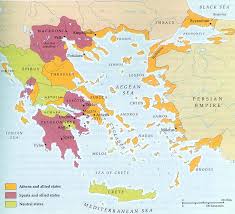
History can often be hauntingly familiar, even across the 2500 year divide that separates classical Athens from America in the second half of the twentieth century.  A case in point is the catastrophic Peloponnesian War (431-404) between the Athenian Empire and the Spartan controlled Peloponnesian League, a conflict that to a great extent ruined the Greek world.


The Athenian Empire was naval based, taking in virtually all the island and coastal city-states of the Aegean, and constituted a wealthy trading block.  Though progressive and inclined to support democratic governments, Athens nevertheless maintained tight control over her “allies,” taxing them to pay for her powerful fleet (and the beautiful buildings upon the Acropolis).  Encompassing most of the rest of the Greek states, the so-called Peloponnesian League was land based and included most of the Peloponnesus and central Greece.  It was dominated, but not absolutely controlled by Sparta, which supplied the semi-professional core of the huge army, some 35,000 heavy infantry, that the League could field.  Sparta was the most reactionary state in Greece, and her small citizen body of perhaps 8000 was supported by an immense number of unfree serfs (helots).  Semi-socialist and nominally democratic, Spartan society was essentially authoritarian, and she favored oligarchic governments.
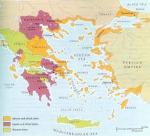
A divided Greece

A divided Greece

Athens began the war with immense advantages.  Her control of the sea was virtually absolute, which meant that the enemy was going to have a hell of time just getting at her and her allies.  The completion of the long walls linking the city with the port of Piraeus had turned Athens into a kind of artificial island, rendering her immune to the traditional strategy of laying waste the enemy’s territory and forcing them to come out and fight.  Offensively, the navy provided the Athenians with a big edge in rapid troop deployment and threatened the Peloponnesians with surprise raids on their coastal areas.  Athens also had unprecedented economic resources from her imperial income and her trade and went into the conflict with something unheard of in Greece: a  financial  reserve.  And finally there was the open and democratic nature of Athenian society, which had already made her preeminent in human resources, out-producing other cities in leadership, talent and imagination.


The Peloponnesians had but a single advantage over the Athenians – they were overwhelmingly powerful on land.  In every other respect they were hurting.  Any fleet they might scrape together would be dramatically outnumbered and out-rowed (the main pool of skilled rowers was within the Athenian empire), and the alliance was financially unprepared to launch and maintain many more ships.  And under the leadership of the Spartans, who did not even use coined money, that financial picture was not likely to change in the near future.  A further big disadvantage for the Peloponnesians: Spartan leadership.  A system geared to the status quo and limited mental horizons only rarely produces leaders of more than plodding ability, and Sparta’s traditional insularity and policy-bending paranoia about the helots might also be expected to hamper the war effort.  But blinding many to these serious weaknesses was the centuries old Spartan reputation as the alpha male of Greece, and there was widespread belief that ships and money and newfangled ideas would not save Athens from the juggernaut of the Spartan led Peloponnesian levy.


Pericles, the Athenian leader, knew better, and he intended to fight a new kind of war, one for which only Athens was in any way prepared – a war of attrition.  He was concerned simply with the preservation of Athenian interests, not the utter defeat of Sparta, which meant that Athens could achieve her victory by remaining on the defensive.  This he proposed to do by evacuating the population to the Athens-Piraeus fortress and temporarily abandoning Attica, the territory controlled by the city, whenever the Peloponnesians invaded.  Supplied from the sea, Athens could theoretically hold out indefinitely, while the fleet conducted raids on the enemy coasts to remind them of the price of war.  Pericles figured that after a few years of spending their summers in Attica and accomplishing nothing most of the Peloponnesians would lose whatever little interest they had in the first place, and the war would fizzle to an end.

Pericles aka "Old Squill Head"

Pericles aka “Old Squill Head”

Would the plan have worked?  Probably.  In the first several years of the war the Peloponnesian levy ravaged Attica and absolutely nothing happened.  Meanwhile, the Athenian fleet conducted hit and run operations against the coastal towns of the Peloponnesus, and it is hard to see how Sparta could sustain interest, especially among her already unenthusiastic allies, in a war that was making no real headway and bringing Athenian raids down on their territory.  Athens had even survived the devastating “plague” of 430 (probably epidemic typhus or cholera), which had carried off as much as a quarter of the city’s population.


But we will never know, because in 429 Pericles died from the contagion, and without his restraining hand Athens’ strength, her democracy, gradually became her downfall.  The cautious defensive strategy steadily evolved into an offensive one, and the goal of the war became the defeat of Sparta and the expansion of the empire.  This would have been dangerous enough, but the democracy itself began to undermine the war effort.  The traditional political leadership had been provided by the annually elected board of ten “generals,” so called because they were the men who actually led Athenian forces if needed; Pericles had been reelected to the board for thirty years.  The war now produced a new kind of politician, the demagogues, men of mostly limited abilities who wielded power not by holding office but by manipulating the citizen assembly, which in the unlimited democracy of Athens was the ultimate seat of power and could not be challenged.  They rode to  power on their rhetorical abilities and by advocating a war of conquest.  This led to a growing number of bad decisions and ill-considered strategies and created threatening divisions in Athenian society, as the increasingly radical democracy struggled to manage a people becoming intoxicated with their own power.


The first phase of the conflict, from 431 to 421, saw a steady departure from Pericles’ defensive strategy after his death.  In 425 the Athenians almost accidentally captured a unit of Spartans, which lead to peace overtures from Sparta, but the Athenians went on a roll and launched a land campaign in central Greece, a complete reversal of Pericles’ policy.  It was a disastrous failure and was followed by the loss of Amphipolis, an utterly vital city on the north Aegean shore.  Athens was ready for peace.


The Peace of Nicias, signed in 421, had about as much chance of success as the Munich agreement of AD 1938, and in 418 an Athenian supported coalition in the Peloponnesus was defeated by Sparta.  Meanwhile, a war-weary Athens was becoming more and more divided.  The older generation in particular was getting fed up, while the younger was increasingly enthusiastic for more military adventures.  The hawks got the upper hand, and in 415 a huge force was sent to Sicily to attack Syracuse and seize the entire island, an act of incredible imperial hubris.  Primarily because of divided leadership, a result of the political situation at home, the expedition failed, and in 413 it and a large relief force were essentially annihilated.  The Spartans decided to reopen the war and invaded Attica that same year, beginning the second phase of the war, from 413 to 404.


All hell broke loose for Athens.  In 412 her allies began revolting in droves, and even worse, Sparta signed an alliance with the Persia Empire, which meant money for a Peloponnesian fleet, which meant in turn a spread of the revolt and a threat to the security of Athens itself.  Back home extremist conservatives launched a coup in 411, setting up a narrow oligarchy of 400 and driving the Athenians to the brink of a civil war.  Athens was now at war with virtually everyone in the Greek world, including herself, but the people were not about to give in.  The democracy was restored in 410, and by 407 the Athenian position in the Aegean had been almost fully restored.  But the Athenians seemed bent on self-destruction, and in the next several years they turned down several peace offers from Sparta.  In 405 they lost their last fleet and were forced to surrender in 404, losing all their possessions, their walls and even their democratic government.


The Athenian democracy had failed.  Despite an immense superiority in resources and talent Athens had found herself unable to put an end to the war and after twenty-seven years of struggle had lost everything.  How could this happen?  For Thucydides, the Athenian historian of the war, the answer is clear.  The way of life fostered by the democracy was a source of powerful forces, but it took a capable leader to control and direct these forces, to restrain the people and channel their energies towards realistic ends.  Pericles was of course this kind of leader, able and patriotic, and Athens’ misfortune was that after his death the democracy found no one who combined these two qualities.  The prosecution of the war, the foreign policy of the state became more and more a reflection of internal politics, as Athens became the prey of the demagogues.  Time and again the Athenians passed up opportunities to end the conflict as winners in order to try instead for a vastly greater victory.  And time and again these attempts to grasp more were ruined not by the strength of the enemy, but by the Athenians themselves, as the political feuding created dangerous cracks in the democracy.  This domestic disunity was bad enough, leading ultimately to oligarchic revolution, but the cracks also showed themselves in the conduct of the war, in divided leadership of campaigns, inadequate support of expeditions and sudden reversals of policy.

Thucydides

Thucydides

I am inclined to agree with Thucydides.  Athens in the second half of the fifth century was simply under too much stress and faced with too many temptations to survive without the restraining hand of a leader like Pericles.  And it was clearly a question only of guidance, for the democracy – the common people who voted every important policy decision – constantly showed itself to be perhaps the most aware and able body politic in history.  It was after all Athens that lost the war, not Sparta that won it.  Their own worst enemy, the Athenians bounced back again and again after each new disaster, revealing the nature of the human resources shaped by a democratic society.   The Athenians and their experiences in the Peloponnesian War are a powerful testament to both the weaknesses and strengths of democratic government.


While suffering the political difficulties, the Athenian democracy also underwent during the war a moral crisis, which was both cause and result of the political trials.  This was the period when the radical sophists, extremist political thinkers, were attacking the democracy and its egalitarian notions.  Instead of the people they would see as rulers those who were by nature suited to rule – the “superior men” – and in place of the democracy they would have a narrow oligarchy.  Well, after the disasters of the latter part of the war people began to listen to these characters.  Reasonable and moderate men were losing faith in the democracy and becoming more attentive to these characters at the other end of the political spectrum.  Germany in the twenties and thirties saw a similar development, as moderate middle class Germans reacted to the perceived failures of the Weimar government and the threat from the left by paying greater heed to the far right.


The ideas of these sophists on the nature of justice – that might made right – fit perfectly with the growing will to power and empire among the Athenians.  As the war continued the means slowly became the end for the Athenian people, as demagogic factionalism and the temptations of power combined to drive them to extremes.  Pericles’ simple defense of the empire was forgotten, and victory gradually became instead the grasping of more, the expansion of power and the total defeat of Sparta.  Rather than what they might bring, success and power themselves became the real goal of the Athenians.  At the same time the continuation of the war produced among the Athenians a growing sense of frustration because of their seeming inability to bring it to an end.  When they were losing, the quality and strength of their national character compelled them to fight their way back, and when they were winning, that same character seduced them into reaching for more.  Athens had the power and the resources to carry on the war, even after a disaster like Sicily, but she could not stop it.  And this frustration further aggravated the problem, driving the Athenian people to seek even more urgently that light at the end of the tunnel, that final victory that would solve all their problems.  It might be fair to label the response of Athens to this frustration, her continued and amplified operations of war, as acts of collective hysteria.  This is the tragedy of a people being destroyed by their own greatness.


All of these things – the political turmoil, the frustrations, the national hysteria – were accompanied, perhaps inevitably, by a steady moral disintegration.  As the war dragged on there was a growing loss of respect for authority and the moral traditions of the community, indications of a loss of faith in the society as a whole.  The war certainly contributed to this moral breakdown, especially through the psychic conditions – the uncertainties, the alternating hopes and fears, the frustrations – it imposed on the Athenians, but the far more important cause was sophism.  Part of the impact of sophistic skepticism was the general erosion of accepted tradition and its authority.  If, as the sophists said, man-made law is all relative anyway, why necessarily accept that of your fathers?  Their values and standards of behavior may not be pertinent to your situation, and perhaps you should look instead to your own definitions.  This of course can be mighty dangerous for the social fabric.


Finally, there is an aspect of the Athenian moral crisis that should be familiar to late twentieth century America – the development of something like a generation gap.  Athenian society during the Peloponnesian War gave rise to what appears to be the first serious challenge of one generation by another in history.  As with America in the sixties it was precisely the young, primarily young aristocrats, who were the focal point of the moral crisis in Athens, although their reaction was hardly one of protesting the war and using controlled substances.  In fact it was generally the younger generation who were in favor of greater imperialist adventures.  But Athenian youth of the period of the Peloponnesian War were like many young Americans of the Vietnam era in that the morality of their fathers, the inherited ethos of the society, was not necessarily valid for them.  The extent of this challenge should not be exaggerated, being apparently essentially limited to aristocratic youth, but it did exist.


A generation gap had never occurred before this for the simple reason that only now had the ascendancy of the state and the individual so undermined the strength of the family that the ties binding one generation to the next had been loosened.  With the stage thus set by the general social development of the Greek state conditions particular to Athens then prompted the generational challenge.  First of all there was the democracy, which itself involved a certain rejection of tradition.  The egalitarianism that was fundamental to democratic society eroded the authority of parents, of the previous generation, by stressing the importance of the individual and the equality of all.  As an eighteen year old Athenian male, you are a full political person, with a vote in the assembly equal to that of your father, and in the assembly you might even become more influential than he.  So why should you then obey him when the two of you differ back at home?  Political freedom is not conducive to the passive acceptance of traditional authority.


Nor is an emphasis on reason, which only naturally tends to devalue authority based on tradition, and the growing respect for reason in fifth century Athens was causing many to question and sometimes reject traditional values.  The focus of this was of course the sophists, whose rationalism was especially zeroed in on an attack on tradition.  It was not just their hostility to tradition, but also the simple fact that they existed, breaking the monopoly parents had held in the education of the younger generation.  It is hardly surprising that the Baby Boom generation that was the first to seriously challenge traditional American values was also the first to go to college in massive numbers.  Reason and doubt are deadly to knowledge based only on faith and acceptance.


The final factor contributing to this generational phenomenon was the social and political failure of the democracy during the war and the loss of faith in the established order that it incurred.  We need only to look five decades into our own past to see the effect of such a failure on the young of society.


(An additional note: included in the ranks of the neocons, who played an instrumental role in leading the United States into its pointless and costly war with Iraq, are at least two classical historians, and it is said that Thucydides’ history of the Peloponnesian War is a sort of bible for them.  Apparently they neglected to read the chapters on the Sicilian expedition.)

JFK and another lost poem of Lord Byron

It was fifty years ago this week that President John F. Kennedy was assassinated, and this anniversary has naturally spawned a host of articles and television programs on the Kennedy administration, many gushing about lost Camelot.  America was the shining city on the hill, filled with hope and a beacon to peoples everywhere, and then an assassin’s bullet ushered in a time of despair, the age of Vietnam, social upheaval, violence, burning cities and rampant cynicism.  The golden age of America had abruptly ended when it had hardly begun.

Kennedy’s administration does seem a watershed, and indeed, a national feeling of pride and hope did give way to seemingly endless troubles.  But this is of course not only too simplistic (being Black in the forties and fifties would hardly fill one with hope), but also to a great extent Camelot was a sham.  Only after his death was the metaphor of Camelot applied to JFK’s brief time in office – by his widow.  A half century later historians have exposed the reality of the Kennedy administration, but Camelot has nevertheless become a compelling American myth, evoked by the likes of Clinton and Obama.

President Kennedy

President Kennedy

The two beautiful people, Arthur and Guinevere, with their equally beautiful children bringing a new sense of culture and class to the White House, especially in the wake of the far less colorful Eisenhower, this was the image.  They listened to string quartets rather than pop, and Jackie was the paragon of style, once again especially when compared with the former First Lady.  This was not just the First Family, but the family every American dreamed of being.

The First Lady

The First Lady

In reality Jackie was more often found shopping than enjoying Beethoven and five years after Jack’s death married one of the richest men on the planet, better to serve that retail habit.  Her husband, meanwhile, was screwing every upscale woman he could get his presidential hands on, enjoying a freedom from media attention that Clinton must have envied.  His bad back was famously known and evoked sympathy, but few seemed to understand this meant he was constantly pumped up on painkillers, even when making critical decisions, such as going to war the USSR.  He appointed his brother Attorney General, a questionable act in itself, and ordered surveillance and wire-taps on any number of politicians, businessmen and journalists.  For all his grand rhetoric about equality he only took action in the South when increasing violence made the problem impossible to ignore.

He has a noteworthy achievement, the Nuclear Test Ban Treaty, and the Peace Corps was a wonderful idea.  He may have been a calming influence during the Bay of Pigs crisis, but he could have derailed the whole stupid affair from the start.  The pledge to go to the moon was stirring, but given the state of technology at the time, it was as hollow as Bush’s pledge to go to Mars, though Kennedy may have actually believed in what he said.  And like Ronald Regan, he made America feel good.

No, Kennedy’s real legacy was becoming a martyr and a myth, an object of veneration.  Beyond that he was an insignificant President.

But what if he had lived?  No Vietnam, no violence in the streets, no counter-culture and a better America?  Hardly.  He fell for the domino theory, and Eisenhower’s 600 American advisors became 17,000 troops.  And Johnson inherited Kennedy’s advisors, the “best and brightest,” who would play him like a violin when it came to increasing the American presence in Vietnam.  More important, there is absolutely no reason to believe that Kennedy could have been anywhere near as successful as LBJ in getting civil rights legislation through the Congress.

Getting shot made JFK, at least for a while, one of the greatest Presidents, and it has been suggested that the same happened to Lincoln.  What nonsense.  Lincoln dealt with the greatest crisis facing America since the Revolution, ended slavery and enfranchised Blacks.  Ironically, this week is also the 150th anniversary of the Gettysburg Address, words that have achieved a statue second only to the preamble of the Declaration of Independence.  This is why no one remembers Garfield and McKinley.  Lincoln was great; Kennedy looked great.

A final thought.  The people around JFK would refer to excellent weather as “Kennedy weather.”  Well, in the Second Reich they called it “Kaiser weather” and in the Third Reich “Führer weather.”

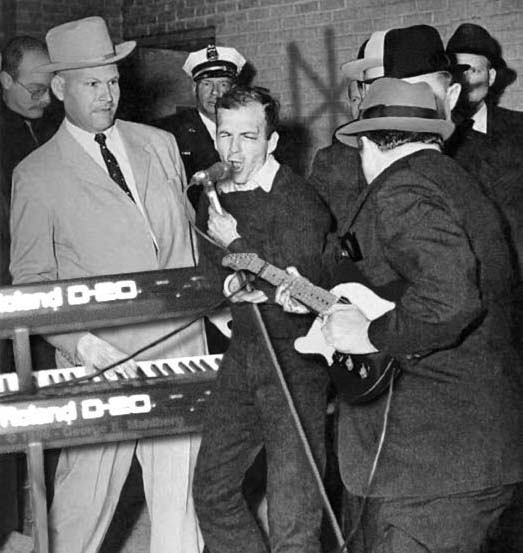
The last performance of the Lee Harvey Oswald Band

The last performance of the Lee Harvey Oswald Band

The Destruction of Kennedy

Lord Byron

The assassin came down like the wolf on the fold,

With his Carcano all loaded and ready to hold;

And the hate in his heart burned deadly and hot,

As he stationed himself for the ultimate shot. 

Like the leaves of the forest when summer is green,

The car with his target was suddenly seen:

Like the leaves of the forest when fall turns them red,

The man from the White House would so soon be dead.

For the Agent of Death  braced his gun on the sill,

And looked in the face of the man he would kill;

And the rifle spat fire, one shot then two,

And the life of a President is just about through.

And there lay the victim, America’s pride,

While the eyes of his agents, they looked far and wide,

But too late to stop now the bark of the gun,

And thus in an instant was Camelot done.

And the cameras were rolling, the images bleak,

And the hope of the nation was no more to speak;

And the crowds were all silent, the cheers gone away,

And shocked were the people in Dallas that day.

 And the lovers of John Boy are loud in their wail,

And there stands the widow, all bloody and pale;

And the man from Hyannis, by destiny called,

Hath melted like snow in the glance of Oswald.

Stuff from Way Back # 21: Antony, Cleopatra and Who?

tony and Cleopatra are perhaps the most famous romantic couple in history, thanks to Augustan propaganda, Shakespeare and Hollywood, and consequently the actual people and their lives have been seriously distorted.  At the same time, Octavian, the winner of the civil war and first emperor, who was in fact far more important to history than the happy couple, has been relegated to relative obscurity and a distinctly unromantic role.  Richard Burton and Elizabeth Taylor played Antony and Cleopatra; Octavian was portrayed by Roddy McDowall.

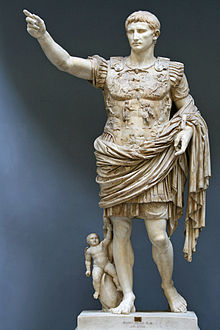
Octavian/Augustus

Octavian/Augustus

Marc Antony

Marc Antony

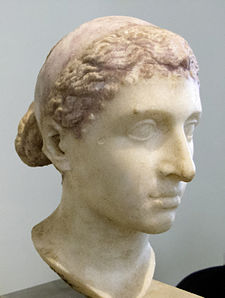
Cleopatra VII

Cleopatra VII

Marcus Antonius was born into as noble family, most likely in 83, (all dates are BC) and was said to have spent his youth in dissipation.  He grew up in the later stages of the Roman Revolution (133-30), the hundred year descent of the Republic into political instability and ultimately civil war.  In 54 he joined the military staff of one of the major contenders for sole power, his mother’s cousin Gaius Julius Caesar (100-44), and quickly demonstrated his military talents during the course of the Gallic wars.  The two men became fast friends, and Caesar supported Antony in his political career, the younger man becoming the proconsul’s right hand man in Rome.  In 49 Caesar crossed the Rubicon River, initiating a civil war between him and Pompey the Great (106-48), who was defeated in 48 and fled to Egypt, where he was assassinated by an officer of the boy king Ptolemy XIII (62-47).

Pursuing Pompey, Caesar arrived in Alexandria and supported Cleopatra VII (69-30) in the civil war between her and her younger brother.  Ptolemy was killed, and Caesar installed Cleopatra as co-ruler with another brother, Ptolemy XIV (60-44).  He dallied a while with the queen and had an illegitimate son, Caesarion.  He then went off to defeat the remaining Pompeian forces and return to Rome, where he was joined by Cleopatra, Ptolemy and Caesarion in 46.  Two years later Caesar fell to the knives of the assassins, and Cleopatra, who was not popular with the Roman crowd, returned to Egypt, where she killed Ptolemy and made Caesarion her co-ruler.

Meanwhile, back in Rome Antony was primed to step into Caesar’s sandals, rousing the mob against the conspirators, who ultimately fled to Greece and began raising an army.  Unfortunately for Antony, Caesar had in his will posthumously adopted as his son his closest legitimate male heir, his grandnephew Octavian, to whom he left his considerable personal fortune.  But Octavian was only eighteen, in Greece and completely unknown to the Roman public, and Antony began spending the inheritance and public funds to raise troops.  Octavian was dismissed as the “boy,” about whom Cicero said “the boy is to be praised, to be honored, to be set aside.”  But the boy had two assets: he had a political talent completely unmatched by his opponents and he had the name of Caesar, something with which he could conjure.  Very quickly Caesarian legions and veterans were flocking to his side, to Gaius Julius Caesar Octavianus, the son of the soon to be deified Caesar.  He was not to be set aside.

the boy

the boy

the chick magnet

the chick magnet

For the moment Antony and Octavian needed each other, and in 43 the Second Triumvirate was formed with another of Caesar’s officers, Marcus Aemilius Lepidus.  Lepidus was, however, a lightweight, and he would be retired by Octavian in 36, when he tried to assert his independence.  Essentially, Octavian ruled over the western half of the Empire, while Antony went off to the wealthier, though now drained, east to launch an invasion of Parthia, the kingdom currently occupying Mesopotamia and Persia.  He was looking for glory, money and most important, a veteran and loyal army to use in the inevitable showdown with Octavian.  All Octavian got was an Italy that was financially exhausted and in social turmoil and a surviving son of Pompey who seized Sicily and threatened Rome with starvation.  On the other hand, though Gaul had been assigned to Antony, he had the immediate access the legions stationed there, and he surely realized that for all its current problems Italy was the key in the struggle inasmuch as it was the source of men for the legions.

Antony had met Cleopatra after the defeat of the conspirators in 42 at Philippi in Greece and confirmed her position as queen of Egypt, but he had to immediately hasten back to Rome.  When he returned to the east, he rejoined Cleopatra and possibly married her in 36, creating an awkward situation since he was already married to Octavian’s sister Octavia.  But this made him king of Egypt and provided access to the bulging treasuries of the kingdom, which money he certainly needed.  In 36 he began his assault on Parthia, but his ally the Armenian king deserted him, and he was forced to retire to Syria, his military reputation undermined rather than enhanced.  A successful expedition to punish Armenia in 34 restored his prestige and was followed by what was the biggest news to come out of the east: the Donations of Alexandria.  By virtue of the proconsular power he possessed as a Triumvir Antony gave to Cleopatra and her children Cyprus, Cyrene, Syria-Palestine, Cilicia and Armenia, all but the last being Roman controlled areas.

The Donations provoked a crisis, and in 32 Antony’s supporters fled east and in the following year Octavian obtained a declaration of war against Cleopatra.  Antony divorced Octavia, collected his scattered troop and began shipping them to Greece.  The two forces met near Actium on the east coast of Greece, and after a long delay Antony engaged Octavian’s fleet, only to flee with Cleopatra to Egypt when his men began to mutiny.  By the middle of 30 Antony finally accepted that the game was over and committed suicide, while Cleopatra awaited Octavian and the chance to beguile the new ruler of the Roman world.  But the future emperor had other plans, and Cleopatra took the noble way out (the asp is a fiction).  Rome appropriated Egypt.

The age-old story that Antony fell head over heels in love with the incredibly beautiful Cleopatra and was seduced into betraying Rome and his own interests is essentially the creation of Octavian’s propaganda.  The “boy” turned out to be a master of public relations and in his struggle with Antony launched the first national propaganda campaign in history.  The conflict was not with Antony, who was a good Roman, but with the foreign queen who had seduced him, just as Dido had captivated Aeneas.  So this was not a civil war but a war against the seductress, who with poor Antony’s help was going to seize the Roman Empire and rule it from Alexandria.  The Donations of Alexandria of course played right into Octavian’s hands.  This traditional tale is mostly rubbish.

the real queen

the real queen

idealized portrait?

idealized portrait?

Antony’s relationship with Cleopatra was certainly not based on her looks.  As the coin portraits and statuary reveal, she was at best a plain woman and may have had a sizable honker.  And after all, Caesar and Antony could have any pretty face they desired, if that was their game.  No, it was her mind that attracted these powerful men.  She was a full-blooded Macedonia Greek, well educated, charming and possessing a formidable wit; she was the only Ptolemaic ruler to learn Egyptian.  To be sure, they produced three children, but the relationship was founded on the fact each had something the other desperately wanted.  Antony needed money, lots of it, to pay his troops, and Ptolemaic Egypt was extremely wealthy.  He could of course march in and simply take it, but even though Cleopatra’s mercenary army would have no chance whatsoever, there might be complications that Octavian could take advantage of.  Better to have the queen give it to him, which for her own reasons she was willing to do.

the last Ptolemy

the last Ptolemy


Cleo tetradrachm

Cleo tetradrachm

What Cleopatra wanted and what Antony could supply was to recreate the Ptolemaic empire and return to her control territories from which she could recruit the all-important Greek soldiers.  She was shrewd enough to realize her kingdom could only continue to exist through the sufferance of Rome, and first Caesar, then Antony were the tickets to that sufferance.  What Antony required – we will never know exactly how he felt about Cleopatra – was Egypt’s treasury, and the idea that he intended to rule Rome from Alexandria with his Ptolemaic queen is nonsense.  Not only was Italy the only source of recruits for the legions, but more compelling, Antony was a Roman.  He would accept nothing less than ruling Rome, and he knew the Roman people would accept nothing else.  His fatal mistake was allowing Cleopatra, who was probably afraid of losing him, to accompany him to Actium, since she was very unpopular with his troops, who began to believe Octavian’s propaganda.

In the end, if Plutarch and Cassius Dio are to be believed, Cleopatra showed her true feelings.  When it was clear that Antony’s remaining troops were deserting and his position was hopeless, she had word sent to him that she had committed suicide, and he fell on his sword.  With the loser gone, she awaited the winner.

Cleopatra VII was a fitting end to the Ptolemaic dynasty, its finest ruler since the first three kings.  Finally, though Antony was the far more colorful and romantic character, there is no reason to believe that he – or anyone else – could have had anywhere near the success that Octavian would have in facilitating Rome’s transition from republic to military autocracy.  If Antony was romance, Octavian/Augustus was history.

the winner and new emperor

the winner and new emperor

Stuff from Way Back #20: We hold these truths to be self-evident…

(Writing about Washington at the moment leads only to bewilderment, disgust, anger and obscenities, so time off for some very relevant history stuff.)
The Greek enlightenment of the sixth century (all dates are BC), which had discovered rationalism, continued into the fifth century and produced a new group of rationalists who were less interested in the nature of the universe than in the nature of man and society.  These men, who might be considered the first sociologists or political scientists, are called the sophists (from sophia, “wisdom”).

The term sophist as used by the Greeks referred to the teachers who began appearing in the first half of the fifth century.  These were men who for a fee would teach you whatever there was to know, but most especially rhetoric, the art of persuasive speaking.  The appearance and multiplication of these teachers is hardly surprising; they served a vital function in a society that had no public education or institutions of learning whatsoever.  If you wanted to know something beyond what your parents taught you, you went to a sophist.  The subject of rhetoric was particularly in demand, since in an age blessed with the absence of the professional attorney the ability to speak persuasively was utterly important to your ability to defend or prosecute a case in the courts.  And if you lived in a democracy like Athens, rhetorical skills were an important tool for exerting influence in the assembly.

So for the Greeks the sophist was a kind of traveling tutor.  For the modern historian, however, the sophists are of considerable interest chiefly because of their examination of man and society.  These thinkers inherited the skepticism of the Ionian rationalists and applied it to human affairs, ultimately producing disastrous social consequences.  The whole structure of law and morality in the polis would be undermined and traditional sources of authority called into question.  By the last quarter of the fifth century sophists were openly attacking the polis (city-state), and sophistic ideas were providing justification for the Athenian Empire and contributing to the breakdown of Athenian society.  This was serious business.

Central to sophistic thought is the distinction made between nomos and physis, literally the Greek words for “law” and “nature.”  For the sophist nomos is man-made law, that is, all the rules made by society, whatever form they take: unwritten customs, decrees of a king, legislated statutes, whatever.  It is obviously mutable, changing from place to place and from one time to another.  Physis, on the other hand, is understood to be completely unchanging and to consist of universal absolutes imposed by the nature of things, including the nature of human beings, and it is thus contrasted with man-made nomos.  Most commonly physis referred to a body of natural law that served as a basis for behavior and morality, a basis rooted in nature rather than a particular human society and thus universally valid and compelling.  It is a manifestation, it seems, of the instinctive feeling on the part of all normal humans that there are some things that are always right, like protecting a child, and some that are always wrong, like sleeping with your sister or taking a life without good reason.  Today natural law is generally understood to be a body of moral absolutes and is frequently connected to a deity (e.g., “Thou shall not kill.”), but a god is not necessary.  Whether you call it natural law or god’s law or the law of the gods or higher law or conscience, it is all the same – physis.

An immediate question arises: What if nomos and physis are in conflict?  What do you do if your vision of natural law is contradicted by some man-made law of your society?  Antigone faces this problem in Sophocles’ (c. 496-406) play Antigone.  King Creon of Thebes has decreed that Antigone’s brother Polyneices may not be given the burial rites the Greeks considered the absolute right of every Greek corpse.  Antigone violates this order, which is nomos, and defends her action by appealing to physis, which she defines as “the gods’ unwritten and unfailing laws.”  She justifies her violation of man-made law with an appeal to natural law, just as twenty-five hundred years later those who because of the war in Vietnam burned draft files, obstructed the government or in some way broke the law justified their actions with the same appeal.  Antigone calls it “the laws of the gods” and Jerry Rubin and Daniel Elsberg called it “conscience” or “higher law,” but they all refer to the same thing – physis.
Antigone and Polyneices

Antigone and Polyneices

Grouping the sophists according to their views on the nature of the polis and the relationship between law and morality is particularly convenient for examining the evolution of sophistic thought.  The Greeks traditionally believed that the polis had a positive moral purpose, that is, the state, through the mechanism of its laws, should produce virtuous citizens.  We have some limited experience of this with our laws against prostitution, gambling and other “immoral” activities, but essentially this idea is alien to our concept of the state, which views the law as being morally neutral.  We hope our laws coincide with our notions of morality, but they are not the source of those notions; religion is.  For the Greeks, however, the state and its laws had a positive moral role, and they consequently accepted a close relationship in society between law and morality.

The first category of sophists accepted this traditional view, despite their general skepticism.  Men like Protagoras of Abdera (c. 490-420) recognized the existence of natural law, but felt that it was compatible with the changeable, man-made laws of society.  Skeptics that they were, they no longer accepted that the polis had a divine origin, but because they believed nomos and physis to be complementary, they did view the state as natural, a product of physis.  They thus accepted the traditional notion that the state had a moral function and that its laws should create virtue.

Others were not so sure, and the second group of sophists asserted that the polis and its laws had no positive moral purpose.  Law was simply a body of morally neutral, expedient measures that allowed society to function.  It might by chance happen to reflect true morality, which was embodied in natural law, but essentially it was irrelevant to morality.  The state was therefore not natural, but rather an artificial creation, a product of nomos.  This is in essence the modern western view: the law is a neutral agent, which the society hopes reflects its moral values, which are derived from religion.  A representative of this category of sophists is Antiphon (c. 480-411), who felt that the laws of the polis were artificial, established by human convention and thus not as critically important to the individual as natural law was.  Laws might be necessary to society and the state, but not to life, which in fact might be hindered by them.  True morality was independent of nomos and could be found instead in physis.  In a word, man-made law was irrelevant.  Antiphon and his friends thus rejected two essential facets of the traditional concept of the polis: that it had a divine or natural basis and that its laws were positive moral agents.  For these sophists the polis was an artificial construction, the result of a kind of social compact, and its laws were morally neutral.

The sophists of category two challenged the very nature of the classical polis, but they tolerated its existence.  It was left to the final group, the radical sophists, to carry the thinking to the logical extreme and openly and directly attack the polis.  These characters felt that the state, as it existed, interfered with and impeded true morality, that the state was in fact immoral.  A spokesman for this position is Critias (c. 460-403), leader of the oligarchic Thirty Tyrants, who ruled Athens for a brief period after her defeat by Sparta in 404.  According to him, the state was not based upon divine or natural sanction (Group 1 and the traditional view), nor upon a compact (Group 2 and our view), but upon fraud, and law was thus an agent causing men to act immorally.  This of course was a very convenient point of view for Critias, whose terror-filled regime openly flouted the laws and traditions of the Athenian polis.  Another member of this group, Thrasymachus of Chalcedon (fl. c. 430-400), spells it out exactly: “That is what I mean when I say that right (or justice) is the same thing in all states, namely the interest of the established ruling class; and this ruling class is the strongest element in each state, and so if we argue correctly we see that right (or justice) is always the same, the interest of the stronger party.” (Plato, Republic 339A, trans. by H.P.D. Lee)  In other words, might makes right.  This is the ultimate destination of sophistic skepticism: ethical nihilism.

Critias

Critias

Thrasymachus

Thrasymachus

Actually, Callicles (historicity disputed), who appears in Plato’s Gorgias, takes the line of thinking a bit further.  Thrasymachus says that the acts of certain extraordinary men who have power are beyond accepted standards of justice and are not subject to normal moral judgment; their might makes right.  Callicles pulls out all the stops and proclaims that the actions of the superior man in fact constitute a superior form of justice; his might is right.  And who are these superior men?  Simply put, they are those who are clever and strong enough to seize power and hold on to it.  For Callicles it is a fact of physis, a dictate of natural law that these individuals should rule and should enjoy complete satisfaction of all their desires, completely free of the restraints customarily imposed by nomos.  This kind of thinking is a moral justification for even the most brutal sort of rule and can lead to disastrous social results, as for example in Germany in the 1930s.

Thus, when the newly discovered skepticism of the sixth  century scientists was applied by the sophists to the subject of man and society it led rapidly to the definition and examination of perhaps the most basic social question – the relationship between law and morality.  Is morality rooted in man-made law, nomos, as the Greeks traditionally believed?  Or are our moral standards to be found in natural law, physis?  And if this is so, who is to define physis?  Suppose there is conflict between nomos and physis?  How should society deal with those individuals whose vision of physis and resulting morality is radically at odds with that of the majority?

The Athenians had to deal with these questions, and so must we.  Since the collapse of the classical world the west has derived its morality from a particular understanding of physis, hanging its basic system of moral values from the metaphysical peg of the Judeo-Christian god and attempting to varying degrees to bring nomos into line with these values.  This has not always been very successful, especially under the No Fun God of Christianity, since human desires and expediency are in constant conflict with our notions of morality.  Further, the moral standards required of individuals seem always to be incompatible with those applied to nations, and human beings are easily led to do as a group things they absolutely shun as individuals.  The problem associated with attaching an ethical system to a particular view of natural law of course is getting everyone in the society to accept that view.  If an individual does not accept the existence of the Christian god, the moral precepts of that deity can hardly be of any great weight.  And even if by some totalitarian miracle the entire community accepts the metaphysical standard, the inherently relative nature of all value judgments will quickly reveal itself.  Take what is probably the most basic moral absolute: thou shall not kill.  Inasmuch as most human beings will grant that there are circumstances, such as self-defense, that may require one to kill, the prohibition is more accurately stated as thou shall not kill without good reason.  But what exactly constitutes a good reason?  Killing someone whom you believe is about to attack you?  Assassinating a tyrant?  The moral absolutes are never so absolute.

And those “self-evident truths” (physis) are never really self-evident to everyone, which leads to the most fundamental problem arising from a consideration of nomos and physis – what if they conflict?  What if the morality of the community, as expressed in its laws, and the morality of the individual, which springs from his own mind, do not match?  Of course the society must protect its members from physical harm, so that the man whose definition of physis involves god telling him to shoot certain people must be forced to follow the nomos of the community.  But what about the most obvious manifestation of the potential nomosphysis conflict, civil disobedience?  This is a tough one.  Civil disobedience has clearly resulted in great social progress in American society, especially in the area of civil rights, but it must be remembered that a very dangerous principle is being entertained here.

Civil disobedience is the open and nonviolent violation of nomos justified by an appeal to physis and the intention of bettering society.  It is at heart a political-social expression of the notion that the end justifies the means, and this is always a dangerous proposition, especially in the absence of any precise definition of valid ends and acceptable means.  Since the justifying goal here depends upon the individual’s vision of physis there can be no definition of valid ends, and the door to chaos is open.  An illegal demonstration by Blacks in favor of integration and one by the Klan in favor of segregation are in essence the same, since each group will justify its breaking of human law with its particular definition of natural law.  (And ironically both groups would see physis embodied in the same Christian god.)  Therein lies the problem: physis is defined by the individual, whether he dreams it up himself or takes it ready-made through an inherited religion.  Critias and Thrasymachus felt that justice or right was what was in the interest of the strong, whereas singer Joan Baez violated the tax laws because her view of physis indicated that for the strong to dominate the weak was wrong and unjust.  Neither vision of natural law is more or less valid than the other.  Both are quite correct or quite incorrect, depending upon your point of view.  For society to allow any group, no matter how apparently noble its cause, to selectively violate the laws is thus to court disaster.

police response to civil disobedience

police response to civil disobedience

What then do you do if according to your values a law or policy is immoral and legal means to change it fail?  Only you can decide that, but when you consider that decision remember that you are standing in a line that stretches back to fifth century Athens and men like Critias.

Stuff from Way Back #19: All Hail the (Greek) Phallos

Virtually overnight the western world, including even parts of Latin America, has come to accept homosexuality, and the major issue is no longer tolerance but the public and legal status of a homosexual marriage.  On the other hand, there is central Africa, where practicing homosexuality can mean death, and the hypocritical Islamic (mostly Arab) world, where homosexuality is typically a crime but often engaged in because of the extreme sexual segregation, especially in the Gulf states.  And of course Russia has now enthusiastically embraced homophobia, hardly surprising in a county where the majority of the population is still coming to terms with the nineteenth century.


This sort of serious hostility towards homosexuality is yet another gift of the No-Fun God, who declares such behavior unnatural and an abomination, and prior to the arrival of the Christians (and outside Judea) attitudes were very different.  While there are exceptions, most non-Abrahamic societies have tolerated or in some cases even accommodated homosexuality in their social and religious values.  The Greeks are an excellent example, and ironic, since Greek values and ideas are at the heart of the western tradition, while their sexual practices were vehemently rejected by the religion that affixed itself to that tradition.


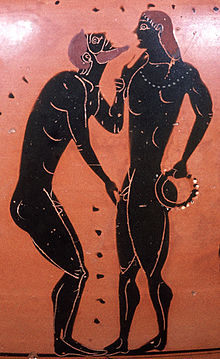
Because of deep-seated hostility in the Christian west to such practices, Greek homosexuality traditionally received little or no attention in the standard histories, and when it did, the account was typically distorted by the moral prejudices of the author.  Otherwise competent scholars turned a blind eye to the evidence of widespread homosexuality, including the so obvious and explicit scenes found on pottery.  (The Greeks depicted every sort of activity on their pots.)  Only recently has classical studies turned to serious investigation of Greek sexuality, much of which investigation is unfortunately marred by new prejudices.


It should be noted right off that if modern terminology is to be used, Greek society was not homosexual, but rather bisexual.  Homosexuality may be defined as the more or less exclusive sexual preference for members of the same sex and must be considered some sort of biological aberration (no offspring can be produced) affecting a minority in every society.  Bisexuality is the willingness to entertain sexual partners of either gender and would appear to be in large measure a socially determined trait, unless we assume that the Greeks were somehow physiologically different from other people.  Thus, while there was surely the usual homosexual minority, many urban Greeks, especially those of high social status, were apparently bisexual, seeking different things from the different sexes.  In fact, to judge from the large numbers of female prostitutes and evidence such as the successful sex strike launched by the Athenian women in Aristophanes’ Lysistrata, heterosexual relations were very important to Greek men.


Using modern terminology is in any case a dangerous practice, since there is the risk of also projecting into the past modern concepts that have a different or no meaning in ancient society.  The terms “heterosexual” and “homosexual,” which are little more than a century old, are valid classifications for Greece only in the most superficial sense, that is, labeling a single different-sex or same-sex act.  As more general characterizations they are useless because they group behaviors that the Greeks considered very different, the sex of the partner, for example, being almost a trivial concern compared to the all-important issue of social status.  Dominance and issues of penetration and receptivity were frequently of far greater importance than gender, and certain areas of Greek society might be more appropriately described as phallocratic rather than heterosexual or homosexual, though this term as well is too restrictive and potentially misleading.


Why ancient Greece – or at least the upper levels of its urban population  – should have been one of the very few openly bisexual societies in history, certainly in the West, is not perfectly clear.  The origins of male homosexuality were seen by the Greeks in the sexual segregation of the military societies of the Dorians (the second wave of Greek-speaking invaders from the north, c. late 13th to early 11th centuries), and Plato in fact blames the Spartans and Cretans, who were Dorians, for spreading the practice.  But while Plato may be reflecting an opinion generally held in Greece during the classical period, that opinion is not necessarily true, and there is no hard evidence for the diffusion of Dorian practices through the rest of Greek society.  It is true, however, that the overwhelming male orientation of polis (city-state) society, which resulted in a sort of sexual segregation, can probably be traced back to the warrior communities of the early Dark Age, which resulted from the Dorian invasions.  The warrior hosts disappeared, but because of the endless intercity warfare, the polis was in many ways also a warrior society, and the absolute dominance of males continued.


The pertinent fact here is that outside of childbearing everything that mattered in the polis was in the hands of males, which meant in turn that outside of heterosexual relations everything that was of any concern to a Greek male involved other males.  With very few exceptions women were completely uneducated and uninvolved in anything beyond the household and the odd cultic practice, and consequently, for meaningful companionship and a relationship with any intellectual content whatsoever a male normally had to turn to another male.  Male relationships thus filled a basic social need.  This situation of course does not necessarily lead to open homosexuality and did not in most other similar societies.  Further, while it is perfectly clear that extreme sexual segregation inevitably leads to some degree of homosexual behavior (look at any prison population), it generally does not lead to open, socially acceptable homosexuality.


Why then the Greeks?  An entirely satisfactory explanation is elusive, and I can only suggest a few reasons.  First, the relatively high level of social and intellectual freedom in Greek society, due in part to the open nature of the constitutional polis and in part to the fragmentation of Greece into hundreds of separate political units, which encouraged some small measure of diversity.  This resulted in a social atmosphere more conducive to change and acceptance of different practices.  This is not to suggest that Greek society was wildly progressive – it certainly was not, even in the heady days of change in the sixth century – but rather that the polis was at least marginally more inclined to accept nontraditional behaviors than the average pre-modern society.  Much more important, the Greeks had no inherited prohibition of homosexuality, no command from god that erotic experiences between persons of the same sex were wrong, which would allow the homosexuality inevitably practiced in secret in sexually segregated societies to come out into the open.  Finally, because sex was viewed as an important expression of status and citizenship, social position became much more important than the actual gender of the partner, producing an environment more open to sex between males.  In short, the male dominance and sexual segregation fosters the bisexuality, and the relative social freedom and lack of any serious religious prohibition brings it out of the closet.


But let us not misunderstand Greek sexuality and think simply of cheap thrills and bathhouse promiscuity.  Obviously, there were those who engaged in casual sex, especially with slaves and male prostitutes, but a serious relationship involving free males was bounded by a strict set of rules, and behavior that publicly violated those rules was socially unacceptable and sometimes criminal.  An acceptable pairing involved an older male, the erastēs, who was the active partner, and a younger male, the erōmenos, who played a passive role.  The erōmenos could not be too young, less than about twelve, and there would be talk if he were still playing the passive role much beyond the age of fifteen or sixteen (“when the beard was grown”).  The pair could not openly engage in oral or anal sex, because that would compel the erōmenos to play a subordinate, female role and not only bring shame upon him, but also injure his future status as a citizen.  Personal physical inviolability was one of the hallmarks of citizenship, and penetration of a male would place him in the category of slave and woman.  The kinaidos, the man who allowed himself to be so used, was the negation of everything represented by the hoplite, the heavy infantryman who defended the polis: manliness, citizenship and dominant status.  Indeed, the worst insult you could deliver to a man was to call him euryprōktos, “wide-assed.”  The acceptable practice was intercrural copulation, in which the erastēs, facing his partner, thrust his penis between his thighs, thus avoiding penetration.


Such at least was the social ideal, and some men maintained lofty attitudes regarding their liaisons, emphasizing the educational aspect of the relationship and their responsibility for the development of their erōmenoi as men and citizens.  There is some truth to this, inasmuch as Greek society (excepting Sparta) had no formal educational apparatus and the continued absence of the urban father from the household may have strained the relationship between father and son, but this must not be exaggerated.  The evidence suggests that sexual attraction to and pleasure with adolescent males was the common motivation and that penetration was frequently practiced, for all that one never spoke of it in public.  The Romans, incidentally, shared these attitudes, though unlike the Greeks they considered citizen youths out of bounds, and the distinction between penetrating men (permitted for virile males) and being penetrated by men (definitely not permitted) is still made among males in some Mediterranean and Latin American societies.

Greek honesty concerning homosexual behavior was only a single facet of their incredibly open attitude about human sexuality in general.  Sex, and in fact body functions in general, rather than being a taboo subject were a source of great amusement, as is readily obvious from Aristophanes and from Greek pottery (the stuff hidden away by Christian museum curators).  Aristophanes’ comedies were at heart social and political satire, the highest form of comic expression, but that satire was wrapped in humor that a modern audience would find obscene and puerile – jokes about farting, penis size and suchlike.  But the Athenian audience loved it, and these were people who had just sat through and enjoyed several tragedies; the modern equivalent might be several Ingmar Bergman movies followed by some mixture of Redd Foxx and the Three Stooges.


Free of any divine commandments to the contrary, the Greeks were able to develop a more open attitude about human sexuality, and I suspect their society was all the more psychologically healthy for it.  The Greeks were far more willing than most civilized peoples to recognize the inner nature of the human animal and squarely face what this meant in terms of human needs and behavior.


Finally, a popular Greek “pottery joke.”  There were traditional shapes for wine cups, and one was similar, though smaller, to the common chamber pot.  A picture of a woman peeing was painted on the inside bottom of this type of cup, and when the imbiber (inevitably male) finished his drink, he suddenly discovered the squatting woman and got the joke.  Yes, these are the same people who discovered democracy and philosophy, and yes, they would have found dribble glasses and whoopee cushions completely hilarious.


When men were men

When men were men

Hey, it's Greek art

Hey, it’s Greek art

And women were women

And women were women


Stuff from Way Back #17: The Beloved Land

Egypt used to be a much happier place, even while under an authoritarian government that makes Mubarak and Morsi look like progressive leaders.  This was of course when the world was young, very young.  Egyptian civilization formally begins c. 3100 BC with the 1st Dynasty and the unification of Upper and Lower Egypt, which means Egypt came in second to Sumer (far southern Iraq) in the “Birth of Civilization” sweep stakes.  Ironically, though both were river valley civilizations that had emerged because of generally similar factors, because of their very different local environments they were completely different in their attitudes and understanding of the universe.

Menes (Narmer), the first Pharaoh, unites Egypt

Menes (Narmer), the first Pharaoh, unites Egypt

The Nile valley, which essentially defined ancient Egypt, was a grand place to live.  The river, with its incredibly regular ebb and flood that rejuvenated the soil every year, produced a large and extremely dependable food supply.  The security of the land was for thirteen hundred years guaranteed by physical barriers – the Mediterranean to the north, Sinai and deserts to the east, the river cataracts and difficult terrain to the south and desert wastes to the west.  There was virtually no weather, and excepting the rhythms of day and night, the rotating stars and the rise and fall of the Nile, the land was unchanging.  It was the Beloved Land.

The result of this environment was perhaps the most positive view of the world ever entertained by a society.  The universe was inherently good and just, a status guaranteed by the gods of the Two Lands.  Indeed, the harmony and order of the land was further secured by the presence of heaven on earth in the form of the Pharaoh, the continually reincarnated Horus.  The head of state was quite literally a god, and the state itself was a part of nature.  Life was so good that except for the god-king the afterlife was seen simply as a continuation of the one on earth.  Heaven and earth were so tightly bound that they were seen as a whole, and the peasant working his fields shared an essence common to both his animals and the gods.

And this never changed.  There were only three inescapable, non-periodic changes in the Egyptian universe: creation and the birth and death of an individual; all other non-reoccurring change was either so trivial or so slow that it could be ignored.  The exact Egyptian understanding of birth is unclear, but it could be minimized as a natural extension of the mother.  Death was tougher since there was a quite obvious change when the individual died, but this was explained as a sort of shift rather than an absolute change.  The essence of the person simply shifted to the afterlife, where in a world identical to the one he had left he would carry on with his business, be it farming, trading, building, administering or whatever.  That bodies buried in the desert fringe naturally mummified instead of rotting helped support this belief.

Creation was thus left as the one non-periodic change of any significance.  Consequently, as the universe was at the moment of creation, so it would be for all time.  And unlike the creation myths of the Asian and Aegean societies the Egyptian account involved no struggle.  It began, as in the Sumero-Babylonia system, with a watery chaos (these are hydraulic societies, after all), but the world was created peacefully, Ptah (or Atum) spitting out or ejaculating the first gods, who then continued the process through sexual reproduction.  In the universal mythic thought of the pre-Greek world these deities, though envisioned in human form, were actually manifestations of the natural phenomena with which they were associated, and thus the world was created.

By way of contrast, the Sumero-Babylonian account of creation involved struggle, as Enlil (or Marduk) battled and defeated Tiamat, the personification of chaos, and thus established the ordered world.  But unlike the permanent Egyptian cosmos the Sumero-Babylonian world required constant attention, lest it collapse back into chaos.  The difference was the environment.  The Tigris and Euphrates were wild rivers, which could flood or dry up the fields, and there were violent storms and periodic droughts.  The Sumerian city-states were constantly at war with one another, and barbarians from the Syrian deserts and Zagros mountains plundered the land.  Life was very uncertain, and disaster, natural and human, constantly threatened.  The afterlife consisted of a grim underworld, to which everyone went.  Pessimism reigned in the lands of the two rivers.

The negative result of the secure and unchanging life of Old and Middle Kingdom Egypt (c. 3100-1800 BC) was an unchanging culture.  Because of the focus on the eternal, the canons of Egyptian art and to a lesser degree literature were frozen at the beginning of her history, and a statue of the Pharaoh from the early second millennium is virtually identical to one from the late first millennium.  From the 1st Dynasty to the 18th Egypt essentially produced nothing new.  Creativity and progress require a certain level of struggle and tension, and Egypt was simply too content.

Thutmose III, creator of the empire

Thutmose III, creator of the empire

When her splendid isolation came to end with the Hyksos invasion and domination of the delta c. 1800 BC, Egypt was ill-equipped to deal with the sudden intrusion and rule of non-Egyptians and the arrival of new ideas.  The collapse and troubles of the First Intermediate Period (c. 2200-2050 BC) were an internal affair and could be accommodated by the traditional culture, while the Second Intermediate Period (c. 1800-1550 BC), initiated by the arrival of the Hyksos could not.  The kings of the 18th Dynasty drove out the invaders and restored a united Egypt, but it would never be the same.  The experience of the Hyksos seriously injured the self-confidence and optimism of the older days.

And Egypt was allowed no rest, as the impulse that drove out the Hyksos carried her into Syria-Palestine, where she stayed (New Kingdom or Empire c. 1550-1085 BC) and began a long struggle with the Hittite Empire in Anatolia.  New ideas and peoples poured into the Two Lands, preventing any return to the old ways and attitudes.  Tending to its Asian empire, the New Kingdom was too involved in the world, too nervous for eternity.  The god-king, leading the armies north, was no longer the distant majestic figure of the Old and Middle Kingdoms, but more human – and ephemeral.  The increasingly weak kings of the 20th Dynasty fell more and more under the growing power of the Temple of Amon-Re, as Egypt began the slide into impotence and ultimately foreign domination.  In the wisdom literature of the New Kingdom: silence and submission emerge as the leading virtues of the wise man.  Insecurity and outright fear enter Egyptian religion, and the once virtually automatic passage into the next world becomes a trial.  A good heart is no longer enough; the deceased must be armed with special prayers and magic, like the Book of the Dead, to overcome the new obstacles.

Ramses today

Ramses today

Ramses II, PR genius of the New Kingdom

Ramses II, PR genius of the New Kingdom

By the beginning of the first millennium Egypt had disintegrated into a collection of independent principalities, and in the seventh century the Assyrians, the “wolf in the fold,” captured the Beloved Land.  The ancient culture of the society lived on, but under a succession of imperial rulers: the Babylonians, the Persians, the Greeks and the Romans.  The three thousand year old religious beliefs could survive in the polytheist societies of Egypt’s conquerors, but in late antiquity Christianity began to seriously erode them, at least in the urban areas.  The final extinction of ancient Egypt, however, did not come until the seventh century AD, when the Arabs arrived with their particularly nasty version of the No Fun God and created modern Egypt.

Until the arrival of serious tourism Muslim Egypt has had very little regard for its glorious past, stripping away the finer stone of the ancient monuments to build mosques, as the Christians were doing in Europe.  The last two centuries have seen a rebirth of interest in the Beloved Land, but even now extremists want to destroy the remaining art in the name of their primitive aniconic god.  All things considered, better to live under the Temple of Amon-Re than the Muslim Brotherhood.

Stuff from Way Back #15: These Christians Are Really Annoying

(Three weeks ago I posted a piece on Albert Göring, who was being considered for inclusion in the Israeli Righteous Among the Nations for his work in rescuing Jews. Apparently he did not make it, presumably because of a rumor of a Jewish father, which would make him ineligible, and Israel avoids the embarrassment of having Reichsmarschall Göring’s brother among the honored.)

The Roman persecution of Christians is a well-known episode in the history of the religion, but inasmuch as these events occurred almost two millennia ago, there is no longer a Roman Empire and the Church was the winner, one might expect that some distortion has crept into the popular narrative. And it has, primarily because few people have any real knowledge of the Empire beyond what Christianity and Hollywood have suggested and even fewer understand the nature of traditional Roman religion. As a result a key fact has been lost: so long as you observed Roman tradition the state did not give a damn what gods you worshipped (at least until the state became Christian).

At first of course Rome did not even notice the new cult. Those with any knowledge of Judaea assumed it was yet another Jewish heresy, doomed to disappear, as in fact the sect of Christian Jews did. As the adherents of the new faith spread and multiplied, it was popular dislike that first caught the attention of the authorities. Like the Jews, Christians were monotheists, compelled by their beliefs to deny the existence of other gods, and they were doing this in a society that was completely polytheist. Polytheist societies are generally tolerant when it comes to religion, even in states with a religious establishment supporting a divinely connected kingship, as in the Sumerian city-states and Egypt. Inasmuch as deities were typically personifications of natural phenomenon, it was easy to identify gods across cultural lines, and in any case no one (excepting perhaps Akhenaten) was about to deny the existence of other gods and certainly not resort to violence in order to teach others a lesson.

Into this world come the Christians, telling their neighbors that the gods of their fathers do not exist and that they are wasting their time worshipping idols. Of course the Jews had been doing this for quite a while, but apart from small communities in some of the cities of the Empire, they were essentially a phenomenon localized in Judaea, and in any case they did not proselytize. Early Christians were in fact confused with Jews, but as their numbers grew, people realized this was something new – and very annoying. And if modern evangelicals are any indication, these early Christians likely often displayed a holier-than-thou attitude; they had the good news after all.

There was also a feeling that for all their professed love these people actually hated mankind. The first generation or so of Christians believed that the Christ would be returning soon, perhaps in their lifetimes, and there was consequently talk of what would happen then. And if Revelations is the guide, it would be unmitigated horror, suffering and death for non-believers, which was of course virtually all of humanity. There were also rumors of strange and disgusting rites, such as incest and cannibalism, the sort of things that are said of the despised and alien throughout history. Natural disasters and unexplained misfortunes were blamed on them. The Christians were strangers in a strange land and initially played the same role of the “other” that the Jews would play in medieval and modern Europe.

Capping it all off was the growing suspicion that they were disloyal as well as obnoxious. The traditional religion of Greece and Rome was primarily civic in nature, concerned with the cohesion and well-being of the community, and as such, it was closely connected to the idea of the state. The sacrifices and rituals were communal, designed to keep the community in the right relationship with heaven, and in the case of Rome this led to the emergence of priesthoods, such as the Pontifex Maximus, that were actually state offices. The holders of these positions were not “priests” in the familiar sense of the word, that is, representatives of a centralized church, as the priests of the temple of Amon-Re or the Catholic Church. Their job was not to intercede for or counsel the individual, but to conduct the rituals necessary for the survival and prosperity of the community.

As a result, honoring Jupiter Best and Greatest and his colleagues was more of a social act than a religious one, declaring ones good standing as a member of the community. If the worshipper had other more personal concerns regarding heaven, he would turn to gods more pertinent to his situation, especially traditional local deities among the provincials. As with most things, Rome had always had a laissez faire attitude regarding non-Roman religions, so long as there was no threat to public order and morals, such as led the Senate to ban certain Bacchanalian rites in 186 BC. She was even ready to tolerate an extremely intolerant religion, Judaism, because it was essentially local and no threat to the state. Nevertheless, denying the existence of the Olympic gods was in fact directly assaulting one of the foundations of the state and endangering the well-being of the society.

Even so, Christianity might have gone unnoticed were it not for the fact that they quickly became almost universally unpopular, even hated, and their vociferous rejection of the Roman gods struck people as disloyal. Constantly claiming that their god was their only true “king” and master also did not sit well in an autocratic society, and the ideas of their founder/prophet regarding the poor and the rich were absolutely revolutionary in a world always dominated by the propertied classes. So, there was in fact public disorder in the form of anti-Christian riots, which the authorities were compelled to deal with. All the evidence indicates that the Roman government was completely aware of the essentially innocent nature of the new religion, but Roman officials were hardly likely to defend an unpopular minority in the face of overwhelming public displeasure.

Apart from their refusal to pay even lip service to the imperial cults, there was actually a legal problem for the new church. Since the time of Augustus (27 BC-AD 14), the first emperor, new clubs and associations were prohibited unless they were specifically granted imperial approval. The reason was clear: private associations could easily harbor conspiracies against the state (as they did during the collapse of the Republic), and autocrats tend to be very sensitive about this issue. And here was a new and offensive cult spreading throughout the cities of the Empire.
As it happened, the Empire was mellow about the whole issue, and generally confronted the issue only when it could not be avoided because of public clamor. This was certainly the case under Trajan (98-117), who when asked what to do with Christians by his governor in Bithynia, Pliny the Younger, instructed him not to search them out but only act when it was unavoidable. The typical procedure was to require the Christian to make a token sacrifice, a pinch of incense, to an imperial cult, generally that of Roma et Augustus. For the authorities this was far more a pledge of allegiance than a religious act; perform this one act and you would get your “ticket,” your libellus, and could go home and worship whatever gods you pleased. Of course, for a Christian this was apostasy, and though many took the plunge, many did not, which baffled the Romans, who could not fathom such religious fanaticism.

Decius: "Smoke 'em"

Decius: “Smoke ’em”

The result of all this was that violence against Christians was for two centuries limited to popular outbursts, such as blaming Christians for the fire in 64 (encouraged by Nero), and the odd official currying favor with the locals. Not until the third century was there an actual persecution in the sense of the central government taking Empire-wide action against the religion, and this would come during the Anarchy (235-285), a fifty year long civil war that essentially killed the Empire, even though it would stagger on for another century or so. During his short reign Decius (249-251) required that all Christians be put to the test and imprisoned if they refused, and this was repeated, with more severe penalties, by Valerian (253-60) in 257-258. Both of these men were ruling during a period of widespread instability coupled with serious barbarian invasions and internal military revolts and were desperately attempting to restore loyalty to the state. An obvious target was the Christian community, which was now highly organized and blatant in its rejection of the state religion, which now included deified emperors.

Diocletian (285-305) ended the Anarchy, but the Empire would never again come close to the stability and economic well-being it enjoyed before 235, and the history of the Late Empire was one of military autocracy alternating with periods of civil war. In 304 Diocletian launched the last anti-Christian crusade, destroying churches and sacred books and imprisoning priests, but it ended with his abdication the following year and seems to have petered out because of lack of popular support. His ultimate successor, Constantine the Great (305-337), legalized Christianity with the Edicts of Toleration (311-313), and with his conversion it became the official religion of the Roman Empire.

Valerian: "Crush 'em"

Valerian: “Crush ’em”

And then the real persecutions begin, as the government implements a continuous policy of crushing polytheism and eliminating the pagani (“rural folk”), so called because the old cults hung on the longest in the rural areas. Unlike those carried out against the Christians this persecution was moved by nothing other than simple religious intolerance.

Diocletian: "Eat 'em"

Diocletian: “Eat ’em”

In the end Christians themselves would slaughter tens of thousands more Christians than the Roman Empire ever did.

Paris 1572 - Christians killing Christians

Paris 1572 – Christians killing Christians

Stuff from Way Back #14: The New God on the Block

(In keeping with the season I present a brief historical (leaving any deities out of it) understanding of exactly why Christianity was so damn successful.  Next week I will deal with the other question: what exactly was the reaction of the Roman government and why, a topic that has been seriously distorted because, well, the Empire no longer exists and Christianity does.)

Christianity is clearly a fusion of east and west, being a sort of religious hybrid produced by the intersection of Hebrew monotheism and the Greek mystery cult brought on by several hundred years of Greek control of Palestine. To some degree it is also a mix of oriental mysticism and Greek rationalism, inasmuch as the basic beliefs were later influenced by Stoicism and neo-Platonism. In essence, the Jews supplied the idea of the sole, ethical creator god, disconnected from the natural world, while the Greeks, through their mystery religion, contributed the notion of the dying and resurrected god. Paul and his associates made the new religion palatable for the world outside Judaea by stripping it of unappealing Jewish ritual, such as circumcision and dietary laws, and Greek rationalism then proceeded to refine the understanding of the godhead.

First of all, Christianity shared the ideas that had made the mystery cults so popular in Greece and later the Roman Empire. Traditional Greek and Roman religion was essentially civic in nature, primarily serving the community and devoid of any personal or inspirational quality. The mystery religion, which came in a variety of specific cults, did not deny the traditional gods but rather focused in on a single or tiny group of deities, providing the worshipper with a more personal and intimate relationship with divinity. The cults also involved emotional initiations and revealed knowledge, known only to the initiates, who gained in the cult at least a measure of equality with their richer and more powerful brethren. Christianity had no secrets but it rested on revealed knowledge and also offered a sense of special community within its ranks. Most all the mystery cults revolved around the central figure of a god or human who either literally or figuratively dies and is resurrected, thus providing an analogue of hope for the worshipper facing the inevitability of death. Further, the cults promised some reward, initially in this life, but by the end of the fifth century BC evidence appears suggesting the idea of judgment and reward in another life.

Christianity offered all these things but was something more than just another mystery religion. The Christian god was not just some Olympic retread, but the god of love, completely absorbed in those he had created. His death and resurrection was not simply some mythic event that had nothing to do with humanity beyond providing a message of hope. Rather, he became human and died specifically for humanity, a divine sacrifice that reveals an entirely novel concept of god. He was the god of all – rich, poor, slaves, free, men, women – something that was not always true of polytheist deities; for example, Mithraism, far and away the most popular cult in the Empire, was open only to men. And Christianity (at least until a powerful church emerged) cost nothing but commitment, while the polytheist religions required sometimes costly sacrifices, such as the bathing in bull’s blood incumbent on Mithraists.

Above all, this new god may have been open to everyone, but he definitely had a bias towards the poor and downtrodden. The rich and powerful had always had the edge in spiritual affairs, whether in the quality of their gifts or in outright control of the mechanisms of the religion. For the first time in history there was a god who favored the meek and chided the wealthy, and of course the vast majority of the in habitants of the Empire fit into the former category. This must have made for immense drawing power.

The religion also quickly developed the primitive ideas of judgment in the mystery cults into a full-blown system of reward and punishment in the next life and firmly rooted the judgment in the moral code inherited from Judaism. Obviously, promise of a better life in the next world is going to turn the heads of those whose life in this one is not that great, and while Christianity is born into an imperial society that constituted one of the more comfortable periods in history, in a few centuries life in the Roman Empire was going to become very unpleasant for most of its subjects. Now, the reward and punishment was based on the observance of a fairly strict ethical code, which might be expected to turn away potential converts. Most of us can get through life without committing homicide or adultery, but the thought crimes are very tough; “Thou shall not covet thy neighbor’s wife” is after all a rule even Jimmy Carter violated. But most people want a moral structure provided for them, and the basic rules provided by Christianity struck a favorable chord precisely because they were good rules. The Ten Commandments are the Ten Commandments because they proclaim the basic laws absolutely necessary for a stable society.

So the demanding moral code was likely also an attraction of the new religion, which was offering reward in the afterlife for behavior that virtually all normal humans consider good and proper. On the other hand, not even a Mother Teresa could keep all these rules all the time, and what made the whole system feasible for the average Joe was the loophole: forgiveness. Were it not for the mechanism of contrition and forgiveness, the new religion would be making impossible demands and simply not work.

Extremely important in the triumph of Christianity is the simple fact that it happened in history. The core event of the religion, the death and resurrection of the god, did not take place in some distant mythic past, as in the mystery cults, but right there in the Roman province of Judaea during the reign of Tiberius (14-37). The first apostles of the new god had actually been there, first hand witnesses of the essential events of the religion. They heard the sermons and saw the miracles and the crucifiction, and some claimed experience of the resurrection itself. This gave the religion an impetus unmatched by the old belief systems.

Additionally, though it may have played something of a negative role in the spread, the exclusiveness of the monotheistic religion certainly helped preserve it intact. Syncretism, the identifying and combining of gods across cultural lines, was an inevitable component of polytheism and produced religious hybrids, such as the cult of Isis and Serapis. This simply could not happen to Christianity – at least in any serious way – because there were no other gods. This would produce a religious fanaticism unknown in antiquity outside the Hebrews, and that fanaticism presumably helped a bit. These were people who were willing to die for their god, and that kind of commitment surely had to impress potential adherents.

Finally, there is the element of coincidence: the charismatic preacher was born at the height of the Roman Empire.  Without this huge area of political stability and easy communications the new religion would very likely not have been anything more than another eastern cult.  Two centruies earlier Rome was only beginning to nose into the eastern Mediterranean, and it is not all clear that the new religion, which would be perceived as a heresy by the Jews, would have survived the religiously reactionary Hasmonean kingdom.  Two centuries later and the religion would almost certainly not have the time to spread and develop its infrastructure before the western Empire collapsed.  It might survive in the east, but the conversion of the barbarian tribes becomes more problematic, and what would the history of the west be like without the Church to carry civilization through the Dark Ages?

"In hoc signo, Baby!"

“In hoc signo, Baby!”

Such are the reasons for the initial survival and spread of Christianity, but the final triumph and emergence of the new creed as the exclusive religion of the western world owed less to its nature than to political developments. Because of popular hostility and ultimately government obstruction (tune in next week), by the beginning of the fourth century Christians constituted perhaps only ten percent of the population, but for seemingly cynical political reasons Constantine the Great (sole emperor 324-337) embraced the religion. One might question the conviction of Constantine, who converted only on his deathbed, but the imperial family became Christian, and after Constantine every emperor but one (Julian the Apostate) was a member of the faith, thus making Christianity a powerful force in the government of the Empire. With the power of the sate behind it Christianity began a rapid expansion, as polytheists were subject to greater and greater persecution.

The collapse of the western Empire in the fifth century guaranteed the complete supremacy of Christianity, as the Church, now the only surviving governing structure in the west, emerged as a kind of international corporation manipulating the emerging barbarian kingdoms. The conversion of the Germanic tribes, especially the
Franks, resulted in a new warrior Christianity, which spelled doom for the surviving polytheists of Europe. The Prince of Peace had finally triumphed, albeit with a sword in his hand.