Stuff from Way Back #31: When Iraq Was Civilized

(Inasmuch as Iraq is constantly in the news these days it seems appropriate to talk about a time when the region played host to the two most momentous events in human history: the discovery of agriculture and the birth of civilization. Actually, the discovery of farming appears to have happened in a number of places in the Near East, but the first urban civilization was unquestionably born in southern Iraq.)


After 5000 years of urban settlement Iraq only became a country in 1920 in the wake of the collapse of the Ottoman Empire, and it may be questioned a century later if it really is a country.  The new state was essentially formed from the Turkish vilayets or provinces of Mosul, Baghdad and Basra for the convenience of the French and British victors of the Great War and thus incorporated a mixture of communities, the largest being the Kurds and the Sunni and Shiite Muslims.  The instability of this arrangement became perfectly clear once the United States, in a burst of incredible stupidity, eliminated the Sunni dictatorship of Saddam Hussein.


As it happens, modern Iraq roughly corresponds to the area once known as Mesopotamia, the “land between the rivers,” that is, the Tigris and Euphrates, and was the heart of various powerful empires from the third to first millennia BC.  For convenience pre-classical historians have traditionally called the northern half of the area Assyria and the southern Babylonia, with Babylonia divided into Akkad in the north and Sumer in the south.  It was in Sumer that civilization was born, nosing out the Egyptians, Indians and Chinese.
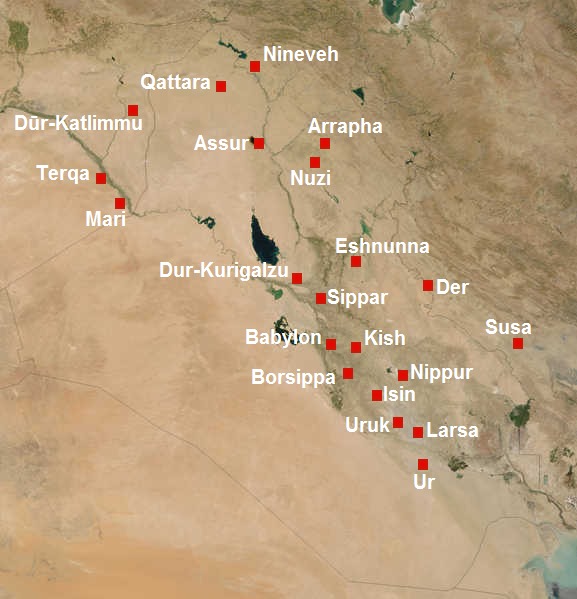
Sumer

Sumer

Agriculture was of course the prerequisite for settled society, inasmuch as hunting and gathering cultures must continually move around, and developed agriculture was necessary to support the non-food producing populations of cities.  Proponents of “Paleolithic” diets are calling the agricultural revolution a catastrophe for humanity because humans were not really designed to live off grains and settlements brought problems, such as new diseases, but all the growth and material and intellectual progress of humanity arises from farming and building cities.  This is exactly why it has been called the Neolithic Revolution.  I certainly will take the problems of civilized society over the short, brutish and ignorant life of the Paleolithic hunter.


Humans had discovered that certain grasses could be eaten – they were gatherers after all – and those grains, emmer and einkorn wheat and hulled barley, grew wild on the hilly borders of the Fertile Crescent (Mesopotamia, Syria-Palestine and the Nile valley), such as the flanks of the Zagros mountains, where there was sufficient rainfall.  Along the way some communities realized, probably mostly accidentally (spilled grains later sprouted), that grain seeds placed in the earth would produce more grain.  Initially, however, the supply of these grains was large enough that there was no need to cultivate them; they were just another, though plentiful, gathered food.  Why men actually began primitive farming, serious and tedious labor compared to hunting and gathering, is not clear, but most likely it had to do with growing populations forcing some groups into more marginal areas that were less bountiful.
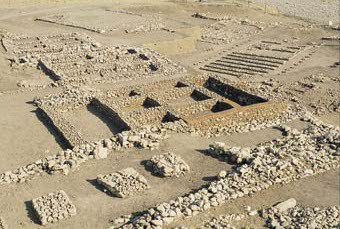
 

Neolithic farming settlement - eastern Anatolia

Neolithic farming settlement – eastern Anatolia

wild emmer wheat

wild emmer wheat

The Mesolithic Age, from about 9000 to 7000 BC (in the Near East) was the transition period, during which sown grain becomes a major part of the diet, animal domestication begins and temporary and then permanent settlements appear.  By the beginning of the Neolithic around 7000 BC farming appears to have displaced hunting and gathering, at least in those upland areas on the fringes of the Fertile Crescent where there was regular rainfall.  During the seventh millennium real villages, pottery and baked bricks all appear, while growing population and the lure of richer soil was pushing men towards the next development: irrigation agriculture at lower altitudes.  By the early centuries of the sixth millennium copper was being used, ushering in the Chalcolithic Age.  During this period temples, seals, mural paintings and more elaborate painted ware appear, and the use of bricks becomes much more widespread.  Major agricultural towns are now found on the river plains, employing the ground water for their crops, and in the fourth millennium a cooler and drier climate in the region accelerated the move into the rich river valleys themselves.  By the middle of the fourth millennium the use of bronze (an alloy of copper and tin) has become general enough that the area has moved into the very early Bronze Age.


By the later fourth millennium, during the Uruk period, human society in Mesopotamia has taken the critical step into what is generally understood by the term “civilization.”  The potter’s wheel, the sail, sculpture and statuary had all arrived, but far more important were two other developments: the earliest group habitation that might be called a “city” and writing.  “Civilization” traditionally means an urbanized society, and writing, the other hallmark of civilization, inevitably follows that urbanization, a response to the growing complexities of human activity.


An immediate question of course is exactly what constitutes a city.  Size is probably the least important factor, and the cities of the fourth millennium would indeed strike us as tiny towns.  By the end of the period Uruk (Erech), from which the period gets its name, was perhaps 1200 acres at its height at the beginning of the third millennium, but this is very late and Uruk was likely the biggest city in the world at that time.  A more common size for the late fourth millennium is 100-200 acres.
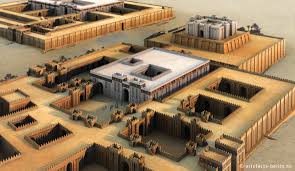
Uruk

Uruk

Uruk

Uruk

The most important factor is differentiation of population, that is, not all those living in the city grow food; no matter how large, if all the residents are directly involved in the food supply, it is not a city but an agricultural village.  There is a specialization of labor, and the specialists – craftsmen, merchants, officials, etc. – are supported by the farmers in the countryside.  This external food support also allows the higher population density associated with urban areas.  There will be an economically and politically stratified population, that is, differences in wealth and power, and there will be an institutionalized and formalized governmental structure, with officials (including priests in the case of Sumer) supported by the state through taxation.  Monumental architecture, including city walls, is characteristic, since these projects involve state control of resources, generally through some form of taxation and conscripted labor.


These are the core requirements, but other characteristics inevitably follow.  Typically, there is well developed trade, allowing the import of materials unavailable locally and the export of local resources and manufacture.  The concentrated wealth of the city will attract predators and consequently lead to more organized defense in the form of soldiers, also necessary to enforce the power of the elites and maintain control.  More important, administrative and mercantile needs will require increasingly sophisticated record keeping, and at some point that record keeping will become writing, allowing an exponential increase in human development and thought.  Primitive writing in Sumer appears to have emerged by about 3300 BC, though our examples come centuries later.  Civilization was born, and unfortunately it involved from the start organized violence in the form of armies, large scale chattel slavery and incipient bureaucracy.  But that’s the price you pay.
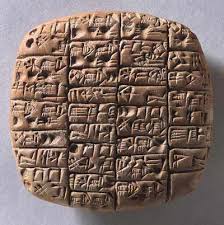
cuneiform - the first writing

cuneiform – the first writing

Why cities and why in Mesopotamia?  For the same reasons that urban civilization will quickly follow in the Nile and Indus valleys: the rivers.  These are “hydraulic” civilizations, in that the water of the rivers provided the stimulus and reward for further social development.  Growing population and increasing aridity pushed the early agriculturalists down into the river valleys, where their developing agricultural technique allowed them to face the greater challenge of groundwater farming.  Very simply put, constructing the irrigation systems that would insure a regular supply of water to the fields required increased cooperation and more sophisticated direction and social management.  The greater returns provided by more dependable water resources and the richer soils of the riverine areas provided growing food surpluses, which in turn supported a growing population of “specialists,” who did not directly participate in the production of food, leading to an increasingly differentiated and efficient society.  The appearance of institutionalized leadership, that is, government, permitted and enforced greater cooperation and communal use of resources.  That the emerging elites were likely able to manipulate to some degree the all-important water supply (which is in part why they were the emerging elites) could only accelerate the process.

Sumerians

Sumerians

Allowing for specialization of labor, food surpluses produced a more efficient, more materially productive society.  That specialization, however, also permitted the existence of inhabitants who contributed nothing to the material well-being of the group, and one of the most obvious manifestations of this is the evolution of the arts, at least the graphic and plastic arts.  Art thus moves beyond the decorative – designs on pottery, for example – and becomes symbolic and communal, as artist specialists engage in large projects supported by the economic elites, the state and the temple.  Which brings up the priests.  The emergence of the city allows the institutionalization of religion as well, and the society can now afford to maintain what are in essence full-time shamans and an increasingly elaborate religious infrastructure, centering on the temple.


The temple was in fact the center of the Sumerian city and state, and increasing levels of resources were lavished on construction and decoration. We might consider priests to be parasites and temples a waste of resources, but given the nature of Sumerian culture (and that of subsequent societies in the area, who inherit it), they are absolutely necessary for the survival of the state.  The mythic world view of Sumero-Babylonian culture understood that humans were created to serve the gods, and each city-state in fact belonged to a specific deity; the patron goddess of Uruk, for example, was Inanna (the Semitic Ishtar).  Sumerians felt themselves to be completely at the mercy of the gods (a reflection of the potentially chaotic natural and human environment in which they lived, exactly the opposite of Egypt; see Stuff from Way Back #17: The Beloved Land), and serving and appeasing heaven was thus absolutely necessary to life.
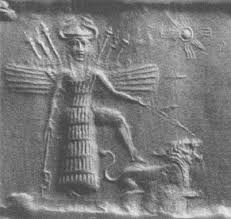
Inanna

Inanna

This is illustrated by the early political history of Sumer, which is unfortunately not all that clear. There are hints of some sort of assembly of notables very early on, which would be consistent with the state’s village origins, but the inevitable concentration of power afforded by the emergence of the city did not at first produce a secular kingship.  Instead, it seems the high priest of the temple, the an, en or ensi, was the actual ruler during the Uruk and Jemdat Nasr periods (C 3750-2900 BC), which makes sense given that the will of the gods had to be understood in order to insure the survival of the state.  This practice survived into Early Dynastic I (c. 2900-2750) – considered to be the real beginning of history – when the city-state of Kish appears to have held a loose hegemony over Sumer.  A secular leader, the lugal, was called up for the occasional war when the high priest was incapable of such leadership, and when the hegemony broke down in Early Dynastic II (c. 2750-2600 BC), leading to frequent wars, the lugal begins to emerge as an actual king.  The kingship is institutionalized as paramount and separate from the temple (though the king still carries out the will of the gods) during the times of increasing internal struggle and foreign invasion in Early Dynastic III (c. 2600-2334).


Civilization thus appears in southern Iraq in the later centuries of the fourth millennium BC, and history begins in Sumer with the invention of writing and the ability to keep permanent records. Fully matured civilization must, however, wait for the seventh century BC and the Greeks.  Missing from the mythic and autocratic states of the Fertile Crescent (and other parts of the world) are the essential elements of western civilization: rationalism, constitutionalism and humanism.  They simply did not exist prior to the Greeks of the first millennium BC.


Iraq Redux

(My apologies for the long delay between posts, but I had a lot of distractions.  I hope to return to a post every week to week and a half.)


The Romans often fought series of wars, returning to the same battlefield because of unfinished business or a failed settlement.  Examples abound in the later Republic: three Punic wars over a century, four Macedonian wars in sixty-six years, three Mithridatic wars in a quarter century.  (During WW I there were twelve battles of the Isonzo River in Italy in two and a half years, surely some sort of record.)  America has fought two Iraqi wars: driving Saddam out of Kuwait in 1990-1991 and destroying the Saddam government in 2003-2011.  And now we are creeping towards a Third Iraqi War, as the US desperately searches for a way to repair the damage resulting from a completely botched post-war settlement.


Invading Iraq in 2003 was utterly pointless in terms of American interests.  Saddam had absolutely nothing to do with 9/11; he was in fact second only to the Saudi Royal family on Al-Qaeda’s to-do list.  His was a thoroughly secular administration, one of the places Gulf royalty went to in order get a drink and get laid.  His government was oppressive, but it was stable and anti-Islamist, and when was Washington ever troubled by oppressive governments?  He was an implacable enemy of Iran, for which we have a hatred bordering on the completely irrational, and he was zero threat to anyone except his own people.

former ally

former ally

Why the Neocons were so determined to go to war with this character is not at all clear.  Frustration from the government’s inability to strike back at the actual terrorists?  Embarrassment from seeing our accusations against Saddam prove baseless?  Israeli interests?  Whatever the case, we were forced to invent hidden weapons of mass destruction in order to create some threat to the United States and ultimately justified our invasion with the claim that Saddam had violated provisions of the armistice or 1991.  In effect, we declared war on a country that had done us no harm and was not threatening us.  This is the sort of thing that makes our demands that persons like Vladimir Putin observe international law ring a bit hollow.


The war, which was not to be paid for by Iraqi oil as promised, was easily won, but as is generally the case, the peace was not.  Not only did the Bush administration have no plan for securing a stable post-Saddam Iraq, apparently presuming it would just spring into being, but it sometimes seemed that they were trying to plunge the country into chaos.  Disbanding the Iraqi army rather than co-opting it left Iraq with no indigenous force to police the country, presenting the American military with a task for which it was not really prepared.  The Americans would consequently look more like occupiers than liberators, especially when the Pentagon began hiring foreign mercenaries for many policing duties.  Dismissing every public servant who was a member of the Ba’athist party was utterly foolish, immediately robbing the country of much of its human infrastructure.  Most of these people were Ba’athists simply because it was a requirement for keeping their jobs; even the Nazis were not treated to such a drastic measure.


Seemingly the only plan for post-war Iraq was to make it a democracy, which all Iraqis would eagerly embrace, as did the Germans and Japanese after WW II.  At least that is what Cheney and friends kept reminding us, conveniently ignoring the vast differences between those countries and Iraq.  Germany and Japan were actual nations with relatively homogeneous populations, and they had centuries of history as established communities.  Iraq has never been a nation.  For millennia it has simply been the center or part of a variety of empires, most recently the Ottoman, and it only became a “state” in 1920, when according to the Sykes-Picot Agreement it became a British mandate under a client king, Faisal.  It became an independent kingdom in 1932 and a republic in 1958 after a coup.  The borders of this state, determined by the French and British according to their interests, enclose three distinct and generally hostile populations: the Kurds in the north, the Sunni Arabs in the center and the Shiite Arabs in the south.


This is not a country.  It is an arena, and with the removal of the authoritarian regime of Saddam the games began, even while the American military was still present.  A devastating civil war was prevented only by sending in more American troops and massively bribing Sunni leaders.  It could easily be predicted (as I and others did) that with the withdrawal of American forces the society would begin to unravel.  Washington’s man, Nouri al-Maliki, immediately began establishing a Shia dictatorship and taking action against the Sunni minority (35%).  He established relations with Hezbollah, designated a terrorist organization by the US, and Shiite Iran, considered an enemy by the US since 1979.  Democracy is crumbling, sectarian violence is on the rise and threatening to break up the country and Baghdad now courts Teheran and aids their interests.

Shiite thug and "ally"

Shiite thug and “ally”

Now, Dick Cheney, in a flight of fancy that even by his lofty standards is mind-boggling, is blaming the whole crisis in Iraq on Obama because he pulled out our troops.  Cheney of course ignores, as do other Republican critics, that Obama had absolutely no choice inasmuch as Malaki refused to agree to the Status of Forces conditions required by the US, namely, that American troops be granted legal immunity.  So what do Cheney and other right-wing idiots think Obama should have done?  He could have agreed that American forces were subject to Iraqi law, which would have had the conservatives howling, or he could simply kept the troops there on American terms, which would have made the American army an occupying force, which the hawks probably would not have any trouble with.  (Why does the media waste time interviewing Cheney the Undead and providing a soapbox for his nonsense and outright lies?)

the Undead

the Undead


And through our utter mismanagement of Iraq we have helped create ISIS (Islamic State of Iraq and Syria), a Muslim fundamentalist group so despicable and cruel that even al-Qaeda will have little to do with them.  One of the circumstances that led to the emergence of these barbarians is the Syrian civil war, but their spectacular success in Iraq is clearly due to Malaki’s Shiite dictatorship.  The average Iraqi Sunni wants nothing to do with the ISIS murderers, but the enemy of my enemy is my friend and Sunni communities are supporting them, a deal with the devil.

the golden age of the 7th century

the golden age of the 7th century


This places Washington in a very tough spot, one reminiscent of Vietnam’s invasion of communist Cambodia in 1978, which presented the US with a choice between two unpleasant regimes.  Obviously, ISIS is the far more disgusting group (as was the Khmer Rouge) and threatens America with terrorism, but supporting Maliki presents some serious problems.  Propping up a dictator has never been a problem for Washington, and this is a dictator we pretty much created, but the Maliki government is aligned with Iran, which is supposedly the big threat in the region and a country we have despised since they had the temerity to overthrown the oppressive regime of the American-installed Shah.  We would consequently be indirectly working with a country that Israel thinks should be bombed immediately.  Malaki has also joined Iran in supporting Hezbollah, designated a terrorist organization, and is sympathetic to Bashir Assad, currently the biggest mass murderer in the region.  More important, helping Maliki means taking sides in the growing sectarian strife between Sunnis and Shiites and can only lead to more trouble, since anti-America terrorists are all Sunnis, as are our “friends” in the gulf.


Well, it seems we will be helping Maliki, though constantly trumpeting that the price he must pay is to create a more inclusive government, which absolutely no one believes he will do.  The advisors are already arriving, though what they can do for an army that is riddled with corruption and lacking any motivation, at least in the case of the Sunni soldiers, is not at all clear.  Of course American involvement in Vietnam also began with advisors, but popular disgust with our recent wars should keep actual fighting forces out of Iraq, though you never know how stupid politicians will be.  Air strikes then, and according to the President, airstrikes without collateral damage, which I suppose means declaring that anyone killed by a strike is by definition the enemy.


And why are we getting involved at all?  Because ISIS clearly represents a threat to American national security, which in reality of course means little, since it appears that virtually everything is a threat to national security.  If they prevail, they will establish an Islamic state that will be churning out terrorist to send to America.  I have written previously on why I feel the terrorism threat has been stretched completely out of proportion in the interest of enhanced government power.  9/11 was the Reichstag fire for the Bush administration, and Obama, as would be expected of any administration, is not about to surrender any of the powers gained by his predecessors.  Has not more than a decade of homeland security made us any safer?  No one, even those armed with firearms, will ever again be flying planes into buildings, and how does one get a bomb onto a planes these days?


It is quite easy to put together a car bomb in this country, and that can happen whether or not ISIS rules in Iraq.  Yes, an American citizen could get training from ISIS and then reenter the US, but it hardly takes a genius to build a bomb (see Timothy McVeigh or the Zarnaev brothers) and in any case one can get instruction in plenty of places, including our ally Pakistan.  And one cannot fail to notice that the people crying the loudest about terrorism and national security seem completely unconcerned about the now regular shootings in American schools.  (One might also notice that while our intelligence apparatus is snooping on virtually everyone on the planet, it failed completely regarding the Crimea and ISIS.)


Oh, there is the oil, but I thought we were on the edge of energy independence.


What to do then?  Jordan must receive serious aid and be protected (a useful job for Israel) but otherwise ignore the whole thing.  Why are we so damned concerned that Iraq not break up into three states?  Because it would further accentuate the total failure of our ill-considered invasion of Iraq?  Iraq is manifestly not a real state and the hostilities are simply too great, especially for a culture that seems to slip so easily into violence (which is perhaps hypocritical for an American to say).  The Kurdish north is essentially now an independent state, and if anything, this has created more stability in the area.  Given the history of Iraq in the past half century, it is simply impossible for us to guarantee peace without occupying the entire country for a very long time.


ISIS actually establishing a “caliphate” of any permanence is a bit hard to believe.  The Iraqi Sunnis have already made it clear that they do not like the ISIS fanatics, and one can expect a violent falling out should this Sunni alliance actually topple the Malaki “democracy.”  It is difficult to see how a group with essentially no real support among the Iraqi (or any other) population can erect a state with any hope of lasting.  Political entities based solely on terror are incredibly unstable; ask the Assyrians.  Meanwhile, the moment the caliphate begins training terrorists for a campaign against America, we blow away every government/military facility we can identify, while pumping resources into the hands of the opposition.  We can pretend they are clients of the Soviet Union – it will be like old times.


A final note: Syria has just bombed suspected ISIS positions inside Iraq, apparently killing for the most part innocent Iraqis.  Assad versus ISIS.  Now there is a great choice, reminiscent of choosing between Hitler and Stalin.  In any case, Assad has now attacked another country, which used to be an act of war, but this is something the US can hardly complain about anymore.  It would be wonderful to shoot down Syrian warplanes, but then we would be aiding both Malaki the Thug and ISIS.  The Middle East is certainly an interesting place.

Ten Years Ago On a Lone Dark Night Someone Got Killed…

(On the occasion of the ten year anniversary of our invasion of Iraq I am posting an updated version of a piece written in December 2011 when the President announced the “end” of the war.)

On 19 March 2003 the United States bombed the Presidential Palace in Baghdad, beginning an eight year war in Iraq. Those eight years came at a stiff price. 4486 American military personnel were killed and 30,327 were wounded, 500 of them amputees, and it is estimated that some 20,000 veterans of the war now suffer some sort of psychological problem. 1487 coalition troops died, along with 281 media and aid workers; 10,569 were wounded. The war cost us about $1.7 trillion, and we are still paying, despite the fact that Iraq is now producing more oil than Iran. The war quickly eliminated the world-wide support for America in the wake of 9/11, fomented more anti-American feelings in the Muslim world, blew our reputation for moral behavior and distracted the US from serious operations against al-Qaeda.

evil

evil

The price for the Iraqis was much greater. The butcher’s bill is very hard to calculate, but while the media now regularly tosses off 100,000 dead, a variety of investigating NGOs has set that as the absolute minimum, suggesting 600,000 as more realistic; some estimates exceed a million. And they continue to die, as the expended depleted uranium ordinance and other toxins of modern war produce birth defects and cancers. Almost two million people fled the country, and a million internal refugees were produced. What little infrastructure the country possessed under Sadam was utterly destroyed, and it appears that the Sunni dictator has simply been replaced by a Shiite one. Meanwhile, all those billions in aid from the US flow into the pockets of the increasingly autocratic Prime Minister Nouri al-Maliki and his completely corrupt government apparatus. Even their very country is falling apart, as the north has emerged as a more or less independent Kurdistan.

And what do we all get in return for this massive expenditure by the American and Iraqi people?

incompetent

incompetent

It is clear now, as it was to many then, that Saddam was absolutely no threat to anyone except his own people, and rather than “protecting” America the conflict has only exacerbated the terrorist problem and immensely strengthened the position of Iran. Iraq, once a bulwark against Iran (remember Rumsfeld shaking hands with Saddam?) is under its emerging Shia dictatorship already falling rapidly under Iranian influence. Only two states in the region have refused to go along with the Arab League and condemn the bloody Syrian government: Iran and Iraq. Indeed, Iranian aid to the Syrian government appears to be moving through Iraq. Under the guise of a program of reconciliation Baghdad is even releasing prisoners accused or convicted of murdering Americans, and as the economic frosting on this ineptly baked cake, it is primarily non-American companies that are signing up to exploit Iraqi resources, should that ever be possible.

Meanwhile, American diplomatic personnel will be hiding out in the biggest and most heavily fortified embassy on the planet, a target so protected that even American journalists are not allowed to see it. Bereft of troops, we will be hiring 5000 mercenaries to protect these people, further enhancing our wonderful image in the region. We get to look like an imperial power and pay mightily without enjoying any of the benefits associated with such a status. And outside the walls of Fortress America, euphemistically called the Green Zone, the life of the average Iraqi is, unbelievably, worse than it was under Sadam.

We got nothing out of the war. (Well, if you are Haliburton or Blackwater Mercenaries or the armaments industry, you actually got plenty, and the Pentagon certainly had a grand time.) Perhaps we learned something from this mistaken adventure? Not likely.

traitor

traitor

We promptly repeated the whole thing in Afghanistan. Trashing the Taliban for harboring our enemies was fine, but then, as if Iraq had never happened, we determined to create a democracy among people who have not a clue as to what that or nationhood means. The ill-advised and ineptly conducted war of aggression against Iraq appears almost sensible compared to our current hemorrhaging of lives and money for an unbelievably corrupt and ineffective government of an area that is even less of a country than the one time Ottoman province.

Even now, that blatant and shameless cheerleader for the war, the national media, is hypocritically discussing the mistakes of the war while saying virtually nothing of its own disgusting role. Perhaps as a measure of their ignorance and certainly of their arrogance, the neo-con architects of the war are unrepentant. Donald Rumsfield, who should be in prison for criminal incompetence as Secretary of Defense, at least had the good grace to resign and disappear. Dick Cheney, another of those hawks who somehow never found the time to serve (“I had other priorities in the 60s than military service”) and who appears to have been a prime mover in launching the war, even now claims it was justified, though he seems unable to say exactly why. (Perhaps I am biased: his wife put me on an academic black list of “Americans behaving badly.”) Paul Wolfowitz, recognized as the major architect of this stupid policy, continues to defend it, though Richard Pearle, another neo-con mover of the war, now denies he had any serious role, which is simply laughable. (Perhaps I am biased again: in a recent interview he responded to questions about the war by stating that looking back on history does not teach us anything. So much for my profession – and his intelligence or honesty.) These are the bozos who implemented a disastrous and dishonest foreign policy, yet they all still prosper, unlike the 4500 dead American soldiers and the entire country of Iraq.

traitor and idiot

traitor and idiot

So, happy anniversary. The date should be remembered, because this is when American seriously began to shed its historic image as the good guy, the protector of the weak and defender of freedom, the foe of brutality and torture. And in Afghanistan, Pakistan, Yemen, Somali and god knows where else the beat goes on.

our democrat in Baghdad

our democrat in Baghdad

A 2012 Wish List

This Wish List involves changes that might conceivably be made, though I suspect it will be a frosty day in the nether regions, since most of them would have to be implemented by politicians, and they and the interests that own them would face losing the most.  But they nevertheless may be distinguished from the truly impossible, such as altering our political system to break the grip of the Democratic and Republican parties or requiring an intelligence test for holding national political office (good-bye GOP).


GET US OUT OF AFGHANISTAN (AND IRAQ) NOW

Why wait another two years?  Iraq is actually a country with an infrastructure, albeit damaged, and a serious potential revenue source in the form of oil, yet it is already collapsing, only weeks after the departure of our military.  Afghanistan is less a country than a space defined by the nations surrounding it, and virtually every one of the four major ethnic groups would like to lord it over the others or create its own country.  The last national election was a farce, corruption is an embedded Afghan tradition and any sort of real loyalty can be found only at the tribal level.  The only time Afghanistan has come even close to a national entity is under autocratic strong men, and while the locals might appreciate the odd school or clinic, they clearly do not like foreign military on their soil, especially when that military tends to be a bit casual about collateral damage.  Yes, we have pulled most of our military out of Iraq, but do we need a “diplomatic” presence of some ten thousand, guarded by five thousand of the mercenaries the locals have come to love?  What will all these people be doing as Iraq slides into civil war and/or Iranian control?  With Kuwait (and to a lesser extent Bahrain) being little more than a giant American military base, why do we need Baghdad?


REGULATE THE FINANCIAL INDUSTRY

This should be simple.  A relative handful of people almost brought down the global economy, yet very little has been done to correct this liability.  There remains a dangerous lack of transparency, especially regarding arcane financial instruments, and major banks are still finding ways to dodge what little regulation exists, especially given the increasing globalization of banking.  The EU is considering a tax on financial transactions, which would help against the growing number of parasites whose manipulation of markets produces nothing except wealth for themselves and helps distort the relationship between supply, demand and price.  But unless all the industrialized countries participate, this activity will simply move to New York.  Meanwhile, the income gap in America is reaching unprecedented levels.


IMPOSE TERM LIMITS

An incumbent in Congress, unless he is a complete fool, may essentially keep his seat until he dies, which means he can spend his whole life running for reelection.  In the eighties the turnover in the Soviet Politbureau was greater than that of the American Congress, and even in the unhappy year 2010 the Congressional reelection rate was 97%.  Polls indicate that the public feels that all these political lifers should be thrown out, but the feeling apparently rarely extends to their own Senator or Representative.  This reform is actually talked about, but it is hard to imagine someone in Congress voting to limit their own access to the federal gravy train.


PUBLISH CAMPAIGN CONTRIBUTIONS

It is clearly impossible to limit campaign contributions and thus the power of big money to influence elections: even those laws that do not run afoul of the First Amendment are always easily sidestepped.  Instead, allow anyone or any entity, even foreign governments, to contribute money, but all contributions will be published on a dedicated website, on a periodic nationally broadcast television program and in major newspapers across the country.  Any violation would result in the immediate termination of the individual’s candidacy.  Monies spent by advocacy groups rather than by an individual will be treated similarly, and violations will be rewarded with huge fines.  If Americans cannot be bothered to avail themselves of all this information concerning who is buying whom, which is likely, then we get what we deserve.


DETERMINE OUR POLICY IN THE MIDDLE EAST ACCORDING TO AMERICAN INTERESTS

For reasons that have everything to do with domestic politics we have with Israel the sort of “passionate attachment” to a foreign power that George Washington warned against.  The interests of Israel are not always the same as America’s; they are in fact increasingly divergent.  Israel is permitted behavior that would immediately stir official outrage were it any other country, and our unqualified support for a state that routinely violates accepted international law, especially regarding Arab populations, contributes mightily to our reputation as self-serving hypocrites.


CONFIGURE OUR MILITARY RESOURCES ACCORDING TO REALITY

The size, nature and equipment of our military should be determined by realistic evaluation of the actual threats out there rather than based on outmoded thinking inherited from the twentieth century, the insatiable desires of the Pentagon and the needs of politics and the defense industry.  With economic globalization the chance of a real war with a major industrial and military power like China is becoming vanishingly small and with it the need for $100 million fighter aircraft and more attack submarines.  And any (for the moment inconceivable) war with a power strong enough to require all the systems the Pentagon wants must inevitably go nuclear.


HANG PIRATES

For several thousand years the approach to pirates has been summary execution.  Why are these people now being given trials, especially at a time when we are executing from above even American citizens if they are designated terrorists by the government/military?  Any man who attempts to hijack a ship clearly designates himself a pirate and should thus be liable to execution, preferably by the traditional hanging.  Make it clear to the denizens of Somalia and other places that any unidentifiable vessel found in certain delineated international waters will be immediately destroyed.


STREAMLINE NUCLEAR POWER

Nuclear fission is a proven non-fossil fuel source of power, requiring nothing more than easily produced fissionable material and water for cooling.  It produces no pollutants, and examined sensibly, the issue of what to do with the radioactive waste disappears.  We already have the technology to bury and secure this stuff for the next several centuries, by which time we will have better technology or more likely, no longer exist.  The imagined need to secure this waste for ten thousand years is simply silly.  Further, the industry must produce standardized designs and streamline the licensing process, as has France, which has for decades successfully generated some 75% of its power through fission.  Other green technologies are not yet developed enough, and nuclear power could easily carry us through until technologies like solar and even fusion are perfected.


SERVE THE BEST AND BRIGHTEST

A mature society should indeed look after its disadvantaged, but not at the expense of those who can contribute the most.  A major problem, among others, in our public education system is the waste of resources and time on those who simply will not learn, a waste exacerbated by the tendency of these same people to degrade the education of those who would learn.  There is of course the problem of what to do with the negative element, but keeping them in school is not the answer, inasmuch as they harm the educational environment of others and end up joining the underclass of the uneducated anyway.  And while we should look to the education of those with “special needs,” mainstreaming them clearly comes at the expense of those who have functioning intellects and bodies.  I cannot confirm this, but I have read that for every $1 spent on those who are in some way dysfunctional, about 3¢ is spent on the gifted.  This is no way to secure the future of our country.  Incidentally, it is of course impossible to remove big money sports and its corrupting influence from American higher education, but at the very least the NBA and NFL should be paying for all those athletic scholarships.

TELL THE “GREAT SUCCESSOR” TO PISS OFF

OK, this is emotion-based, but make it clear to the ruthless jerks in Pyongyang that any assault on South Korea or anyone else will result in their capital being turned to glass, China notwithstanding.

I Fought in Iraq and All I got Was This (Bloody) T-Shirt?

On December 12 President Obama and Iraqi Prime Minister Nouri al-Maliki announced the end of the war in Iraq.  Those eight years of war came at a stiff price.  Approximately 4500 American troops were killed, and some 33,000 received significant wounds; how many thousands will suffer psychological problems in the future can only be guessed at.  The war cost taxpayers a trillion dollars, and the expenses continue despite the departure of our military.  The war quickly eliminated the world-wide support for America in the wake of 9/11, fomented more anti-American feelings in the Muslim world and distracted the US from operations against al-Qaeda.

The bill for Iraq is far greater.  Saddam is dead, but so are more than 100,000 (perhaps many more) Iraqis, and 1.6 million are still refugees abroad.  Over one million internal refugees were also created.  What little functioning infrastructure the country possessed before the invasion has been mostly destroyed, and 23% of Iraqis live in utter poverty, earning $2 or less a day.

And what do we all get in return for this massive expenditure by the American and Iraqi people?

It is clear now, as it was to many then, that Saddam was absolutely no threat to anyone except his own people, and rather than “protecting” America the conflict has only exacerbated the terrorist problem and immensely strengthened the position of Iran, beckoning the US into another armed conflict.  That the new democratic Iraq would be a beacon of freedom and hope in the region has not played out, and the present toppling of authoritarian governments in the Arab world owes absolutely nothing to American efforts.

Whether or not Iraq now has a functioning democracy remains to be seen, and in any case the current government is unable to provide even basic services for its people, who are still being blown up on a regular basis.  Unfortunately for the US, Iraq has also failed to become a compliant “ally” and serve American interests in the region.  Quite understandably, the Iraqis refused to continue granting the American forces immunity from Iraqi law and prosecution, which with the war officially ended would go a long way to marking the American military as an occupying force.  Predictably, Obama took credit for removing our troops, though he actually had no say in the matter, and the Republicans, seemingly unaware of the meaning of “national sovereignty,” complained that we were leaving without having finished the job.

It is not even clear if Iraq can succeed as a country, whatever the nature of its government.  The Kurdish north is already on the brink of becoming a separate state and is increasingly under the influence of Turkey.  Iraqi Sunnis are somewhat less than enthusiastic about the Shiite dominated government and its ties to Iran, and Sunni insurgent activity threatens to turn into an outright civil war, especially if the government proves unable to alleviate the miserable conditions in which most Iraqis live.  Being a province carved by the Ottomans out of a multi-ethnic and multi-religious area is hardly a strong foundation for a nation state.

And for all our blood and treasure and newly enhanced imperial reputation?  Iraq, once a bulwark against Iran (remember Rumsfeld shaking hands with Saddam?) is already falling rapidly under Iranian influence.  Only two states in the region have refused to go along with the Arab League and condemn the bloody Syrian government: Iran and Iraq.  Under the guise of a program of reconciliation Baghdad is even releasing prisoners accused or convicted of murdering Americans, and as the economic frosting on this ineptly baked cake, it is primarily non-American companies that are signing up to exploit Iraqi resources, should that ever be possible.  Few outside Washington would consider this a successful foreign policy outcome.

Meanwhile, American diplomatic personnel will be hiding out in the biggest and most heavily fortified embassy on the planet, a target so protected that even American journalists are not allowed to see it.  Bereft of troops, we will be hiring 5000 mercenaries to protect these people, further enhancing our wonderful image in the region.  We get to look like an imperial power without enjoying any of the benefits associated with such a status.

On the other hand, this ill-advised and ineptly conducted war of aggression appears almost sensible compared to our current hemorrhaging of lives and money for an unbelievably corrupt and ineffective government of an area that is even less of a country than the one time Turkish province: Afghanistan.