Hear, O Israel!

(I am considering shelving my current project, a scholarly book on Marathon; the twenty years of missed bibliography are overwhelming me and I am having doubts about humanity’s need for another classical tome.  I contemplate returning to a novel of Moses I began over twenty years ago, abandoned because an academic work appeared more important and because of the mounting evidence against the historicity of the Exodus itself.  Well, it is fiction and most people will certainly not rush to abandon a story so important to all the Abramic religions, so what the hell.  But writing fiction is not the same as writing history [well, usually not] and this could all be crap.  So, I will post some of what I have written and invite you to let me know if it works.  This week I offer the Preface [I just can not get away from being an historian] and the Prologue.)

PREFACE

This novel is historical fiction, but only in the sense that it takes place far in the past.  The society and environment of thirteenth century Egypt depicted in it are real, but except for the Pharaohs all the characters and events are fictional, including Moses and the Exodus itself.

Nothing is known about the historical Moses, and even his existence is now seriously doubted.  The stories about him found in Philo, Jospehus and the Midrash and Talmud have long been recognized as secondary and unhistorical, and our sole “primary” source for the leader of the Exodus is the Old Testament, which is itself derivative.  The first five books of the Bible, called the Pentateuch or Torah, are manifestly not historical documents, but rather the final version of an oral and written tradition that constantly revised stories handed down through perhaps thirty generations.  Biblical scholars have discerned four major “authors” or strands interwoven in the text of the Pentateuch: the Yahwist, the Elohist, the Priestly and the Deuteronomist; and these sources were themselves assembled and edited into the finished product by a group of compilers, collectively known as the Redactor.  The oldest of these sources, the Yahwist, is dated to the tenth century, already two to three centuries after the putative date of the Exodus, and the editing of the texts continued into the sixth and fifth centuries and later; even as late as the time of Jesus there still existed no accepted canon for the Hebrew texts that made up the Biblical tradition.

The books of the Pentateuch, once ascribed to Moses himself, almost certainly contain no real history.  They comprise instead collections of folk tales, wisdom and cultural information gradually assembled over the centuries into the often incoherent and inconsistent narrative that has come to be accepted as the early history of Israel.  All the major figures of the Patriarchal period, such as Abraham, were almost certainly local heroes or cult figures, whose stories were modified and woven into the developing tapestry of a Hebrew national history as those localities came under the control of the west Semitic tribes that had accepted Yahweh.  A few, like Joseph, might be vague reflections of actual historical characters, but none of the exploits attributed to these figures can be accepted as historical fact.  Further, these stories were constantly revised by later editors, who reworked them according to the ideas, institutions and events contemporary to their own environments.  The figure of Moses’ brother, Aaron, for example, was added to the Exodus story much later by the Priestly source to emphasize the dignity and importance of the priesthood, which was frequently at odds with the prophets, who traced their line back to Moses.

Much more fundamental, the historicity of the Exodus and the Conquest are now seriously doubted.  There is absolutely no non-Biblical evidence, textual or archaeological, for the Exodus, and the last forty years of excavations in Palestine have produced no evidence whatsoever of an outside conquest of the area in the later second millennium.  Rather, the archaeological remains are constantly at odds with the Biblical stories, especially regarding towns, many of which simply did not exist during the periods to which they are assigned by the Bible.  The evidence instead strongly supports the proposition that the people who became the Hebrews were ultimately indigenous to the area and came west from the Transjordan at the end of the end of the thirteenth century.  Less certain, but still more credible and better supported by the evidence than the Biblical account, is the suggestion that the traditions of a flight from Egypt and a violent conquest of Canaan, as well as much of the Biblical history of Israel and Judah, were in fact assembled for political reasons in the late seventh century under King Josiah of Judah.

That the Old Testament is a sacred text for millions of Hebrews, Christians and Muslims ought not to obscure this historical reality of its composition and nature, and as an historical source such a work must be approached very cautiously.  Certainly, the details found in the Biblical account of the Exodus cannot bear the weight of the conclusions that have been laid upon them.  Using, for example, clues in the text to locate Mt. Sinai is an utterly futile exercise, since all those clues date from a later age that itself had not the vaguest idea where Sinai was, and the very existence of the mountain is in fact doubted by most scholars.  Most important, the god portrayed in the Pentateuch is a historical mishmash, revealing elements of the primitive henotheistic tribal deity of the age of Moses, the institutionalized national god of the states of Israel and Judah and the more perfectly monotheistic universal lord of the later prophets.  From this hodgepodge of stories and images of god believers, ancient and modern, (and Hollywood) have taken what they will, inevitably creating a Moses and an Exodus that reflect the society and values of the interpreter, rather than what might conceivably have actually existed some three thousand years ago.  Moses and his god are a work in progress, constantly being reinvented, from the time of King Josiah to that of Cecil B. DeMille

Despite all the evidence to the contrary, many scholars still entertain some notion of an escape from Egypt, arguing that the Bondage is too unlikely and the Exodus too compelling and central to the Hebrew tradition to be pure inventions.  They consequently accept from the sweeping narrative of the Pentateuch the bare fact that sometime during the history of New Kingdom Egypt, possible in the thirteenth century BC, a group of west Semites left the Nile delta.  Rejected, however, are all the Biblical details and scale of the event, which after all went completely unnoticed by one of the most meticulous record-keeping civilizations in history.  Since names are very persistent in oral tradition, the group may well have been led by a man named Moses, but if so, it is nevertheless impossible to know anything about him and what role, if any, he played in bringing the god Yahweh to these people.

There is a problem on the Egyptian side as well.  While Egyptian history and society, especially during the New Kingdom, are well documented and we have a good appreciation of the nature of that society and its beliefs, we can never truly understand what went on in the heart and mind of the average Egyptian.  Like all the other pre-Greek inhabitants of the eastern Mediterranean world, including the early Hebrews, the Egyptians were mythopoeic, seeing life and will in all the phenomena of nature.  Egyptian, Sumero-Babylonian and Assyrian religious texts allow us to construct an intellectual approximation of this mythic universe, but we do not know exactly what this meant in the life of an individual.  It is clear that in their daily lives the ancient Egyptians, who were after all human beings living in an agriculturally-based urban society, had a great deal in common with us, but it is also clear that they viewed the world around them in a way that is extremely difficult, if not impossible, for us to comprehend fully.

The dangers, then, for a novelist seeking to produce a historically credible Exodus are manifold, not the least of which is that the Exodus itself is not historically credible.  And even assuming the event took place, not only do we know absolutely nothing about it and the man who may or may not have inspired it, but also any attempt to create characters a modern reader can understand and relate to emotionally risks distorting the seriously alien nature of pre-classical society.  Moreover, we know that the evolution of Yahweh from a petty desert god to the universal deity of mature Judaism took more than a millennium, suggesting that one should be careful of placing too much responsibility on the shoulders of a single man, which of course is exactly what the Biblical tradition does to Moses.  On the other hand, religion is also an area of human endeavor where it is quite clear that a single individual in a single lifetime can have a tremendous historical impact, and it is perhaps possible that Moses, if indeed he existed, may have played such a role.

This novel presumes that there was an Exodus and offers a possible Moses, one who fits what we know about the historical development of the Hebrew religion and the practices of the time.  The tale may lose the sweep and majesty of the Pentateuch and its cinematic realization in The Ten Commandments, but what remains is something closer to historical possibility.

* * * * * * * * * *

Transliterated from hieroglyphics into Latin characters, Egyptian names come in a wide variety of spellings; I have attempted to use the most common versions.  Place names can be even more confusing, since a site will have an Egyptian name, an Arabic name, often a Greek name and sometimes a Biblical name.  The ancient Egyptian town of Iunu, for example, was known to the Greeks as Heliopolis, to the Bible as On and is today Tell Hisn.  In dealing with this I have followed a policy of enlightened inconsistency, generally employing the Egyptian name, except where the Greek is more familiar (e.g., Memphis rather than Mennufer).

The Egyptian cubit was composed of seven palms and equaled approximately .523 meters; 20,000 cubits equaled an atour, about 10.46 kilometers.  Ten kite equaled one deben, which was about 91 grams.

Richard M. Berthold

Albuquerque, New Mexico

##############################

CHRONOLOGY

(The chronology of Moses’ life is conjectural.

All dates are B.C.)


c. 1450 Hebrew tribes at Kadesh and in northern Canaan

1427-1401 AMENHOTEP II

1401-1391 THUTMOSE IV

c. 1400 Hebrew tribes active in central Canaan

1391-1353 AMENHOTEP III

1353-1334 AMENHOTEP IV (AKHENATON)

c. 1345 Yanhamu (Joseph) into Egypt

1336-1334 SMENKHKARE

1334-1325 TUTANKHAMON

c. 1335 Hebrew elements enter Egypt

1325-1321 AY

1321-1292 HAREMHAB

1292-1290 RAMSES I

1290-1279 SETI I

1279-1213 RAMSES II                

1265 Moses born

1237 Moses leaves Egypt

1228 Moses returns to Egypt

1227 Exodus; arrival in Kadesh

1213-1203 MERNEPTAH               

1203-1199 AMENMESSE?

1199 Moses dies

1199-1193 SETI II                    

##############################

PROLOGUE

Memphis

And Pharaoh said unto Joseph, See, I have set

thee over all the land of Egypt.

Genesis 41:41

The sun hung low over the western desert as Yanhamu emerged onto the broad roof of his house, a tall, almost spectral figure draped in a robe of fine white linen.  Curly hair gone gray and a swarthy face seamed with lines betrayed long years, but the gaunt body was unbent, the narrow head held steady.  Sharp eyes scanned the surrounding world.

The valley and the river were already in shadows, but the parched hills rising from the east bank were momentarily afire, bathed in oranges and pinks by the departing sun.  To the northwest the great man-made mountains of Khufu and Khefren were barely visible in the evening haze, but through the date palms that lined the walls of his estate Yanhamu could easily make out a half dozen pyramids to the south.  His location in the far northern suburbs of Memphis, on high ground hard up against the margin of the Red Land, actually placed him slightly to the west of the tombs that lined the western escarpment for as far south as he could see.  From this vantage point the pyramids were temporary beacons marking the boundary between desert and cultivated field, as the white limestone casing blocks of their western faces blazed with the last rays of the setting sun.

Though he had lived in Egypt for over four decades, Yanhamu was still awed and still a little mystified by these monuments to long dead kings and the Egyptian mania for the next life.  According to the priests, the pyramids were already ancient when the kings of Ur ruled the eastern lands.  And apparently already emptied by robbers of the treasure and bodies they were meant to protect through eternity, an irony that delighted Yanhamu.  Tens of thousands had labored for years to erect these immense piles, yet the body of the poor peasant, lying with a simple clay pot or favorite utensil in an unmarked desert grave and preserved by the dry sands, long outlasted those royal corpses.  The Pharaohs of Egypt were perhaps more cautious now; they were hiding their sarcophagi away in rock-cut tombs, especially in the high cliffs opposite distant Thebes.  But they still filled those tombs with staggering amounts of wealth, guaranteeing, in Yanhamu’s opinion, that their owners would rest undisturbed not for eternity, but only until authority broke down in the next time of troubles.

Of course, thought Yanhamu as he watched the sun slip below the horizon, extinguishing the royal tombs, most Egyptians simply refuse to believe that Pharaoh’s authority could break down, despite the evidence of the recent past.  The trouble that followed the death of Akhenaton some thirty years ago is already being forgotten, swallowed by the timelessness that pervades this land.

From his study of temple records he knew that the land had in fact suffered great upsets in the past, times when the god-king had been unable to insure that ma’at – justice and right – lay upon the kingdom of the Two Lands.  Egypt had even endured the humiliation of foreign rule under the Hyksos.  But few outside a small circle of priests were aware of Egypt’s history or that Egypt even had a history.  History implied change, and the Egyptian resolutely refused to recognize that there had been any significant change since the Creation.  Even death was only a sort of transition to another world where life would go on exactly as it had here.  And so the tremendous urge to preserve the body, to keep it as unchanging as the desert, river and sky that constituted the universe of the average Egyptian.  The very human fear that things would not be as they had always been, perhaps that was the real meaning of the vast necropolis that covered the western plateau from the delta to Thebes and beyond.

Soon enough I will be taking up residence in that silent city, mused Yanhamu, trying in vain to locate in the darkening desert the site of his own modest tomb.  And there I will wait with kings for the robbers, who to their surprise will find in the tomb of Yanhamu son of Sabtah nothing more than his body.

As usual this thought brought a smile to his face, and as usual he wondered if his wife and sons would actually keep their promise to inter him in an empty tomb.  For all their years of marriage and his distinctly un-Egyptian influence on her, Asenatis remained at heart an Egyptian, and the tomb was mostly a concession to her sensibilities.  What happened to the empty shell that had carried his life mattered little to Yanhamu, an attitude that set him apart from not only his wife, but virtually everyone he met.

And it was not just this, he knew.  His whole approach to the world about him was different.  He did not look at things in the way most men did, be they Egyptians or Canaanites or Hittites or Nubians.  They saw life and consciousness in everything in nature, in the weather, the rivers, the plants and animals, even the rocks of the earth.  Each and every thing in the universe possessed a unique personality that must be dealt with, just as one dealt with fellow humans.  Yanhamu did not for a moment doubt the existence of the gods, of powers that directed the great natural forces, and he believed that his spirit would survive the death of his body.  But from earliest adolescence he had been unable to accept the seemingly universal notion that the reeds in the river or the stones in his garden or the salt in his cupboard were companion beings, little different from the boatman or the gardener or his wife.

Addressing the inanimate could only strike Yanhamu as foolish, but such was the belief of virtually every person he met.  Even Haremhab, a hard-bitten military man and his close friend, had defended this world view, amazed that Yanhamu should question such an obvious fact of nature.  In his younger days Yanhamu had often wondered about the soundness of his own mind, so pervasive was this belief he could not share, but he had come to realize that whether he or the rest of mankind was right, it made little difference to his ability to get through life successfully.  It left an unbridgeable gulf between him and his fellow man, but as a Canaanite living in Egypt he would in any case have found a divide between himself and most he met, the native Egyptians.  His alienation from the common understanding of the nature of the world was more profound, relegating him to a universe in which conscious life was the oddity rather than the common denominator, but like the inbred Egyptian contempt for outsiders there was absolutely nothing he could do about it.

He rubbed his hands together.  The joints were swollen and painful again and the salve the physician had given him seemed to be losing its effectiveness.  Relegating the pain to the back of his mind, something he had learned in the hard days of his youth, he crossed to the eastern parapet of the roof.  Spread out below was the estate’s formal garden, which Yanhamu counted as Egypt’s greatest gift to civilization.  The arrangement was traditional: a rectangular pool filled with fish and lotus, surrounded by orderly rows of oleanders, chrysanthemums, jasmine and other flowers.  Further out, hiding the wall and the outside world, were sycamores, tamarisks, pomegranates, acacias and an unbroken line of palms.  Paths of crushed rock meandered about the garden, and all was in perfect order, maintained by an overseer who ruled over this tiny kingdom with as iron a hand as any Pharaoh.

Savoring the smells of the spring blossoms below, Yanhamu looked out towards the river, now at almost its lowest point.  In little more than two months akhit, the Season of Inundation, and the summer flood would begin, and once more the fields would return to the river, turning the villages and estates into little islands.  This was the blessing of Egypt, the annual flood that renewed the farmland with a thick carpet of silt and made this desert country perhaps the most bountiful in the world.  It was hardly surprising that Pharaoh spent so much time in ceremonies connected with the well-being of the river.

Yanhamu hoped that this akhit would not bring a “red” Nile.  There was the occasional year when the flood carried an extra burden of reddish-brown silt, providing the fields with an added measure of renewed fertility.  The peasants welcomed this “blood of Hapi,” a gift of the Nile god who in his cave far to the south poured out the life-giving waters, but like most not intimately involved with agriculture Yanhamu greeted the phenomenon with far less enthusiasm.  For whatever reason, a “red” Nile almost always heralded the imminent arrival of armies of frogs and clouds of insects.  The frogs he could live with, even though their irresistible invasion of every corner of the household meant doing exactly that.  But the flies!  The buzzing, biting, inescapable swarms of tiny flying creatures had more than once brought him to the desperate consideration of the existence of malevolent deities whose attention was focused on him alone.

For the moment, however, it was a scene of complete tranquility that confronted Yanhamu.  The land was soft in the twilight and the haze created by thousands of cooking fires, and the cool stillness of the evening was broken only by the barking of dogs and the occasional quacking of the ducks found on every estate.  Work in the fields, the endless toil of bringing water to the crops, had mostly ceased, and even Memphis, the bustling northern capital, was shutting down for the night.  This was the peace that Yanhamu – and every other old man in the world, he suspected – relished.  The revolutionary years of Akhenaton’s reign had been filled with excitement and were an experience he would not have missed, but that was for eager young men.  Old bones found comfort in traditional Egypt, quiet and unexciting, undisturbed in its dream of eternal sameness.

General Haremhab had done his job well, restoring ma’at to a land that had reached the brink of civil war.  Actually, it was Pharaoh Haremhab now, and his old friend’s elevation to the throne confirmed for Yanhamu the nonsense of dynastic succession.  Haremhab was an old army man, lacking even the vaguest connection with the royal family, and yet his performance as the most recent incarnation of the god Horus was magnificent compared to that of his pathetic royal predecessors.  The official line emanating from the temple of Amon-Re was even now styling him the first legitimate king since Amenhotep III.  So much for bloodlines.

Both he and Haremhab had gotten their start under the “heretic” Akhenaton.  Yanhamu had followed the example of generations of his Canaanite countrymen and fled local trouble and family problems by migrating to Egypt.  Rather than sinking like most into the food-producing masses, however, he parlayed his contacts in Canaan into a minor government job, where a talent for economic administration quickly appeared.  He was also fortunate enough to enter Egypt during Akhenaton’s revolution, a time when the traditional rigid patterns and xenophobia of Egyptian society were temporarily shelved, at least among the court circles.  Learning to speak and read Egyptian, he had rapidly advanced in power and by the time of Akhenaton’s death was virtually managing the national economy.

Those had been heady days of freedom indeed, as Akhenaton turned Egypt on its head with his religious revolution.  His aim of course was not the shattering of the tight molds of Egyptian culture; that was incidental to his real purpose.  Those close to the king knew him to be purely and simply a religious fanatic, consumed with the cause of his new god, the Aton.  Changing his name from Amenhotep, “Amon-Is-Content,” to Akhenaton, “It-Goes-Well-with-the-Aton,” he moved the court out of Thebes and built a new capital, Akhetaton, halfway down the river to Memphis.  From there he directed a campaign against the other gods of Egypt, especially the powerful Amon-Re, dispatching stonecutters to chisel the name of the “Hidden One” off monuments and walls.  Henceforth only two gods would matter in the Two Lands: the Aton and his incarnate son, Akhenaton.

Ironically, the Aton had reminded Yanhamu of the traditional gods of the desert dwellers.  Ironically, because one could hardly find a people more culturally distant from the Egyptian king than the nomadic herdsmen and sometime farmers of southern and eastern Canaan.  Yet, Akhenaton’s understanding of divinity was in many ways similar to that of the tribes wandering the fringes of the desert.  Each of the clans had a single, often nameless god with whom its members had made a sort of contract: you specifically watch over us and we will ignore other gods and worship only you.  These were family gods for people whose widest political horizon was the family, and their appellations revealed that fact: the god of Noath, the god of Cabor or simply the God.  And Akhenaton’s sun god was like that, a sort of family deity with whom the Pharaoh had an exclusive relationship.  Like the desert clans the king did not deny the existence of other gods, but only attempted to elevate the Aton as the sole important god of Egypt besides Pharaoh.

Yanhamu smiled.  Only?  Only demoting gods that had been with the Egyptians for thousands of years, a task not even a god-king might hope to accomplish.  Akhenaton’s misfortune had in fact been that he was not some desert clan chief, but Pharaoh, and his family numbered not in the hundreds, but in the millions, all of them following their own notions of heaven.  Nor was Akhenaton acting only against the religious convictions of his people.  Amon-Re, chief among the old gods, had powerful earthly defenders, and his temple, with its immense financial resources, was already a challenge to the government and army long before Akhenaton was born.  The priesthood of Amon-Re were not about to surrender their god, and more importantly their wealth and power, without a fight.

There, Yanhamu knew, was the real struggle.  The army and parts of the government initially supported the Pharaoh, but not because they were transported by his religious vision.  For the hard headed men who dealt with Egypt’s concerns here on earth Akhenaton’s revolution was the opportunity to check the swelling power of the temple of Amon and reassert the independence of the throne.  The Pharaoh must have been at least vaguely aware of this more mundane conflict, but if so, he never showed the slightest interest.  Instead, he remained shut away in Akhetaton, surrounded by the converted and seemingly converted, directing his war against the name of Amon-Re and dreaming of the triumph of the Aton.

It was only a dream. Akhenaton’s ideas were too radical, his assault on Egyptian tradition too blatant.  The priesthood of Amon held the support of the people and had little trouble depicting the Pharaoh as a heretic and perverter of ma’at and discrediting all those who followed his cause.  The sensible and the ambitious among the king’s supporters soon saw the inevitable outcome of the struggle and were deserting him even before his early death.  His short-lived successors, Smenkhkare, Tutankhamon and Ay, though members of his family, were all tools of the temple, and now Haremhab, ever the realist, was working diligently to restore order to the land and power and glory to the name of Amon-Re.  The Aton was forgotten, vanished from the consciousness of Egypt, as the walls of Akhenaton’s abandoned city were now vanishing beneath the desert sand.

Yanhamu was startled out of his reverie by sounds behind him.  He turned and saw the cleanly shaved head of his household steward, Kasa, emerge from the stairwell.  With painful slowness a thin and stooped body followed.

Here is something else that was already old when the kings of Ur ruled, thought Yanhamu, watching the ancient servant creep across the roof towards him.

“Your evening drink, Master,” announced Kasa in a reedy voice.  He held out a blue faience goblet decorated with scenes of Pharaoh smashing the enemies of Egypt.

“Thank you, Kasa, but you know it isn’t necessary for you to climb those stairs.  Next time get one of the house boys to do it.”

The bent back straightened slightly.  “It is my duty to attend the Master of the house.”

Receiving the expected solemn pronouncement, Yanhamu shrugged and took the drink.  As ever, his sense of mischief was tweaked by Kasa’s seriousness.

“Tell me, Kasa, what do you remember of Akhenaton?”

The old servant’s eyes went wide and darted to either side, searching for any temple agents who might be hiding on the roof.

“I do not recognize the name, Master,” he said in almost a whisper.

“Is your memory failing so rapidly, Kasa, that you forget our younger days, when you joined this house?  Who was it who then ruled over the Two Lands?”

“Pharaoh has always watched over the land, and Amon has always been his strength.”

The almost whisper had changed to an almost shout, and Yanhamu could imagine his neighbors on their rooftops looking up in surprise at this sudden pious proclamation shattering the evening quiet.  He had no doubt that his servant’s mind was as sharp as ever, but he also knew that like most Egyptians Kasa was careful and conservative when it came to political affairs.  And there were matters cautious people simply did not discuss these days, especially people in the household of a foreigner who had found his fortune in the service of the heretic king.

“Quite true, Kasa, quite true.  You may go.”

A perceptibly relieved chief servant bowed slightly and turned to face the long trek to the ground floor, moving a bit more spryly in his eagerness to escape the Master’s dangerous games.  He was utterly loyal to the man who had provided so well for him and his family all these years, but he was no closer now to understanding him than he had been when he entered the household back in the bad days.  The Master only underlined Kasa’s convictions about foreigners: this one had spent his life in Egypt in service to the kingdom, but still remained alien.  The constant questioning of everything, so typical of outsiders, was bearable, but this open disrespect for the gods was an invitation to trouble.  The Master was a good man, but how great was divine tolerance?  Kasa was convinced that only his frequent prayers and offerings stood between the house and disaster.  He had best head directly for the shrine in the alcove of the great room.

Yanhamu watched the retreating back for a moment.  No doubt off to beseech Amon-Re not to send a plague upon the household of the impious one.

He sighed and turned back to the view over the valley.  Details were disappearing rapidly in the deepening dark, and the now dim panorama would soon be replaced with isolated and more intimate images created by the odd lamp and exposed fire.

Why do we need to take ourselves so seriously, he wondered, his fingers idly tracing the carved figures on the goblet.  Is it fear that if we did not act with complete seriousness others might not believe us important?  Or perhaps that we might have trouble believing it ourselves?  Priests were easily the worst of the serious lot, no doubt because what they did was on the face of it pretty absurd when compared to other occupations.  Of course they portrayed it as the proper attitude of respect and awe when dealing with the gods, but Yanhamu suspected it had more to do with convincing themselves and their congregations that activities normally associated with children and the feeble-minded were indeed of the utmost importance.  Otherwise who would listen to grown men who spoke to statuary?  More than most, this society was steeped in religion, but the Egyptian also had a strong sense of humor, and any departure from the utter solemnity maintained by the priests might cause the temples to echo with laughter.

He sipped the beer, cool from evaporation and pleasantly bitter on the tongue.  A fine beverage, which in sufficient quantity could undermine the demeanor of the most solemn priest, something he expected happened often enough when the faithful were not present.  He certainly remembered witnessing drunken priests of Aton during his frequent visits to the court at Akhetaton, though never in the presence of Pharaoh, who was very serious about his god.  Ironically, the revolutionary nature of Akhenaton’s fanaticism created a freer, less serious atmosphere in the royal city, one that encouraged openness and experimentation.  Artists, given the opportunity to break free of thousand-year-old canons, had flocked to Akhetaton to produce works that were almost shocking, at least to the average Egyptian.  Far from following the traditional rigid forms, their depictions of the king actually played upon the abnormalities of his strange, androgynous body, emphasizing the elongated head, narrow shoulders and wide hips.  Many of these creations had struck Yanhamu as grotesque, but the unconventional approaches could also lead to objects of exquisite beauty.  Much to the dismay of Kasa, Yanhamu kept a copy of one of these works, a painted head of Queen Nefertiti, in his sleeping chamber.  He wondered briefly what had happened to the original.  If not destroyed by some servant of Amon, it was probably now sitting in a tomb somewhere.  How typically Egyptian to create beauty and then bury it away.

Setting the goblet down on the parapet, he stretched until the joints in his arms cracked.  As he began massaging his hands again, his ear caught the sound of music and voices in the distance, and he could see off to the left that the gardens of Senmut’s house were a bright island in the darkness.  The walls of the estate hid the party itself, but Yanhamu could imagine the pompous bureaucrat strutting about, constantly reminding his fawning guests of just how important he was to Pharaoh and the government of the land.

Haremhab, my poor friend, he thought.  Sparring with the temple and facing Egypt’s enemies must be a pleasure compared to dealing with puffed-up fools like Senmut.  Is it impossible to form a government that does not immediately fill up with inefficient little men who take themselves too seriously?  The governments of both Akhenaton, the detached fanatic, and Haremhab, the man of action, rested, he knew, on identical foundations of Senmuts, all striving to inflate the importance of their positions by creating unnecessary work and growing piles of reports.  These people seemed to be part of the nature of things, a burden that even an incarnate god could not lift from the kingdom.

On the other hand, he considered, picking up his drink, the Senmuts of the world are the heart of every large organization, and the High Priest of Amon must be as hampered and frustrated as Pharaoh in his efforts to get things done.  Perhaps I underrate you, Senmut.  Perhaps I should see you as another manifestation of the balance the gods have built into the universe.  In that case I salute you and your fellow papyrus eaters.  Kings and priests will come and go, but you will be with us always.  He drained the goblet, only half filled by a servant concerned for his master’s health, and let loose an immensely satisfying belch.

“But fortunately I don’t have to be with you always, or even briefly,” he said aloud.  Being an ex-minister of the better-to-be-forgotten Pharaoh meant being anathema to career officials, despite his lingering friendship with the man who was now Pharaoh, and Yanhamu expected and received few invitations to social gatherings.  Besides, even had he not been tainted by his association with Akhenaton, he would still be shunned by good society because of his origins.  All his years in Egypt and all his love for the land did not make him an Egyptian; he was and ever would be in their eyes an Asiatic.  Worse, he was from Canaan, a place that Egyptians felt especially demonstrated the innate superiority of their civilization.  And worse still, he came from one of the poor, semi-nomadic tribes of the region, which branded him as Habiru, in Egyptian estimation at best a tramp or migrant worker, at worst a bandit.  As far as class-conscious little men like Senmut were concerned, no amount of wealth or degree of success could overcome that disability.

Asiatics, and in particular the Habiru, Yanhamu certainly knew, had always been treated with contempt, but the situation had worsened considerably in the wake of Akhenaton’s reign.  Lost in his religious vision, the eccentric king had completely neglected Egypt’s foreign affairs, a factor that contributed to the ultimate desertion of the military to the side of Amon.  Lacking any attention from Egypt, the petty princes of Syria began falling away from Pharaoh’s control, aided from the north by the powerful empire of the Hittites.  Emboldened by the realization that Egypt was doing nothing to preserve her empire, the Hittites themselves were soon on the move and easily swallowed Syria and the Phoenician cities.  Disaffection had meanwhile spread throughout Palestine, and one by one the Egyptian garrisons were overwhelmed, their desperate pleas for more troops unanswered.  The surviving forces were finally withdrawn, and the land was abandoned to local rebels and adventurers, like the notorious Yashuia, leading large bands of Habiru.  Overnight the Egyptian empire had vanished, a casualty of Akhenaton’s devotion to the Aton.

Among those creating havoc in Palestine were many tribes known to Yanhamu from his youth, including his own.  While it seemed to him that they spent most of their time in bloody conflict with one another, he also remembered well his father’s hatred and envy of their settled neighbors.  If anything could unite the desert clans, it was their distrust of the town dweller, and any breakdown in the settled power structure was a signal for an assault on the cultivated lands.  Tribes in northern Canaan and around Kadesh in Sinai, he knew, were already stirring up trouble in central Palestine when he forsook his homeland for Egypt.  With the violence escalating in the face of Egyptian indifference, before long he was followed by a growing stream of refugees, many of them Habiru, who settled in the Nile delta, particularly the eastern fringes.  Egypt had been long accustomed to migration from Palestine, but not in such numbers, and the efforts of frontier officials to control the influx were thwarted by Akhenaton’s lax administration.

As he thought of the Habiru immigrants, Yanhamu found himself unconsciously staring off to the northeast, towards the settlements hidden in the distance and darkness.  Living there were many families from his own tribe, as well as large numbers of Simeonites, who had fled to Egypt after their failure to hold the city of Shechem.  Other tribes were represented, but he was not sure of their identities.  It took a desert mind to remember all the names and complex relationships of the Habiru clans; after a half century of dealing with documents Yanhamu no longer had the sharp memory of the illiterate.

Nor the interest, he thought.  These are not my people, whatever the blood connection.  Years before he had visited a Habiru encampment near Tjeku on the frontier and had been surprised and amused to discover that many of the families considered themselves to be of the “tribe of Yanhamu.”  It was pleasant to speak his mother tongue again, but he quickly realized that beyond the language he had little in common with these squabbling herdsmen and their petty tribal affairs.  He could not help comparing them to the hardworking Egyptian farmers and craftsmen.  Egypt had many shortcomings, but it was bringing ideas and beauty into the world.  The warlike Habiru had yet to leave any more sign of their passing than looted towns and animal droppings.

No, Egypt was his home, and if it never fully accepted him, it would accept his children.  They had inherited their mother’s features and language and despite their father’s origins thought of themselves as Egyptians.  Yanhamu had told them as much as he could remember of the tribal traditions he had learned from his father, but the boys had easily sensed the contempt in his words and dismissed them.  He had as little time for the desert gods of the Habiru as he did for their Egyptian counterparts, and apart from a healthy dose of skepticism his sons had consequently received an orthodox Egyptian religious education at the hands of Asenatis and the ardent Kasa.  Both had taken Egyptian wives, and their children were as distant from the Habiru and their culture as any full-blooded Egyptian.

Which is just as well, thought Yanhamu.  It hardly takes a professional fortuneteller to see that the future of the Habiru in the Two Lands is filled with trouble.  Egypt is back on course, and life is going to get hard for strangers.  Especially for strangers being blamed for all the trouble in Palestine and Syria. 

He knew, and Haremhab and the temple of Amon knew, that Egypt’s imperial problems were Akhenaton’s responsibility.  But when did any country willingly blame itself for its failures when there were convenient outsiders at whom to point the finger?  With order returning to the Nile valley popular feeling against the Habiru was growing, supported by the official attitude of the government and temple.  And the reconquest of Palestine could not be that far off, which meant a further increase in hostility towards Canaanites.  Yanhamu himself had no fears; he enjoyed the protection of Pharaoh, and in any case he was an old man.  With his family secure what happened in the next generation was a matter of interest, but not concern to him.

He yawned and stretched again, trying to ease the lower back pain that had come with standing too long.  The evening chill, carried on the rising north wind, was beginning to penetrate his thin gown, and a sudden shudder caught his body.

Time to retire, perhaps for another losing game of Senit with Asenatis, he told himself.  That or suffer Kasa’s reproaches.

Yanhamu looked a final time towards the northeast, then turned towards the stairs.

##############################

Updated Republican Policy Guide

(Yes, this is essentially a repeat and it is being posted early, but it seems appropriate to post the Policy Guide on the occasion of the Republican Convention.  If you have not seen it, you might want to check out the immediately preceding post: Das Mitt Romney Lied.  Get together with you friends and sing!)


Economy

1. A graduated income tax is socialism.

2. Any government mandated distribution of wealth is socialism.

3. Specifically taxing the wealthy is class warfare.

4. Any wealthy person, even a market speculator, is a “job creator.”

5. Poverty is always the result of individual character failure.

6. The free market always works in our best interests.

7. The deficit can be eradicated by cutting government programs.


Government 

1. Any government regulation is inherently bad, unless it is aimed at labor unions or recreational drugs.

2. Any government plan to supply medical care is socialism, unless the care is for   veterans.

3. The only valid function of government is to support a strong military and security apparatus.

4. Our constitutional rights are given to us by God.


National Security

1. The most important element of national security is the military.

2. The defense of freedom requires giving up some freedoms.

3. Leaking any classified information, no matter how important it is for the people to know and no matter how old it is, is treason.

4. The military knows best what resources it should have.

5. A suspected terrorist, even if an American citizen, may be detained indefinitely.

6. Because of national security needs, the government may employ secret witnesses and evidence.

7. The free press is inherently a threat to national security.

8. Islam is inherently a threat to national security.

9. Allowing any authority besides the military and intelligence agencies to deal with foreign and domestic enemies is inherently a threat to national security.


Foreign Policy 

1. America is qualitatively different from and consequently better than other industrial democracies.

2. America has the right to violate the sovereignty of any other country if it feels threatened.

3. Other countries have no right to violate the sovereignty of America for any reason.

4. America has absolutely no obligation to observe international law or conventions.

5. The United Nations is a tool of America’s enemies and seeks to limit our sovereignty.

6. Our only important and faithful ally is Israel.

7. American foreign policy in the Middle East is what Israel says it is.

8. Russia is the major threat to the United States.

9. Canada is a part of the United States filled with foreigners.


Energy and Environment 

1. America’s best energy plan is to produce more oil and coal.

2. Coal is clean energy source.

3. Renewable energy is inherently a threat to national security and probably socialist.

4. The natural environment is to be mastered for the benefit of the economy.

5. Hunting is the natural relationship between humans and animals.

6. God gave Christians the world to use.

6. Global warming, if it even exists, is a natural cyclical phenomenon.


Society 

1. Medical care need not be available to the average citizen to be considered “excellent.”

2. Failure is always the result of individual character defects.

3. Citizens should be permitted to practice any non-Christian false religion they wish to.

4. Catholicism may not be a Christian religion.

5. Mormonism is not a Christian religion.

6. The only valid purpose of science is to provide new technology.

7. Evolution is only a theory, unlike Genesis.

8. Sex education is inherently a threat to national security.

9. Fertilized eggs and corporations are “persons.”

10. While there is legitimate rape, most rape results from the woman “asking for it.”

11. Women are equal to men, but their natural place is in the home.


Patriotism

1. A patriot may be identified by his flag lapel pin.

2. Criticizing any military action is unpatriotic and dishonors the military personnel involved.

3. A veteran, no matter how decorated, dishonors himself and his country if he criticizes the war in which he fought.

4. Criticizing the government during wartime, that is, whenever we are being threatened, is unpatriotic and inherently a threat to national security.

5. Any protestor is a “hippie,” unless it is a conservative cause.

6. Believing “My country right or wrong” is unpatriotic since our country is never wrong.

7. Democrats are unpatriotic and inherently a threat to national security.

This is the land which I sware unto Abraham, unto Isaac, unto Jacob, and unto Bibi

(Pre-blog note: We celebrate a fantastic achievement for mankind: landing a one-ton nuclear powered science vehicle on Mars, all without human direction.  Unfortunately, most writers for the general media feel compelled, perhaps inevitably, to add that it cost $2.4 billion, implying that this is perhaps too expensive.  Why then do articles about the war in Afghanistan never mention that this war costs $2 billion a week?  The $2.4 billion Curiosity will operate for at least 104 weeks and actually produce something of value to humanity, which seems like a much better deal.  Perhaps if Curiosity carried weapons no one would notice the price tag.  Three cheers for my fellow geeks at NASA and JPL!)


The mainstream American media typically reports news involving Israel only when the Israelis do something spectacular, like invading Lebanon, or when American politics are involved, such as Mitt Romney’s brown-nosing comments about Jerusalem and the Palestinians.   Hardly surprising then that most American newspapers and television stations made no mention of the Levy Report, despite its important implications for Palestine and American policy in the area.  To be fair, some major newspapers, such as the NY Times, carried the story, but clearly most Americans, even those who keep abreast of the news, are unaware of the report, being inundated with the apparently more interesting details of the lives of mass murderers.

Regarding their occupation and colonization of the West Bank, Israel has (when it bothered at all) traditionally excused its clear violation of accepted international law by pointing out that inasmuch as there is no Palestinian state the strictures of such international instruments as the Fourth Geneva Convention and the UN Charter do not apply.  This rationale of course places Israel in what should be uncomfortable company: Hitler in part justified his monstrous treatment of the Soviet Union by noting that they had never signed the Geneva Convention.

This has apparently changed.  Prime Minister Netanyahu appointed a three member commission, headed by former High Court justice Edmund Levy, to investigate the legal status of the so-called “illegal” settlements, that is, those not authorized by the government.  The implication of course is that all the other settlements are legal, despite their obvious violation of basic international law.  But what the panel concluded goes way beyond the issue of the handful of “illegal” settlers, and it is breathtaking in its self-serving cynicism and implications.

Basically, they determined that that the “illegal” settlements – and thus all the settlements – are not illegal because they are not in fact in occupied territory.  This conclusion might seem a bit surprising since the Israeli army has been obviously occupying the West Bank for 45 years, and this is territory designated as part of the Palestinian state created by the same UN resolution that created Israel.  The commission, however, concluded that since Israel has been in the West Bank for such a long time that this is unique occurrence and thus not actually an occupation.  Bingo, all the settlements are perfectly legal in the light of international law.  As, I suppose, would be the German colonization of Poland if they had only hung on longer.

Israeli politicians either hailed this as a triumph of jurisprudence or remained silent, and I am unaware of an official response from the US government, which is in the midst of an election, when even the faintest criticism of Israel is viewed as political poison.  As a signatory of all the international conventions Israel is currently violating, it would be awkward for the US to officially accept the colonization of the West Bank, and our official position is that the settlements are unacceptable.  But no American president has dared take any action on the issue, and so far as I know, no administration has even publically referred to them as violations of international law.  Instead they are “obstacles to peace” or some such euphemism, despite the fact that as a High Contracting Party America is legally bound to “ensure respect” for the Fourth Geneva Convention, which the settlements blatantly violate.

The self-serving and perfectly silly arguments of the Levy Report are designed to satisfy the all-important settler block in the present extremist Likud coalition, but what are the wider implications if this position becomes the official policy of the Israeli state?  This would essentially amount to an annexation of the West Bank, and while the US has pretty much turned a blind eye to the annexation of the Golan Heights and east Jerusalem, this would be very different and disastrous for Israel and perhaps the US.

Annexing the West Bank, even if the word “annex” is avoided, would certainly create a crisis for Israel, which would be faced with only two options.  Israel could enfranchise the 2.3 million Palestinians who live there, but that would be the end of Israel as a Jewish state and is inconceivable.  The alternative is to create (or formalize what is already the case) an apartheid system, which would be the end of Israel as a democratic state.  The second solution would appeal to many religious fanatics, but it would mean the end of US support and the complete isolation of Israel unless it chooses to ally with blatantly undemocratic states like Russia and China.

Well, it would probably mean the end of American support.  American politicians of both parties have a very well established tradition of prostrating themselves before Israel for reasons that are actually becoming less compelling as relentlessly liberal American Jews reconsider their unqualified support of an increasingly illiberal and sometimes outright intolerant Israel.  Israel has become so imbedded in our political arena and its excesses so constantly ignored that it is not a certainty that American politicians, especially evangelically inclined conservatives, would actually abandon it.

We have been quite willing to call Israel a model democracy in the Middle East despite the clear evidence that Palestinian citizens are not just treated as second class but are actually legally disabled.  And in the eyes of many Americans every Arab is suspicious anyway, and the Palestinians have always been terrorists, right?  That Palestinians would be treated as American Blacks were before the civil rights legislation or as South African Blacks were under the apartheid government would clearly be no problem for many conservative Americans.  Yes, we finally severed relations with South Africa, but this is different.  Israel is vital to American security (at least that is what we have been told for a half century) and in any case this is the land the Bible says is special, the land where Jesus walked and where the end of days will take place.  Would Rick Santorum or Michele Bachmann be bothered by any of this?

Many conservatives in Israel are not bothered.  Dani Dayan, head of the Yesha party, has just argued in the NY Times that because Arabs have called for the destruction of Israel and because the West Bank was the heart of ancient Israel, it is not just reasonable but actually moral for Israel to acquire this territory.  Think of it as Judea and Samaria rather than Palestine and you will see the moral imperative to annex.  American evangelicals, who seem to have an incredible capacity for ignoring the truth, especially when religion is involved, would surely endorse this idea, particularly since it involves not just their religion but also national security, which for some has become a quasi-religious concept.

To be sure, because of its unqualified support for Israel and Arab dictators and monarchs, its massive military presence in the Middle East and its expanding program of assassination by drone, America already has little credibility in the Arab world.  But accepting an apartheid Israel would surely end our credibility as leader of the democratic world and spoil our relationship with Europe, whose politicians (even in Germany) are not pathetically subservient to the interests of Israel.

For an historian this is of course all fascinating stuff, but for an American, especially one already concerned about the road we are taking, this is scarey stuff.

Excerpts from the Book of Yitzhak

(Yitzhak Shamir and Menachem Begin, the two one-time terrorists become Prime Ministers of Israel, were inclined to speak in Old Testiment terms, inevitably referring to the West Bank as Judea and Samaria and reminding the world that these areas once belonged to Israel and should again.  It is thus appropriate to provide an account of the Shamir administration in such terms.  Just to remind you: Shamir was PM from 1983 to 1984 and again from 1986 to 1992; from 1984 to 1986 his ally Shimon Peres was PM.  In 1986 Israel withdrew from most of Lebanon, Ariel Sharon having presided over the Phalange massacre of Palestinians in the Sabra and Shatila refugee camps.  The first Intifada erupted in the West Bank in 1987 and over a thousand Palestinians were killed.  The First Gulf War erupted in 1991.)                        

And it came to pass in the thirty-fifth year of the kingdom of Israel that the Lord said unto Yitzhak, This day will I begin to magnify thee in the sight of all Israel, that they may know that, as I was with Moses and Menachem, so will I be with thee.  And I will give unto thee, and to thy brother Shimon, the land wherein thou art a stranger, all the land of Canaan, and Judea and Samaria, and Sinai and Golan, for an everlasting possession; and I will be their God, and thou my prophet.

And so Yitzhak went forth among the children of Israel and said unto them, Come hither, and hear the words of the Lord thy God.  And Yitzhak said, Hereby ye shall know that the living God is among you, and that He will without fail drive out from before you the Jordanites, and the Iraqites, and the Syrians, and the Palestites, who art an abomination in the sight of the Lord.  Ever with us is He, Who in the ancient days of Baal Four set up an ensign for the nations, and assembled the outcasts of Israel, and gathered together the dispersed of Judah from the four corners of the earth.

And heavy was the burden set upon the children of Israel by the Lord of Hosts, for many were the enemies of Zion and great the company of unbelievers and idolaters.  And the kings of the earth rose up, and the rulers took counsel together against the Lord and against His annointed, and said unto the seed of Abraham, Go forth from the Lebanon, O Israel, for this land is not given thee, and in Sabra and in Shatila the Palestites have suffered a great wickedness and pain, as of a woman in travail.

And the children of Israel gathered themselves together, as the sand which is on the seashore in multitude, and they cried unto Yitzhak, saying, We have sinned, and have done perversely, we have committed wickedness.  And Yitzhak said unto the people, You come to me with lamentation, but I come to ye in the name of the Lord, the God of the armies of Israel.  What is my sin before ye, that I have gone the way of Menachem and his captain Ariel?  But the hearts of the children of Israel were hardened.

And so it came to pass that the hosts of Israel came forth out of the Lebanon, and the valley of Bekaa, unto the waters of Litani.  And Yitzhak said unto the nations, Comfort ye, Speak ye comfortably toJerusalem, for she cries unto ye, that her warfare is accomplished.  But the cry of the Shiites is great, and their sin is very grievous, and ever will the Lord rain upon them brimstone and fire from the Lord out of heaven, that He may overthrow their wickedness.

And it came to pass in Gaza, and in Samaria, and in Judea, even unto the waters of Jordan, that the Palestites corrupted themselves, and they worked a great evil upon the children of Israel.  And the wrath of Yitzhak waxed hot, and he cast the tablets of David out of his hands and brake them beneath his feet.

And Yitzhak went unto his captain Ariel, wherein his strength lay, and he laid his hands upon him, saying, Like unto Joshua art thou to me, and like Moses I give thee a charge.  Do thou cross over into Samaria, and Judea, that thou mayest smite the Palestites with the edge of the sword, for they conspire to do a great evil against the children of Zion.  And Yitzhak said unto Ariel, And thou shalt do to Hebron, and to Shechem, and to Ramallah as thou didst unto Tyre, and Sidon, and mighty Beirut; only the spoil thereof, and the water thereof, shall ye take for a prey unto yourselves.

And so it came to pass that Ariel went forth into Samaria, and Judea, and even unto the Golan, and many were the tents and camps of the children of Israel.  And great was the anger of the Lord of Hosts, and His wrath blew hot upon the Palestites, and the cries of the rulers of the west were as chaff upon the wind.  And Ariel sent to Yitzhak, saying, Now the Lord my God has given me rest on every side, and, behold, I propose to build a house in Jerusalem, unto the name of the Lord my God.

But the hearts of the Palestites were hardened in their wickedness, and no more would Yitzhak forebear, because their sin was very grievous.  And Yitzhak said unto the people, If a Palestite smite a man of Israel with throwing a stone, wherewith he may die, and though he not die, he is a murderer, and the murderer shall surely be put to death.  And Yitzhak sent to his captain Shinbet, saying, Send thou men, that they may search the land of Canaan, which the Lord gave unto the children of Israel.  And the spirit of the Lord came mightily upon the people, and they slew the Palestites, who had transgressed.

And it came to pass in the east, by the waters of Babylon, that the Iraqites builded themselves a great army, with chariots of iron, and they conspired all of them together to come and fight against Jerusalem.  And Yitzhak said unto the children of Israel, A great evil and abomination unto the Lord is spawned in the east.  And it is an accursed thing, and ye, in any wise keep yourselves from the accursed thing, lest ye make yourselves accursed and make the camp of Israel a curse.  And the rulers of the west heard Yitzhak, and they gathered a great host, and the Lord rained upon Baghdad brimstone and fire from the Lord out of heaven, and great was the rejoicing of Zion.

But great was the number of the enemies of the Lord, and the princes of the west cried unto the seed of Abraham, saying, Go forth from Jerusalem, O Israel, for this land is not given thee, and the Palestites suffer a great wickedness and pain.  And Yitzhak was called forth, out of the land of Canaan, by the kings of the west, and he went unto the Amerikites.  And Bey Ker the Amerikite spake unto Yitzhak, saying, Bring forth the children of Israel out of Judea, and Samaria, and proclaim liberty throughout the land.  Go forth from Golan, and from Gaza, O Israel, for thine enemy is fallen, and by the waters of Jordan shall the Palestites raise a nation.  And even in the house of Israel, Shimon, and his brother Yitzhak, turned not from iniquity, but led their tribe in rebellion against the Lord of Hosts.

And great was the power of the Amerikites, but like unto a lion out of the desert was Yitzhak, and his servant Benjamin, and they were filled full with the strength of the living God.  And Yitzhak said unto his people, The kings of the earth seduce ye, saying, Peace, when there is no peace, and terrors by reason of the sword shall be upon the children of Israel.  But he that dwelleth in heaven shall laugh them to scorn, the Lord shall have them in derision.

Pitch thy tents in Judea, and in Samaria, O Israel, for out of Zion shall go forth our law, and the word of the Lord from Jerusalem.  And we shall judge among the nations, and shall rebuke many people; and we shall beat our plowshares into swords, and our pruning hooks into spears.  For we are the annointed of the Lord, who art charged to carry out His holy work, and I will make of thee a great nation.

And the Lord gave unto Israel all the land which he sware to give unto their fathers, and they possessed it, and dwelt therein.  And Yitzhak went into Samaria, and looked over Jordan.  And the Lord said unto him, Behind thee is the land which I sware unto Abraham, unto Isaac, unto Jacob, and unto Menachem, saying, I will give it unto thy seed.  And I have caused thee to see it with thine eyes, but thou shalt not go over thither.  Behold, thou shalt sleep with thy fathers.

And it came to pass in the forty-fourth year of the kingdom of Israel that Yitzhak the servant of the Lord died, according to the word of the children of Israel.  And he was buried in the land of Moab, in the tomb of Likud, wherein lay his father Menachem.


Sheol Welcomes Yitzhak Shamir

Yitzhak Shamir, a founding father and two-time Prime Minister of Israel (1983, 1986-1992), died on June 30.  He was given a state funeral and praised as an outstanding patriot by virtually every Israeli political leader of prominence, including Benjamin Netanyahu, with whom he had fought politically.  Interestingly, in praising him his daughter took the opportunity to stick it to the current leadership: “(My father) belonged to a different generation of leaders, people with values and beliefs. I hope that we have more people like him in the future.”

There is no question that Shamir was a patriot and a brave man, who essentially dedicated his life to serving his county.  But of course the same could be said about Adolph Hitler, and while Shamir is certainly not in the same league as the man who murdered his family, life does reveal that Israeli patriotism can accommodate serious brutality.  As in the days of the First Temple, when the Lord of Hosts often expected His people to treat their neighbors with utter barbarity, so too in modern Israel does serving the country sometimes involve behavior generally condemned by democratic societies.

Shamir was born in 1915 in a Jewish village in Belarus, then part of the Russian Empire, became a Polish citizen after the Russian-Polish war of 1920 and moved to the British Mandate of Palestine in 1935.  There in 1940 he joined the Irgun, a paramilitary organization fighting the British, and when it split into two factions a short time later, he went with the more extreme Lehi, also known as the Stern Gang after its leader.  Financing themselves with bank robberies, the group was so anti-British that it actually had talks with the Nazis and proposed a Jewish state based on fascist principles.  After Stern was killed in 1942, Shamir became one of the leaders of Lehi, which gravitated towards the USSR, declaring in 1944 that it supported a national bolshevism (whatever that is).  While under Shamir’s leadership Lehi assassinated the British Resident Minister in Cairo in November of 1944 and subsequently engaged in terrorist acts both in Palestine and the UK, tactics which Shamir justified with references to the Old Testament.  He was arrested by the British in 1946 but escaped and found political asylum in France, where he was when the state of Israel was established in 1948.

Shamir immediately returned to Palestine and Lehi, which teamed up with the Irgun in March for an attack on the Arab village of Deir Yassein.  The Irgun was then led by Menachim Begin, another future Prime Minister (1977-1983), whose group had blown of the King David Hotel in 1946, killing 103 people, many of them Jews.  In the Deir Yassein operation over a hundred villagers were killed, many of them women and children, and according to the later testimony of an Irgun fighter 80 prisoners were executed.  The massacre was condemned by the two chief rabbis in the area, by the leadership of the Haganah and even by Ben-Gurion, but no one was punished.  Then, in September of 1948 Lehi assassinated the UN mediator, Folke Bernadotte, fearing his peace proposals would surrender coveted territory.  This was too much even for the Israeli provisional government, since during the war Bernadotte had rescued some 30,000 inmates from Nazi camps, about 10,000 of them Jews.  Lehi was declared a terrorist group and its members arrested, only to be pardoned the following year.  In 1980, seemingly as part of the sanitizing of the country’s origins, Israel created a military decoration, the Lehi ribbon, becoming the only democratic state to officially celebrate a terrorist organization.

After the war for independence Shamir served from 1955-1965 in the Mossad, where he could indulge his penchant for assassination.  He entered politics in 1977, and in 1983 the one-time terrorist became the Prime Minister of Israel.  And there he would wield his righteous sword against a new group of terrorists, this one seeking to end the Israeli Mandate in Palestine.

The irony is neverending.


Our Desert Shepherd God

One constantly hears of the importance of the “Judeo-Christian tradition” to Western society and values.  Apparently Islam, which is clearly also part of the Abrahamic family, does not count, perhaps because it is so obviously at odds with the values touted in the West.  Yet apart from the fact that the West has been essentially Christian, with a smattering of Jews, it is not exactly clear how Judeo-Christian ideas are so important to modern society.

The two religions certainly espouse basic social values common to virtually all of humanity – homicide, theft, adultery, etc. are bad and family, compassion, charity, etc. are good – and they at least suggest that law and justice are vital to a well-organized society.  But does not the classical tradition also support all these values and do so within a context of rationalism, eliminating the need for any god?  Further, the Greco-Roman legacy lays the foundation for scientific enquiry and the democratic state, emphasizing a rule of law disconnected from any sort of faith.  The mainstream versions of the three Abrahamic religions ultimately accommodated, at least to some degree, rationalism and constitutional government, but this evolution took a very long time and segments of these faiths are still hostile to such Western notions.  Yahweh/God/Allah is manifestly not a democratic figure and has required unthinking acceptance of his words.

Inasmuch as they are rooted in faith rather than reason all religions are inherently silly to one degree or another, but the believer will of course only see the silliness in the other guy’s religion, especially if it is not Abrahamic.  There are, to be sure, differences in what might be called sophistication: god as a first principle behind the universe is more sophisticated than god as a personal savior requiring certain ethical behavior, which is in turn more sophisticated than god as nature spirit requiring offerings and ritual behavior.  But no matter how primitive or sophisticated all religions require a suspension of reason, and consequently Athena springing full grown from the brow of Zeus is inherently no more unreasonable than Jesus being born of a virgin mother or a Buddhist being reborn as a bug.  In fact, it is easier to make sense of the utterly anthropomorphic Olympic gods, who act just as humans do, than of the Abrahamic deity, who demands often strange behavior and proclaims his love of humanity while loosing all manner of evils upon us.

The many flocks of Abraham are of course generally oblivious to such considerations and display an arrogance possible only for a monotheist, dismissing poor benighted polytheists (the term “pagan” – “those of the countryside” – carries the contempt) as ignorant fools who cannot see how obviously false and man-made their gods are.  Ironically, the historical and cultural roots of the Abrahamic god, particularly in his Christian and Muslim incarnations, are quite evident, as obvious as the environmental origins of any weather god or fertility goddess.

The invisible tribal god of the people who would become the Hebrews readily betrays his local and west-Semitic character, particularly in his often bizarre prohibitions and punishments, many of which are common to other deities in
Syria-Palestine at the time.  Despite centuries of redactions the early books of the Old Testament still reveal signs of the polytheist and mythic past of the Judge of Nations, the creation of one time semi-nomadic stock herders.  This nameless desert shepherd god shares the original henotheistic nature possessed by many of his Canaanite colleagues, and only because of the understandable historical circumstances that detached him from nature and made him the sole god in the universe does he escape the scrap heap of religion to which they were ultimately consigned.  He becomes the ethical deity, but remains encrusted with the ritual and animal sacrifice of his early days.

His next incarnation comes out of the conjunction of a number of religious and historical factors that are found in Judea in the first century AD.  Because of the return of the Babylonian exiles, who had preserved his ancient character, and the successful nationalist revolt of the Maccabees, which helped stem the tide of Hellenism, Yahweh survived intact in a rapidly changing world.  The centuries old tradition of religious activists – the prophets – challenging the authority of a wealthy and corrupt priesthood allied with the state continued with the appearance of a charismatic preacher from Galilee.  As a heretic and potential revolutionary the popular Jesus would have to die, and his execution was approved by a Roman governor interested in maintaining order and keeping the propertied classes happy.

But because of the Greeks the story did not finish there, and Jesus did not simply join the line of martyrs for the Mosaic god.  The Hellenic wave that washed over Judea in the wake of Alexander brought with it a new religious form, the mystery cult, at the heart of which was a new idea of deity, the dying and resurrected god.  Jesus could thus live on, united with his divine father and divine spirit in a new version of the sole god, one more concerned with the downtrodden rather than the powerful, with forgiveness rather than punishment.  This was the Prince of Peace rather than the Lord of Hosts, Yahweh with a smiling face – and in a questionable three pack edition.

And the timing was perfect, which is of course why a new major religion emerged from this amalgam of ideas.  The Roman Empire allowed for the easy and rapid spread of the Christian god into the most distant corners of the Mediterranean and western Europe, and that Empire was packed with people ready to hear about the first truly poor man’s god, who preferred the powerless and offered a reward in the next life.  Facilitating all this was Saul/Paul of Tarsus, who striped the new creed of all the intimidating dietary and ritual practices of traditional Judaism.  The one ethical god was now available to the uncircumcised.

Some six hundred years later the third and seemingly final model of the god of Moses appeared, essentially the work of a single individual.  Growing up in the polytheist and socially retarded society of Red Sea Arabia, Mohammed did not have to create an Arabic supreme being from scratch but could draw upon the ideas of the Jews and Christians found in Medina.  Fully reflecting the primitive and semi-Bedouin environment, the resulting deity was a return to the more west-Semitic Jewish version, a Lord of Battles suitable for the constantly warring tribes.  Even more aniconic than his Hebrew predecessor, Allah was the ultimate desert shepherd god, who would carry his barbarian adherents to world power.

Yahweh/God/Allah is now worshipped by more than half the people on the planet, quite an achievement for a deity who started out as the tribal god of a tiny group of semi-nomadic herders.  And while he has undoubtedly satisfied the spiritual needs of millions upon millions of humans and has certainly inspired incredible art, he has equally clearly brought untold misery into the world.  Polytheists are almost relentlessly religiously tolerant (extremist Hindus only demonstrate what happens when you share a country with Arab Muslims), but monotheism introduced humanity to religious arrogance, holy war and baptism by the sword.  Two millennia after Christ and fifteen hundred years after Mohammed the world is still plagued with religious bigotry and violence and hostility towards rationalism.

Even worse, this is the no-fun god, enshrining the puritanical and narrow-minded attitudes of his herding and Bedouin progenitors and the uneducated and rural masses that underpin his worship.  Human sexuality, an inescapable element of our being, is suppressed and considered virtually an evil necessity, and the human body, celebrated by the high civilizations of Greece and India, has become an object of shame.  Islam carries the travesty even further, prohibiting alcohol, the chosen drug of the human race and the solace of millions, while its more extreme adherents seek to remove all the most colorful elements from the tapestry of life.  How is that sex and drink have fallen into the same category as theft and murder?

Suppose that priestly Judaism had disappeared under the impact of Hellenism or that the Galilean preacher had never appeared.  The educated elites in the classical world were already abandoning polytheism for a more unitary understanding of god, a divine principle rather than a personal savior.  How would that have played out without the intervention of Christianity and Islam?  In the midst of all its polytheist beliefs Hinduism has produced for the educated a more unitary notion of deity.  It is far too much to believe that humanity would have moved away from religion altogether, but the absence of the desert shepherd god would likely have resulted in a more pleasant history for the race.

Our Best Ally and the USS Liberty

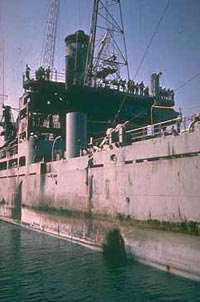
Liberty on June 9

          On June 8, 1967, a perfectly clear day, the American electronic surveillance vessel USS Liberty was in international waters about 30 miles northeast of el-Arish in the Sinai Peninsula, monitoring the signals traffic of the Israelis, Arabs and Russians.  At about 2 PM the ship was attacked by Israeli Mirage and Mysteres fighters, which strafed, bombed and napalmed the Liberty, killing nine crewmen and wounding others.  Their munitions expended, the planes broke off the attack, and the Liberty radioed for help.  The nearby 6th Fleet twice scrambled fighters, but each time they were recalled within minutes, and about 30 minutes after that the Liberty was attacked by three Israeli torpedo boats, which almost sank the vessel with torpedo hits.  They then closed and strafed the vessel, including life rafts that were being launched.  According to the Israeli military, only then did they identify the ship as American and left the scene at 3:30, returning about an hour later to offer help, which the Liberty refused.  34 crewmen were dead and 174 wounded.

The Israelis immediately apologized for what they claimed was an accident, and this explanation was immediately accepted by President Lyndon Johnson and his Secretary of War, Robert McNamara.  Many others, including members of Congress and Secretary of State Dean Rusk, were appalled and believed the attack to have been deliberate.  Surviving Liberty crew were instructed never to talk about the incident under threat of court martial, and while many received decorations, all but one citation said nothing about the identity of the attacker.  Captain William McGonagle received the Medal of Honor, but rather than being awarded the decoration in the White House by the President, as is traditional, he received it from the Secretary of the Navy in an unpublicized ceremony at the Washington Naval Yard.  Stating that it was not their intention to “rule on the culpability of the attacker,” the Navy conducted a 10 day investigation, although the chief of the court, Rear Admiral Isaac Kidd, thought the probe would require at least six months.  This was by far the briefest investigation of a naval disaster in modern American history, and the fact that official letters to families of the casualties, stating it was an accident, were sent out the day before the court convened strongly suggests the investigation was a sham.  The Navy of course concluded that the attack had been an accident.  It remains the official policy of both the Israeli and American governments that it was.

Thanks, Israel!

It was not.  Despite the withholding and editing of documents and tapes, particularly by the NSA, the evidence is overwhelming.  Retired Liberty crewmen, who after all were first-hand witnesses, are adamant in their belief that the attacking Israelis knew it was an American ship.  They have pointed out that in their initial flyovers the planes were so close they could see the faces of the pilots, making it difficult to believe the pilots in turn could not see the 13 foot American flag and other identifying marks and the plainly non-Arabic sailors.  Retired members of the intelligence community have stated they knew it was deliberate and that operators on the Liberty actually overheard the Israeli pilots telling their superiors that it was an American vessel.  Vice-Admiral William Martin claimed the fighters were recalled because it was feared the attackers were Russians, an incredible proposition, and defending the Liberty could thus start a war with the USSR.  It is now known that Johnson, who lies about the affair in his autobiography, personally ordered (through McNamara) the planes recalled, unwilling to “embarrass my ally.”  25 American sailors would subsequently die because of that decision.

Attempts in the last four decades to reopen the investigation have been met with government indifference and outright hostility, even towards the aging survivors of the Liberty.  Afraid to level even the mildest criticism against Israel, virtually no American politician will accuse them of deliberately attacking an American vessel.  There is no conclusive evidence, they say, and what possible reason could Israel have to do such a thing?

If there is no “conclusive” evidence (apart from the eyewitness accounts of the sailors and statements of retired officials), it is because the government, despite the Freedom of Information Act, has refused to release box loads of documents pertaining to the attack.  Further, analysts have concluded that a number of the released audio tapes from that day have obvious gaps.  Why would Washington cover up such a blatant attack on Americans?  As the past 45 years have demonstrated, the apparent Israeli stranglehold on American domestic politics has allowed “our best ally” to do whatever she damn well pleases, even if that includes undermining US interests and constantly violating the international law and covenants we have pledged to uphold.  They have spied on us, illegally resold our military technology, interfered in our elections, detained and abused American citizens of Palestinian origin and insulted one American President after another, yet as the recent parade of Republican candidates made startlingly clear, every national candidate must kneel at the altar of Israel.

Israel has continually demonstrated that she has absolutely no concern for anything outside her own interests and is willing even to use Jews living abroad to serve her ends.  Protected by the United States, the Israelis seem to feel they can get away with any sort of behavior, continually violating the sovereignty of other countries (as we now do), maintaining an open season on Palestinian civilians, intercepting and capturing unarmed vessels in international waters and simply murdering people without apology.             This pattern of behavior certainly supports a deliberate assault on the Liberty.  But why?  There are two possible reasons.  Shortly before the attack the Israeli army had summarily executed several hundred Egyptian POWs in el-Arish (the number is disputed but not the massacre) and may well have been concerned that the Liberty, which was in the neighborhood, had gathered evidence of this war crime.  But far more likely is the planned invasion of Syria.  Washington was putting serious pressure (!) on the Israelis, who were dependent upon American resupply, to end the war, but Israel wanted to seize the Golan Heights and was massing forces for an assault on June 9.  If the US learned of this on June 8, the operation could not take place, and here was the Liberty, monitoring all the electronic traffic in the region.  Remove the Liberty and the problem disappears, as in fact happened.  At 3 AM on June 9 Syria accepted a cease fire, and though informed of this, at 7 AM the Israelis seized the Golan, which was subsequently annexed.

Our best ally indeed.

A Lost Poem by Dylan Thomas


Palestine

Dylan Thomas

Do not go gentle into Zion’s night,

The people must resist at close of day;

Rage, rage against the killing of the light.

Since wise men in their hearts know what is right,

Because their homes are ruined by soldiers they

Do not go gentle into Zion’s night.

Good men, in Palestine, crying how bright

Their land might have been and gay,

Rage, rage against the killing of the light.

Brave men, who fought and put the Jews to flight,

And learn, too late, the children have to pay,

Do not go gentle into Zion’s night.

Grave men, near death, who see with blinding sight

The U.S. has the wealth and pays the way,

Rage, rage against the killing of the light.

And you, my country, there on the feared height

Curse, cease support and shame, I prey.

Do not go gentle into Zion’s night

Rage, rage against the killing of the light.

H.R. 4133: the United States-Israel Enhanced Security Cooperation and Screw the Taxpayer Act

On May 9 the House of Representatives passed a bill that could have a dramatic impact on America’s foreign policy and will certainly cost us a lot of money, but since any news of this legislation was virtually absent from the mainstream media, very few Americans are aware of it existence.  H.R. 4133, the United States-Israel Enhanced Security Cooperation Act of 2012, was slipped through the House under a rules suspension that allowed a quick vote with virtually no debate.  The bill had bipartisan backing, being introduced by Democrats Howard Berman and Steny Hoyer and two particularly loathsome Republicans, who seem to owe their primary allegiance to Israel, Eric Cantor and Ileana Ros-Lehtinen.  (Actually, the bill had “tripartisan” backing, since the American Israel Public Affairs Committee, Tel Aviv’s powerful instrument in America, helped write it.)  The vote was 411-2, only Ron Paul (R) and John Dingell (D) voting against.  How odd that our increasingly dysfunctional and divided government could achieve virtually unanimity on a bill, one that most Americans will never hear of.

Anyone with a modicum of intelligence and honesty already knows what actions counter to our interests Israel’s stranglehold on Washington has forced upon us, but this bill represents a mind-numbing escalation of commitment to a state whose foreign and domestic policies are at odds with what this country presumes to stand for.  In essence the bill is a blank check from the American taxpayer, who will now be obliged to support Israel’s “qualitative military edge” over all its neighbors combined, of course leaving it to Israel and its Congressional supporters (which is to say, almost all of Congress) to decide exactly what that vague phrase means.  Certainly, one thing it means is that we will be sending more of our money out of the country in order to support activities of extremely questionable legality and morality.

The legislation also affirms our commitment to the “security of the State of Israel as a Jewish state.”  This is an interesting development in our “passionate attachment” (G. Washington) to Israel.  We have of course spent decades squandering our money and international credibility on an “ally” whose value to American security and interests (apart from domestic politics) is not at all clear and which continually violates the international law we are pledged to uphold and the basic values that we trumpet to the world.  But now we have pledged (for the first time in our history, I believe) to guarantee the religious/cultural nature of a foreign country.

One might legitimately ask why we should care, unless it was to criticize an oppressive government, which we cannot do anyway in the case of Israel, but more than that, what exactly does this mean?  When the Muslim minority in Israel’s citizen body becomes the majority, as it inevitably will, will the US have to intervene?  When Judea and Samaria (the West Bank) are formally incorporated into Eretz Yisrael will we have to help enforce apartheid or deport all those Palestinians?  If a majority of Israeli citizens voted to declare Israel a secular state, would we have to prop up a minority government?  And exactly what is a “Jewish state,” especially when the majority of inhabitants of the state in question do not practice Judaism?

The legislation requires the US to supply all sorts of equipment for the “defense” of Israel.  Of course, Israel has always been able to utterly smash its enemies, requiring only resupply from a compliant Uncle Sam, and the only potentially threatening neighbor whose military might be improving is Egypt, whose major supplier, America, is hardly likely to provide her an edge.  Included in the list are refueling tankers and bunker-busting bombs, which are obviously offensive weapons, unless of course your definition of defense includes preemptive strikes against other countries, which it does in the eyes of Israel – and increasingly the United States.  What are now called “preemptive strikes” were traditionally labeled “wars of aggression.”  I wonder if the Japanese attack on Pearl Harbor can be called a preemptive strike?  After all, American naval power was a threat to the continued existence of the Japanese Empire.

One particularly frightening part of the bill is the expressed desire for Israel to play an increased role in NATO, included a presence at NATO headquarters and involvement in NATO exercises.  The clear intention is that Israel ultimately become a member of NATO, thus dragging the entire European alliance into her wars and making it complicit in her continued violation of international law.  With that Israel could attack Iran or any other country with impunity, because if the victim dare fight back, the United States and the rest of NATO would be required to come to her aid.  This would be placing an assault rifle in the hands of an ill disciplined child.  But it is hard to imagine Turkey signing on to this plan, and one hopes the majority of European members would also object.  Of course, then Congress would begin looking at an actual treaty with Israel, though given the utter subservience of our politicians to Israeli interests, it would hardly be necessary.

One final slap in our face.  Washington has agreed to put up an additional $680 million (beyond the $3.1 billion we pay every year) to help Israel pay for her Iron Dome anti-missile system and the new F-35 fighter.  Israel has also requested another $168 million for security measures, while the Obama administration has asked for $99.9 million on top of that.  And to make sure poor Israel does not run out of American money the Iron Dome Support Act, introduced by Berman and the ever vigilant Ross-Lehtinen, would require our Treasury to keep shelling out the money.  And here is the joke on us: Israel has this year cut its defense budget by 5% and intends to do the same next year!  Oh, there is a second joke: the United States has absolutely no rights to the technology being developed for the Iron Dome system, which will be marketed to the world by Israel.  Perhaps we can get a special deal.

We have become a silly nation.

Grass Roots on Israel

Nobel Laureate author Günter Grass has just published a short poem entitled “What Must Be Said,” in which he accuses Israel, with its undeclared stockpile of nuclear weapons and constant threat of attacking Iran, of being the real threat to peace in the Middle East.  The poem is hardly likely to enter the corpus of great literature, but in it Grass makes valid points that must in fact be made and has stirred a discussion – at least in Germany – that has been constantly avoided.

Granted, Grass has undermined his position and unnecessarily provided material for his critics by suggesting that Israel is poised to launch a nuclear strike that would destroy the Iranian people, something Tel Aviv is not likely to consider doing.  Even the ever-compliant United States would (I hope) bristle at the use of a nuclear weapon, and in any case in the highly unlikely event that Israel’s incredibly powerful conventional defenses were inadequate, the US would be obliged to step in.

Nevertheless, Grass’ basic point is certainly correct: the only Middle Eastern nation west of Pakistan possessing nuclear weapons is Israel, which has never even been asked to sign the Non-Proliferation Treaty, let alone accept inspection of its facilities.  This bit of grand hypocrisy is hardly surprising, given that America and to a lesser extent Europe have historically granted the Jewish state a blanket dispensation when it comes to accepted international law and behavior.

Critics are screaming at the barest suggestion that Iran may be the victim here, but this is perhaps not as outrageous as it first appears, certainly not from the Iranian point of view.  The West overthrew their democratically elected government in 1923, imposed the utterly ruthless Shah, occupied the country during World War II, created and supported a militarily powerful Israel and encouraged Saddam Hussein in his decade-long war against them.  And now, because of the interests of Israel and the Sunni oil barons, America has declared its (albeit reluctant) willingness to engage in a war of aggression because Iran might be working on nuclear weapons and might have one in a few years.  For all that Iran is controlled by a collection of ideological numbskulls there is at least an aura of victimhood, and certainly no rational person could ever consider imperial Israel a victim.

For the obvious reason of its Nazi past criticism of Israel is very infrequent in Germany.  (Because of domestic politics it is also very infrequent in America, but the utterings of a European author typically do not stir the interest of the self-absorbed American media.)  Clearly, the atrocities of the Third Reich neither justify bad behavior on the part of Israel nor require reasonable Germans to be silent, but as Grass predicts in the poem, any criticism of Israel will result immediately in the accusation of anti-Semitism, which is exactly what happened.

Criticizing Israel is of course no more anti-Semitic than criticizing Germany is anti-German, and Israeli citizens in fact do it every day (only to be branded “self-loathing”).  But so great is western guilt and Zionist influence that it is now generally accepted that gainsaying Israel is in fact anti-Semitic; the latest edition of Webster’s does offer as the second definition of “anti-Semitism” criticizing Israel.  So, one does so at one’s own risk.

Sundry Germans, particularly newspaper columnists, immediately jumped on Grass as an anti-Semite, especially the Jewish writer Henryk Broder, who described the novelist as “the prototype of the educated anti-Semite,” in part for labeling the appropriation of Palestinian land as a criminal act (which of course it is by established international law).  As can easily be imagined, the extreme right-wing government in Tel Aviv promptly branded Grass an unrepentant Nazi, and Interior Minister Eli Yeshai barred the author from ever entering Israel, a petty measure already taken against others, such as linguist Noam Chomsky and Nobel Peace Laureate Mairead Maquire, who dared criticize Israel.  (In 2001 there were calls, unsuccessful, to do the same to Daniel Barenboim, who had the temerity to conduct a piece by Richard Wagner; these people are off the deep end.)  To their credit even some German politicians condemned this fit of Israeli pique.

Grass has on numerous occasions demonstrated himself to be something of a jerk, but he is undeniably a world-class novelist and certainly no ignoramus.  Whether or not one agrees with his appreciation of Israel and its nuclear arsenal, he has clearly made a valid point about the danger of criticizing the Jewish state, a point most Germans apparently agree with.  And a point amply demonstrated by the reaction of Israel, which once again has chosen to erect a wall rather than confront rationally those who dare object to its actions, whether they be Palestinian farmers or German authors.

What must be said

Why have I kept silent, held back so long,

on something openly practised in

war games, at the end of which those of us

who survive will at best be footnotes?
It’s the alleged right to a first strike

that could destroy an Iranian people

subjugated by a loudmouth

and gathered in organized rallies,

because an atom bomb may be being

developed within his arc of power.

Yet why do I hesitate to name

that other land in which

for years – although kept secret –

a growing nuclear power has existed

beyond supervision or verification,

subject to no inspection of any kind?

This general silence on the facts,

before which my own silence has bowed,

seems to me a troubling, enforced lie,

leading to a likely punishment

the moment it’s broken:

the verdict “Anti-semitism” falls easily.

But now that my own country,

brought in time after time

for questioning about its own crimes,

profound and beyond compare,

has delivered yet another submarine to Israel,

(in what is purely a business transaction,

though glibly declared an act of reparation)

whose speciality consists in its ability

to direct nuclear warheads toward

an area in which not a single atom bomb

has yet been proved to exist, its feared

existence proof enough, I’ll say what must be said.

But why have I kept silent till now?

Because I thought my own origins,

tarnished by a stain that can never be removed,

meant I could not expect Israel, a land

to which I am, and always will be, attached,

to accept this open declaration of the truth.

Why only now, grown old,

and with what ink remains, do I say:

Israel’s atomic power endangers

an already fragile world peace?

Because what must be said

may be too late tomorrow;

and because – burdened enough as Germans –

we may be providing material for a crime

that is foreseeable, so that our complicity

will not be expunged by any

of the usual excuses.

And granted: I’ve broken my silence

because I’m sick of the West’s hypocrisy;

and I hope too that many may be freed

from their silence, may demand

that those responsible for the open danger

we face renounce the use of force,

may insist that the governments of

both Iran and Israel allow an international authority

free and open inspection of

the nuclear potential and capability of both.

No other course offers help

to Israelis and Palestinians alike,

to all those living side by side in enmity

in this region occupied by illusions,

and ultimately, to all of us.

Günter Grass

(Translated by Breon Mitchell)