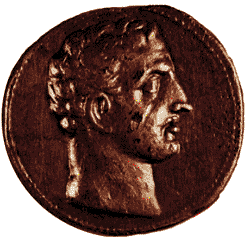
Stuff from Way Back #29b: Roma Aeterna

The last and most critical reason depends upon how one understands life in the Roman Empire, and there is much we do not know about life in the rural areas of the provinces. I am, however, convinced that it was basically good, convinced especially by the belief that the Empire could not have been generally so stable and last so long were its inhabitants generally oppressed. This of course comes close to making a circular argument, but the evidence appears to support the contention that at least until the Anarchy life in the Empire for the average free person was relatively comfortable or at least acceptable. Imperial structures based entirely on fear are simply not stable over the longer run – consider the Assyrian Empire.

 
Strong evidence that the Roman Empire was not such a bad place to live lies in the fact that apart from the Jews the Romans essentially did not have to concern themselves with the revolt of subject peoples. This strikes me as an impossibility were the Empire held together only by fear. There were of course revolts, which were suppressed with great brutality, but they all occur in areas that were recently or incompletely pacified: Gaul in the 50s BC, Illyricum in AD 6, Germany in AD 9, Boudicca in AD 59, Civilis in AD 69, Mesopotamia in AD 116. Once an area had been controlled for perhaps a generation Roman rule was accepted.

 
The one exception was the Jews, who undertook two disastrous revolts against Rome, the results of which were to forever change (and improve) the nature of Judaism by ridding the religion of the temple and all the rituals and sacrifices characteristic of polytheism and allowing it to become more introspective and spiritual. The Jews were a special case inasmuch as their monotheism prevented them from being assimilated into the polytheist Greco-Roman culture of the Empire as were all the other subject peoples. Understanding this, the Romans granted the Jews special exemptions from such things as any obligation to the imperial cult and allowed them more local autonomy, but friction was impossible to avoid. It was not just the religion, which affected every aspect of their society, but also the fact that this religion was inextricably entwined with the idea of a national state, given them by god. This was one thing Rome could not grant, given the strategic importance of Syria-Palestine.

It didn't work out

It didn’t work out

Generally Roman rule appears to have been accepted, certainly once the generation of the conquest had passed. The provincials, a least in the towns and cities, were easily assimilated and ultimately Romanized. The highly urbanized and Hellenized east fit readily into the urban Greco-Roman culture of the Empire; though Latin was the official language, Greek was the real lingua franca of the eastern provinces. In the west Roman civilization was simply at a much higher level of development than that of the Celtic and German tribes and naturally dominated, once again at least in the municipalities.

 
I believe that up until the Anarchy Rome gave more than she took. She obviously robbed the provincials of their nominal independence, but for many, especially in the Greek east, this was meaningless since they had already been under the control of someone else. Self-determination for the Greek states had essentially disappeared with the conquests of Alexander, but Rome had no problem allowing the Greeks and everyone else to run their own cities and communities. In fact, she had little choice but to allow a great deal of local autonomy, since administering the Empire at the grassroots level was beyond the manpower and financial resources of the state. Rome followed a traditional imperial pattern by making alliances with the local elites and drawing upon their experience by allowing them to govern locally under the auspices of the Roman officials at the province level. Such had the additional benefit of shrinking the imperial presence in the lives of the Empire’s subjects.

 
Rome of course also collected taxes. There is a great deal of dispute over what the tax burden was like for the average inhabitant of the Empire, but my estimation is that from the end of the Republic to the Anarchy that burden was not particularly onerous – in general. The civil wars in the first century BC saw the financial rape of the wealthy eastern provinces, but the return to stability and the systemization of provincial administration and tax collection seems to have produced a tolerable level of taxation. In any case, the Empire certainly prospered in the next two and a half centuries, suggesting relatively comfortable or at least livable economic circumstances for most inhabitants. With the Anarchy this changes rapidly, as continual civil war and barbarian invasion drives the government to extremes of revenue collection, which in turn begins to strangle the productive classes of the Empire.
In return the imperial subject received a number of things, the most important of which was peace and security. We tend to underestimate the value of peace because no wars have rumbled through the United States for a century and a half and we are used to it. For most human beings decades, let alone centuries, of peace is a highly compelling commodity. It is clear in the modern world that most people, even in places like America, would gladly trade some of their freedom and civil rights for security and comfort. So, that Gaul who fought against Caesar probably hated Rome, but his grandson would likely think more about the eight legions on the Rhine that prevented the Germans from trashing his farm every summer.
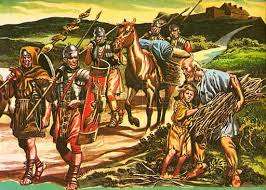
Better than Germans

Better than Germans

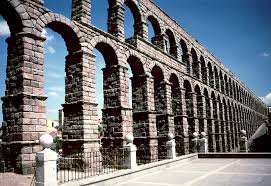
The Empire meant more uniform laws and more efficient mechanisms of justice. This is not to say that the average person was guaranteed justice – as today, money and social standing played a large role – but he certainly had a better shot at it. There were material benefits of course. Those military roads that knitted the Empire together could be used by anyone, dramatically enhancing communications and consequently commerce. In fact, take an area the size of the Roman Empire and guarantee more or less continuous peace for a couple of centuries, and the economy can hardly fail to prosper, assuming reasonable levels of taxation.

 
But far more important, second only to peace, was that the Roman Empire was an open society and became more so as it aged. Rome exported Romanitas, that is, her culture and language, though not through any state directed policy. In the east Romanitas dovetailed perfectly with the Hellenism that had helped shape it, while in the west it naturally overwhelmed the less sophisticated native cultures, at least in the municipalities, which were focal points of Romanitas. Speak Latin and act like a Roman, and few will worry about your Celtic blood.

 
Even the once precious citizenship was available to non-Romans. By the time of the Principate citizenship was politically meaningless on the national level, but municipal politics remained vibrant, and in any case the citizenship brought enhanced social status and some economic advantages. During the Republic, Rome was loathe to extend citizenship to non-Romans – the Italian allies had to revolt to get it – but this hesitation broke down rapidly with the advent of the autocracy. In AD 212 the emperor Caracalla granted the Roman citizenship to virtually every free male in the Empire. Now, he did it as a way to raise more revenues, and being a Roman citizen pretty much lost all its value when everyone was one, but the act is symbolic of the character of the Empire. Henceforth, a Roman who could trace his ancestry back to the early Republic had the same legal status as someone whose ancestors had painted themselves blue and fought Caesar. The conquerors had lost their special status in an increasingly cosmopolitan world. This points the way to the Late Empire, when Italy will simply be another set of provinces.

 
The city was one of the two primary mechanisms for the Romanizing of the Empire. They were the bastions of Romanitas, settled originally by Italians and bringing the trappings of Roman civilization to the provinces. And Rome had an unofficial policy of encouraging urbanization: the more urbanized a province was the more economically active it was and the easier it was to secure. Cities and towns of course also helped spread Romanitas, and they provided higher quality recruits for the provincial military units, who, incidentally, received the citizenship upon discharge.
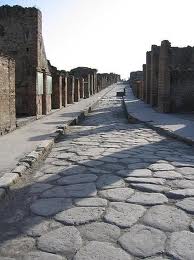
A nice place to raise a family

A nice place to raise a family

The other major Romanizing element was the army, an irony considering that one rarely sees soldiers as a civilizing force. But half the Roman military establishment was composed of the provincial auxiliaries, for whom the army was a factory creating new Romans. One was not going to pick up the finer points of Roman culture in a legionary camp on the Danube, but the recruit learned basic Latin, the essentials of being Roman and came to think of himself as a Roman. It is estimated that during the first two centuries of the Principate the auxiliaries supplied a stream of about 15,000 Romanized provincials a year.

The Empire wants you!

The Empire wants you!

There was a two-way street connecting Rome to the provinces. As she exported Romanitas, she was also importing provincial talent, products of the Romanizing of the Empire. These were people whose bloodlines were not at all Italian but who did not for a minute consider themselves anything other than Roman. The emperors Trajan and Hadrian came originally from Spain, completely Roman but descended at least in part from Iberians. The emperor Septimius Severus hailed from North Africa, and during the Anarchy emperors came all over the Empire.

 
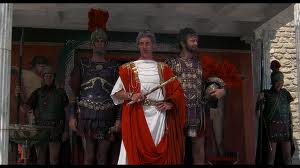
Despite Monty Python’s Life of Brian (the best and truest film ever made about Rome) most people think of the Roman Empire in negative terms – slaughtering Gauls, scattering Jews, oppressing Christians – but to my mind the Empire was perhaps the finest imperial structure ever, which accounts in part for its longevity. This was an incredibly cosmopolitan entity, a rare and seemingly successful multicultural state. The British Empire turned subjects into quasi-Englishmen, but Britain never relinquished its status as imperial master; one was not about to find an African or Indian in Parliament. Rome civilized western Europe and did it without the snottiness and hypocrisy of the British.

Welease Bwian!

Welease Bwian!

What have the Romans ever done for us?” Plenty.

Stuff from Way Back #29a: Roma Aeterna

(I am getting too carried away with these history pieces and must shorten them.  Consequently, this week’s post includes only the first half of the article, and you must wait to find out exactly why Rome was so cool.  I am traveling to Germany for two weeks, so you will have to wait even longer.)


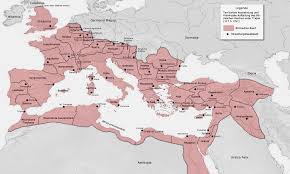
The fall of the Roman Empire has long been the most popular question concerning antiquity, probably because Rome is the most widely known ancient state and because it is the premier empire.  At their peaks the Mongol, Spanish, Russian and British Empires all controlled far more territory than the Roman, but hands down Rome wins the prize for longevity.  (The Chinese “Empire” was essentially a series of relatively distinct Chinese states.)  Beginning as a tiny city-state on the Tiber, a miniscule platform for empire-building compared to the European powers, the Roman Republic methodically conquered and unified the Italian peninsula in two centuries and in another century eliminated every possible rival in the Mediterranean-European world.  The Roman Empire is thus established by the middle of the second century BC, though a great deal of real estate – most of the eastern Mediterranean, northwestern Europe and Britain – was yet to be occupied.

the big one

the big one

The Senate-dominated Republic collapsed in the first century BC, and though “restored” by Augustus in 27 BC (see Stuff from Way Back #26: Image is Everything), the reality was a military autocracy, the Principate.  In AD 235 the Principate gave way to the Anarchy, essentially a fifty year long civil war that vividly revealed the serious cracks in the imperial structure.  A measure of order was restored in AD 285, but in AD 378 the Empire permanently split into a western and eastern half, and the western empire disappeared in the next half century.  If the fall is marked by this final division, then the Empire had lasted some six hundred years; the city of Rome itself had remained unoccupied by a foreign army for eight hundred years.


The decline and fall of such a long-lived and high civilization is understandably a fascinating subject (it had nothing to do with immorality or Christianity), but equally fascinating is a far less frequently posed question: why did it last so long?  Incompetent and outright mad emperors, civil wars, barbarian invasions, military revolts, the Empire went on.  It even survived the Anarchy, a half century of more or less constant civil war, during which barbarians penetrated deep into the Empire, which actually fragmented into three parts at one point.


There are three broad reasons, two of them indisputable historical considerations, the third – and most important – in part a judgment call, though based on the historical evidence.


First, throughout the four centuries of the Late Republic and the Principate and to a lesser degree for another century after that, Rome had no seriously dangerous foreign enemies.  During this long period the Empire had two major foes.  The first was the Parthian Empire.  The Parthians were an Iranian people who established a kingdom in northeastern Iran in the third century BC and expanded south and west as the Greek Seleucid Empire declined.  The kingdom ultimately stretched from Iran to the frontiers of Roman power in eastern Anatolia and in Syria, where constant friction emerged during last century of the Republic.


Parthia was, however, more of a nuisance than a real threat, raiding and capturing Roman territory only when the Romans were distracted, as during the civil wars that brought down the Republic.  (See Stuff from Way Back #21: Antony, Cleopatra and Who?)  Parthia was a very decentralized state, with local governors possessing a great deal of autonomy, and the central government often wrestled with dynastic problems as well.  Unlike the Romans of the Principate, Parthia had no professional standing army, though it could quickly mobilize levies and raise effective horse archers and armored lancers, as M. Licinius Crassus discovered in 53 BC with his defeat and death at Carrhae.  Further, the Parthian king had his own problems with barbarians on his northeastern frontier and commanded far less economic resources than Rome.

next door neighbors

next door neighbors

The relative weakness of Parthia was constantly demonstrated when the Romans were able to easily deal with Parthian incursions even before solving their own problems that had led to the aggression.  Most vividly, there is the emperor Trajan’s rapid conquest of the Parthian heartland in AD 114-117.  That the entire area was immediately evacuated by his successor Hadrian is not a reflection of Parthian strength but a recognition that Rome did not have the manpower necessary to garrison a large area that could not be easily assimilated into the Greco-Roman culture of the Empire.


In AD 224 the declining Parthian Empire was seized by a new Iranian group, the Sassanid Persians, whose new empire was essentially a reprise of the Parthian.  The Persians did, however, develop heavily armored cavalry (but still no stirrups) and siege equipment and tactics, vital in fighting the well-equipped Romans.  The emergence of a new dynasty also generated a new aggressiveness, and this was at a time when Rome was on the brink of the Anarchy.  Still, even during the Anarchy and the frequent civil wars of the late Empire Persia could not permanently occupy Roman territory.  Actually, Persia’s greatest threat to Rome was simply being there, a new Persian Empire that constantly lured foolish and incompetent Roman emperors to attempt to emulate Alexander and launch expensive and pointless invasions of the east.


Rome’s only other enemy was not a coherent state but a category: barbarians.  The barbarians in north Africa were hardly noticed, and those in and around Britain were simply annoying.  The Germanic tribes were a lot tougher and prowled a frontier that stretched from the mouth of the Rhine to the Black Sea.  Nevertheless, they were never any problem for competently led legions, and even during the Anarchy, when tribes were able to penetrate deep into the Empire, they were soon mopped up.  Only with the great folk migrations of the late fourth century and later did they become a serious problem, and one suspects that had the government and army of the fifth century been equal to that of the first, they could have been routinely dealt with.

Thus was the outside pressure on the Empire minimal and relatively easily countered, and Rome could consequently indulge in bad government, a declining military and even a half century of continuous and devastating civil war and not lose it all.


The second factor is the development of an imperial bureaucracy.  The institutional history of the Republic, which built the Empire, was one of constantly adapting the political mechanisms of the old city-state to the demands of a growing and vastly larger political sphere.  The administration of the Empire consequently had an ad hoc and jury-rigged character, and the governance of provinces was in the hands of successful office-holders, frequently in debt because of their political career, and their personal staffs, which almost guaranteed corruption.  And the fact that taxation was privatized and in the hands of groups whose profit margin depended upon how much they could collect over their bid for the contract certainly did not help create could provincial government.


It is astounding that the extent, frontiers, garrisoning and administration of the Empire were not considered rationally and apolitically until Augustus and the advent of the Principate.  Not only did he approach the Empire in terms of grand strategy and Roman resources and regularize and depoliticize provincial governance, but he also laid the foundations of an essentially apolitical civil service.   From this grew an imperial bureaucracy that handled the day-to-day administrative affairs of Rome and the Empire.  In short, the administration of the Empire became routine, allowing it to continue functioning regardless of whether or not the emperor was competent or even in the event of civil war.  Rome could indulge herself in bad government and not lose it all.

Stuff from Way Back #27: Achilles and Aeneas, Alike and Unlike

he Greeks and Romans are, at least since the Renaissance, inevitably associated with one another and clearly differentiated from the Near Eastern societies that preceded them and the barbarian societies that succeeded the collapse of the Roman Empire. They constitute Classical history/antiquity/society, their architecture, arts and languages are Classical and their literature constitutes the Classics; the two millennia of urban civilization before them are pre-Classical. And in many ways Roman civilization appears to be simply Greek society translated into Latin. The two societies do indeed constitute a recognizable and unique period of history, easily distinguished from what came before and what came after, yet the two peoples were very different in character, which accounts for the obvious differences in their histories. The Greeks were the Beatles of antiquity, dabbling in everything and pumping their genius into almost every aspect of culture and politics; the Romans were the Rolling Stones, incredibly good at one thing, the hard-driving rock and blues of the maintenance and expansion of power.

Romans

Romans

Greeks

Greeks

Originally barbarian cousins in the extensive Indo-European migrations of the second millennium, both peoples began with roughly the same social and political institutions, common, it seems, to all the Indo-Europeans, at least while they are still on the move. Most critically, this included a weak kinship and the tradition of an informal assembly of warriors that heard and advised the king and was theoretically the source of his authority, an idea radically different from the sophisticated kingships of Egypt and Asia, which derived their authority from heaven. The Greeks and Latins would be the only groups that developed agriculturally based urban societies without losing these core political institutions characteristic of their hunting and gathering past and would consequently be the only ones to evolve actual constitutional polities in which the power exercised by the state was considered to derived from the people, at least in theory.
This accounts for the remarkably parallel political development of the Greek and Latin city-states from petty tribal kingships to sophisticated democratic republics. The driving engines behind this were the changing economic environment, as growing wealth produced new economic elites that challenged the traditional arrangements, and the emergence of the citizen army, which gave increasing reality to the old notion that the people were at the root of political power. Thus the Latin and Greek proto-cities eliminated their kings and established the basic mechanisms of the constitutional state: precisely defined law, citizen assemblies and elective limited term magistracies. With as many as a thousand independent city-states the Greeks had a larger social laboratory and produced in some cases the most complete democracies the world has ever seen, whereas in Italy the dominance of Rome over the other Latin towns resulted in a single powerful city-state, Rome.
But there were differences, some of them profound. The Greek kingship apparently withered away over a period of centuries during the Greek Dark Age, while the Romans clearly overthrew their last king in historic times. The Greek transition from aristocracies of birth to oligarchies of wealth took a generation or two (the Age of Tyrants) and in many cases involved violence, whereas in Rome the transition required two centuries (the Struggle of the Orders) and was remarkably free of political violence. The Greeks produced radical democracies, but Rome, though technically democratic, never went beyond an oligarchy of wealth. The Greeks excelled in the arts and affairs of the mind; the Romans were great administrators and engineers. Despite a common language and culture the Greeks remained fragmented, and the empires of the fifth and fourth centuries were short-lived; even the huge Macedonian controlled empires of Alexander and his successors were relatively fragile. The Romans of course steadily expanded their power, conquering Italy and the Mediterranean world over a period of little more than three centuries and establishing an immense empire that would endure for almost another five hundred years. This power thing in particular baffled the Greeks, who could not understand why the Romans, who began with the same political, social and military equipment as themselves, could so easily become the stable imperial power that always eluded them. And being almost effortlessly conquered by a people they considered in so many ways intellectually inferior did not help.
Greek thinkers, like the historian Polybius, had trouble seeing beyond the institutions that made the two societies appear so similar. What apparently escaped them, at least in trying to understand Roman history, was something relatively simple: national character. The most important facet of the Greek character, affecting everything they engaged in, was agōn, the need to compete and struggle, which consequently enhanced the importance of both the individual and his city. The Greeks were most definitely not team players. The Romans were. Their prime character directive was pietas, duty, the compulsion to fulfill ones obligations to the family, the gods and the community, which ultimately meant the state. They were incredibly conservative, which slowed their evolution, but at the same time they were also eminently practical, which saved them from that conservatism. While the Greeks theorized, the Romans just did it – and did it differently if the traditional way no longer worked.


Consider the national heroes of the two cultures. For the Greeks it was the Homeric warriors, especially Achilles, extreme and narcissistic individuals who ultimately cared for only one thing – themselves. For them the major importance of the group was simply defining their individual honor, in defense of which they would gladly sacrifice their lives. The Roman heroes, on the other hand, were all men whose defining quality was the willingness to sacrifice for the group. Aeneas, the premier Roman hero, abandons Dido and the kingship of Carthage in order to fulfill his destiny as the ultimate founder of Rome. At great cost to himself he honors his duty to a state that will not even exist for another four hundred years.  Incidentally, Aeneas, though technically a Trojan, is a figure out of Greek literature, a Greek creation, yet the Romans  came to believe that he was the ultimate founder of Rome.
Why these character differences? It probably had much to do with their respective environments. The Balkan Peninsula, especially in the south, is a land of limited resources, notably arable land, and scarcity inevitably encourages competition. In contrast Italy possesses a great deal of good farmland, and Latium, the coastal area where Rome is situated, is particularly bountiful. This is not to say that the early Romans were devoid of any competitive spirit, but rather that survival in the relative economy of scarcity that was Greece instilled in the Greek psyche a far larger measure of competitiveness and aggressiveness. This is hardly a completely satisfactory explanation, but then, I am not a cultural anthropologist.
The Greeks competed in everything (even sex was seen as a kind of competition), which goes a long way in explaining their history and society. They competed in athletics, music and drama; trierarchs competed in equipping the fastest trireme. The incredible cultural explosion of the sixth and fifth centuries clearly has its roots in agōn; societies that are comfortable simply have less motivation to ask questions, to think new thoughts, to create new things. Archaic and Classical Age Greece (8th – 4th centuries) was, like the Renaissance, filled with struggle, and the result was the perhaps the most important intellectual discoveries in history. By way of contrast Old and Middle Kingdom Egypt (27th – 18th centuries) was the most materially and spiritually comfortable society in antiquity, and in the course of a millennium virtually not a single new idea was produced.

Roman genius

Roman genius

Greek genius

Greek genius

But the drive to compete had a down side. City-state governments were very unstable, and political violence was always just outside the door. More devastating of course was the seemingly endless warfare, as each city competed with its neighbors, not just for resources but also status. The city-state was a narcissistic entity, a polity with attitude, and warfare was the ultimate expression of superiority – at least if you won. So deeply ingrained by constant competition was the idea of autonomy that inter-city structures were inevitably based on force or the threat of force, as with the Athenian Empire or the Peloponnesian League, and unity eluded the Greeks until it was imposed from without. Common efforts, such as the defense against the Persian Empire, were extremely difficult, and Greece’s ultimate downfall emerged from her inability to cooperate for the common Hellenic good. It was left to the Macedonians monarchy, the most backward of Greek states, to dominate the Balkan Peninsula and conquer Persia.
The Romans of course also enjoyed a powerful sense of superiority – what successful culture does not – but it was not so all-consuming as with the individual Greek cities. In establishing control over the other Latin towns Rome was able to some extent to share authority and even her citizenship, something unthinkable for the Greeks. Roman arrogance took a back seat to practicality in dealing with defeated non-Latin peoples in Italy, and the Romans were able to create alliance structures that left them stronger and in complete control but offered sufficient mutual benefit to provide for long-term stability. The so-called Italian allies were thoroughly subordinate to Rome yet came to regard themselves as actual allies and ultimately as Romans, thus providing the manpower base that would allow the conquest of the Mediterranean world.

Roman genius

Roman genius

Greek genius

Greek genius

The Roman saw the world around him as a network of obligations, and honor was rooted in fulfilling those obligations. This makes for a very well-knit community, and the political factionalism that plagued the Greeks remained well leashed until the last century of the Republic. The Roman was inclined to accept rather than challenge authority, at least if he considered it legitimate, and as a result, the Senatorial elite smoothly governed Rome for four hundred years, even though for most of that period the Senate possessed no actual constitutional powers but was simply an advisory body. Once again, unthinkable for the Greeks. The system only broke down when the Senate was corrupted by power and wealth, and serving oneself edged out serving the state.
Ironically, but not surprisingly, both peoples initially considered the other barbarians. The Greeks clung to this notion well into their role as provincials in the Roman Empire, an idea perhaps sustained in the face of overwhelming Roman success by the fact that the new masters were so clearly impressed by the Greek cultural achievement. The Romans could hardly deny that achievement, as they learned Greek, imitated Greek arts and looted the statuary of the Hellenic world. So, the Greeks were not barbarians, like the Gauls and Germans; they were just effete.

 
The Hellenizing of Rome began long before Roman legionaries were traipsing about the Balkan Peninsula, and “captive Greece” captured Rome centuries before it actually became captive. The Greek Age of Colonization (late 8th – 6th centuries) saw Sicily and the coastal areas of southern Italy so thickly settled with Greek cities that the area became known as Great Greece, and young Rome could hardly resist the influence. Cumae, the northernmost and possibly earliest Greek establishment in Italy, was barely a hundred miles southeast of Rome, and the tendrils of Hellenism were already caressing the city on the Tiber while it was still being rules by kings. Roman culture was not quite a blank slate, but a couple of centuries behind the Greeks in their development, the Romans were simply overwhelmed.

Greek genius

Greek genius

Roman genius

Roman genius

The Latin alphabet is derived from the Greek, and the more defined and sophisticated Greek gods had such an impact that native Italic deities gradually disappeared, supplanted by the Greek pantheon with Latin names. Greek literature was so far advanced that the earliest examples of serious Latin literature are written in Greek. The Romans copied the hoplite phalanx, the more efficient heavy infantry formation invented by the Greeks, though characteristically, when it ran into trouble operating in the central highlands, they seriously modified it, copying weapons used by their opponents. Greek heavy infantry ended in the dead end of the Macedonian phalanx, while the Roman version grew into the legions.
In a very real sense Rome’s major legacy was preserving virtually intact the Greek achievement. The Greeks simply could not create stable long-term imperial structures, and while the discoveries of the Greeks would not have simply vanished without the Roman Empire, they would have suffered. Hellenized at such an early stage, Rome and her empire embraced Greek culture, and the extent and incredible duration of that empire insured that the grand ideas of the Greeks would be fixed at the heart of European civilization.

Stuff from Way Back #26: Image Is Everything


In 31 BC Octavian (Gaius Julius Caesar Octavianus), grand-nephew and posthumously adopted son of Julius Caesar, defeated Marcus Antonius and Cleopatra VII at the battle of Actium, ending the Roman Republic’s period of civil war.  Most of the people on the planet have likely heard of Antony and Cleopatra, but who has ever heard of Octavian?  The irony is that the romantic and celebrated couple are relatively unimportant figures when compared to the colorless Octavian.  They were simply another set of leading players during the last century of the Republic, while Octavian might be considered the most important individual in the entire sweep of Roman history.


By the middle of the second century BC the Roman Empire had been established, at least in the sense that there remained no power in the Mediterranean world that could seriously challenge Roman authority.  At the same time, however, the pressing need for reform in the state and military ran up against an all-powerful Senatorial class that had become corrupted and self-interested and resistant to even the smallest changes in the status quo.  The result was the Roman Revolution, which in the period from 133 to 30 BC saw the almost four hundred year old Republic gradually collapse into civil war and military dictatorship.  Ironically, the Republic was already dead when the dictator Lucius Cornelius Sulla restored and strengthened the traditional Senatorial government in 83-81 BC and then retired from politics.  Putting the pieces back together again was no longer possible, and Sulla himself provided a role model for future ambitious men.  The second fifty years of the Revolution was dominated not by the Senate but by powerful men and their armies, resulting in two full blown civil wars: Caesar against Pompeius Magnus (49-48 BC), and Octavian against Antony and Cleopatra (32-30 BC).

 Loser

Loser

Loser

Loser


When the 33 year old Octavian returned to Rome in 29 BC, he faced a task that might make the battle against the happy couple seem easy.  The Republic was dead, and as the immediately failure of the Sullan Restoration had demonstrated, it could not be revived.  With some small alterations the machinery of the Republican government was essentially that of the 5th century BC city-state fighting for its life in central Italy, and in the long run it was politically and administratively incapable of running an empire.  Enjoying the complete support of the military, Octavian could establish a blatant dictatorship, as his grand-uncle did, and allow Rome to face a return to civil strife when he died.  As one of Rome’s greatest statesmen, however, what he wanted was to manage the inevitable transition from oligarchic republic to autocracy in a way that would create a stable and lasting governmental structure.  In doing this he would become a second Romulus, virtually re-founding Rome.

Winner and Princeps

Winner and Princeps


While he almost certainly began with a basic idea of what he wanted to do, the realization of that conception would involve much trial and error, and the process would be accompanied by the first real national propaganda campaign in history.  He realized, unlike any before him, that in the public and political sphere image was everything, that the reality could be more easily ignored and accepted if it looked like something else.  The reality was to be a military autocracy; the image was to be the Republic restored.  And it actually worked.  His creation, the Principate, would maintain a stable and prosperous empire for the next two hundred and fifty years and allow a declining Rome to stagger on for another century or so.


The basic problem was to maintain control of the military (which was finally fully professionalized), without looking like a military dictator, and he needed to find Republican precedents for all his arrangements.  He also needed to give the hitherto ruling elites, the Senatorial class, a real role to play in the new government without surrendering the ultimate power in the state.  This was tricky business.


The campaign began in January of 27 BC when with great fanfare he gave up all his illegal powers, declaring the restoration of the Republic.  The Senate, in part cowed by the obvious loyalty of the army to the son of Caesar, in part grateful and supportive of establishing a stable government, then proceeded in the following years to vote all those powers back to him.  He realized early on that continually holding one of the two annual consulships – the supreme office that provided imperium, the power to command troops – would not work.  Not only was this contrary to old Republican tradition and reminiscent of the years of the Revolution, but it also limited the ultimate political prize and administrative training ground that the consulship provided to the Senate.  Instead, by votes of the citizen assembly and the Senate he accumulated and exercised all the powers associated with the consulship and other state offices without actually having to hold any of them, thus being freed from the limited tenure of the actual office.  He subsequently held the consulship only on special occasions.  There was no office of emperor.  He was ostensibly a private citizen, but one possessing a vast amount of power.

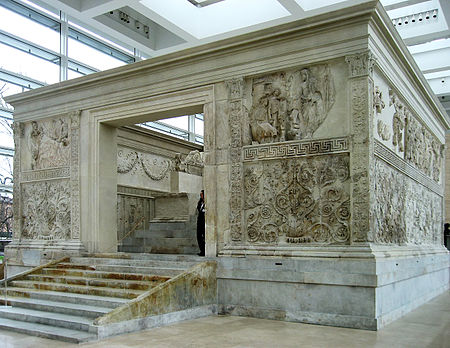
Augustan propaganda: the Altar of Peace

Augustan propaganda: the Altar of Peace

Augustan propaganda: the Deeds of the Divine Augustus

Augustan propaganda: the Deeds of the Divine Augustus


The major support of his authority was a special grant of proconsular imperium over certain provinces designated as “imperial”: initially the Gauls, the Spains and Syria.  These would be governed by legates chosen by him, while the remaining provinces, designated as “senatorial,” would be governed as they were in the Republic, by Senators who had just completed their terms as consuls or praetors (the imperium-granting office just below the consulship).  He also had the authority to interfere in the senatorial provinces if necessary and to move provinces from one category to the other.


This arrangement provided a way to control the army without actually being a supreme commander, which would be very un-Republican and redolent of the civil wars.  The imperial provinces were precisely those where the bulk of the military was stationed, thus providing Octavian with indirect command of the legions.  Grants of proconsular authority dated back to the early days of the Republic, but the only precedents for proconsular power on this scale were found in the Revolution and thus not very good.  But it could not be avoided: he absolutely required “legal” control of the military or Rome would slide back into civil strife.  Consequently, the confirmation of this power, first for ten years and then for life, was done quietly.  Incidentally, governance of the imperial provinces was generally of a higher quality than in the senatorial.


The other significant power granted him for life was the tribunician authority, which provided him all the powers wielded by the tribunes of the people.  These powers were really not that important to him, but the grant was very significant in terms of image.  The tribunate was an ancient office, created back in the fifth century BC, during the political struggles between the commoners, Plebians, and the aristocrats, Patricians.  The original mandate of the ten tribunes was to defend Plebians from hostile actions of the Patricians, and consequently Octavian could showcase this authority to demonstrate his position as a defender of the Roman people.


Supplementing his legal powers was his unmatchable auctoritas.  Auctoritas, “influence,” came with dignitas, “prestige,” the quality associated with an individual who had served Rome in some capacity.  In the grand days of the early and middle Republic it was dignitas that Senators competed for, rather than wealth and power, though dignitas did bring a form of power with its accompanying auctoritas.  (Yes, for almost four hundred years the majority of the Roman Senate actually thought first of Rome rather than themselves.)  The man (or men) recognized to be covered with the most dignitas would be styled princeps senatus, the First or Dean of the Senate.  Prestige of course brings political influence in any system, but for the Romans it was a much more real and compelling power.  And Octavian, who had literally saved the Roman state and restored order and prosperity, had a measure of dignitas unparalleled in Roman history.  He had become the princeps romani, the First Citizen of Rome.  Romans would listen to his advice.


Rome had become a military based autocracy, but there was no actual office of autocrat, no emperor, inasmuch as that would hardly look republican.  There was instead a Princeps and thus the early empire (27 BC – 235 AD) is known as the Principate.  Octavian took the more impressive name of Augustus and became in effect the second founder of Rome and its first emperor.  To the Roman people he was Princeps, to the army he was Imperator and to the provincials he was king and the center of the imperial cult of Roma et Augustus.  In the year 2 BC, acting on the proposal of Valerius Messalla, who had fought against him at Philippi, the Senate named Augustus pater patriae, the father of his country.

Pater Patriae

Pater Patriae


The Roman people were delighted with the Principate.  There was peace and growing prosperity, and in any case libertas, the Roman concept of freedom, had for them never meant any political participation beyond attending assemblies and voting according to Senatorial advice.  The Equestrians, the traditionally apolitical business interests, were of course more concerned with stability and prosperity than forms of government.


It was the Senatorial families, the former ruling elite, that were Augustus’ real concern as a potential source of trouble.  So he made them partners in the new order, both to give them something to do and to reconcile them to the Principate.  He actual had no choice: he could not govern the empire without the pool of administrative talent that was the Senate.  They were of course junior partners, but while the Princeps was the ultimate power, the Senate administered the state and through its ex-officials the empire.  They could still compete for offices and honors, for dignitas, but now in the shadow of the Princeps, who worked to keep that shadow as small as possible.  He showed the Senate respect and listened to its advice, and with imperial patronage he aided the political careers of members of the old families, especially those who had been against him.  And the whole thing looked like the Republic.  In fact, Rome was still in theory a constitutional state, inasmuch as it was the Senate, representing the Roman people, that voted the Princeps his power.  Image is everything.


Augustus succeeded in his establishment of a military dictatorship for a number of reasons.  The Roman world was tired of instability and war; they had just emerged from a century of struggle and two recent civil wars.  There was no one left alive who knew the Republic as anything but disorder and strife.  There were no rivals left.  The Senatorial oligarchy had been drained, and all the powerful men were now loyal to Augustus.  And there was the Principate.  Anyone with any intelligence knew the restoration of the Republic was a sham and that Augustus was the absolute ruler of Rome, but the Senate had no choice but to accept it.  The legions were completely devoted to the son of the now divine Julius Caesar, so that while there might be conspiracies, there could be no real threat to the Princeps.  Besides, he gave them a real role in the governance of the state and left them with all the trappings of power, while he maintained a low profile.  He made it as easy as he could for the former rulers of Rome to swallow the bitter pill of autocracy.


Finally, he lived long enough, dying on 19 August 14 AD at the age of 76.  Some forty years of power had allowed him not only to construct the Principate but also to wean it from dependency on his guiding hand.  Power passed more or less smoothly to his adopted son Tiberius.


There were of course weaknesses in the structure of the Principate.  It was after all an autocracy and thus faced the age old problem: what do you do when you get a bad autocrat?  Augustus hoped that each Princeps would select and train the best candidate and gradually associate him in power, but autocracies almost inevitably become dynastic, even in the Democratic People’s Republic of Korea.  This was virtually guaranteed in the case of the Principate since for the foreseeable future the Princps must be a Julian in order to secure the loyalty of the army.


The other problem was that the autocracy was based on the military, thus presenting the danger that the army would sooner or later involve itself in the making and breaking of emperors.  The remarkable thing about the Principate is that it took so long for the legions to actually do this.  When Nero, the last Julio-Claudian, died in 68 AD, several army commanders converged on Rome, and after a brief and limited conflict Titus Flavius Vespasianus became Princeps in 69 AD, establishing a new dynasty, the Flavians.  The legions then retired to their camps and did not get directly involved in the political arena again until the death of Lucius Aurelius Commodus in 192 AD.  There was another brief but more widespread civil war to select the next ruler, Lucius Septimius Severus, in 193 AD.  The army was subsequently favored but not pampered by the Severans and remained loyal to the empire.  It is only with the outbreak of the Anarchy (235-285 AD) that the military loses that sense of duty and becomes corrupted and interested only in itself and thus a major force in the ultimate collapse of the empire.


Augustus probably foresaw these problems, but what else could he do?  In the last century before Christ the Roman Republic was irretrievably dead, and the only option was an autocracy.  And the only real base of power for that autocracy was the military.  Given the circumstances and the evolution of Rome in the last century of the Republic, a military dictatorship had become unavoidable.  But it is hard to see anyone else who could have come even close to facilitating that transition and preserving Rome’s future as well as Gaius Julius Caesar Octavianus.  Few men have made history on that scale.

Stuff from Way Back #1 Redux: Happy New Year, Q. Fulvius Nobilior

(A slightly different version of this piece was published more than two years ago, my first Stuff from Way Back.  It is perhaps my favorite anecdote from antiquity.  I am reposting it for the New Year and because I am a bit short of time.  It makes an excellent New Year’s Eve party anecdote, at least before everyone is gasolinoed.  Happy New Year, though I expect it will just see our country slide further into silliness and stupidity.)


Ever wonder why the year begins on January 1?  Probably not.  It is the sort of thing that is such an established facet of life that it never occurs to one to ask why:  “Because that’s when the calendar begins,” which is of course not much of an explanation.  That’s akin to saying because the previous year ends on December 31.  But consider: why should we begin our year in the middle of the winter and on a day that has absolutely no significance, except that somehow it has become the first day of the year.  Why not on a day that has some significance in nature, such as the equinoxes and solstices.  Or considering the importance of agriculture, why not in the spring, when life returns, or fall, when the harvest is in?


In fact, in antiquity states typically began their calendar years in the spring or in the fall with the harvest.  So, what happened?  Well, it’s because of the Romans and an otherwise relatively trivial event in their history.  It begins with the defeat of Hannibal.


Part of Rome’s booty in the Second Punic War (218-201 BC) was the Mediterranean coast of Spain, formerly territory of the now defunct Carthaginian empire.  The Romans of course had no intention of allowing this area to go free, but neither were they moved to any campaign of conquest in the Iberian peninsula.  Italian capital and manpower were exhausted by  the long and costly struggle against Carthage,  and the first half of the second century BC was filled with major conflicts in the Greek east.  The result was that the Roman occupation of Spain was haphazard and slow, driven by the desire to exploit the natural resources and to protect the coastal communities from the natives of the interior.


The Roman Senate was loathe to create provinces; they had to be administered and garrisoned, which was expensive.  Nevertheless, there were in Spain no potential client kingdoms ready at hand, and consequently the Spanish possessions were organized into two provinces in 197 BC.  But poor Roman administration led in that same year to the first serious insurrection, and crushing it triggered the First Celtiberian War (181-179 BC).  Relative peace then lasted until the outbreak of the Lusitanian War (154-138 BC), during which occurred also the Second Celtiberian War (153-151 BC) and the Third Celtiberian (or Numantine) War (143-133 BC).  Thus it was that three quarters of a century of cruel and bloody counterinsurgency warfare were necessary to pacify the peninsula, and the job was not actually completed until the reign of Augustus, the first emperor, at the end of the first century BC.  The Spanish provinces then went on to become the most peaceful and Romanized in the empire.


When in late 154 BC a number of Celtiberian tribes, encouraged by the Lusitanians, revolted, Rome appointed Q. Fulvius Nobilior commander of four legions about to be sent to quell the revolt.  Nobilior had just been elected consul, one of the two annual magistrates who were the executive heads of the Roman state.  The consulship, like the subordinate praetorship, conferred upon its holder imperium, the superior form of official power, one element of which was the all-important power to command troops.  The consuls (and to a lesser degree the praetors) were thus Rome’s generals.


The consuls and most of the other important magistrates began their terms of office on  the Ides of Martius, that is, March 15, which consequently placed the beginning of the Roman civil year at roughly the vernal equinox (March 21) and the beginning of the seasonal year.  The Senate was anxious to get Nobilior to Spain as early as possible in order to extend his campaigning season, but until he actually took office some three months hence the consul-elect had no authority to command troops.  Preeminently pragmatic, the Romans solved the problem and avoided any constitutional crisis by simply moving the beginning of the civil year, and thus Nobilior’s term, to the Kalends of Januarius, that is January 1.


When the new year began had never been of much importance in the generally sloppy and conflicting calendars of the ancient Mediterranean, and the Romans, seeing no compelling reason to move the beginning of the civil year back again, left it on 1 January.  (Coincidentally, Januarius was named after the god Janus, who as the god of gateways and transitions looked both ways, making the month of January very apt as the first of the year.)  This day was thus enshrined as the beginning of the year in the Julian calendar, which was passed on to Europe and much of the rest of the world.  Because of the Roman Senate and an obscure Iberian war, the vast majority of the human race celebrates New Year’s in the middle of the winter.


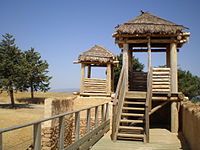
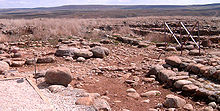
Reconstruction of Numantia's fortifications

Reconstruction of Numantia’s fortifications

Ruins of Numantia

Ruins of Numantia

Incidentally, in August Nobilior’s army was ambushed by the Belli and Arevaci on its way to capture the city of Numantia in north central Spain and lost 6000 men, and it was only saved from complete annihilation by his Roman cavalry.  He never did take the city and was replaced the following year.  The war went on.

Stuff from Way Back # 21: Antony, Cleopatra and Who?

tony and Cleopatra are perhaps the most famous romantic couple in history, thanks to Augustan propaganda, Shakespeare and Hollywood, and consequently the actual people and their lives have been seriously distorted.  At the same time, Octavian, the winner of the civil war and first emperor, who was in fact far more important to history than the happy couple, has been relegated to relative obscurity and a distinctly unromantic role.  Richard Burton and Elizabeth Taylor played Antony and Cleopatra; Octavian was portrayed by Roddy McDowall.

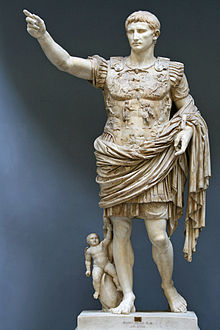
Octavian/Augustus

Octavian/Augustus

Marc Antony

Marc Antony

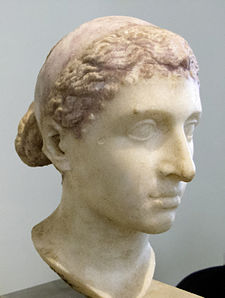
Cleopatra VII

Cleopatra VII

Marcus Antonius was born into as noble family, most likely in 83, (all dates are BC) and was said to have spent his youth in dissipation.  He grew up in the later stages of the Roman Revolution (133-30), the hundred year descent of the Republic into political instability and ultimately civil war.  In 54 he joined the military staff of one of the major contenders for sole power, his mother’s cousin Gaius Julius Caesar (100-44), and quickly demonstrated his military talents during the course of the Gallic wars.  The two men became fast friends, and Caesar supported Antony in his political career, the younger man becoming the proconsul’s right hand man in Rome.  In 49 Caesar crossed the Rubicon River, initiating a civil war between him and Pompey the Great (106-48), who was defeated in 48 and fled to Egypt, where he was assassinated by an officer of the boy king Ptolemy XIII (62-47).

Pursuing Pompey, Caesar arrived in Alexandria and supported Cleopatra VII (69-30) in the civil war between her and her younger brother.  Ptolemy was killed, and Caesar installed Cleopatra as co-ruler with another brother, Ptolemy XIV (60-44).  He dallied a while with the queen and had an illegitimate son, Caesarion.  He then went off to defeat the remaining Pompeian forces and return to Rome, where he was joined by Cleopatra, Ptolemy and Caesarion in 46.  Two years later Caesar fell to the knives of the assassins, and Cleopatra, who was not popular with the Roman crowd, returned to Egypt, where she killed Ptolemy and made Caesarion her co-ruler.

Meanwhile, back in Rome Antony was primed to step into Caesar’s sandals, rousing the mob against the conspirators, who ultimately fled to Greece and began raising an army.  Unfortunately for Antony, Caesar had in his will posthumously adopted as his son his closest legitimate male heir, his grandnephew Octavian, to whom he left his considerable personal fortune.  But Octavian was only eighteen, in Greece and completely unknown to the Roman public, and Antony began spending the inheritance and public funds to raise troops.  Octavian was dismissed as the “boy,” about whom Cicero said “the boy is to be praised, to be honored, to be set aside.”  But the boy had two assets: he had a political talent completely unmatched by his opponents and he had the name of Caesar, something with which he could conjure.  Very quickly Caesarian legions and veterans were flocking to his side, to Gaius Julius Caesar Octavianus, the son of the soon to be deified Caesar.  He was not to be set aside.

the boy

the boy

the chick magnet

the chick magnet

For the moment Antony and Octavian needed each other, and in 43 the Second Triumvirate was formed with another of Caesar’s officers, Marcus Aemilius Lepidus.  Lepidus was, however, a lightweight, and he would be retired by Octavian in 36, when he tried to assert his independence.  Essentially, Octavian ruled over the western half of the Empire, while Antony went off to the wealthier, though now drained, east to launch an invasion of Parthia, the kingdom currently occupying Mesopotamia and Persia.  He was looking for glory, money and most important, a veteran and loyal army to use in the inevitable showdown with Octavian.  All Octavian got was an Italy that was financially exhausted and in social turmoil and a surviving son of Pompey who seized Sicily and threatened Rome with starvation.  On the other hand, though Gaul had been assigned to Antony, he had the immediate access the legions stationed there, and he surely realized that for all its current problems Italy was the key in the struggle inasmuch as it was the source of men for the legions.

Antony had met Cleopatra after the defeat of the conspirators in 42 at Philippi in Greece and confirmed her position as queen of Egypt, but he had to immediately hasten back to Rome.  When he returned to the east, he rejoined Cleopatra and possibly married her in 36, creating an awkward situation since he was already married to Octavian’s sister Octavia.  But this made him king of Egypt and provided access to the bulging treasuries of the kingdom, which money he certainly needed.  In 36 he began his assault on Parthia, but his ally the Armenian king deserted him, and he was forced to retire to Syria, his military reputation undermined rather than enhanced.  A successful expedition to punish Armenia in 34 restored his prestige and was followed by what was the biggest news to come out of the east: the Donations of Alexandria.  By virtue of the proconsular power he possessed as a Triumvir Antony gave to Cleopatra and her children Cyprus, Cyrene, Syria-Palestine, Cilicia and Armenia, all but the last being Roman controlled areas.

The Donations provoked a crisis, and in 32 Antony’s supporters fled east and in the following year Octavian obtained a declaration of war against Cleopatra.  Antony divorced Octavia, collected his scattered troop and began shipping them to Greece.  The two forces met near Actium on the east coast of Greece, and after a long delay Antony engaged Octavian’s fleet, only to flee with Cleopatra to Egypt when his men began to mutiny.  By the middle of 30 Antony finally accepted that the game was over and committed suicide, while Cleopatra awaited Octavian and the chance to beguile the new ruler of the Roman world.  But the future emperor had other plans, and Cleopatra took the noble way out (the asp is a fiction).  Rome appropriated Egypt.

The age-old story that Antony fell head over heels in love with the incredibly beautiful Cleopatra and was seduced into betraying Rome and his own interests is essentially the creation of Octavian’s propaganda.  The “boy” turned out to be a master of public relations and in his struggle with Antony launched the first national propaganda campaign in history.  The conflict was not with Antony, who was a good Roman, but with the foreign queen who had seduced him, just as Dido had captivated Aeneas.  So this was not a civil war but a war against the seductress, who with poor Antony’s help was going to seize the Roman Empire and rule it from Alexandria.  The Donations of Alexandria of course played right into Octavian’s hands.  This traditional tale is mostly rubbish.

the real queen

the real queen

idealized portrait?

idealized portrait?

Antony’s relationship with Cleopatra was certainly not based on her looks.  As the coin portraits and statuary reveal, she was at best a plain woman and may have had a sizable honker.  And after all, Caesar and Antony could have any pretty face they desired, if that was their game.  No, it was her mind that attracted these powerful men.  She was a full-blooded Macedonia Greek, well educated, charming and possessing a formidable wit; she was the only Ptolemaic ruler to learn Egyptian.  To be sure, they produced three children, but the relationship was founded on the fact each had something the other desperately wanted.  Antony needed money, lots of it, to pay his troops, and Ptolemaic Egypt was extremely wealthy.  He could of course march in and simply take it, but even though Cleopatra’s mercenary army would have no chance whatsoever, there might be complications that Octavian could take advantage of.  Better to have the queen give it to him, which for her own reasons she was willing to do.

the last Ptolemy

the last Ptolemy


Cleo tetradrachm

Cleo tetradrachm

What Cleopatra wanted and what Antony could supply was to recreate the Ptolemaic empire and return to her control territories from which she could recruit the all-important Greek soldiers.  She was shrewd enough to realize her kingdom could only continue to exist through the sufferance of Rome, and first Caesar, then Antony were the tickets to that sufferance.  What Antony required – we will never know exactly how he felt about Cleopatra – was Egypt’s treasury, and the idea that he intended to rule Rome from Alexandria with his Ptolemaic queen is nonsense.  Not only was Italy the only source of recruits for the legions, but more compelling, Antony was a Roman.  He would accept nothing less than ruling Rome, and he knew the Roman people would accept nothing else.  His fatal mistake was allowing Cleopatra, who was probably afraid of losing him, to accompany him to Actium, since she was very unpopular with his troops, who began to believe Octavian’s propaganda.

In the end, if Plutarch and Cassius Dio are to be believed, Cleopatra showed her true feelings.  When it was clear that Antony’s remaining troops were deserting and his position was hopeless, she had word sent to him that she had committed suicide, and he fell on his sword.  With the loser gone, she awaited the winner.

Cleopatra VII was a fitting end to the Ptolemaic dynasty, its finest ruler since the first three kings.  Finally, though Antony was the far more colorful and romantic character, there is no reason to believe that he – or anyone else – could have had anywhere near the success that Octavian would have in facilitating Rome’s transition from republic to military autocracy.  If Antony was romance, Octavian/Augustus was history.

the winner and new emperor

the winner and new emperor

Alexander Lives! Part II

(This post is a week late because of out of town business.)

But not everyone grieved, and the new King was immediately faced with revolts from Sicily to the far east.  Philip first dealt with Syracuse and its coalition, using the force mustered for the invasion of Italy.  Late in 297 he was able to leave Antigonus’ son Demetrius to finish reestablishing control of Sicily, while old Ptolemy had arrived in the Peloponnesus to stamp out small revolts, during which the Spartan dual kingship came to an end.  Philip meanwhile moved east to deal with revolts by his governors in Media and Bactria, gathering a mixed Greek-Asiatic force, which reached the Iranian plateau in 295.  Media was easily pacified, but there he encountered Greek troops fleeing the occupation of the Indus valley by Chandragupta and learned that Seleucus had been killed.  The King made a momentous decision and sent envoys to recognize Chandragupta’s conquest and Bactrian independence, deciding to withdraw the frontiers of the empire west to a line from the Caspian Gates south along the eastern boarder of Persis.  Seleucus’ son Antiochus Philopater, was made viceroy of the entire Persian heartland.

Back in Babylon in 293 Philip decided to move the capital to Alexandria and ordered the Old Royal Road west of Babylon refurbished and a spur built south to Egypt.  With the empire momentarily at peace he turned to domestic activities, especially Hellenization, and began a program of encouraging poorer Greeks to settle in western Asia, particularly Syria-Palestine and along the route to Babylon.  Because of continued Macedonian resistance, his father’s experiment with joint Greco-Iranian units was abandoned, and Asian troops were henceforth used almost exclusively in the east.  Despite calls by his more aggressive generals to revive the Italian campaign, the King decided to postpone it in favor of more consolidation.  Then suddenly he was dead, killed when thrown from his horse in 290.

The heir, Alexander IV, was still in his early teens, and his grandfather’s old Companion Ptolemy was established as Regent.  Until his death in 283 Ptolemy continued to advise the King, even after he achieved his majority, but Alexander was not cut from the same cloth as his predecessors and fell into a life of indolence, the court filling with sycophants.  The administration of the empire fell upon the shoulders of its governors and viceroys, who began passing their power on to their own sons.  Revolts, all stirred by Greek and Macedonian adventurers, were successfully suppressed with little direction from Alexandria.  In 263 the viceroy in Macedon, Demetrius’ son Antigonus Soter, having spent the later 270s smashing Gauls on both sides of the Danube, decided to expand his power by “liberating” the Greek cities in Italy, which had by now fallen under Roman control.  Experienced only in fighting barbarians, however, his poorly led army was twice defeated by the Roman legions, and the enterprise was abandoned.  Intimidated by the Macedonian fleet, Rome was content with repelling the invasion, but was now clearly eyeing Sicily, whose garrisons were beefed up by Antigonus.

Alexander died in 258 and was succeeded by his son Perdiccas III, who after three years of incompetent rule was assassinated, perhaps by his younger brother, who succeeded him as Philip IV.  Philip is generally considered the last of the great Temenid kings, and during his long reign the empire was as united as it ever would be.  While he confirmed the position of many of the governors inherited from his brother, he attempted to regain control of the offices, fearing any long tenure of power could provide a dangerous local power base.  Unfortunately, that was already the case in Macedon and Babylonia, and for all his ruthlessness Philip hesitated plunging the empire into civil war and tolerated the powerful Antigonid and Seleucid families.  He signed a treaty with Rome delineating spheres of influence: Spain and Gaul, where the Romans already had colonies, would be off limits to the empire, and while both parties were free to send raids into the area north of the Alps and the Adriatic, neither could establish any permanent facilities.  Apart from periodic punishment of various barbarians off the northern and eastern frontiers and an expedition up the Nile, he refrained from serious military operations and oddly, patronized the arts.

Incredibly, Philip ruled until 209, dying at the age of 80, still loved and feared by his subjects.  He had outlived all his sons, and a nephew took the throne as Alexander V.  Trouble began almost immediately.  In Pella Demetrius, son of Antigonus Soter, contested the succession, asserting that the Macedonian troops did not accept Alexander, and in 208 he began moving forces into Asia Minor, replacing the local governors with his own men.  Alexander mustered what forces he could and moved north to bar the Cilician Gates, summoning Antiochus, great grandson of Philopater, from the east, where he was embroiled with the troublesome Parthians. Fortunately for the King, whose hastily collected forces would have serious trouble facing Demetrius, the Illyrians, quiet for several generations, poured into Macedon and more threatening, Syracuse was said to have appealed to Rome for liberation from the Macedonian yoke.  Leaving what forces he could, Demetrius rushed back west and sent his fleet back from the Aegean to Sicily to block any attempt by the Romans to cross to the island.

Coming west, Antiochus affirmed his loyalty to the King, if only to see the rival Antigonids crushed, and 207 was spent clearing Asia Minor and raising new troops.  The following year Alexander invaded Europe, while Antiochus returned to the east to deal with a Parthian invasion of Media through the Caspian Gates.  The Illyrians had been subdued, but now outmatched by the King, Demetrius retreated into the Macedonian highlands and offered the Gauls land in Thrace if they aided his cause.  This caused the Thracian tribes to enthusiastically support the King, and soon Demetrius’ Macedonians were deserting in ever increasing numbers.  He fled to Italy and sought asylum with the Romans.

Alexander spent two more years in the ancestral homeland and the lands to the north, repairing the damage done by Demetrius and executing every member of the Antigonid family he could get his hands on.  In early 2003 came news of a usurper in Alexandria claiming to be a surviving son of Philip and raising an army, his funds most likely supplied by Antiochus, now surnamed Parthicus.  The following year the King easily defeated the usurper, who had been unable to secure Gaza and had remained in the Delta, but he was killed in the battle under suspicious circumstances. Alexander’s youngest son, still a boy, was proclaimed King as Alexander VI by the Macedonians in the army, while his eldest brother, serving as viceroy in Pella, was elevated as Philip V by his Macedonians and immediately began collecting an army.  With a promise of autonomy he recruited Alexandria Hesperia and Numidia to his side, raised troops in Sicily and sent several delegations to the Parthians.

Antiochus collected his forces from his eastern frontier and marched toward Anatolia, while Philip secured the Ionian cities and cleared the Cilician Gates of the small Seleucid detachment there.  Remembering the destruction of Carthage, the Phoenician cities declared for Antiochus, who had reached the upper Euphrates by 200.  But the grand battle never materialized.  From east and west came the news: the Parthians were swarming into Media and the Romans had invaded Sicily.  Antiochus agreed to recognize Philip as the true King, and Philip in turn formally ceded all the territory east of the Euphrates to Antiochus and guaranteed his right to recruit from the Greek cities.  King Antiochus I returned home to face the Parthians, the Phoenician cities submitted and Philip’s boy king brother was dead by the time the small force dispatched by the King reached Alexandria.  Philip took his army back to Macedon, where he confirmed that the Romans, never very good at siege craft, were bogged down before the walls of Syracuse.  Sending his western allies home with specific instructions and more promises, he began planning the recovery of Sicily, where Syracuse was now singing a very different tune.

Sailing unopposed from Epirus in 198, he landed in Lucania and secured Tarentum and its convenient port through treachery.  At the same time Alexandria Hesperia and its Numidian and Libyan allies put ashore near Agrigentum and began moving eastward, meeting only scattered Roman resistence.  Leaving a covering force at Syracuse, the Roman consul T. Quinctius Flamininus hastened westward to intercept the invaders with his two legions and half his allied infantry, while the other consul, P. Cornelius Scipio, already on his way south from Massilia with two legions, began a forced march.  Two legions under the praetor M. Porcius Cato left Rome for the south, while one of the Spanish legions was recalled.

Despite his weakness in cavalry Flamininus was able to defeat Philip’s African allies, the remnants of which took refuge in Agrigentum, which had gone over to their side the moment they had landed.  Leaving a legion and some of his allied infantry to besiege the city, he headed towards Messana.  On the mainland Philip, despite his “liberate Italy” proclamation, had managed to attract only a few Lucanian and Bruttium tribes; the Greek cities refused to open their gates.  He decided to face Cato’s army before Scipio brought up his forces and began moving north on the Via Appia, discovering to his astonishment that Cato was already approaching Beneventum.  The armies met east of the Appenines just south of Venusia, and again to Philip’s surprise Cato’s force of perhaps 25,000 immediately offered battle though outnumbered by more than 5000.  In a drawn out struggle the Romans slaughtered Philip’s Greek infantry but could make little headway against his phalanx and finally began a withdrawal as the King’s horse began to seriously threaten their flanks.  Cato managed to get most of his retreating army into Venusia, but he had lost almost a third of his men.  Philip offered terms, which were promptly refused, and learning that Flamininus had managed to slip across the straits to Rhegium, he headed back south.  Meanwhile, Syracuse had fallen, freeing the rest of Flamininus’ army, and the African army in Agrigentum, judging the war in Sicily lost, negotiated an armistice and free passage off the island.  The invasion of Sicily, designed to draw Roman troops from the peninsula and his invasion, had failed completely, and Philip realized the whole adventure had been ill conceived.  Leaving a large garrison in Tarentum, he began shipping his forces back to Greece before the sailing season ended.

Rome refused to accept anything but unconditional surrender, and stationing his fleet in the Adriatic, the King began assembling in Macedon forces from fall over the empire.  The counterattack did not come until 196, as Rome spent the intervening year securing its position in Sicily and dealing with problems in the Po valley.  A new Roman fleet cleared the way across the Adriatic, easily handling the more experienced Greek sailors with their boarding tactics.  Four legions were shipped to Greece, while Athens and other cities revolted.  It took the Romans almost three years to break into Macedon, and there they met Philip at Dion in the biggest battle ever fought: T. Sempronius Longus and Gn. Domitius Ahenobarbus led more than 40,000 men against Philip’s 55,000.  By nightfall Philip and his Companions lay dead on the field, along with perhaps 25,000 Greeks and Romans.  The King’s eldest son, now Alexander VI, fled with his remaining troops to Anatolia, where a number of revolts had erupted.  The Romans declared the Greeks free and placed the exiled Demetrius on the Macedonian throne.  The empire had lost the homeland and all its European possessions.

The dynasty began a downward spiral.  Alexander was assassinated in 193 while on campaign in Cappadocia, to be followed by Alexander VII, Perdiccas IV and Alexander VIII in scarcely two decades.  Although the Romans kept Demetrius and his successor Antigonus on a short leash during this period, a Gallic invasion of Anatolia and internal revolts, some prompted by Rome, were chipping away at the empire.  Adding to the troubles were the Seleucids, who seized control of Syria-Palestine when they were finally driven from Mesopotamia by the Parthians.  By the middle of the century the Alexandrine empire, once stretching from Numidia to the Indus, had been reduced to Lower Egypt, Cyrene and the fortress of Gaza and under the child King Philip VI was being governed by a constantly scheming coterie of advisors.  Prematurely aged from his sybaritic life, Philip died suddenly in 142 and a nephew was elevated as Alexander XII.  Within the year he was dead, the victim of a coup launched by a Sicilian Greek mercenary, who promptly proclaimed himself Sosistratus I, ruler of Egypt.  The ancient Temenid dynasty was at an end.

In the century following the demise of Alexander the Great’s empire the Romans slowly moved into the lands of the oikumene, ending the second Antigonid dynasty in Macedon when its kings refused to stop meddling in Greece and occupying Anatolia and Syria in order to prevent the Parthians from doing so.  Thus, the Romans became rulers of the Hellenic world, and while the Alexandrine empire had disappeared, the work of the Temenid kings in Hellenizing Anatolia, Syria-Palestine and Lower Egypt remained.  The urban centers and even some of the rural populations of these regions were thoroughly Greek; even the curious and obstinate Judeans, having lost the most fanatic zealots of their invisible god in a failed revolt, were Hellenized.  The Romans would preserve this inheritance intact for another half millennium and pass the Greek legacy on to the new states that would arise in Europe.

Finally, there has long been speculation about the course of Mediterranean and Western history had Alexander the Great not died on the eve of the planned invasion of Italy.  At that time Rome had not yet crushed the Samnites or occupied the southern peninsula, and while already a formidable power, she was not the unstoppable force that she would become even a generation later.  Her victory at Dion clearly demonstrated the dreadful efficiency of the legions against the Macedonian phalanx and Greek heavy infantry, but facing those troops under the leadership of Alexander would have been a different matter altogether.  The destruction of Roman power would certainly have left Hellenism dominant in the Mediterranean, and the West might now be speaking Greek derived languages.  On the other hand, Roman will and her manpower base in central Italy would very likely have confronted Alexander with a long and exhausting campaign, something he could ill afford, given, ironically, the immense size of the empire and above all the propensity of the Greeks to dissension and revolt.  Further, there is little reason to believe, given the history of the post-Alexander III oikumene, that a Greek Mediterranean could produce the long-term stability that allowed the Roman Republic/Empire to establish classical civilization so well in western Europe that its core could survive the devastation of the barbarian migrations.  And in any case, it was essentially Hellenic civilization that was passed on by Rome.


Stuff from Way Back #9: Olympics

          Once again the Olympics are upon us, as London hosts the quadrennial city-bankrupting festival that every city nevertheless craves.  Of course, now it is not just the expense of building new venues that will likely go unused after the event, but also the cost of providing security in a world descending into paranoid madness over the issue of terrorism.  A British warship come up the Thames to London, surface-to-air missiles on the roofs of apartment houses and with the failure of the contracted security firm more British military personnel than are currently fighting in Afghanistan.  You might guess that the Armada or Luftwaffe is heading towards the city.

On the other hand, since the site is London and not Beijing or Moscow or Riyadh there are no boycotts or protests to disturb the celebration of sport (and sports equipment) and no voices decrying the “politicizing” of the Olympics.  And the Cold War is over, which means no ideologically motivated second guessing of East Block gymnastic judges and no East German women with mustaches and bulges between their legs, always a favorite of the post-war games. Nationalism and patriotic tribalism are of course alive and well, but mobs chanting “USA! USA!” and individual athletes being absorbed into the national herd is not considered inappropriately political.  You may trumpet the superiority of your country; just don’t criticize it.

Is this not how it should be?  Pure sport (well, except for the nationalism), and amateur athletes (except for the professionals) competing simply for honor (except for the product endorsements).  According to Baron Pierre de Coubertin, founder of the modern Olympics: “The important thing in the Olympic Games is not to win but to take part, just as the most important thing in life is not the triumph but the struggle.”  Fine sentiments indeed, except that they have nothing whatsoever to do with the Greeks and the ancient games.

The strongest component of the Greek character was agōn, the need to compete or struggle, and this drive manifested itself in every aspect of their society, from sporting events and dramatic contests to constant political upheaval and warfare.  Unlike the Romans, the Greeks were definitely not team players, and even sex was viewed as a kind of competition, with a winner and a loser.  One result of this urge to competition was the fragmentation of Greece into hundreds of independent and narcissistic little political units, the city-states.  All life revolved around the city-state community, and you were not so much a Greek as you were an Athenian or a Theban or a Corinthian, willing to do almost anything to demonstrate the superiority of your city.

Since everything you did reflected upon your city, everything you did had a political aspect, and sport was no exception.  The original Olympics were consequently highly politicized, more so than their modern successors, and places like Argos and Chios had discovered the public relations value of athletic triumphs long before Berlin or Beijing.  And as far as lionizing our sports figures goes, how many mothers now pray to Jim Thorpe or Wilma Rudolph to cure a sick child?

Ancient Olympians were also hardly the disinterested amateurs of de Coubertin and Avery Brundage.  By the last quarter of the fifth century BC professional athletes were already dominating the games, which were rapidly evolving into pure spectator sport.  Competitors were financially supported by wealthy individuals or the cities themselves, and it became a common (and frequently derided) practice for a city to hire a successful athlete from another city, in effect a ringer, to compete as one of their own citizens and enhance their “medal count.”

But even before the emergence of the professionals the Olympics fell considerably short of de Coubertin’s dream of pure sport.  Amateur athletes expected serious financial gain from their victories, and although the big festivals at Olympia, Nemea, Delphi and Isthmia granted only wreaths, those victors could expect substantial material rewards from their cities.  Money, valuable goods, tax breaks, public support and even political preferences awaited the winners, all of which calls to mind the “amateur” Olympians of the former East Block countries, with their cars, apartments and special access to western goods.

Far more accurately than de Coubertin, Coach Vince Lombardi captured the attitude of the Greek athlete: “Winning isn’t everything; it’s the only thing.”  Greek society had little sympathy for life’s losers or those who tried their best and failed.  There was no second and third place, and losing brought dishonor and even public disgrace.  Consider the epitaph of Agathos Daimon, buried at Olympia: “He died here, boxing in the stadium, having prayed to Zeus for the crown or for death.  Aged 35.  Farewell.”

For all the pressure to win, however, we know of remarkably few instances of cheating in the thousand year history of the games.  For one thing, given the relative simplicity of the events and the lack of our modern pharmacopoeia, it was not that easy to cheat in the athletic competitions, though bribing judges in the more subjective artistic events was certainly possible.  More important, though, was the fact that the Olympic games were first and foremost a religious festival, honoring the god Zeus, and cheating meant that an angry deity would sooner or later be on your case.

In practice the ancient games were more politicized than their modern counterparts, and were it not for the fact that the classical world did not have a consumer market economy, they would almost certainly have been as commercialized.  Souvenirs were in fact sold, and had the Greeks discovered marketing, their businessmen would certainly have vied for the right to sell the official tunic or kylix or whatever of the Olympics.  Even the discoverers of rationalism and builders of the Parthenon could indulge in bad taste.

The modern games have left de Coubertin behind and now more closely approach the spirit of the ancient Olympics, celebrating victory and gain rather than simple participation and effort.  Only in their universalism can the modern Olympics claim to be something greater than the original.  The classical games were limited to able-bodied males (the Greeks would find our Special Olympics an obscene joke) and until the Romans took over, Greeks.  On the other hand, the Greeks considered anyone who did not speak Greek to be a barbarian, so why bother?

Stuff from Way Back #7: Flip the Avis

(NOTE: These posts are not appearing as frequently as I would like because of time spent on my book and because they occassionally – as with this post – take a lot of time in research.)

(This piece was prompted by bird flippage observed in the Super Bowl halftime show.)

Extending the middle finger as an insulting gesture – “giving the finger,” “flipping the bird” – seems as American as apple pie, but in fact it has a long history, stretching at least as far back as the Greeks.  This is hardly surprising since all humans have hands with five digits and half of them have a penis, and it seems likely the obvious phallic symbolism of sticking up the middle digit would occur to any culture.

Conquer this, Caesar!

             In Aristophanes’ (c.455-386 BC) comedy Clouds (l. 1023) Right Logic refers to someone as filled with καταπυγοσύνης  – “unnatural lust” in polite academic language, more accurately “desire for anal sex.”  In his Onomasticon (2.184) Iulius Pollus (2nd cent. AD) says that in Attic Greek καταπύγονα, another form of the word, specifically meant a gesture with the middle finger, which dovetails nicely with the use in Aristophanes.  Elsewhere in Clouds (ll. 649-654) Aristophanes puns on the word δάκτυλος, which can mean both “dactylic,” a Greek poetic rhythm, and “finger,” and while it is not explicit, the joke only makes sense if Strepsiades is referring to his johnson when he says “this,” which suggests that his earlier finger reference is to the middle finger.  In Peace (l. 549) Aristophanes uses the verb σκιμαλίζω – “jeer at,” “flout” – but the scholiast on this line adds “to hold up the middle finger.”

And on to the Romans.  In Latin the expression is quite clear: digitus impudicus or digitus infamis may stand in for digitus medius.  One of Martial’s (AD c.40-c.101) epigrams (6.70.5) sports the line: Ostendet digitum, sed impudicum, which is pretty much Latin for “flip the bird.”  In his Life of the Divine Augustus (45.4) Suetonius (AD c.70-c.130) relates that the emperor banished from Italy the actor Pylades because demonstrasset digito at a spectator who was hissing him.  Since simply pointing at a member of the audience was hardly a crime, the digitus used could only have been the infamis – the middle finger.  Also frequently cited is Suetonius’ Life of Caligula (56.2), where the emperor insults a member of the Praetorian guard by offering his hand to kiss, formatam commotamque in obscaenum modum, but this means “formed and moved in an obscene fashion,” which could indicated all sorts of things.

And you thought classics was boring!  Well, it certainly used to be a lot more stuffy, and early translations of Aristophanes, whose plays are filled with stuff modern society considers obscene, featured a great deal of mistranslation in the quest to keep the classics pristine and edifying.  Earlier editions of the Loeb Classical Library, a favorite with students because they feature Latin or Greek on one page and the translation on the facing page, often had a sequence of pages with no translation at all, an indicator that these were indeed the good parts.  In fact the Romans and especially the Greeks were nowhere near as prudish as we with our No Fun God and found human sexuality and bodily functions a huge source of humor.

So, the next time you flip somebody off remember that you are continuing a proud tradition that goes back more than two millennia.

Stuff from Way Back #5: Hannibal: The Sunset Years

"Die, Roman scum!"

Most everyone has heard of Hannibal Barca and his
exploits against the Romans during the Second Punic War (218-201 BC).  Undefeated in Italy, he fought his last engagement in 202 at Zama in
North Africa, where P. Cornelius Scipio Africanus gained the distinction
of being the only man to defeat him in battle.
Not quite.  There was also Eudamus
the Rhodian.

By the terms of the peace treaty that was signed in 201 Carthage was stripped of her possessions and reduced to being a
Roman client, her independence and political importance at an end.  Her commercial activities certainly did not
cease and she was able to pay her annual war
indemnity to Rome, but a corrupt and oppressive oligarchic government
began to exploit the people, who at last turned to Hannibal.  In 196 he was
chosen suffete, one of the two annually elected chief magistrates of the
Carthaginian republic.  Under his
leadership the popular assembly broke the back of oligarchic power, and Hannibal attended to the finances of the state, so improving matters
that in 191 Carthage offered to pay off the remaining forty years of
reparation payments in one lump sum.

Loved by the people, Hannibal nevertheless had in the dispossessed oligarchs a block
of powerful enemies, who in turn had influential friends in Rome.  Prominent among
these friends was M. Porcius Cato, a rival of Scipio and a man soon to be consumed
with an almost hysterical fear and loathing of Carthage.  Acting on
behalf of the anti-Barcid oligarchs, Cato claimed that Hannibal was conspiring with the Seleucid king Antiochus  III, with whom Rome was gradually sliding towards war.  In 195 a commission was sent to Carthage to complain, and Hannibal, suspecting what the outcome would be, fled east to Tyre, the mother city of Carthage.  He then moved on
to Antioch, the Seleucid capital, and thence to Ephesus, where he found the king.  A frightened Carthaginian government
meanwhile formally exiled him.

The arrival of Rome’s worst nightmare at the Seleucid court only worsened
the deteriorating situation in the east, and in 192 the Aetolians captured the
key port of Demetrias and convinced Antiochus to strike now by sending an
army to the Balkan peninsula.  Hannibal is said to have urged the king to give him ten thousand
infantry and one thousand cavalry, with which he would stir up Carthage and then invade Italy.  But it is difficult
to believe that Hannibal could possibly imagine assaulting Italy with such a meager force, and more likely he suggested
simply that an attempt be made to arouse Carthage, a plan that would fit better with Antiochus’ apparent more
limited goal of asserting his equality as a Mediterranean power by rebuffing Rome in the Balkans.
These limited war aims, potential jealousy and discontent among the his
generals and the reluctance of Greek troops to serve under a “barbarian”
probably explain why Antiochus made such little use of the great captain.  In fact, Hannibal’s sole command in the war was a naval squadron.

When Antiochus was booted out of Greece in 191, the naval war heated up, and later in the year
the king sent Hannibal to Phoenicia to collect reinforcements for the main Seleucid fleet
at Ephesus.  It is hard to
avoid the impression that Hannibal
was sent simply to give him something to do, and the king probably did not
expect that Hannibal would actually be fighting a naval engagement on his
own.  But in the summer of the following
year as he was bringing his ships north, he ran into a Rhodian squadron sent to
block him off Side on the Anatolian shore.
Hannibal formed a line perpendicular to the shore and awaited the
Rhodian attack.

The Rhodian force was inferior in numbers, but the skill
of Rhodian sailors was legendary, while the Phoenician crews were unused to the
heavier warships Antiochus had ordered built after his taste of Roman boarding
tactics the previous year.  Actually, as
the battle opened, the Rhodian admiral, Eudamus, hardly displayed great
skill.   Because of a poor deployment and resulting
confusion, he found  himself engaging the
enemy left, commanded by Hannibal,
with only five ships.  But the Rhodians
quickly sorted themselves out, and superior seamanship began to tell as Rhodian
ramming tactics punched hole after hole in the Seleucid line.  Hannibal’s right and center were soon in serious trouble, and
ships from the victorious Rhodian left were able to speed to the rescue of
Eudamus.  With the battle now clearly
lost, Hannibal began to retire and was followed by the rest of his
fleet, more than half his ships having
been disabled.

Hannibal had been defeated in a serious engagement for only the
second time in his life. The battle of Side was a relatively small-scale affair,
but it did prevent the linkup of the two Seleucid fleets, and control of the
sea was decisively lost a month later at the battle of Myonnesus.  The war ended in early 189 with
Antiochus’  defeat at Magnesia in Asia Minor, at which battle Hannibal
does not seem to have been present, probably for the reasons mentioned earlier
and perhaps because Antiochus was overconfident.  The peace settlement included a demand for
the surrender of the Carthaginian, but the Romans, probably influenced by
Scipio Africanus, who was with the Roman delegation, took no real action.  Hannibal escaped first to Gortyn on Crete
and then on to King Artaxias I of Armenia.

The last stage of Hannibal’s military career took place under King Prusias I of Bithynia on the Black
Sea coast.  Sometime around 186 Prusias began a war with
his major Anatolian rival and loyal client of Rome, Eumenes II of Pergamum, but all that survives of this war is a naval
anecdote.  Pressed by a numerically
superior Pergamene fleet, Hannibal
defeated them by hurling aboard the enemy ships pots filled with poisonous
snakes, causing panic among the crews. The war became a stalemate, and both
kings appealed to Rome, which in 183 sent T. Quinctius Flamininus to settle
the war.

Whether on instructions from the Senate or his own
initiative, Flamininus demanded from Prusias the surrender of Hannibal.  Seeking to
avoid violating at least the letter of the law of hospitality, Prusias left it
to the Romans to capture the Carthaginian themselves, and they surrounded his
house with troops.  Discovering that
every exit was guarded, Hannibal
committed suicide by taking poison.  At
the end, according to Livy and Plutarch, he proclaimed “Let us relieve the
Roman people of their long anxiety, since they find it tedious to wait for the
death of an old man.”

One of the greatest captains in history was dead,
needlessly, at the age of sixty-three. Ironically, his old rival Scipio
Africanus died in the same year, himself an exile from his mother city.  And thirty-seven years later Carthage would follow its most famous son into extinction, also
at the hands of Rome.