Iraq Redux

(My apologies for the long delay between posts, but I had a lot of distractions.  I hope to return to a post every week to week and a half.)


The Romans often fought series of wars, returning to the same battlefield because of unfinished business or a failed settlement.  Examples abound in the later Republic: three Punic wars over a century, four Macedonian wars in sixty-six years, three Mithridatic wars in a quarter century.  (During WW I there were twelve battles of the Isonzo River in Italy in two and a half years, surely some sort of record.)  America has fought two Iraqi wars: driving Saddam out of Kuwait in 1990-1991 and destroying the Saddam government in 2003-2011.  And now we are creeping towards a Third Iraqi War, as the US desperately searches for a way to repair the damage resulting from a completely botched post-war settlement.


Invading Iraq in 2003 was utterly pointless in terms of American interests.  Saddam had absolutely nothing to do with 9/11; he was in fact second only to the Saudi Royal family on Al-Qaeda’s to-do list.  His was a thoroughly secular administration, one of the places Gulf royalty went to in order get a drink and get laid.  His government was oppressive, but it was stable and anti-Islamist, and when was Washington ever troubled by oppressive governments?  He was an implacable enemy of Iran, for which we have a hatred bordering on the completely irrational, and he was zero threat to anyone except his own people.

former ally

former ally

Why the Neocons were so determined to go to war with this character is not at all clear.  Frustration from the government’s inability to strike back at the actual terrorists?  Embarrassment from seeing our accusations against Saddam prove baseless?  Israeli interests?  Whatever the case, we were forced to invent hidden weapons of mass destruction in order to create some threat to the United States and ultimately justified our invasion with the claim that Saddam had violated provisions of the armistice or 1991.  In effect, we declared war on a country that had done us no harm and was not threatening us.  This is the sort of thing that makes our demands that persons like Vladimir Putin observe international law ring a bit hollow.


The war, which was not to be paid for by Iraqi oil as promised, was easily won, but as is generally the case, the peace was not.  Not only did the Bush administration have no plan for securing a stable post-Saddam Iraq, apparently presuming it would just spring into being, but it sometimes seemed that they were trying to plunge the country into chaos.  Disbanding the Iraqi army rather than co-opting it left Iraq with no indigenous force to police the country, presenting the American military with a task for which it was not really prepared.  The Americans would consequently look more like occupiers than liberators, especially when the Pentagon began hiring foreign mercenaries for many policing duties.  Dismissing every public servant who was a member of the Ba’athist party was utterly foolish, immediately robbing the country of much of its human infrastructure.  Most of these people were Ba’athists simply because it was a requirement for keeping their jobs; even the Nazis were not treated to such a drastic measure.


Seemingly the only plan for post-war Iraq was to make it a democracy, which all Iraqis would eagerly embrace, as did the Germans and Japanese after WW II.  At least that is what Cheney and friends kept reminding us, conveniently ignoring the vast differences between those countries and Iraq.  Germany and Japan were actual nations with relatively homogeneous populations, and they had centuries of history as established communities.  Iraq has never been a nation.  For millennia it has simply been the center or part of a variety of empires, most recently the Ottoman, and it only became a “state” in 1920, when according to the Sykes-Picot Agreement it became a British mandate under a client king, Faisal.  It became an independent kingdom in 1932 and a republic in 1958 after a coup.  The borders of this state, determined by the French and British according to their interests, enclose three distinct and generally hostile populations: the Kurds in the north, the Sunni Arabs in the center and the Shiite Arabs in the south.


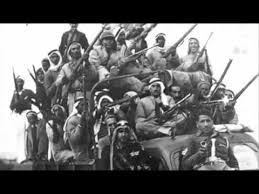
This is not a country.  It is an arena, and with the removal of the authoritarian regime of Saddam the games began, even while the American military was still present.  A devastating civil war was prevented only by sending in more American troops and massively bribing Sunni leaders.  It could easily be predicted (as I and others did) that with the withdrawal of American forces the society would begin to unravel.  Washington’s man, Nouri al-Maliki, immediately began establishing a Shia dictatorship and taking action against the Sunni minority (35%).  He established relations with Hezbollah, designated a terrorist organization by the US, and Shiite Iran, considered an enemy by the US since 1979.  Democracy is crumbling, sectarian violence is on the rise and threatening to break up the country and Baghdad now courts Teheran and aids their interests.

Shiite thug and "ally"

Shiite thug and “ally”

Now, Dick Cheney, in a flight of fancy that even by his lofty standards is mind-boggling, is blaming the whole crisis in Iraq on Obama because he pulled out our troops.  Cheney of course ignores, as do other Republican critics, that Obama had absolutely no choice inasmuch as Malaki refused to agree to the Status of Forces conditions required by the US, namely, that American troops be granted legal immunity.  So what do Cheney and other right-wing idiots think Obama should have done?  He could have agreed that American forces were subject to Iraqi law, which would have had the conservatives howling, or he could simply kept the troops there on American terms, which would have made the American army an occupying force, which the hawks probably would not have any trouble with.  (Why does the media waste time interviewing Cheney the Undead and providing a soapbox for his nonsense and outright lies?)

the Undead

the Undead


And through our utter mismanagement of Iraq we have helped create ISIS (Islamic State of Iraq and Syria), a Muslim fundamentalist group so despicable and cruel that even al-Qaeda will have little to do with them.  One of the circumstances that led to the emergence of these barbarians is the Syrian civil war, but their spectacular success in Iraq is clearly due to Malaki’s Shiite dictatorship.  The average Iraqi Sunni wants nothing to do with the ISIS murderers, but the enemy of my enemy is my friend and Sunni communities are supporting them, a deal with the devil.

the golden age of the 7th century

the golden age of the 7th century


This places Washington in a very tough spot, one reminiscent of Vietnam’s invasion of communist Cambodia in 1978, which presented the US with a choice between two unpleasant regimes.  Obviously, ISIS is the far more disgusting group (as was the Khmer Rouge) and threatens America with terrorism, but supporting Maliki presents some serious problems.  Propping up a dictator has never been a problem for Washington, and this is a dictator we pretty much created, but the Maliki government is aligned with Iran, which is supposedly the big threat in the region and a country we have despised since they had the temerity to overthrown the oppressive regime of the American-installed Shah.  We would consequently be indirectly working with a country that Israel thinks should be bombed immediately.  Malaki has also joined Iran in supporting Hezbollah, designated a terrorist organization, and is sympathetic to Bashir Assad, currently the biggest mass murderer in the region.  More important, helping Maliki means taking sides in the growing sectarian strife between Sunnis and Shiites and can only lead to more trouble, since anti-America terrorists are all Sunnis, as are our “friends” in the gulf.


Well, it seems we will be helping Maliki, though constantly trumpeting that the price he must pay is to create a more inclusive government, which absolutely no one believes he will do.  The advisors are already arriving, though what they can do for an army that is riddled with corruption and lacking any motivation, at least in the case of the Sunni soldiers, is not at all clear.  Of course American involvement in Vietnam also began with advisors, but popular disgust with our recent wars should keep actual fighting forces out of Iraq, though you never know how stupid politicians will be.  Air strikes then, and according to the President, airstrikes without collateral damage, which I suppose means declaring that anyone killed by a strike is by definition the enemy.


And why are we getting involved at all?  Because ISIS clearly represents a threat to American national security, which in reality of course means little, since it appears that virtually everything is a threat to national security.  If they prevail, they will establish an Islamic state that will be churning out terrorist to send to America.  I have written previously on why I feel the terrorism threat has been stretched completely out of proportion in the interest of enhanced government power.  9/11 was the Reichstag fire for the Bush administration, and Obama, as would be expected of any administration, is not about to surrender any of the powers gained by his predecessors.  Has not more than a decade of homeland security made us any safer?  No one, even those armed with firearms, will ever again be flying planes into buildings, and how does one get a bomb onto a planes these days?


It is quite easy to put together a car bomb in this country, and that can happen whether or not ISIS rules in Iraq.  Yes, an American citizen could get training from ISIS and then reenter the US, but it hardly takes a genius to build a bomb (see Timothy McVeigh or the Zarnaev brothers) and in any case one can get instruction in plenty of places, including our ally Pakistan.  And one cannot fail to notice that the people crying the loudest about terrorism and national security seem completely unconcerned about the now regular shootings in American schools.  (One might also notice that while our intelligence apparatus is snooping on virtually everyone on the planet, it failed completely regarding the Crimea and ISIS.)


Oh, there is the oil, but I thought we were on the edge of energy independence.


What to do then?  Jordan must receive serious aid and be protected (a useful job for Israel) but otherwise ignore the whole thing.  Why are we so damned concerned that Iraq not break up into three states?  Because it would further accentuate the total failure of our ill-considered invasion of Iraq?  Iraq is manifestly not a real state and the hostilities are simply too great, especially for a culture that seems to slip so easily into violence (which is perhaps hypocritical for an American to say).  The Kurdish north is essentially now an independent state, and if anything, this has created more stability in the area.  Given the history of Iraq in the past half century, it is simply impossible for us to guarantee peace without occupying the entire country for a very long time.


ISIS actually establishing a “caliphate” of any permanence is a bit hard to believe.  The Iraqi Sunnis have already made it clear that they do not like the ISIS fanatics, and one can expect a violent falling out should this Sunni alliance actually topple the Malaki “democracy.”  It is difficult to see how a group with essentially no real support among the Iraqi (or any other) population can erect a state with any hope of lasting.  Political entities based solely on terror are incredibly unstable; ask the Assyrians.  Meanwhile, the moment the caliphate begins training terrorists for a campaign against America, we blow away every government/military facility we can identify, while pumping resources into the hands of the opposition.  We can pretend they are clients of the Soviet Union – it will be like old times.


A final note: Syria has just bombed suspected ISIS positions inside Iraq, apparently killing for the most part innocent Iraqis.  Assad versus ISIS.  Now there is a great choice, reminiscent of choosing between Hitler and Stalin.  In any case, Assad has now attacked another country, which used to be an act of war, but this is something the US can hardly complain about anymore.  It would be wonderful to shoot down Syrian warplanes, but then we would be aiding both Malaki the Thug and ISIS.  The Middle East is certainly an interesting place.

Grief Again: Lucy

(This is perhaps self-indulgent, but it is born of love.)


Lucy the dog, our companion for eleven years, embarked on her last journey Sunday morning. She was a big rescued dog of indeterminate age and ancestry. She was found tied to a sidewalk pole, where she had been left unattended for three days. She had a hernia that was repaired, but she was frightened of humans, evidence of abuse by some useless human animal. With one blind eye and a wart on her face she was not an attractive dog – people always commented on how cute Alfred  was but said nothing about Lucy.  But she was beautiful to us.  She got used to us and became Alfred’s constant companion. In her later years she suffered from a torn ligament and arthritis, but with pain killers life was still good, if considerably slower. Last week she suffered from a bleeding nostril of unknown cause, but it seemed to be getting better, when she began having serious trouble getting to her feet and difficulty sleeping.  We needed to come to the terrible decision and perform our last act of love for her.

       Lucy 2000? - 2014

Lucy
2000? – 2014

It seemed harder to see Lucy off than had been the case with Alfred, probably because she was the surviving dog and for all her leg problems still seemed to be enjoying life. Her ashes will also be placed by a tree planted for her, next to Alfred’s, and they can in some sense be together again.

Lucy, Alfred and George the cat.

Lucy, Alfred and George the cat.

I have already written about the meaning of pets and the nature of grief – see “Grief: Alfred” (2013/11/01) – and will not repeat it all here. Suffice it to say that like Alfred she was a member of our family, as important to us as any child, and the grief is very, very real.  Like Alfred, she will be remembered so long as Denise and I are alive.


The Land of Lost Content: a Fifty Year Reunion

Long, long ago Stanford University maintained branch campuses in several European countries, including West Germany. From June to December 1964 I was a member of Group XIII, along with about 80 other students. The campus was at Landgut Burg, an old estate on a hill above the village of Beutelsbach, just east of Stuttgart. We took regular Stanford classes and one hell of a lot of German and were adopted by local families, accustomed to the gaggle of young Americans that arrived at the Burg every six months.

Landgut Burg 2014

Landgut Burg 2014

We were all young, very young, ranging from 18 to 21, and we were not just Americans, the Masters of the Universe, but we were also Stanford students, the best and the brightest. To varying degrees we were naïve, relatively well-off and arrogant. We stood out simply because of the way we were dressed, and we knew the latest popular music and dances. We were proud to be Americans, and many of us, certainly myself were stupid, a facet of being 18 years old, I now know.
For most of us Stanford-in-Germany was an introduction to a wider world. Many of us were in a foreign country (at least other than Mexico) for the first time, and in 1964 Germany was still a foreign country, a taste of old Europe. Most Germans spoke German. Chasing German girls generally meant pursuing them in German, a strong motivation to learn the language. We were of course also in a place where we were adults and old enough to drink.

 
And drink we did. Reading my diary from that year, I was surprised by just how much beer and wine swilling there was, at least until the novelty of legal alcohol wore off. Then we continued to drink a lot anyway, because that is what college students do. I was amazed to discover just how many classes I, the normally oh so responsible student, cut in order to drink and court. It appears that I spent almost as many evenings at my favorite watering hole as at the campus, which naturally put a bit of a squeeze on my classwork.

 
There was a small informal gathering of Group XIII alumni at Stanford some several decades ago, but after graduating in 1967 I essentially did not see any of these people again. Until a few weeks ago. A fifty year reunion in Germany (no more West) was organized, and since Landgut Burg is now a hotel, we were able to actually stay on the old campus. The old buildings were we lived and attended class were renovated but still there, allowing us to seriously savor those experiences of fifty years ago. About half the people who made up Group XIII attended.

 
This was an exercise in nostalgia. Back to the land of one’s youth, the happy highways where one went and cannot come again. The downside, of course, which did not seem to bother the others, is that fifty years have passed. In 1964 we were all young, and the future stretched ahead, filled with hope. America was at its apogee, and a citizen could be proud. Now, we were old, retired, with grandchildren, and if one had not done it yet, it was not going to be done. Germany was no longer the poor relation; we were. Our country was now in decline, the recognized bully of the world. It was all a vivid reminder that things change in a half century.

 
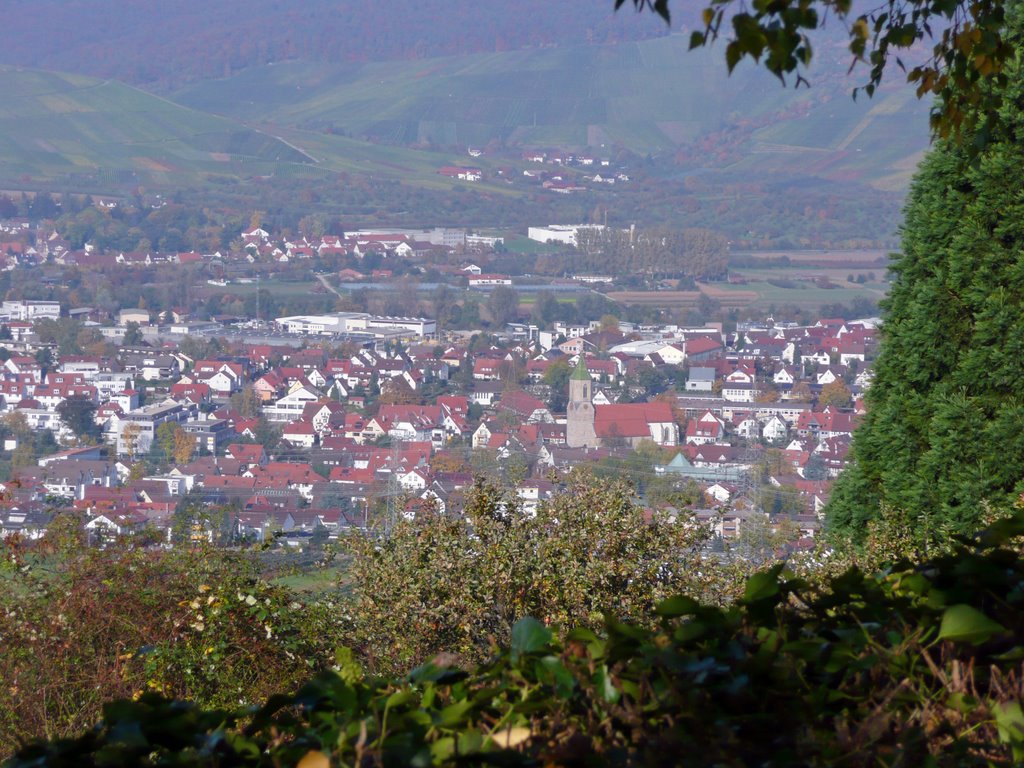
Beutelsbach, the village at the foot of the hill, had not changed all that much. It and four other villages had coalesced into the city of Weinstadt, but it was still familiar to us. Stuttgart was extensively rebuilt, but it was still the city we remembered – or thought we remembered. It was we who changed. I could still see the young students under the wrinkles and grey hair, but most of us had grown up, probably I the least of all. We were no longer students but doctors, attorneys and professors, groups not traditionally known for drinking and raging. In 1964 most of us smoked; now only three of us did: I and another couple, my Rauchenkameraden.

Beutelsbach 2014

Beutelsbach 2014

Even in the still familiar confines of the Rems valley, where Weinstadt is located, it was clear that Germany was a different place. It was no longer old Europe. No more piles of manure outside houses in the villages, no more horse drawn vehicles and far fewer people speaking the incomprehensible Swabian dialect. Immensely wealthy, the country is no longer a bargain, and where we once got four marks for our dollar, now we got only three-quarters of a Euro. We now looked no different from Germans, and our pop culture edge had completely disappeared. And apparently everyone in Germany now speaks English. It does get a little annoying being around crowds of people who speak at least two languages.

 
That fifty years is a long time, however, was nowhere more obvious than in Berlin, where about half of us spent a second week. In November of 1964 we took a field trip to Berlin, then the front lines of the cold war. The Wall had gone up only three years earlier, and West Berlin was a neon island in the socialist sea of the German Democratic Republic. For us the center of town was the Kurfürstendamm in Charlottenburg, and Checkpoint Charlie and access to the western marches of the Soviet empire was way off to the east. The Ku’damm was alive, filled with shops and clubs and open 24 hours. By contrast East Berlin was a tomb, seemingly closed at night; there was still some rubble from the war two decades earlier. Berlin was almost literally a city in film, the West in vivid technicolor, the East in black and white.


Alexanderplatz

Alexanderplatz

The Ku'damm

The Ku’damm

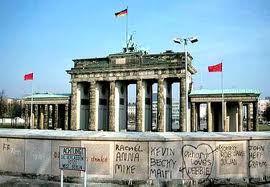
A quarter century later the Wall, the DDR and the Soviet Union itself were gone, and Berlin then had another twenty-five years to rebuild itself before we visited again. It might have been a completely different city. With the fall of the Wall the city center moved east to where it was before the war, and our hotel was near the Alexanderplatz, now one of the major candidates for the “center of town.” The Ku’damm is now a relatively quiet neighborhood way off in the west, and all the action is in what was once the mean streets of East Berlin. Our major landmark and point of orientation, the Wall, is gone, along with the checkpoints and expanses of no-man’s land. The only obvious traces of the former capital of the DDR are the prefabricated apartment blocks and the streets named after German socialists.


Brandenburg Gate 2014

Brandenburg Gate 2014

Brandenburg Gate 1964

Brandenburg Gate 1964

This Berlin, the once and future capital of Germany, is fun and extremely engaging, especially for an historian, but it can hardly match the Berlin of five decades ago. The Berlin of 1964 was a large scale piece of cold war performance art, history encapsulated in single city. In old West Berlin, the showcase of the free market world, there was a vibrancy, an intensity, an edge that certainly no longer exists – that can no longer exist. And it was the Berlin of an eighteen year old student, which brought its own intensity and edge, and that too can never again be regained.

 
For me Berlin was emblematic, a vivid reminder of lost youth. And it was a full circle of sorts. I remember the young and undecided student standing in awe before the altar in the Pergamon Museum, and now the retired classical historian has done the same, with far more cynicism but with the same awe.

Stuff from Way Back #29b: Roma Aeterna

The last and most critical reason depends upon how one understands life in the Roman Empire, and there is much we do not know about life in the rural areas of the provinces. I am, however, convinced that it was basically good, convinced especially by the belief that the Empire could not have been generally so stable and last so long were its inhabitants generally oppressed. This of course comes close to making a circular argument, but the evidence appears to support the contention that at least until the Anarchy life in the Empire for the average free person was relatively comfortable or at least acceptable. Imperial structures based entirely on fear are simply not stable over the longer run – consider the Assyrian Empire.

 
Strong evidence that the Roman Empire was not such a bad place to live lies in the fact that apart from the Jews the Romans essentially did not have to concern themselves with the revolt of subject peoples. This strikes me as an impossibility were the Empire held together only by fear. There were of course revolts, which were suppressed with great brutality, but they all occur in areas that were recently or incompletely pacified: Gaul in the 50s BC, Illyricum in AD 6, Germany in AD 9, Boudicca in AD 59, Civilis in AD 69, Mesopotamia in AD 116. Once an area had been controlled for perhaps a generation Roman rule was accepted.

 
The one exception was the Jews, who undertook two disastrous revolts against Rome, the results of which were to forever change (and improve) the nature of Judaism by ridding the religion of the temple and all the rituals and sacrifices characteristic of polytheism and allowing it to become more introspective and spiritual. The Jews were a special case inasmuch as their monotheism prevented them from being assimilated into the polytheist Greco-Roman culture of the Empire as were all the other subject peoples. Understanding this, the Romans granted the Jews special exemptions from such things as any obligation to the imperial cult and allowed them more local autonomy, but friction was impossible to avoid. It was not just the religion, which affected every aspect of their society, but also the fact that this religion was inextricably entwined with the idea of a national state, given them by god. This was one thing Rome could not grant, given the strategic importance of Syria-Palestine.

It didn't work out

It didn’t work out

Generally Roman rule appears to have been accepted, certainly once the generation of the conquest had passed. The provincials, a least in the towns and cities, were easily assimilated and ultimately Romanized. The highly urbanized and Hellenized east fit readily into the urban Greco-Roman culture of the Empire; though Latin was the official language, Greek was the real lingua franca of the eastern provinces. In the west Roman civilization was simply at a much higher level of development than that of the Celtic and German tribes and naturally dominated, once again at least in the municipalities.

 
I believe that up until the Anarchy Rome gave more than she took. She obviously robbed the provincials of their nominal independence, but for many, especially in the Greek east, this was meaningless since they had already been under the control of someone else. Self-determination for the Greek states had essentially disappeared with the conquests of Alexander, but Rome had no problem allowing the Greeks and everyone else to run their own cities and communities. In fact, she had little choice but to allow a great deal of local autonomy, since administering the Empire at the grassroots level was beyond the manpower and financial resources of the state. Rome followed a traditional imperial pattern by making alliances with the local elites and drawing upon their experience by allowing them to govern locally under the auspices of the Roman officials at the province level. Such had the additional benefit of shrinking the imperial presence in the lives of the Empire’s subjects.

 
Rome of course also collected taxes. There is a great deal of dispute over what the tax burden was like for the average inhabitant of the Empire, but my estimation is that from the end of the Republic to the Anarchy that burden was not particularly onerous – in general. The civil wars in the first century BC saw the financial rape of the wealthy eastern provinces, but the return to stability and the systemization of provincial administration and tax collection seems to have produced a tolerable level of taxation. In any case, the Empire certainly prospered in the next two and a half centuries, suggesting relatively comfortable or at least livable economic circumstances for most inhabitants. With the Anarchy this changes rapidly, as continual civil war and barbarian invasion drives the government to extremes of revenue collection, which in turn begins to strangle the productive classes of the Empire.
In return the imperial subject received a number of things, the most important of which was peace and security. We tend to underestimate the value of peace because no wars have rumbled through the United States for a century and a half and we are used to it. For most human beings decades, let alone centuries, of peace is a highly compelling commodity. It is clear in the modern world that most people, even in places like America, would gladly trade some of their freedom and civil rights for security and comfort. So, that Gaul who fought against Caesar probably hated Rome, but his grandson would likely think more about the eight legions on the Rhine that prevented the Germans from trashing his farm every summer.

Better than Germans

Better than Germans

The Empire meant more uniform laws and more efficient mechanisms of justice. This is not to say that the average person was guaranteed justice – as today, money and social standing played a large role – but he certainly had a better shot at it. There were material benefits of course. Those military roads that knitted the Empire together could be used by anyone, dramatically enhancing communications and consequently commerce. In fact, take an area the size of the Roman Empire and guarantee more or less continuous peace for a couple of centuries, and the economy can hardly fail to prosper, assuming reasonable levels of taxation.
 
But far more important, second only to peace, was that the Roman Empire was an open society and became more so as it aged. Rome exported Romanitas, that is, her culture and language, though not through any state directed policy. In the east Romanitas dovetailed perfectly with the Hellenism that had helped shape it, while in the west it naturally overwhelmed the less sophisticated native cultures, at least in the municipalities, which were focal points of Romanitas. Speak Latin and act like a Roman, and few will worry about your Celtic blood.

 
Even the once precious citizenship was available to non-Romans. By the time of the Principate citizenship was politically meaningless on the national level, but municipal politics remained vibrant, and in any case the citizenship brought enhanced social status and some economic advantages. During the Republic, Rome was loathe to extend citizenship to non-Romans – the Italian allies had to revolt to get it – but this hesitation broke down rapidly with the advent of the autocracy. In AD 212 the emperor Caracalla granted the Roman citizenship to virtually every free male in the Empire. Now, he did it as a way to raise more revenues, and being a Roman citizen pretty much lost all its value when everyone was one, but the act is symbolic of the character of the Empire. Henceforth, a Roman who could trace his ancestry back to the early Republic had the same legal status as someone whose ancestors had painted themselves blue and fought Caesar. The conquerors had lost their special status in an increasingly cosmopolitan world. This points the way to the Late Empire, when Italy will simply be another set of provinces.

 
The city was one of the two primary mechanisms for the Romanizing of the Empire. They were the bastions of Romanitas, settled originally by Italians and bringing the trappings of Roman civilization to the provinces. And Rome had an unofficial policy of encouraging urbanization: the more urbanized a province was the more economically active it was and the easier it was to secure. Cities and towns of course also helped spread Romanitas, and they provided higher quality recruits for the provincial military units, who, incidentally, received the citizenship upon discharge.

A nice place to raise a family

A nice place to raise a family

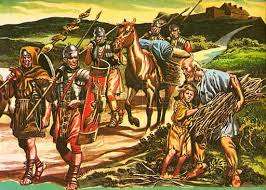
The other major Romanizing element was the army, an irony considering that one rarely sees soldiers as a civilizing force. But half the Roman military establishment was composed of the provincial auxiliaries, for whom the army was a factory creating new Romans. One was not going to pick up the finer points of Roman culture in a legionary camp on the Danube, but the recruit learned basic Latin, the essentials of being Roman and came to think of himself as a Roman. It is estimated that during the first two centuries of the Principate the auxiliaries supplied a stream of about 15,000 Romanized provincials a year.

The Empire wants you!

The Empire wants you!

There was a two-way street connecting Rome to the provinces. As she exported Romanitas, she was also importing provincial talent, products of the Romanizing of the Empire. These were people whose bloodlines were not at all Italian but who did not for a minute consider themselves anything other than Roman. The emperors Trajan and Hadrian came originally from Spain, completely Roman but descended at least in part from Iberians. The emperor Septimius Severus hailed from North Africa, and during the Anarchy emperors came all over the Empire.

 
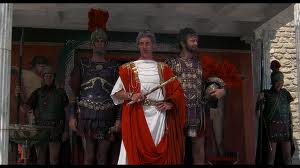
Despite Monty Python’s Life of Brian (the best and truest film ever made about Rome) most people think of the Roman Empire in negative terms – slaughtering Gauls, scattering Jews, oppressing Christians – but to my mind the Empire was perhaps the finest imperial structure ever, which accounts in part for its longevity. This was an incredibly cosmopolitan entity, a rare and seemingly successful multicultural state. The British Empire turned subjects into quasi-Englishmen, but Britain never relinquished its status as imperial master; one was not about to find an African or Indian in Parliament. Rome civilized western Europe and did it without the snottiness and hypocrisy of the British.

Welease Bwian!

Welease Bwian!

What have the Romans ever done for us?” Plenty.

Stuff from Way Back #29a: Roma Aeterna

(I am getting too carried away with these history pieces and must shorten them.  Consequently, this week’s post includes only the first half of the article, and you must wait to find out exactly why Rome was so cool.  I am traveling to Germany for two weeks, so you will have to wait even longer.)


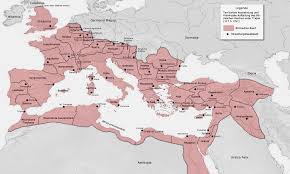
The fall of the Roman Empire has long been the most popular question concerning antiquity, probably because Rome is the most widely known ancient state and because it is the premier empire.  At their peaks the Mongol, Spanish, Russian and British Empires all controlled far more territory than the Roman, but hands down Rome wins the prize for longevity.  (The Chinese “Empire” was essentially a series of relatively distinct Chinese states.)  Beginning as a tiny city-state on the Tiber, a miniscule platform for empire-building compared to the European powers, the Roman Republic methodically conquered and unified the Italian peninsula in two centuries and in another century eliminated every possible rival in the Mediterranean-European world.  The Roman Empire is thus established by the middle of the second century BC, though a great deal of real estate – most of the eastern Mediterranean, northwestern Europe and Britain – was yet to be occupied.

the big one

the big one

The Senate-dominated Republic collapsed in the first century BC, and though “restored” by Augustus in 27 BC (see Stuff from Way Back #26: Image is Everything), the reality was a military autocracy, the Principate.  In AD 235 the Principate gave way to the Anarchy, essentially a fifty year long civil war that vividly revealed the serious cracks in the imperial structure.  A measure of order was restored in AD 285, but in AD 378 the Empire permanently split into a western and eastern half, and the western empire disappeared in the next half century.  If the fall is marked by this final division, then the Empire had lasted some six hundred years; the city of Rome itself had remained unoccupied by a foreign army for eight hundred years.


The decline and fall of such a long-lived and high civilization is understandably a fascinating subject (it had nothing to do with immorality or Christianity), but equally fascinating is a far less frequently posed question: why did it last so long?  Incompetent and outright mad emperors, civil wars, barbarian invasions, military revolts, the Empire went on.  It even survived the Anarchy, a half century of more or less constant civil war, during which barbarians penetrated deep into the Empire, which actually fragmented into three parts at one point.


There are three broad reasons, two of them indisputable historical considerations, the third – and most important – in part a judgment call, though based on the historical evidence.


First, throughout the four centuries of the Late Republic and the Principate and to a lesser degree for another century after that, Rome had no seriously dangerous foreign enemies.  During this long period the Empire had two major foes.  The first was the Parthian Empire.  The Parthians were an Iranian people who established a kingdom in northeastern Iran in the third century BC and expanded south and west as the Greek Seleucid Empire declined.  The kingdom ultimately stretched from Iran to the frontiers of Roman power in eastern Anatolia and in Syria, where constant friction emerged during last century of the Republic.


Parthia was, however, more of a nuisance than a real threat, raiding and capturing Roman territory only when the Romans were distracted, as during the civil wars that brought down the Republic.  (See Stuff from Way Back #21: Antony, Cleopatra and Who?)  Parthia was a very decentralized state, with local governors possessing a great deal of autonomy, and the central government often wrestled with dynastic problems as well.  Unlike the Romans of the Principate, Parthia had no professional standing army, though it could quickly mobilize levies and raise effective horse archers and armored lancers, as M. Licinius Crassus discovered in 53 BC with his defeat and death at Carrhae.  Further, the Parthian king had his own problems with barbarians on his northeastern frontier and commanded far less economic resources than Rome.

next door neighbors

next door neighbors

The relative weakness of Parthia was constantly demonstrated when the Romans were able to easily deal with Parthian incursions even before solving their own problems that had led to the aggression.  Most vividly, there is the emperor Trajan’s rapid conquest of the Parthian heartland in AD 114-117.  That the entire area was immediately evacuated by his successor Hadrian is not a reflection of Parthian strength but a recognition that Rome did not have the manpower necessary to garrison a large area that could not be easily assimilated into the Greco-Roman culture of the Empire.


In AD 224 the declining Parthian Empire was seized by a new Iranian group, the Sassanid Persians, whose new empire was essentially a reprise of the Parthian.  The Persians did, however, develop heavily armored cavalry (but still no stirrups) and siege equipment and tactics, vital in fighting the well-equipped Romans.  The emergence of a new dynasty also generated a new aggressiveness, and this was at a time when Rome was on the brink of the Anarchy.  Still, even during the Anarchy and the frequent civil wars of the late Empire Persia could not permanently occupy Roman territory.  Actually, Persia’s greatest threat to Rome was simply being there, a new Persian Empire that constantly lured foolish and incompetent Roman emperors to attempt to emulate Alexander and launch expensive and pointless invasions of the east.


Rome’s only other enemy was not a coherent state but a category: barbarians.  The barbarians in north Africa were hardly noticed, and those in and around Britain were simply annoying.  The Germanic tribes were a lot tougher and prowled a frontier that stretched from the mouth of the Rhine to the Black Sea.  Nevertheless, they were never any problem for competently led legions, and even during the Anarchy, when tribes were able to penetrate deep into the Empire, they were soon mopped up.  Only with the great folk migrations of the late fourth century and later did they become a serious problem, and one suspects that had the government and army of the fifth century been equal to that of the first, they could have been routinely dealt with.

Thus was the outside pressure on the Empire minimal and relatively easily countered, and Rome could consequently indulge in bad government, a declining military and even a half century of continuous and devastating civil war and not lose it all.


The second factor is the development of an imperial bureaucracy.  The institutional history of the Republic, which built the Empire, was one of constantly adapting the political mechanisms of the old city-state to the demands of a growing and vastly larger political sphere.  The administration of the Empire consequently had an ad hoc and jury-rigged character, and the governance of provinces was in the hands of successful office-holders, frequently in debt because of their political career, and their personal staffs, which almost guaranteed corruption.  And the fact that taxation was privatized and in the hands of groups whose profit margin depended upon how much they could collect over their bid for the contract certainly did not help create could provincial government.


It is astounding that the extent, frontiers, garrisoning and administration of the Empire were not considered rationally and apolitically until Augustus and the advent of the Principate.  Not only did he approach the Empire in terms of grand strategy and Roman resources and regularize and depoliticize provincial governance, but he also laid the foundations of an essentially apolitical civil service.   From this grew an imperial bureaucracy that handled the day-to-day administrative affairs of Rome and the Empire.  In short, the administration of the Empire became routine, allowing it to continue functioning regardless of whether or not the emperor was competent or even in the event of civil war.  Rome could indulge herself in bad government and not lose it all.

Bibi Tells It Like It Is (Not)


(The five statements in this piece come from Dale Sprusansky, “Netanyahu’s AIPAC Speech: 5 Lies,” Washington Report On Middle East Affairs, May 2014, pp. 36-37.)


On March 4 Israeli Prime Minister Benjamin Natanyahu gave a speech before the American Israel Public Affairs Committee, Israel’s powerful lobbying organization. One certainly does not expect an Israeli politician speaking to AIPAC to present a completely objective view, but Bibi’s total disregard for facts is breathtaking. The sad fact of course is how many members of the US Congress believe the Prime Minister’s words, which he himself clearly knows to be lies.

 
In the Middle East bludgeoned by butchery and barbarism, Israel is humane; Israel is compassionate. Israel is a force for good.”


"Please like me."

“Please like me.”

Bibi gives the salute to the Volksgenossen

Bibi gives the salute to the Volksgenossen

No one can deny that the Middle East is indeed awash with “butchery and barbarism,” and Syria’s Bashir Assad is setting the bar to new heights. But for any sane person to honestly describe Israel as “humane” is absolutely absurd. Can the treatment of Palestinians, especially in the vast open air prison of Gaza, be considered humane and compassionate? Her actions in operations like Cast Lead in Gaza would be described as “barbarism” by most civilized people, and the constant violation of international covenants, particularly the colonization of the West Bank, is in my opinion barbaric according to the established norms of the post-WW II world. “Butchery” is certainly not a term that can be generally associated with Israel, but the slaughter in the refugee camps of Sabra and Shatila in 1982, enabled and supported by the Israeli army, is aptly described by the word. And if Israel is anyway a force for good, it is only in contrast to the despicable regimes that inhabit the region.

 
“(Israel has) values that move us to treat sick Palestinians, thousands of them from Gaza. They come to our hospitals. We treat them despite the fact that terrorists from Gaza hurl thousands of rockets at our cities.”

 
Israelis may have such values, but the state of Israel manifestly does not. Some Palestinians have found help in Israeli hospitals, but because of the extreme difficulties involved in crossing into Israel, far more sick and desperate people are denied any such succor. For Netanyahu to mention “values” in the same sentence as “Gaza” is a sick joke. The world – excepting of course the US – recognizes Gaza as little more than a huge prison camp, sealed off from the world and regularly assaulted by one of the strongest militaries on the planet. Because of the Israeli blockade, people are actually suffering severe malnutrition, and Palestinian public facilities that patently have nothing to do with any ability to attack Israel are regularly destroyed. For Hamas or whoever to shoot missiles into Israel is barbaric, but consider the whole picture. In the last seven years Palestinians in Gaza have fired some 9000 usually ineffective rockets at Israel; in two years, 2005-2006, Israel fired 15,000 very effective shells into Gaza. And there are the ever wildly unequal casualties: in the period since 2008 30 Israeli civilians have been killed, as opposed to 1867 Palestinians in Gaza.

 
“Israel is the nation-state of the Jewish people, where the civil rights of all citizens, Jews and non-Jews alike, are guaranteed.”

 
Even if Israel did not openly discriminate against non-Jewish citizens, this would still be a ludicrous statement. How is it possible for a state, 20% of whose citizens are not Jewish, to be both a “Jewish state” and a democracy? If the term is not completely meaningless, there must be discrimination: if it is a Jewish state, then the implication is that Jewish citizens are somehow more suitable than non-Jewish, that this is their state. And the fact is that Arab citizens are indeed discriminated against, both unofficially – and now with increasing violence – and officially. How could it not be? Israel is in a virtual state of war with the inhabitants of Gaza and the West Bank and seizing more and more Palestinian land. How are the Palestinians of Israel, most of whom have relatives in the occupied territories, supposed to respond to these actions of “their” government? Meanwhile, Arab ghettos have become a prominent feature of the Israeli landscape. I have personally witnessed this, and that was twenty years ago.

 
There are perhaps a hundred “unregistered” Arab villages in Israel, recognized as illegal, though they have been there for centuries. The inhabitants cannot get public services or building permits, which means any repairs to a home invites the arrival of the government bulldozers. Meanwhile, their ancestral lands are being appropriated by Jewish communities, some of which openly declare “Jews only,” apparently missing the incredible irony. The legal Center for Arab Minority Rights identifies some 50 or more laws that openly discriminate against Palestinian citizens. Most damning, however, 93% of the land in Israel is owned by the state or quasi-state entities, and non-Jews cannot legally buy or lease that land. It is after all a Jewish state.

 
Consider Avigdor Lieberman, the thug who is currently Minister of Foreign Affairs. He has proposed a two state plan that would not only incorporate West Bank Jewish settlements as part of Israel, but also assign some Israeli Arab areas to the Palestinian state. So much for being a citizen. He believes that Arab members of the Knesset who even speak to Hamas are terrorists and should be executed. He would also like all Israeli citizens to swear an oath of loyalty or lose their citizenship, demonstrating, I suppose, that he is an equal opportunity fascist.

Reichsminister Lieberman

Reichsminister Lieberman

“Israel, the one country in the Middle East that protects Christians and protects the right of worship for everyone.”

 
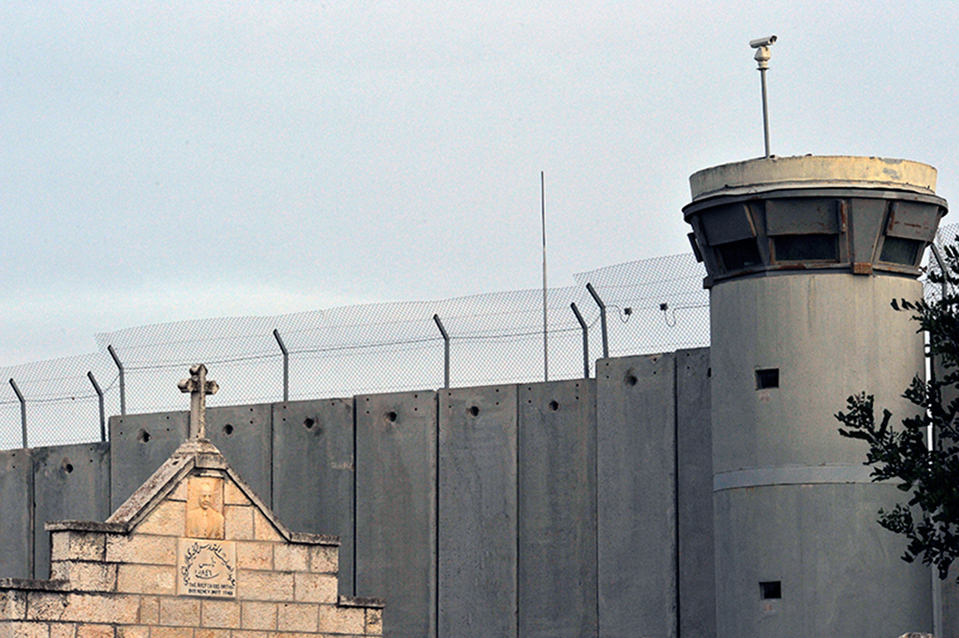
Well, the Turks might disagree with this proposition, and the Syrian Christian community has enjoyed the protection of the Assad government, though certainly not because of any humanitarian concerns. The Palestinian Christian community, meanwhile, has been steadily declining, and it is clear that the Israeli occupation is at least partly responsible. Access to the holy sites in Jerusalem is apparently not part of Netanyahu’s definition of “right of worship,” since it is extremely difficult for non-Israeli Palestinians to obtain a permit to visit the holy city. It is also indisputable that Israeli Jews are steadily taking over the Arab neighborhoods of east Jerusalem, and there seems little concern for the religious concerns of non-Jews. The Ministry of Religious Affairs, in pursuance of 1967 law for the protection of holy sites, has designated 135 Jewish sites and not a single one for other religions. See also Ironies from Israel #1: Archeological Hypocrisy.

Welcome to Bethlehem

Welcome to Bethlehem

“(Iran obtaining a nuclear weapon) would open up a Pandora’s box of nuclear proliferation in the Middle East and around the world.”

 
This is not so much a lie as an incredible exercise in hypocrisy. Leaving aside the consideration that it is not entirely clear that Iran is dead set on obtaining a weapon, the fact is that aside from Pakistan the only nuclear power in the Middle East is Israel. Everyone knows this, but the US and Israel play a stupid game of never mentioning it – or that Israel had actually cooperated with apartheid South Africa in weapons development. And while Washington is badgering everyone in the Middle East to sign the Nuclear Non-Proliferation Treaty, which Iran has, no American politician dares even bring up the subject in the case of Israel. Given Israel’s history of doing whatever she pleases, regardless of international law, it might be considered understandable if places like Iran were a bit paranoid. Admittedly there is some truth concerning proliferation: a Shiite bomb in Iran could easily drive the Sunni Gulf autocracies to start shopping around, as if the ruling elites in Teheran could possibly be stupid enough to start threatening a nuclear strike. Given the strength of its military and the unqualified support of the US, it is certainly questionable that Israel requires a nuclear arsenal, and a first step in dealing with Iran might be simply admitting that Israel actually possesses such weapons. But given the attitude of Washington, that will never happen.

 
Sprusansky ends his article with “The time is coming when lies no longer will suffice.” Given the growing detachment of the American Congress from reality, that time is likely to be very far off indeed.

American Exceptionalism #2: College Athletics

Other countries of course have intercollegiate athletics, but nowhere are they as popular, important and corrupting as in the United States.  It is not at all clear how athletics became so ensconced in the American university, but certainly a major factor is the fact that American schools are essentially businesses.  Even state institutions, which receive part of their funding from the state government, are dependent upon tuition and donations, and there is a belief that a high profile sports program will attract more students and contributions.  That the average student is moved by this is very questionable, but alumni donors are clearly influenced by athletic success.  In fact, to many in the community the university is nothing more than its football and basketball teams.  Further, because of television revenues, successful football and basketball programs can earn huge amounts of money, particularly in the post-season.  In 2013 March Madness, the college basketball playoffs, earned $1.15 billion in ad revenue, and $200 million was divided up among the participating schools.  And the general economic impact is mind boggling: it is estimated that the 2014 March Madness generated $13 billion in revenues.


The National Football League and the National Basketball Association are also driving forces, since it is the universities that feed new players into the professional teams.  The other major American sport, baseball, also draws players, but college level baseball is virtually a minor sport compared to football and basketball, and professional baseball has a system of minor league teams as a feeder system.  For the NFL and the NBA American universities are the minor leagues, the farm clubs, and they cost the professional teams nothing.  They cost the schools a lot.

The real face of the American university

The real face of the American university

Basketball and especially football programs are expensive.  Equipment, travel and facility costs are huge, and because of their popularity, even in the case of low profile and losing teams, there is constant pressure to upgrade those facilities.  Then there are the coaches, who are becoming more and more expensive, often regardless of success.   Consider the state schools.  Last year the highest paid state employee in 47 of the 50 states was with either a football or a basketball coach.  At my former institution, the University of New Mexico, a low quality school in a very poor state, the 2014 base salary (not including bonuses and perks) of the basketball coach, Craig Neal, is roughly $750,000.  The football coach for 2009 and 2010, Mike Locksley, also earned $750,000 a year and won exactly two games.  He was fired early in the 2011 season, despite the huge buyouts that are typically part of coaching contracts.  Coincidentally, as a successful faculty member for thirty-one years, I earned a grand total of approximately $750,000.


Very few schools, even in the high-profile conferences, earn a profit from athletics, and those that do pump it back into their athletic programs.  Meanwhile, the vast majority of college football and basketball programs do not earn enough revenue to even support themselves, and since the money spent on minor sports – and to a degree women’s sports – is miniscule, those dollars must come from the general fund of the university.  This is one part of the corrupting influence.  Resources that would have been used in support of what one might suppose is the essential mission of the university, education, are drained off by football and basketball.  And this is ultimately to the benefit the multi-billion dollar NFL and NBA, who contribute absolutely nothing.  Incidentally, while the thirty-two teams in the NFL are taxpaying businesses, the NFL itself is a non-profit tax exempt organization, yet one that paid commissioner Roger Goodell $44.2 million.


Because American schools require students to pay tuition and sundry fees, promising “student” athletes can be paid with scholarships, which represent considerable sums, given the skyrocketing cost to attend an American university, especially the private institutions.  Adding equipment, travel and other expenses dramatically raises the cost to the school.  Consider these expenditures in the six most important football conferences: the cost per student is $10,000 to $20,000; the cost per athlete is $42,000 to $164,000.  And insult is added to injury inasmuch as most of the “student” athletes are students in name only, only going through the motions of attending classes and supported by teams of personal tutors.  Football and basketball stars also get preferential treatment, often engaging in behaviors that would get actual students thrown out of the institution.  One frequently hears coaches explaining such things as shoplifting and drunken driving with phrases such as “blowing off steam,” as if outright criminality was normal for a twenty year old.


Then there are the athletes themselves, who are exploited by the universities to a degree not seen since the early days of the industrial revolution.  They do get a free ride at increasingly expensive schools, but inasmuch as very few acquire a real education (the graduation rate for football and basketball players is inevitably well below that of students and frequently below 50%) this is a benefit of questionable value.  Meanwhile, they are spending huge amounts of their time earning money for their institutions, most particularly to pay the generally fat salaries of athletic personnel, especially coaches, who may be making in one year more money than most of them will see in a lifetime.  Playing for an NFL or NBA team of course means earning millions, but only a tiny percentage of college players will be drafted into the professional ranks.  It is estimated that the average market value of top level college football and basketball players is well over $100,000, which means the schools are getting an incredible deal.  Further, with the merchandising of such things as jerseys a university can make huge amounts of money off an individual player, who is barred from receiving any of it.


The universities are obviously quite pleased with the system and have resisted all attempts to provide actual compensation to their athletes, insisting that they are not workers but students.  In fact they are workers, employed in programs that can generate millions in revenues and are every bit as professional as the teams they aspire to join.  The University of Alabama football team, for example, is considered to have a market value greater than any of the teams in the National Hockey League.  And the National Collegiate Athletic Association is losing its grip, especially in football, as schools are acting on their own to rearrange conferences in order generate more money.

Alabama - the most important school in America

Alabama – the most important school in America


The whole sham edifice of college athletics is beginning to crumble, however.  Last month the National Labor Relations Board agreed with football players at Northwestern University that they are indeed employees and entitled to engage in collective bargaining.  This decision applies only to private schools, but state schools are almost certain to follow, particularly since the major football powers are state institutions, and the issue may well go to the Supreme Court.  But while this development may clear away the obvious nonsense of amateur athletics and student athletes, it is likely to only further injure the American university.  Football and basketball will become an even more important facet of the university and suck up even more resources, as schools compete for good players by offering them more money.


College sports may have once had some vague relationship to higher education – sportsmanship and all that – but that is gone forever.  In an institution that is already a business, unlike higher education in the rest of the industrial democracies, sports have become another and growing aspect of that business, one that has absolutely nothing to do with education.  The American university is already pricing itself beyond the reach of most young Americans, supporting ever larger and more expensive administrative structures, and football and basketball are another growing and irrelevant drain on resources.  On the other hand, the American public school system is failing so dramatically that perhaps we no longer need higher education.


Stuff from Way Back #28: Hey, Buddy, Can You Spare a Myth?

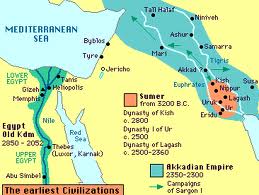
The early parts of the Biblical book of Genesis involve a great deal of water, which might seem odd in the mythic tradition of a society that emerged and evolved in the relatively arid environs of Palestine. There is of course the Mediterranean Sea, but the land itself is very dry, depending for the most part on rainfall for agriculture. The local rivers are mere rivulets compared to the Tigris and Euphrates and the Nile, which river systems witnessed the birth of the first urban civilizations, Sumer and Old Kingdom Egypt. Yet the creation story in Genesis begins with a watery chaos, and later the first human society is destroyed in a world-wide flood, a somewhat unlikely proposition in a land that experienced only the very ephemeral flash floods common to desert regions. Such stories would make much more sense in the hydraulic societies of Mesopotamia and Egypt.


And indeed in the creation myths of these areas the emergence of the familiar universe involved aquatic beginnings. For the Egyptians the process was peaceful, reflecting the confidence of a culture whose world-view was shaped by an isolated, secure, bountiful and essentially unchanging environment. The primeval hill arose from the waters, and there Atum (or Ptah), a self-created god, generated other deities by spitting out or ejaculating them or in a later more sophisticated account simply speaking their names. They in turn produced more gods and ultimately men in an ordered world without end.

Atum

Atum

The Sumerians, on the other hand, lived in a far less hospitable environment: the Tigris and the Euphrates, unlike the Nile, were wild unpredictable rivers, there were extremes of weather and life was very insecure because of the constant warfare among the city-states and the periodic incursions of barbarians. Consequently, in their view (and that of subsequent societies in the region) creation was a struggle, and the forces of order under Enlil (later Marduk) had to wage an epic battle against Tiamat, the chaotic salt waters. Further, creation was not necessarily permanent and could collapse back into chaos, just as the Sumero-Babylonian societies were continually threatened with natural and man-made catastrophe.

Water world

Sumer


Enlil

Enlil

The Sumero-Babylonian tradition also features a global flood, a tale so ubiquitous that some actually hold the utterly nonsensical idea that there was indeed a planetary deluge. Southern Iraq, the location of Sumer, was frequently flooded by the Tigris and Euphrates overflowing their banks and the sea driven in by storms, natural disasters that early on gave rise to the tradition of a universal flood. Significantly, the Egyptians did not produce such a story, since while the Nile did flood, it did so on a regular annual basis, rejuvenating the farmland rather than creating havoc. Sumer was a land of natural and human conflict; Egypt was not.


Here then is the source of all that Biblical water. With the rise of empires, such as the Babylonian and Assyrian, communications between the Land of the Two Rivers and Syria and Palestine on the Mediterranean coast were greatly enhanced, and along with goods and people ideas and tales traveled eat and west. The story of Abraham coming from Ur, the most important of the Sumerian cities, is a reflection of this. As the Yahwists, the future Hebrews, absorbed Canaanite groups, many of the local traditions of these peoples were woven into the evolving tapestry of early Hebrew history. Very probably a group that had come from the east preserved a memory of its origins, and the birthplace of Abraham, himself a local cult figure from Hebron, was transferred to Ur. Thus the watery story from the Sumero-Babylonian creation epic, Enuma elish, traveled west to become, with many alterations, part of the mythic tradition of a distinctly non-watery people.


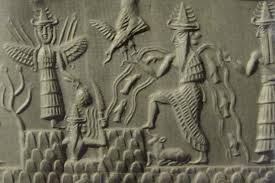
So also did the flood story make its way to the Hebrews. The tale is most fully recounted in the epic of Gilgamesh, the tablets of which date from the reign of the Assyrian king Ashurbanipal in the seventh century BC, but there is a Sumerian version from about 1700 BC, and it undoubtedly draws upon even earlier accounts. Long ago the gods sent a flood to destroy mankind, but the god Ea (Enki) took pity and warned Utnapishtim (Ziusudra in the Sumerian version) of Shuruppak to build a huge boat. He did so, and when the flood came, he boarded with his family and clan and “the beasts and the birds.” But the gods relented and the deluge ended, and the ark came to rest on Mt. Nimush. Utnapishtim released a “watch-bird,” which returned, then a swallow, which also returned, and finally a raven, which did not. Humanity was saved, and Utnapishtim was given the gift of eternal life.


Utnapishtim

Utnapishtim

Ea/Enki

Ea/Enki

And so a group of people in Palestine, who would never have seen any real flood, came to accept a universal deluge as part of their mythic history. That oral tradition was ultimately recorded and became part of the Hebrew testament, later accepted as valid by Christianity and Islam. As a result for almost two millennia half the population of the planet believed in the literal truth of a story created by a “pagan” people they had never heard of and would despise as unbelievers if they had. Even today there are those who ignore the overwhelming and obvious evidence of science, Biblical analysis and common sense and insist on the historicity of a flood, diligently searching the mountainous interior of Anatolia for traces of the ark of Ziusudra/Utnapishtim/Noah.

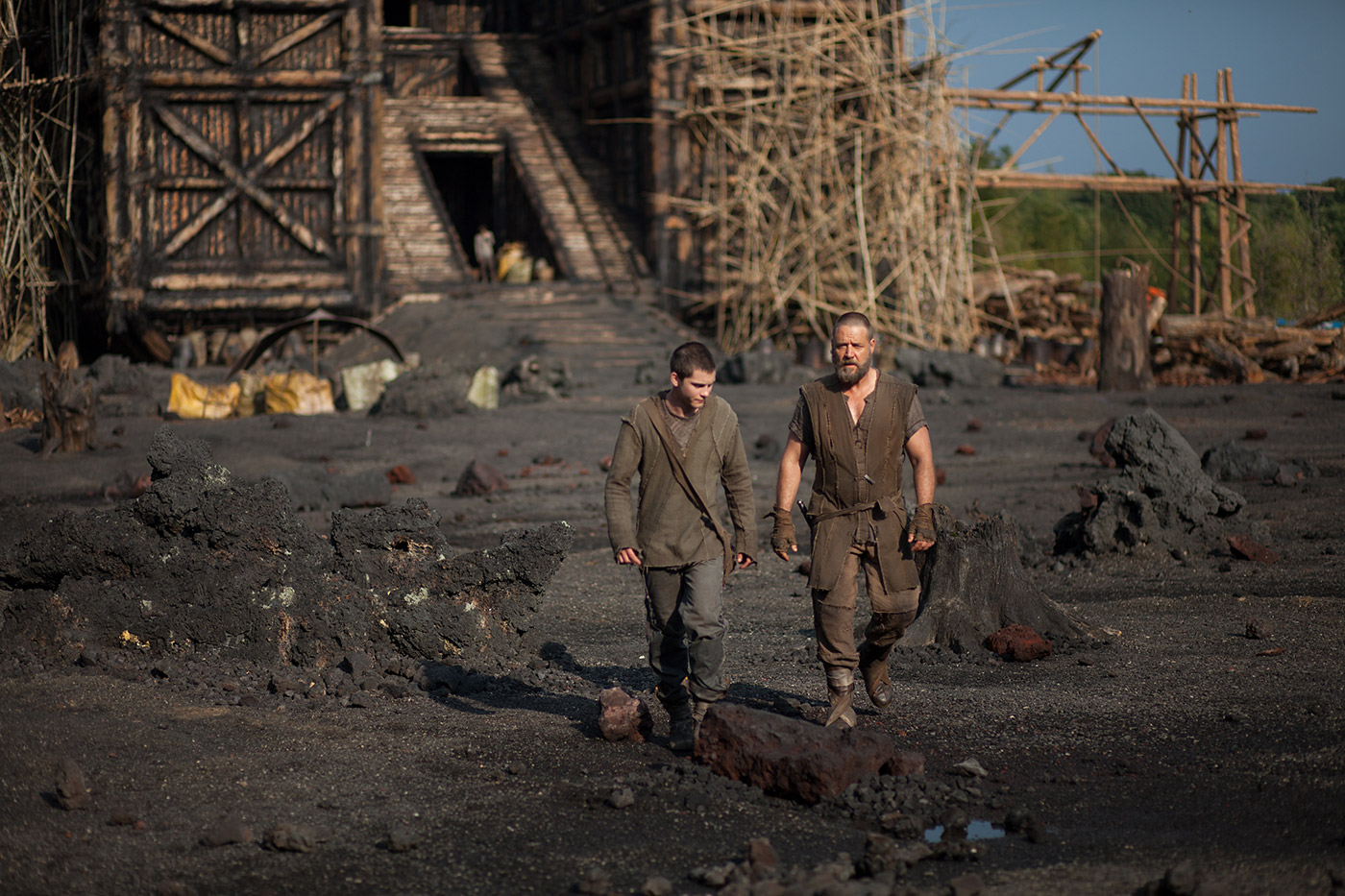
Rare photo of Noah

Rare photo of Noah

A sucker born every minute

A sucker born every minute

Joshua Redux

The current Prime Minister of Israel, Benjamin Netanyahu, seems the embodiment of intransigence and resistance when it comes to the West Bank and peace with the Palestinians, but he appears almost liberal when compared to his Economics Minister, Naftali Bennett. Bennett is head of the extremist Jewish Home party, the third largest group within the coalition currently controlling the government, and he is willing to bring that government down should “Bibi” continue showing such weakness. His is a sweeping mission: “My task is to keep Judaism alive, to make it stronger and to fight its enemies.” Inasmuch as slightly more than half of world Jewry lives outside Israel, his mission statement might be a bit too sweeping, but conservative Israeli politicians seem to feel that Israel is Judaism.

Joshua Redux

Joshua Redux

In his struggle Bennett’s main concern is the West Bank, the territory that in the eyes of the world is to become the Palestinian state. In the eyes of Bennett, however, the West Bank is Israel. He actually has a point, at least to the extent that this territory was once Judea and Samaria, the heart of ancient Israel. But that was a couple of millennia ago, and one can hardly claim, as he does, that the land has belonged to the Jews for 3000 years. There have certainly been Jews living in the area all that time, but the state of Israel disappeared in antiquity and until the creation of modern Israel Jews were a minority. If any group can claim the land on the basis of continuous habitation, it would be the Arabs. Bennett’s reply to this argument is simple: anyone who makes it does not understand history, at least history as he imagines it. Thus, referring to the Israeli “occupation” of the West Bank is completely wrong, because, as Bennett puts it, “You can’t occupy your own land.”


This is of course nonsense, and in any case, claiming territory on the basis of prior occupation, especially so long ago, is an extremely dangerous principle. But Bennett would doubtless point out that Israel is a special case because of the history of the Jews and especially the Holocaust, a proposition perhaps more palatable to the West because ancient Israel and its “history” are so important to Christianity. Special case or not, the problem is that people who are not Jews have been living on this land for more than a thousand years and are wondering why they must be displaced because of the actions and guilt of the West. Palestine was manifestly not, as the Zionist catchphrase put it, “a land without a people,” and in 1948 the Palestinians saw half of their homeland given to the Jews by an international organization created and dominated by a country whose President was anxious to secure the American Jewish vote for his reelection.

armed non-people

armed non-people

But historical fact notwithstanding, Bennett, like many others, fervently believes Judea and Samaria are part of Israel, and consequently, settling Israeli citizens in the West Bank, seen as a gross violation of international law by the rest of the planet (quietly by the US), is quite proper. And like the Lord of Hosts once smiting the idol worshippers in the land He gave unto His people, there is the Israeli Defense Force, smiting their modern enemies, though they are no longer idol worshippers. These are the Chosen People, chosen a second time by the United States, the closest thing earth now has to a Judge of the Nations. The world is treating Israel unfairly, according to Bennett, an ironic supposition given that under the protection of the United States Israel is permitted behavior condemned by international covenants (which we are pledged to uphold).

 
Bennett believes time is on his side since the settlement program, despite the (empty) objections of the Washington, is actually accelerating, and every Israeli colonist is, as they say, a fact on the ground. There are already more than a half million Israelis (including almost half the ministers in the Netanyahu cabinet) living in the West Bank; send in enough and it is Israel, regardless of quibbles about silly international law. But Bennett is not an unreasonable man and is willing to compromise. Israel will annex only Area C, which is to say, 68% of Palestinian territory, and the Arab inhabitants (180,000) will be offered the blatantly second class citizenship already enjoyed by their cousins in Israel proper. The other 32% of the West Bank will be administered by a toothless Palestinian Authority, protected of course by the Israeli Defense Force and Shin Bet, the Israeli secret police. This sounds a lot like the Generalgouvernment, the Nazi administrative structure that ruled Poland. And sooner or later the entire area would almost surely be annexed.

Apartheid plan

Apartheid plan

Bennett and friends apparently do not see the underlying problem in all this – or they simply do not care. Apart from the fact that outright annexation of that much territory, acquired through conquest, is likely to be difficult for even ever compliant Washington to swallow, Israel would then control a huge and ever growing Arab population, confined to obvious Bantustans. Not only would this guarantee eternal hostility and instability, but Israel would be not just a Jewish state but also an Apartheid state. On the other hand, so long as the United States puts up with it, what do the Israelis care what the world thinks? The Palestinians are doomed. Where are the Romans when you need them?


(I just discovered a related news item regarding the West Bank, one that demonstrates the strength of Israel in American politics.  New Jersey Governor Chris Christie was speaking before the Republican Jewish Coalition and happened to refer to the West Bank as “occupied territory,” which characterization did not please the crowd.  He promptly apologized to billionaire Zionist Sheldon Adelson for his “misstatement,” though of course the West Bank is as much occupied territory as Poland was under the Germans.  The UN resolution of 1947 created the state of Israel, and the West Bank and Jerusalem were not part of that state.  That the Arabs did not accept the partition is irrelevant; the resolution also created a Palestinian state, the territory of which Israel is now occupying (and settling).  And the American media?  A former White House hack, Bill Burton, responded to a question from Candy Crowley of CNN by saying that the remark showed that Christie is “not on top of his game,” which is perhaps true if he dared to speak the truth to this particular audience.  But Crowley then told viewers that presidential candidates are “all going to make really stupid mistakes, which that was one.”  She could not be bothered to even mention that this “really stupid mistake” involved stating a fact.)


And question it they did. Former Deputy White House Press Secretary Bill Burton told CNN’s Candy Crowley on Sunday that Christie’s remark is “the sort of thing that shows he’s not on top of his game like you need to be when you’re a presidential candidate.” Instead of pointing out the absurdity of Burton’s statement, Crowley validated his point, saying, “They’re [presidential candidates] all going to make really stupid mistakes, which that was one.” Just like that, the self-described “most trusted name in news” assured viewers that there is no Israeli occupation of Palestine.

Stuff from Way Back #27: Achilles and Aeneas, Alike and Unlike

he Greeks and Romans are, at least since the Renaissance, inevitably associated with one another and clearly differentiated from the Near Eastern societies that preceded them and the barbarian societies that succeeded the collapse of the Roman Empire. They constitute Classical history/antiquity/society, their architecture, arts and languages are Classical and their literature constitutes the Classics; the two millennia of urban civilization before them are pre-Classical. And in many ways Roman civilization appears to be simply Greek society translated into Latin. The two societies do indeed constitute a recognizable and unique period of history, easily distinguished from what came before and what came after, yet the two peoples were very different in character, which accounts for the obvious differences in their histories. The Greeks were the Beatles of antiquity, dabbling in everything and pumping their genius into almost every aspect of culture and politics; the Romans were the Rolling Stones, incredibly good at one thing, the hard-driving rock and blues of the maintenance and expansion of power.

Romans

Romans

Greeks

Greeks

Originally barbarian cousins in the extensive Indo-European migrations of the second millennium, both peoples began with roughly the same social and political institutions, common, it seems, to all the Indo-Europeans, at least while they are still on the move. Most critically, this included a weak kinship and the tradition of an informal assembly of warriors that heard and advised the king and was theoretically the source of his authority, an idea radically different from the sophisticated kingships of Egypt and Asia, which derived their authority from heaven. The Greeks and Latins would be the only groups that developed agriculturally based urban societies without losing these core political institutions characteristic of their hunting and gathering past and would consequently be the only ones to evolve actual constitutional polities in which the power exercised by the state was considered to derived from the people, at least in theory.
This accounts for the remarkably parallel political development of the Greek and Latin city-states from petty tribal kingships to sophisticated democratic republics. The driving engines behind this were the changing economic environment, as growing wealth produced new economic elites that challenged the traditional arrangements, and the emergence of the citizen army, which gave increasing reality to the old notion that the people were at the root of political power. Thus the Latin and Greek proto-cities eliminated their kings and established the basic mechanisms of the constitutional state: precisely defined law, citizen assemblies and elective limited term magistracies. With as many as a thousand independent city-states the Greeks had a larger social laboratory and produced in some cases the most complete democracies the world has ever seen, whereas in Italy the dominance of Rome over the other Latin towns resulted in a single powerful city-state, Rome.
But there were differences, some of them profound. The Greek kingship apparently withered away over a period of centuries during the Greek Dark Age, while the Romans clearly overthrew their last king in historic times. The Greek transition from aristocracies of birth to oligarchies of wealth took a generation or two (the Age of Tyrants) and in many cases involved violence, whereas in Rome the transition required two centuries (the Struggle of the Orders) and was remarkably free of political violence. The Greeks produced radical democracies, but Rome, though technically democratic, never went beyond an oligarchy of wealth. The Greeks excelled in the arts and affairs of the mind; the Romans were great administrators and engineers. Despite a common language and culture the Greeks remained fragmented, and the empires of the fifth and fourth centuries were short-lived; even the huge Macedonian controlled empires of Alexander and his successors were relatively fragile. The Romans of course steadily expanded their power, conquering Italy and the Mediterranean world over a period of little more than three centuries and establishing an immense empire that would endure for almost another five hundred years. This power thing in particular baffled the Greeks, who could not understand why the Romans, who began with the same political, social and military equipment as themselves, could so easily become the stable imperial power that always eluded them. And being almost effortlessly conquered by a people they considered in so many ways intellectually inferior did not help.
Greek thinkers, like the historian Polybius, had trouble seeing beyond the institutions that made the two societies appear so similar. What apparently escaped them, at least in trying to understand Roman history, was something relatively simple: national character. The most important facet of the Greek character, affecting everything they engaged in, was agōn, the need to compete and struggle, which consequently enhanced the importance of both the individual and his city. The Greeks were most definitely not team players. The Romans were. Their prime character directive was pietas, duty, the compulsion to fulfill ones obligations to the family, the gods and the community, which ultimately meant the state. They were incredibly conservative, which slowed their evolution, but at the same time they were also eminently practical, which saved them from that conservatism. While the Greeks theorized, the Romans just did it – and did it differently if the traditional way no longer worked.


Consider the national heroes of the two cultures. For the Greeks it was the Homeric warriors, especially Achilles, extreme and narcissistic individuals who ultimately cared for only one thing – themselves. For them the major importance of the group was simply defining their individual honor, in defense of which they would gladly sacrifice their lives. The Roman heroes, on the other hand, were all men whose defining quality was the willingness to sacrifice for the group. Aeneas, the premier Roman hero, abandons Dido and the kingship of Carthage in order to fulfill his destiny as the ultimate founder of Rome. At great cost to himself he honors his duty to a state that will not even exist for another four hundred years.  Incidentally, Aeneas, though technically a Trojan, is a figure out of Greek literature, a Greek creation, yet the Romans  came to believe that he was the ultimate founder of Rome.
Why these character differences? It probably had much to do with their respective environments. The Balkan Peninsula, especially in the south, is a land of limited resources, notably arable land, and scarcity inevitably encourages competition. In contrast Italy possesses a great deal of good farmland, and Latium, the coastal area where Rome is situated, is particularly bountiful. This is not to say that the early Romans were devoid of any competitive spirit, but rather that survival in the relative economy of scarcity that was Greece instilled in the Greek psyche a far larger measure of competitiveness and aggressiveness. This is hardly a completely satisfactory explanation, but then, I am not a cultural anthropologist.
The Greeks competed in everything (even sex was seen as a kind of competition), which goes a long way in explaining their history and society. They competed in athletics, music and drama; trierarchs competed in equipping the fastest trireme. The incredible cultural explosion of the sixth and fifth centuries clearly has its roots in agōn; societies that are comfortable simply have less motivation to ask questions, to think new thoughts, to create new things. Archaic and Classical Age Greece (8th – 4th centuries) was, like the Renaissance, filled with struggle, and the result was the perhaps the most important intellectual discoveries in history. By way of contrast Old and Middle Kingdom Egypt (27th – 18th centuries) was the most materially and spiritually comfortable society in antiquity, and in the course of a millennium virtually not a single new idea was produced.

Roman genius

Roman genius

Greek genius

Greek genius

But the drive to compete had a down side. City-state governments were very unstable, and political violence was always just outside the door. More devastating of course was the seemingly endless warfare, as each city competed with its neighbors, not just for resources but also status. The city-state was a narcissistic entity, a polity with attitude, and warfare was the ultimate expression of superiority – at least if you won. So deeply ingrained by constant competition was the idea of autonomy that inter-city structures were inevitably based on force or the threat of force, as with the Athenian Empire or the Peloponnesian League, and unity eluded the Greeks until it was imposed from without. Common efforts, such as the defense against the Persian Empire, were extremely difficult, and Greece’s ultimate downfall emerged from her inability to cooperate for the common Hellenic good. It was left to the Macedonians monarchy, the most backward of Greek states, to dominate the Balkan Peninsula and conquer Persia.
The Romans of course also enjoyed a powerful sense of superiority – what successful culture does not – but it was not so all-consuming as with the individual Greek cities. In establishing control over the other Latin towns Rome was able to some extent to share authority and even her citizenship, something unthinkable for the Greeks. Roman arrogance took a back seat to practicality in dealing with defeated non-Latin peoples in Italy, and the Romans were able to create alliance structures that left them stronger and in complete control but offered sufficient mutual benefit to provide for long-term stability. The so-called Italian allies were thoroughly subordinate to Rome yet came to regard themselves as actual allies and ultimately as Romans, thus providing the manpower base that would allow the conquest of the Mediterranean world.

Roman genius

Roman genius

Greek genius

Greek genius

The Roman saw the world around him as a network of obligations, and honor was rooted in fulfilling those obligations. This makes for a very well-knit community, and the political factionalism that plagued the Greeks remained well leashed until the last century of the Republic. The Roman was inclined to accept rather than challenge authority, at least if he considered it legitimate, and as a result, the Senatorial elite smoothly governed Rome for four hundred years, even though for most of that period the Senate possessed no actual constitutional powers but was simply an advisory body. Once again, unthinkable for the Greeks. The system only broke down when the Senate was corrupted by power and wealth, and serving oneself edged out serving the state.
Ironically, but not surprisingly, both peoples initially considered the other barbarians. The Greeks clung to this notion well into their role as provincials in the Roman Empire, an idea perhaps sustained in the face of overwhelming Roman success by the fact that the new masters were so clearly impressed by the Greek cultural achievement. The Romans could hardly deny that achievement, as they learned Greek, imitated Greek arts and looted the statuary of the Hellenic world. So, the Greeks were not barbarians, like the Gauls and Germans; they were just effete.

 
The Hellenizing of Rome began long before Roman legionaries were traipsing about the Balkan Peninsula, and “captive Greece” captured Rome centuries before it actually became captive. The Greek Age of Colonization (late 8th – 6th centuries) saw Sicily and the coastal areas of southern Italy so thickly settled with Greek cities that the area became known as Great Greece, and young Rome could hardly resist the influence. Cumae, the northernmost and possibly earliest Greek establishment in Italy, was barely a hundred miles southeast of Rome, and the tendrils of Hellenism were already caressing the city on the Tiber while it was still being rules by kings. Roman culture was not quite a blank slate, but a couple of centuries behind the Greeks in their development, the Romans were simply overwhelmed.

Greek genius

Greek genius

Roman genius

Roman genius

The Latin alphabet is derived from the Greek, and the more defined and sophisticated Greek gods had such an impact that native Italic deities gradually disappeared, supplanted by the Greek pantheon with Latin names. Greek literature was so far advanced that the earliest examples of serious Latin literature are written in Greek. The Romans copied the hoplite phalanx, the more efficient heavy infantry formation invented by the Greeks, though characteristically, when it ran into trouble operating in the central highlands, they seriously modified it, copying weapons used by their opponents. Greek heavy infantry ended in the dead end of the Macedonian phalanx, while the Roman version grew into the legions.
In a very real sense Rome’s major legacy was preserving virtually intact the Greek achievement. The Greeks simply could not create stable long-term imperial structures, and while the discoveries of the Greeks would not have simply vanished without the Roman Empire, they would have suffered. Hellenized at such an early stage, Rome and her empire embraced Greek culture, and the extent and incredible duration of that empire insured that the grand ideas of the Greeks would be fixed at the heart of European civilization.