Herr Wachtmeister, Wo Ist der Dom?

I was out of town, so I am plugging in a piece I wrote for an anthology of articles on German studies.  This will be boring for most of you, but the German speakers should find it amusing.)


Stray Notes From the Periphery of German Studies

Let me make it clear immediately that I am not now nor ever have been seriously engaged in German Studies, most certainly not as a scholar. I am a classical historian, and German has for me essentially been simply a tool in my examination of antiquity. But one can hardly study the German language without being exposed to some degree to German literature and culture, and I have in any case long been in love with things German. The intent of this piece, then, is not a sober march through some aspect of German Studies but rather a somewhat less than serious meandering about the edges of die Deutschkunde.

 
I was born in 1946, so my earliest association with German culture came in the movie theater and the schoolyard, where I was hardly exposed to its loftier aspects. Post-war Hollywood of course portrayed Germans as sinister people and incompetent soldiers, but neither that nor the vague awareness that some horrible things had been done could dampen the enthusiasm of young American boys for the trappings of the Third Reich. Militarism is always a draw for young males, and these particular militarists had especially sharp uniforms, great parades and a very cool iconography (swastikas, deaths heads, runes, etc.). Sieg Heils and Hitler salutes and the odd ditty learned from Uncle Mac (“Hitler has only got one ball…”) were consequently part of the recess repertoire, and making it even more attractive was our knowledge that for some reason this sort of thing really annoyed adults. “But Mom, didn’t they fight the evil commie Russians?”

 
When I entered high school and was required to choose a foreign language, there was absolutely no question. French and Spanish were the languages of wimpy second-raters, and why in the world would anyone want to study a useless tongue like Latin (an ironic assessment given what I ended up doing for a living)? No, German was the cool language, if only because it conjured up images of the Wehrmacht, and in any case I knew it was also the language of science, and that was where I was headed. I thus found myself, along with many of my brainy (or nerdy) friends, in Jens Shurk’s first year German class, where we quickly discovered from our new dictionaries that the teacher’s name was seemingly an anglicized version of Schurke! And so my career of insufficient respect for authority began, literally auf deutsch in this instance.

 
In four years with Herr Shurk I went through all of Zeydel’s A Basic Course in German, published in 1951, which meant that to a good extent it was illustrated with photos of a Germany that no longer existed and seemed in any case to have no history between 1930 and 1945. The German in the second half of the book was printed in Fraktur, which certainly looked cool but seemed of limited use to a student who had no idea that he would be reading nineteenth century German historians. Zeydel was an uninspiring book of the Ich bin Walter, du bist Marie variety (and did not list coolness as one of its reasons for studying German), but just learning German was a heady enough experience, and Shurk, who had been stationed in Germany and married a German woman, soon began exposing me to perspectives on German culture that extended beyond Teutonic knights and the Third Reich. Most important for me was Richard Wagner, the operas of whom Shurk, a true Wagner freak, played in class under the somewhat specious pretext that they were in German. I wonder about the linguistic value of this practice, given the frequently bizarre nature of Wagner’s German, but while the other students were passing notes or dozing off I was beginning a lifelong love affair with die Zukunftsmusik. The poetry of Christian Morgenstern, the other delightful discovery out of high school German, was a pleasure gained only through laborious translating; the Ring could be absorbed directly into the bloodstream. And it has provided for the effortless acquisition of poetic German handy for all occasions, such as the announcement of a pregnancy – den hersten Helden der Welt hegst du, o Weib, im schirmenden Schoss – or a query about the style of one’s eggs – weiche, Wotan, weiche!

still in print 60 years later

still in print 60 years later

The Shurkjahre provided me with a basic grounding in German and a growing appreciation for the more noble aspects of the Kultur, but for all the club meetings, class discussions, German dinners and movies, actually speaking German remained elusive, as did the legendary Sprachgefühl that Shurk promised would one day descend upon us like a blessing from on high. The opportunity to learn actually to talk the talk came in college, where despite abandoning science as a vocation I continued with German (advanced placement!) as a minor to my ultimate degree in ancient history. This provided a broader and deeper exposure to German literature, which ranged from the tedious (Mann) through the cool (Borchert) to the wonderfully absurd (Dürrenmatt). The down side to this great reading, of course, was that it was in a bloody foreign language, though my concurrent study of Greek and Latin increasingly made German seem a language of stark simplicity.

 
Far more important was the opportunity to attend Stanford-in-Germany, easily the best thing Stanford University provided me (apart from the piece of paper that got me the piece of paper that got me my faculty appointment). In June 1964 I left California for the first time, heading with some eighty other students for sixth months of classes at the Stanford branch campus in the village of Beutelsbach outside Stuttgart, which has subsequently swallowed it. Actually, the “campus” was ensconced in the Landgut Burg, perched on a hill above Beutelsbach, to which we could descend like visiting nobility in order to observe their quaint ways and try their rustic dishes, like Zwiebelkuchen and Spätzle. And their ways did strike a group of American eighteen to twenty year olds as quaint. This was 1964 and Germany and Europe were not yet completely awash in American culture and goods, and consequently one instantly felt he was in a foreign country rather that a German language version of the United States. This was especially so for peer conscious college students with their serious concern for what was hip and now. There were of course the vanishing traces of an older and more rural Europe – the resealable ceramic-capped beer bottles, the unshaven legs and armpits, the smell of the Misthaufen, horse-drawn vehicles – but what struck us most was our young German counterparts, who were in our arrogant estimation most definitely not hip and now. Their dress, their rock ’n’ roll and their dancing, the things that really mattered, were all several years out of date (eastern Europe was like a trip into the fifties), which convinced us more than anything else that these people were provincials, an irony that I can now appreciate.
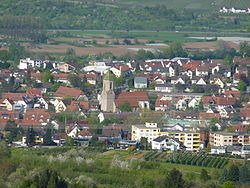
Beutelsbach

Beutelsbach

Landgut Burg

Landgut Burg

Zwiebelkuchen

Zwiebelkuchen

Certainly not provincial at all in our underage eyes was the eminently sensible European attitude towards alcohol, which suggested that if you were old enough to vote and be drafted, you were old enough to drink. This resulted in an initial period of frequent inebriation, but the novelty wore off soon enough for most of us. There was a Ratskeller right bellow the classroom, but most preferred the experience of drinking in a foreign language and enjoying that almost unique German institution, the Gasthaus. Climbing back up to the Burg after a bout of Stein-lifting not being to my taste, I frequented the Gaststätte Hirsch in Eichelsberg, where under the tutelage of Hermann the Wirt and his wife I learned a great deal of the Volksbrauch, at least when it came to swilling beer. On a couple of occasions Hermann (whom we called ihr because of his size) brought a bottle of American whiskey after closing and crushed the cap, an indication that this was likely to end up a Kotzenabend. As I said, the periphery of German Studies.

 
At the Burg we had classes four days a week. We were divided into five groups by level of German, and since I had so much in high school I was put in Gruppe A, also known as the Wunderkinder, which included several native speakers. The seminars were consequently conducted entirely in German, which meant initially that for the first time in my life I did not have much to say. The other classes, economics and German philosophy, were taught in English, though the English of the German professor who taught the latter was certainly novel. Among other things he constantly spoke of “three-angles” and often began by saying “From begin on…” We never had the heart to correct him. It was, incidentally, in that class that I first read a non-mathematical book that I simply could not understand, Husserl’s Cartesian Meditations. Consider the following sentence: “The universal Apriori pertaining to a transcendental ego as such is an eidetic form, which contains an infinity of forms, an infinity of apriori types of actualities and potentialities of life, along with the objects constitutable in a life as objects actually existing.” You said it, Edmund!

 
But the whole point of the program was to get one off the campus into the bosom of Germany and its culture, so we were more than encouraged to travel on those three day weekends. My first trip was with some students who had a car and we visited Munich (with many jokes on the way about Ausfahrt and Einfahrt), where I had the exquisite opportunity to use a stock phrase from Zeydel that had been a constant joke back in high school German. We could not find the cathedral we wanted to visit, and I thus approached a policeman and asked “Herr Wachtmeister, wo ist der Dom?” That was truly a verweile doch moment for me. I subsequently traveled alone, hitchhiking, in order to pump up my German, and this did the trick, since as is clear from what I did for a living, I really like to talk. The flubs were part of the fun, as when I was telling one of the Dienstmädchen, Helga (die ewige Weiblichkeit zieht uns hinan – und hinein, especially when you are eighteen), about World War I ace Rudolf von Berthold: Er hat vierundvierzig Flugzeuge geschissen. An incredible accomplishment, when you think about it.

Rudolf von Berthold

Rudolf von Berthold

Not everyone spoke the German I was familiar with, however, inasmuch as regional dialects were still running strong. We certainly struggled to comprehend schwäbisch, though it was soon discovered that one could fake speaking it by adding –le to the ends of sundry words: Grüβ Gottle! (Much later I learned the reply and was able to use it in the Himalaya when a German hiker greeted me with Grüβ Gott: Wenn ich Ihn sehe!) I had frequent conversations with an old man who seemed always to be leaning out his window when I visited Beutelsbach, and I don’t think I ever understood a tenth of what he was saying. And schwäbisch was nothing compared to Schwyzerdütsch. One weekend I visited the departed Helga in St. Moritz, and the locals might have been speaking an entirely alien language. In fact, some of them were. I happened to be in one of the very few places where they spoke Romansch, apparently a vestige of Latin and the Roman Empire. I wonder about a country that can not decide what its national language is. My conversational ability nevertheless developed steadily, and after a couple of months I suddenly realized that I was sometimes speaking German without thinking about it, that I had developed some instinctive sense of what was correct and what was not. I even began to notice grammatical mistakes made by native speakers. The legendary Sprachgefühl had come upon me!

 
The entire group took field trips. Paris was certainly fun, but Prague was much more beautiful and certainly more interesting. This was Warsaw Pact territory, our ostensible enemy, though that hardly seemed the case with all the Czechs I met, and as a workers’ paradise everything was so cheap that many mothers, including mine, got that European crystal they had been dreaming about. On the other hand, one of the students later tried to smuggle a Czech friend to the west in his car and for two years got see the Czech penal system up close and personal. Easily the most exiting trip was to West Berlin. This was the front line of the Cold War, and the juvenile enthusiasm we had demonstrated in Stuttgart, Paris and even Prague was suddenly tempered in sight of the wall, which had gone up only three years earlier. There is something about tanks and soldiers with assault rifles that takes the fun out of stealing street signs. A showcase for the west and capitalism, West Berlin was like a city on amphetamines, wired up day and night and ablaze with neon and a terrific place for young Americans who couldn’t get into a night club back home. For me of course this was also the capital of the Second and Third Reichs, a place that oozed history, and I spent a lot of time imagining the Red Army advancing on the Tiergarten or the final events in the Führerbunker. Well, perhaps not as much time as I spent watching the girls on the Kudamm.

 
East Berlin was in some sense also a showcase – for the failure of socialism. There were, amazingly, still blocks of rubble from the war, and a notable absence of many sorts of goods in the stores. But the people, even some of the Vopos, were friendly, and on my first trip over I was invited to a family dinner, though they did ask if I might bring some fresh fruit when I came. When I returned that evening, a female border agent on the east side of Checkpoint Charlie looked at my bag of oranges and asked in all seriousness: “Haben Sie eine Pistole versteckt?” Visions of Rosa Klebb in my head, I stammered out a nein and watched a huge grin appear on her face. Here was an evil commie functionary with a sense of humor, something, as I discovered on later travels, that was conspicuously absent from American customs officials. For convenience I normally passed through Checkpoint Charlie, but in order to experience what ordinary Germans endured I once crossed through Bahnhof Friedrichstraβe and had one of the more unforgettable moments of my life. I got separated from my friends and had to wait an hour on the east side for them. The sun had already set, and sitting outside on a bench, I saw a squad of perhaps a dozen Vopos marching down the darkening street. Watching them in their black uniforms with their jackboots kicking up in the goosestep, I was suddenly transported into the past. All that was missing were the swastikas. Heavy stuff for an historically inclined eighteen year old.

 Bahnhof Friedrichstraβe in the day

Bahnhof Friedrichstraβe in the day

The grandest single moment of the entire half year in Germany, however, came on my pilgrimage to Bayreuth. I arrived on the day of the last performance of that year’s Festspiel, but knowing that tickets had been sold out since before Wagner’s death, I expected only to see the Festspielhaus, Haus Wahnfried and the graves of the Master and Cosima. But for the hell of it I went to the ticket office, and a ticket had come back! There were four people ahead of me, but for one reason or another they turned it down, and I realized that I was about to see (for about $15) Götterdämmerung at Bayreuth. Eat your Herz out, Jens Shurk! From then until the opera began I was floating several feet above the ground, watching the opera jet setters in their sometimes antique formal wear while they watched me in my not so formal wear. The production was by Wolfgang rather than Wieland Wagner and thus not that great, but who cared? I was in a box right next to the one Wagner and Mad Ludwig had sat in, and at the end of the performance the actual grandsons of the vile genius appeared on the stage. The ovation went on for the better part of an hour, and my hands were sore from clapping and my voice hoarse from yelling. I expect that I am the only person ever to have yelled “Bitchin’!” in the Festspielhaus.

the holy of holies

the holy of holies

Before I departed Germany in December for the Kindermädchenstaat I stayed a week with a German family in Schorndorf, a whole new experience in Haushaltskultur. I knew Germans did far more handshaking than we, but I was astounded to witness the children in the family shake hands with their parents before retiring for the night and upon greeting them in the morning. My guess is that this custom has evaporated as Germany has evolved – unfortunately – into a less formal society in the last three decades. Also enlightening was a trip with one of the boys in the family to his Gymnasium, where he studied a curriculum that would baffle many of the undergraduates in an American university. His English teacher was delighted to have a native speaker in the class and had me read the text they were preparing. Perhaps not so surprising to me after a half year in Germany, I was periodically interrupted by the instructor, who would point out “That is the way they say it in America. Here is the way it should be pronounced.” And I had thought I spoke standard, non-dialectical English.

 
My time in Germany in 1964 was clearly the high point of my tenuous association with German Studies, but I did visit the Vaterland again. In 1979 a sort of circle was completed as I traveled to Germany (and other countries) in the company of Herr Shurk, who thus had the opportunity to hear one of his former students actually speak passable German. In return I got to meet his wife’s family in Mainz (Gel!), including her father, a former Gauleiter (cleared during the denazification) now in his eighties. My historian’s heart was of course excited – a living relic of the Hitler government – but he was disinclined to talk about the old days. Less lofty, perhaps, was my return in 1984 with my brother, whose German was at the Bier gut! level. The Burg was now a sort of convention center, the Stanford-in-Germany program having expired from lack of student interest, yet another sign of the decline of higher education in the United States. In Munich I insisted we visit the Hofbräuhaus, since I had been there exactly twenty years earlier to the month and every beer drinker should stop in at least once in his life. Just an hour or so in the afternoon for nostalgia purposes; we staggered out after midnight, so schön ist’s im Hofbräuhaus!

 
Meanwhile, German had for me become less the language of literature and beer halls and more the Gelehrtensprache, as I obtained a doctorate in classical history. The language I had as an adolescent thought useful for science turned out to be along with my mother tongue the most useful for studying antiquity. It was after all the Germans who invented “scientific” history (“wie es eigentlich gewesen ist”) in the nineteenth century, better to examine the classical world they had fallen in love with in the eighteenth. Moreover, German can be just perfect for the nitpicking so dear to scholars, especially those in Classical Studies. Was the Peloponnesian League a Staatenbund or a Bundesstaat? This sort of elegance is impossible in English. It is hardly surprising that the most monumental work in classical history, at least in terms of size, is in German: Pauly, Wissowa, & Kroll, Real-Encyclopädie der klassischen Altertumswissenschaft. This was a project that lasted longer than the Second and Third Reichs combined.

 
My conversational ability has gone dormant in recent years, requiring a one or two week dip in a German-speaking environment to revive, and I have not returned to Germany in twenty years. But I have of late spent a lot of time in Greece, and German has frequently stood in for my non-existent modern Greek, since there are so many middle-aged Greeks (and Italians and Turks) who speak German from their days as Gastarbeiter. Besides, Germans and Austrians have the tourist Euros to spend, which more than compensates for any hard feelings left over from the forties, and many shops and restaurants sprechen Deutsch. Indeed, every summer there is a mini-Indo-European invasion, as Germans, dragging their Wohnwagen behind their Benzes, stream into the Adriatic and Aegean, seeking the sun and bargains. And if you fly into Athens, you pass through an airport built and for the next thirty years owned by the Germans.

 
Here in Albuquerque, the land of Karl May, my dance about the fringes of German Studies is maintained through my friendship with Peter Pabisch and Fritz Cocron, a Dolmetscher on the Ostfront (more living history) and possibly the only Wehrmacht veteran ever to be decorated by the Polish government. Our conversations are for the most part in English, but snatches of German nevertheless slip past my lips on occasion and Sprachgefühl appears with me still, ready to be awakened by a sojourn in Germany.

 
Mein Sinn ist in Griechenland, aber mein Herz bleibt immer in Deutschland.
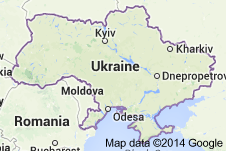
If You Had the Luck of Ukraine, You’d Wish you Were Russian Instead

In 1938 Adolf Hitler prepared to send troops into the Sudentenland, the western predominantly German-speaking region of Czechoslovakia, on the grounds that the ethnic Germans there were being mistreated.  At the infamous meeting in Munich, to which the Czechs were not invited, France and Britain agreed to German annexation of the area, easing Europe a bit further down the road to war, which broke out a year later when the western powers refused accept the same justification for Hitler’s claim on Danzig and the Polish Corridor.  Vladimir Putin, czar of the reborn Russian empire, has now done the same in Ukraine, occupying the Crimea and threatening the Russian-speaking areas of eastern Ukraine.  Unlike Hitler, however, he did not wait for permission from the west.

the Black Earth

the Black Earth


The history of Ukraine is to a large extent the history of Russia, and both groups trace their origins to the Kievan Rus’, the first great Slavic state, which took shape in the late ninth century.  Ironically, the initial ruling elite was not Slavic but Scandinavian, the Varangians, a Viking group that had settled the region via the great rivers from the north.  They quickly disappeared into the Slavic majority, but it was under their leadership that Kievan Rus’ was established, and under the Rurik dynasty it became in the tenth and eleventh centuries easily the most powerful state in Europe, controlling territory from the Baltic to the Black Sea.  The state began to disintegrate in the twelfth century, and in the thirteenth the Mongols showed up, devastating the land and destroying Kiev itself in 1240.  Kievan Rus’ fragmented into separate principalities, the most powerful of which was the kingdom of Galicia-Volhynia, which in the fourteenth century fell under the control of the grand Duchy of Lithuania and the kingdom of Poland.  This complicated matters inasmuch as the new rulers were Catholics, and in 1596 they introduced the Uniate Church, which employed eastern rituals but was under the Pope, thus creating a sectarian divide.

Where it all began

Where it all began

The southern area, along the Black Sea, became the Crimean Khanate, ruled by the Crimean Tatars, descendants of the Mongols.  At the same time a principality on the northeastern periphery of Kievan Rus’, Vladimir-Suzdal, grew into the Grand Duchy of Moscow, which would become Russia.  And there was of course the growing power of the Cossacks on the Dnieper and the Don, leading to the emergence of the Cossack Hetmanate, which dominated much of southern Ukraine.


In the seventeenth century the Ukraine experienced its own Thirty Years War, when from 1657-1686 the Poles, Russians, Cossacks and Turks (and a dash of Tatars) fought for control of the area.  The result was the “Eternal Peace,” which gave the land west of the Dnieper to Poland and the land east to Russia.   This divided the Cossacks, who nevertheless remained a powerful force in Ukraine, and in the early eighteenth century they joined Poland and Sweden in a war against Russia.  They were crushed, and the Hetmanate was abolished by Catherine the Great in 1764.  The last Hetman, Kirill Razumovsky, declared Ukraine a sovereign state in 1763, the first to do so.  When Poland was partitioned at the end of the eighteenth century, Russia and Austria divided Ukrainian territory west of the Dnieper.  The Crimean Khanate was annexed by Russia in 1783.


A relatively backward agricultural area, Ukraine was of little concern to St. Petersburg and Vienna in the nineteenth century.  The western half, Galicia, enjoyed a greater degree of freedom under the Hapsburgs, producing a nationalist movement, while the eastern half suffered under a program of Russification, which attempted to eradicate Ukrainian culture and literature and even language.  Ukrainians fought on both sides in World War I, and the entire nation was swept into the chaos and violence following the Bolshevik Revolution in Russia.  In the period 1917-1921 several Ukrainian “states” came and went, and while the bulk of the territory became the Ukrainian Soviet Socialist Republic in 1922, parts of the west went to Poland, Belarus and the new republic of Moldava.


Then came suffering not seen since the days of the Mongols.  Some million and a half Ukrainians died during the Russian Civil War and the War with Poland, and an unknown number followed them into the grave during the famine of 1921.  During the twenties the Soviet government actually encouraged a revival of Ukrainian culture and language, but that changed with the triumph of Stalin at the end of the decade.  As a result of the forced collectivisation millions died of starvation in the early thirties, and during the purges more than a half million people were murdered, eliminating 80% of the Ukrainian cultural elite.  In the wake of this horror many Ukrainians in the west welcomed the Nazis as liberators, but German atrocities turned most to the unpleasant course of supporting the USSR, and during the war Ukraine actually regained territory previously ceded to others.


To the destruction caused by the war was added the deaths of tens of thousands during the famine of 1946-1947 and the deportation of hundreds of thousands prior to Stalin’s death in 1953.  Familiar with Ukraine and interested in establishing better relations, in 1954 Khrushchev transferred the Crimea to the Ukrainian Soviet Socialist Republic, thus establishing the circumstances for the present crisis.  During the post-war period Ukraine enjoyed tremendous economic growth and influence, producing many prominent figures, including Leonid Brezhnev.


On 24 August 1991 Ukraine declared itself to be an independent democratic state, freeing itself from foreign control for essentially the first time in almost a millennium, and in December Ukraine, Belarus and Russia formally dissolved the USSR.  The Ukrainian economy suffered massively during the wild days of the nineties, but by 2000 real economic growth had been established.  Unfortunately, as with virtually all the former members of the Soviet Empire democracy did not come easy, and increasing fraud, corruption, concentration of power and the plundering of the national wealth led to the Orange Revolution in 2004.  Viktor Yanukovych, winner of rigged elections, was thrown out by Viktor Yushchenko and Yulia Tymoshenko.  Two years later Yanukovych was back in power only to be replaced by Tymoshenko the following year.  In 2010 Yanukovych was elected president in a questionable election and had Tymoshenko thrown in prison.

Ukrainian military

Ukrainian military

the stooge

the stooge

Ukrainian Evita

Ukrainian Evita

Corruption was rampant under Yanukovych, who established a kleptocracy supported by the country’s oligarchs and became a puppet of Vladimir Putin, who, as is perfectly clear, wanted Ukraine in the new Russian empire.  This led to the current revolution and Yanukovych’s flight to Russia.  Having lost his stooge, Putin stirred up trouble among the majority Russians in the Crimea and sent in troops (with no insignia) to “protect” them and the Russian naval base leased from Ukraine.  This was a blatant violation of the 1994 Budapest Memorandum on Security Assurances, signed by Ukraine, the United States, Russia, and the United Kingdom, which guaranteed the territorial integrity of the Ukrainian state.


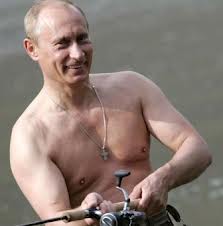
Vladimir Putin in not just the latest autocrat of all the Russias, he also a thug, nurtured in the bosom of the KGB.  Knowing that German Chancellor Angela Merkel was terrified of dogs, he deliberately had his large dog present when they met for the first time in Moscow.  He may be the most buff ruler of Russia in centuries, but he is a thug, with a Mussolini-like propensity to bare his chest.  But then, he is the ruler of Russia, a country filled with a greater than average number of vulgar and cruel people.  He is also a liar and a hypocrite, but what national leader is not?  He constantly touts national sovereignty (“stay out of Syria”) and then promptly invades Ukraine.  Of course US protests about violating sovereignty also ring a bit hollow, since we do it constantly, especially in Pakistan, and give unqualified support to a state, Israel, which seems to have no concept of national sovereignty beyond its own.

macho czar

macho czar

So what can the west do?  Western leaders are of course “closely monitoring” the situation, expressing “grave concerns” and calling for calm, all while wondering what the hell they can do.  Who actually controls the Crimea is hardly a major security interest for the west (good luck with all those Tatars, Vlad!) and places like Germany are far more concerned about Russian natural gas supplies, but from the beginning of time major powers have been concerned about losing face.  And there is substance to the notion that if aggression is not countered, the aggressor will seek more.


Still, we hardly want an actual war with the Russians, despite the fact that their military is a shadow of its former self.  It is mighty risky policy to get into a shooting contest with someone who has nuclear weapons, and if Hungary was not worth getting nuked for in 1956, the Crimea certainly is not in 2014.  Of course there is John “Why Are We Not Still in Vietnam” McCain advocating activating NATO junior partner status for Ukraine and Georgia, failing completely to understand that this is exactly the sort of thing that drives paranoid dictators over the edge.  Look at the virtual wall of American bases encircling Iran, and one gets a better idea of why they are belligerent.


On the other hand, Barack “Everything Is Secret” Obama has hardly been inspiring in his relatively placid response to the crisis.  It certainly does not take an expert in foreign affairs to see the only options available and to begin to implement them.  Immediately pump money into Ukraine to stabilize the economy and provide relief if Putin turns off the gas.  Ratchet up the diplomatic and economic pressure on Russia.  Prince Vlad probably does not care that much about world opinion, despite the big Olympic splash, but his country is a relative economic wimp and might have serious trouble enduring major sanctions, although his people are well accustomed to enjoying a low standard of living.  Throw Russia of the G8, freeze her foreign assets, place a travel ban on her leaders and surround the country with a fence of economic sanctions.  The problem here of course is those trading with Russia are likely to be far more concerned with the money to be made trading with Russia than who controls the Crimea.


And how did this crisis take the US by such surprise?  We are able to monitor every phone call on the planet – to little apparent end – yet our intelligence agencies could not catch troops and equipment being slipped into the Crimean peninsula?  Once the revolution against Yanukovych began last year did no one in the government consider what might happen if he fell from power?  Is that not basic foreign policy planning?  Are we not supposed to mistrust characters like Putin and expect the unexpected?  And this in a country where the Pentagon is rumored to have gamed wars against zombies?  Perhaps the President and Congress were too busy raising money?  I’ll bet there are contingency plans to invade the Russian Commonwealth if they injure Israeli interests.


Well, too bad there is a nuclear component.   A naval battle in the Black Sea would be very cool.  Where is the Wehrmacht when you need them?


Sheol Welcomes Ariel Sharon

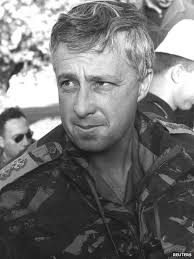
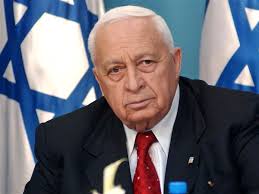
After eight years in a coma Ariel Sharon (1928-2014), Israeli military leader, Prime Minister and war criminal, died on 11 January. Ironically, but quite understandably, he was lauded as a man of peace by western leaders. American Secretary of State John Kerry asserted that Sharon was a man who attempted to “bend the course of history toward peace,” a truly ludicrous proposition that demonstrates the stranglehold Israel has on US politicians. Among Israelis he was more honestly known as the “Bulldozer,” while for Palestinians he was the “Butcher,” a recognition of his complete disregard for non-Jewish lives. Apart from his Jewishness Sharon was an individual who would have been quite comfortable in the Hitler administration, something that may be said about a disturbing number of Israeli politicians these days.

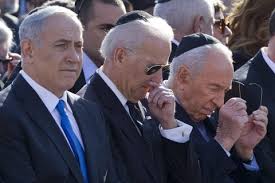
Joe  Biden is Jewish?

Joe
Biden is Jewish?

the world remembers the man of peace

the world remembers the man of peace

Sharon was a sabra, that is, he was actually born in Palestine, giving him marginally more credibility in his claim to the land than someone who had recently arrived from Brooklyn. To his credit he was not involved in terrorism against the British, as were two other Israeli Prime Ministers, Menachim Begin and Yitzhak Shamir, but this may simply be because of his youth. He fought as part of the Haganah in the War of Independence in 1947-48 and after the armistice in 1949 he remained in the Israeli military for the next quarter century. During this long tenure he showed himself to be a brilliant military commander, but he was also insubordinate and extremely aggressive, often losing more men than his superiors thought was necessary.

the young warrior

the young warrior

From the beginning of his career he also demonstrated a ruthlessness and complete lack of morality when dealing with his country’s enemies. Shortly after the armistice he organized Unit 101, a sort of special operations squad that conducted raids across the armistice lines in retaliation for Arab attacks, to some degree setting the standard for the Israeli military. Collateral damage among Arab civilians was not a concern, and responding in 1953 to an Arab raid into Israel, his unit attacked the West Bank (then controlled by Jordan) village of Qibya, which had been used by the Arab force. His men blew up 45 houses, a school and a mosque, killing between 65 and 70 civilians, at least half of them women and children. The operation was disavowed by the Israeli government.

the old politician

the old politician

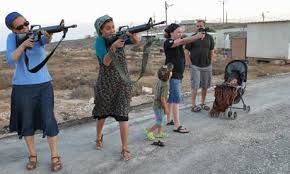
Sharon performed brilliantly during the 1956 Suez crisis, the 1967 Six Day War and the 1973 Yom Kippur War, but controversial political views led to his dismissal in 1974. His political career began the following year, and despite his lack of experience he was made Minister of Agriculture when Menachim Begin became Prime Minister in 1977. During this period Sharon became the major supporter of the settlement movement, which began in 1974 with the creation of Gush Emunim (Block of the Faithful), whose members wished to see the West Bank annexed by Israel. Sharon’s policy: “Everybody has to move, run and grab as many (Judean) hilltops as they can to enlarge the (Jewish) settlements because everything we take now will stay ours. … Everything we don’t grab will go to them.” The Jewish settlement of Palestinian territory would be Sharon’s greatest achievement and his lasting legacy.

defenders of Greater Israel

defenders of Greater Israel

the legacy

the legacy

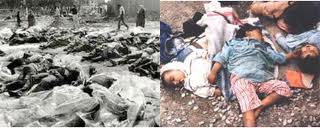
In 1981 Begin appointed Sharon Minister of Defense, and a year later Israel invaded Lebanon, providing the opportunity for Sharon to become an actual war criminal. On 15 September 1982 in response to the assassination of Lebanese president and Israeli ally Bashir Gemayel Sharon, Begin, chief of staff Rafael Eitan and foreign Minister Yitzhak Shamir decided to reoccupy West Beirut, violating their agreement with the United States. The Israeli army surrounded the Sabra neighborhood and Shatila refugee camp, where thousands of Palestinians, mostly women, children and old men, lived, and the following day Sharon and Eitan invited the Christian Phalange militias (See Ironies from Israel #2) to “mop up” the refugee camps, providing Israeli jeeps to transport them. The Phalange, originally modeled on the Nazi SA, entered the camps and began raping, mutilating and butchering the inhabitants, all of this being observed by Israeli officers stationed in buildings around the area. When darkness fell, the Israeli army continuously fired flares, illuminating the camps. The following morning the army ordered the Phalange to stop. By that time more than a thousand Palestinians, including small children, had been killed.

"personally responsible"

“personally responsible”

The United Nations condemned the massacre as “genocide,” with which term the US and other nations disagreed. An independent commission headed by Seán MacBride concluded that Israeli authorities or forces were indirectly or directly responsible for the slaughter, while the Israeli Kahan Commission, created only after 400,000 protestors gathered in Tel Aviv, concluded that Israel was only indirectly responsible. Sharon, Eitan and some intelligence officials were found to “bear personal responsibility,” and it was recommended that Sharon be dismissed. He refused to resign and Begin refused to fire him until massive protests forced a compromise whereby Sharon would cease to be Minister of Defense but remain in the cabinet. He also acquired the name “Butcher of Beirut.”

 
International outrage subsided, and Sharon remained part of the cabinet for the next eighteen years, serving as Minister Without Portfolio, Minister for Trade and Industry, Minister of Housing and Construction, Minister of Energy and Water Resources and Minister of Foreign Affairs. He became Prime Minister in 2001 and served until his stroke in 2006. As a cabinet minister he vigorously pushed the settlement of the
West Bank, but in 2005 he “disengaged” from Gaza, forcibly removing some 7000 Jewish settlers. For this he was lauded as a “man of peace,” taking the first bold step towards ending the occupation and creating a Palestinian state. What nonsense. Unlike the West Bank, which is essentially Judea, Gaza was never part of ancient Israel and consequently expendable in the creation of Greater Israel, and the move took some of the attention away from the massive settlement program in the West Bank. “Disengagement” meant turning Gaza into a huge prison camp, its frontiers, territorial waters and air space controlled by the Israelis, who periodically bomb its fading infrastructure.

 
In an attempt to end terrorist attacks and suicide bombings in 2002 he launched Operation Defensive Shield, the largest military operation in the West Bank since the Six Day War. Various international organizations concluded that both sides could be faulted for their behavior and that Israeli use of heavy weapons in urban areas resulted in civilian casualties. More critically, the Israelis purposefully destroyed much of the Palestinian infrastructure, including private property belonging to a number of NGOs. By deliberately debilitating the Palestinian Administration and weakening the economic infrastructure Defensive Shield dramatically aided the settlement program.

 
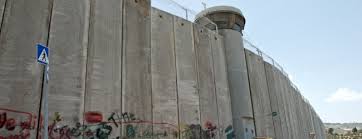
In 2002 private groups began the construction of the “separation barrier,” which after some hesitation Sharon’s government embraced, pouring in funds. The concrete wall, generally more than twenty feet high, and other obstacles, including exclusion zones, are designed to protect Israel, but it also allows the Israelis to begin transferring Palestinian land to Israel by running the wall east of the 1967 cease fire line. More than 8% of the West Bank has now been in effect turned into Israel.


passing the baton

passing the baton

a new crusader castle

a new crusader castle

Many Israelis see Ariel Sharon as an embarrassment and even a war criminal, but generally he is remembered for his heroic and brilliant exploits during Israel’s major wars. His lasting legacy, though, is the settlement of the West Bank, where more than a half million Israelis now live and enjoy rights and resources denied the Palestinians. Israel now directly controls about two thirds of the proposed Palestinian homeland, while the remainder is cut up by Israeli-only roads and military enclaves. In complete conflict with international law Israel is gradually annexing the West Bank and painting herself into a corner. If the Palestinians are granted citizenship in Greater Israel, it will no longer be a Jewish state, which is unthinkable. The only alternative is apartheid, a system that is slowly being established. And through inaction and political cowardice my country is abetting this loathsome development.

honesty!

honesty!

Free Speech. Where?

Freedom of speech is easily the most important of the freedoms guaranteed by the Constitution, the most important freedom in any society.  If the people can say and write what they please, a government will have a difficult time becoming repressive, at least against the will of the people.  (There are clearly many who do not care what the government is doing so long as life is comfortable – five thousand years of civilization has not been so much a march towards greater freedom as towards greater comfort.)  Free expression is at the same time a fragile entity, easily damaged by political, economic and even social concerns.  Even liberal governments and politicians are very uncomfortable with free speech.  They do not like to be questioned or criticized or circumvented, and they certainly do not like to be made fun of.


The greatest threat to free expression inevitably appears when a society’s security is being threatened or perceived to be threatened.  Security is far and away the most common justification for enhancing the power of the government and at the same time checking the free speech that might be employed to expose and oppose the state’s actions.  Threats to the country are also the strongest motivation for the people themselves to do the government’s work and curtail the speech of those with unpopular and thus unpatriotic points of view.  Any American publically suggesting in 1942 that the Japanese were not entirely evil and had some reason to attack the US would immediately receive a personal and violent lesson in the limits of expression during wartime.  The popular protests against the war in Vietnam were tolerated in part because the state failed to demonstrate that there was in fact a serious threat to America.  It also allowed its credibility to be shattered by a news media permitted virtually unlimited access to the war, a situation that was corrected during the war against Iraq, when “embedded” reporters were fed carefully crafted reports.


The popular repression of speech that followed the 9/11 attack was particularly virulent, undoubtedly because the United States itself had been assaulted and we were suddenly at war with shadowy figures who might be lurking right around the corner.  Any criticism of government policies constituted a lack of patriotism, and even the barest suggestion that the terrorists had anything to do with our policy in the Middle East or that they were sacrificing their lives for a principle, benighted though it was, was akin to treason.  An admittedly insensitive crack about blowing up the Pentagon resulted in death threats and demands from individuals and state politicians for my dismissal from the university.  Meanwhile, the administration of the university, a place that should be a bastion of free speech, while justifiably criticizing my remark, refused to defend my right to make it and treated me as road kill,  requesting my retirement.  This attitude is of course that accepted by government, and in response to my comment the presidential press secretary publically stated that “Americans need to be careful about what they say!”  This is an outrageous idea and represents the sort of governmental intimidation that was subsequently built into the Patriot Act.

I worked here

I worked here


A more insidious threat to free speech comes with our attempts at social engineering, a questionable enterprise.  The unvoiced premise lurking behind much of this thinking is that freedom of expression means freedom of popular expression or decent expression or socially useful expression, all things that hardly need Constitutional protection.  So we now talk about “hate speech” and “fighting words,” that is, speech that is not popular, decent or socially useful but in fact constitutes a threat to social harmony and public safety.  This is all pernicious nonsense.  The only valid parameter for limiting speech is whether or not it is likely to cause immediate physical danger.  Inciting a crowd to riot would fall into this category, but hate speech that might indirectly lead to some problem in the future does not.  In the second case who would decide when offensive expression is offensive enough to be considered a danger to society?  Some government body?  Popular vote?  Do this and freedom of speech begins to crumble.  Or the “fighting words” notion, which maintains one cannot use speech that is so offensive to an individual that he assaults the speaker.  More nonsense.  You may be stupid for saying such provocative things, but speech can never justify doing violence to someone.


People seem to have a difficult time recognizing the burden of free expression: tolerance.  Your right to say what you please entails tolerating what others choose to say, no matter how disgusting you find it.  In fact, your duty as a citizen is to defend that person’s right to spout hate or nonsense. The grandest moment of the ACLU was defending the right of American Nazis to march through a Jewish neighborhood in Skokie, a principled act that led to the resignation of many members.  These hypocrites were in effect saying “We believe in free speech, but…,” a statement that guarantees that the speaker is ready to limit that free speech.  Many appear to believe there is a clause in the Constitution that guarantees the right to get through life without ever being offended.

Even these idiots have the right to spew their venom

Even these idiots have the right to spew their venom


Truth is clearly not a necessary component of free expression.  If it were, politicians and advertisers would be in trouble.  Apart from the fact that it is often difficult to define precisely what is true and what is not, speaking nonsense is certainly protected by the right of free speech.  There is, however, a specific case of untrue speech being prohibited.  In Germany and Austria denying the Holocaust is a criminal offense, which is an outrageous abridgement of free expression, designed, presumably, to hinder the emergence of obnoxious and threatening groups.  While it is clear why this particular topic is a sensitive one in these countries, this is a dangerous practice.  Who is to decide what bits of history may not be denied or distorted?  When is an event in the past so horrible that one is punished for saying it did not happen?  Why not outlaw all speech which appears stupid or ignorant?


In Israel it is now illegal to publically support any agency or NGO engaged in boycotting Israeli products or services as a protest against the country’s policies regarding the Palestinians.  People who do so are “delegitimizing” Israel, an assertion that now takes a place alongside “anti-Semitism” as a standard reply to critics of Israel.  It may seem a small thing in a society that enjoys wide freedom of speech, but while an Israeli citizen is free to say all sorts of nasty things about his country, he cannot support or approve any boycott directed against Israel, which is to say, there is one traditional form of protest that is denied to him.  Asserting that it is criminal to “delegitimize” the state comes seriously close to punishing people who insult the state.


And now this Israeli – or at least Likud – assault on free speech in the interest of politics may be coming to America.  Opposing Israeli policies in Palestine, the Boycott, Divestment and Sanctions movement has initiated an academic boycott of Israeli institutions and universities, which has now elicited a response from Israel’s many friends in the Congress.  The proposed Protect Academic Freedom Act provides that any academic institution that participates in the BDS movement will be denied federal funds under the Higher Education Act.  This is bad enough, but the definition of “participate” is breathtaking: “The Secretary shall consider an institution of higher education to be participating in a boycott of Israeli academic institutions or scholars if the institution, any significant part of the institution, or any organization significantly funded by the institution adopts a policy or resolution, issues a statement, or otherwise formally establishes the restriction of discourse, cooperation, exchange, or any other involvement with academic institutions or scholars on the basis of the connection of such institutions or such scholars to the state of Israel.”  Whatever one thinks of the BDS movement and the academic boycott, this ironically named bill would obviously put limits on free speech on the American university campus.


The man who introduced this constitutionally questionable act, Rep. Peter Roskam, explained: “These organizations are clearly free to do what they want to do under the First Amendment, but the American taxpayer doesn’t have to subsidize it. The American taxpayer doesn’t have to be complicit in it.  And the American taxpayer doesn’t have to play any part in it.”  (A perfect of example of “I believe in free speech, but…”)  So, federal funding of academic institutions that merely fund an organization that in turn makes a statement against a foreign country is somehow an unreasonable burden for American taxpayers to bear?  And only in the case of this one particular country?  The Congressman does not explain why it is on the other hand fine that the American taxpayer has to be complicit in and play a part in sending $3 billion dollars a year to a country that is universally recognized to be blatantly violating international covenants the civilized world is pledged to uphold.  How far is this from denying federal aid to a university that allows its faculty to publically support a boycott targeting American policy?  Well, probably very far, since the Congress often seems more concerned about Israel than the United States.

A bit frayed these days

A bit frayed these days

I don't need to show you no stinking Constitution

I don’t need to show you no stinking Constitution


Freedom of speech is the most fragile of our freedoms, since it is so easy to slowly pick away at it, to eliminate free expression in this or that seemingly small area in the interest of social and political welfare.  And most Americans will simply not care because it does not affect them.


A final historical observation concerning free expression.  While Athens was engaged in what would be a life and death struggle against Sparta, the Peloponnesian War (431-404 BC), the comic play-write Aristophanes was producing very successful satires of Athenian society and policy.  Not only did he constantly lampoon the leaders of Athens, but he openly attacked the Athenian empire and the war itself, and he did this in a state that lacked any constitutional guarantees whatsoever, a state where the people in their assembly could take virtually any action they pleased.  It is hard to find a greater commitment to free speech.

"Take your war and shove it."

“Take your war and shove it.”


Abused Metaphors, Soon Dead?

Variety in speech and writing is a desirable trait, and employing a colorful metaphor in place of a more mundane literal statement will enlighten one’s prose. “He swallowed his gun” is certainly more vivid than “He committed suicide.” Some metaphors are so well established that they have become “dead,” that is, they have virtually taken on the meaning of the word they replaced and ceased to be metaphors: “head of state” or “foot of the mountain.” The problem comes in using the same metaphor over and over, eliminating any novelty that it might have once had and rendering it instead an annoyance, akin to a child endlessly repeating some word or phrase he has just learned.

 
It is of course no surprise that it is politicians, and to a lesser degree news anchors, who are most prominent in running metaphorical phrases into the ground. This habit primarily manifests itself in off the cuff (a metaphor!) speech, since political figures have speech writers for prepared comments. Using a trendy metaphor demonstrates that you are with it, and using it repeatedly then demonstrates that you have a certain lack of originality and likely a limited vocabulary. Politicians are after all accustomed to speaking in “talking points” in order to avoid saying something actually revealing and possibly damaging. Endlessly repeated and tiresome metaphors are at least distantly related to talking points, is so far as they are safer than trying another expression, which might lead to a slip.

 
Possibly the most tedious recently overused metaphor is “kicking the can down the road.” This is an especially useful political metaphor, since it means “putting off a serious decision,” which seems to have become endemic in the US Congress. While it is very doubtful that many people under the age of eighty know this is a reference to a depression era children’s game, it nevertheless presents a colorful image and does not have the immediate implication of inability to make a decision, which suggests failure. This expression has become almost intimately associated with America’s fiscal problems, so we can expect it to be trotted out (metaphor!) on a regular basis. Going on about cans being kicked certainly sound better than “we can’t do our job.”

kicking the can

kicking the can

 
Another periodic and increasingly annoying metaphor regularly appears during election campaigns, which seem to be going on most of the time. This is the constant need to “energize the base,” which sounds much more up-beat and electric than “appeal to my core voters.” And in the case of Republicans “base” sounds a lot more innocuous than “the radical minority that can make or break my reelection.” “Base” is incidentally another example of a dead metaphor.

 
Then there are the “options on the table,” wonderful for negotiations and especially non-negotiations, like the Palestinian-Israeli peace talks. Presumably this once had an actual concrete meaning in the sense that negotiators typically do sit across from one another at a table and on that table are documents pertaining to possible deals. This might be considered a legitimate metaphor, evoking as it does the actual negotiating circumstances, but it has been delegitimized by incredible overuse. Once cannot hear of any negotiating or bargaining situation without hearing at the same time references to options and the table. Tedious.

table with no options

table with no options

 
Particularly annoying to me is the ubiquitous “at the end of the day,” a favorite of public figures and news people. No one now ever says ‘in the end” or “at the conclusion” or even the concise “finally.” “At the end of the day” is certainly more poetic than the more literal possibilities, which is probably why it so overused by people who are distinctly non-poetic. It also sounds more romantic, suggesting a manor house rather than an office or studio.

end of the day (with non-people American)

end of the day (with non-people American)

 
Everyone of course has noticed that no politician, especially one who is being grilled, ever says “then.” No, it is always “at that point in time.” The reason for this is obvious and certainly well known to educationists, the other large group abusing our language: why use one word when you can say the same thing with five? “Then” is too simple; common people use it. How much more grand and redolent of intellect and education is “at that point in time.” One could of course say “at that time,” but this does not sound as precise as referring to an actual point in the time-space continuum. Because of their reluctance to commit themselves to well-defined positions, politicians are generally surrounded by a cloud of vagueness, ambiguity and lack of details and referring to a “point in time” creates some illusion of precision. But still, one wants to know: exactly how long is “a point in time.”

 
And have you noticed that politicians never speak about “the people” or about “Americans”? It is inevitably the “American people.” This phrase is obviously not a metaphor, but it is one that is endlessly repeated, which makes one wonder if these people also talk about “free gifts” or “true facts.” Apparently our politicians fear that if they simply said the “people,” listeners would not know exactly which people they were referring to. Perhaps President Lincoln was taking a big chance with his “of the people” thing, though one might think that today the fact that every politician wears an American flag pin would provide a clue as to which people he was talking about. Why not simply “Americans”? Obvious: it surely does not sound as grand (or pompous) as the “American people,” and in any case politicians are only concerned with Americans who can vote, which does not include the Americans who are not people. Odd how frequently what an elected official says the American people want is contradicted by polls. It must be poor polling.

 
Further, why do they always refer to themselves in the plural? Do they consider themselves a sort of royalty, since like Louis XIV they believe themselves to be the state? (The phrase attributed to Louis XV, après moi, les delúge, might be more applicable to American politicians.) Or is it because most of the work and thinking is done by their staffs and they are actually referring to a group? Using “we” instead of “I’ does of course allow the possibility of collective rather than individual responsibility in the event of a problem, an extremely important consideration for any politician.

 
Specific to news anchors is another abused metaphor: “walk us through.” A reporter or expert is never asked to explain something, but rather to walk us through it. Once again, the beauty of a metaphor is the ability to provide an alternative and more colorful way to say something mundane, in this case employing a concrete image of learning (walking one through, for example, a dance step or football play) for an abstract and colorless word, explain. And once again the problem is beating the phrase into the ground with overuse and in this particular instance robbing it of its specific meaning. The expression has been traditionally used for explaining something very complex, something you need to be walked through to understand, but now it is employed to request an explanation of even simple things.

 
Finally, there are two expression that are not overused metaphors but are nevertheless annoying to the intelligent (or at least should be) and plain stupid. They are manifestations of the rot of hyper-sensitivity and political correctness that afflicts our society and demonstrate the silliness people, especially public figures and academics, are willing to engage in. I speak of the “n-word” and the “f-bomb.” They of course stand for the racially offensive “nigger” and supposedly offensive “fuck” and thus allow serious discussion of issues involving these words without actually using the words themselves.

 
This practice is ludicrous. A word is a commonly understood symbol that allows reference to a thing or an act or whatever, and in this case another symbol is simply substituted for the offensive symbol. But does not everyone who hears “n-word” or “f-bomb” immediately think “nigger” or “fuck? So, the perceived problem must lie not in using these terms but only in vocalizing them, which suggests many Americans apparently live in some sort of mythic universe where the symbol is the thing and speaking the name brings about the existence of what is named. The Greeks, for example, never spoke the actual names of the Furies for fear of summoning them but rather referred to them as the Eumenides, the “kindly intentioned ones,” a wonderful appellation for three incredibly malevolent deities. So, is it thus all right to yell “hey, n-word” at a Black? If it is still offensive (which is how it will be understood), then is it not also offensive to sit around and talk about the “n-word”?

 
“F-bomb” deserves special attention. It is even more silly than “n-word,” because virtually everyone, including the well-educated, at one time or another employs obscenities, especially this one. The word is learned early on by most children and is a bit of vocabulary that is deeply embedded in our culture. But official America seems often inclined to pretend that we are not what we are and that most people would be instantly offended by hearing a reporter say “fuck.” Actually, in the case the media it is the fear that the three viewers out of several million who really were offended will take action and scare off sponsors. This at least is a rational consideration. It is interesting that it is not “f-word” but “f-bomb,” suggesting just what an outrage the public utterance of this word it. Then why is it not “n-bomb,” inasmuch as nigger is truly an offensive and explosive term, while fuck is a fun word that almost everyone enjoys using? Who knows? This is America.

Stuff from Way Back #26: Image Is Everything


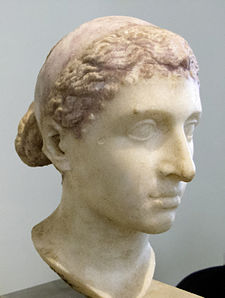
In 31 BC Octavian (Gaius Julius Caesar Octavianus), grand-nephew and posthumously adopted son of Julius Caesar, defeated Marcus Antonius and Cleopatra VII at the battle of Actium, ending the Roman Republic’s period of civil war.  Most of the people on the planet have likely heard of Antony and Cleopatra, but who has ever heard of Octavian?  The irony is that the romantic and celebrated couple are relatively unimportant figures when compared to the colorless Octavian.  They were simply another set of leading players during the last century of the Republic, while Octavian might be considered the most important individual in the entire sweep of Roman history.


By the middle of the second century BC the Roman Empire had been established, at least in the sense that there remained no power in the Mediterranean world that could seriously challenge Roman authority.  At the same time, however, the pressing need for reform in the state and military ran up against an all-powerful Senatorial class that had become corrupted and self-interested and resistant to even the smallest changes in the status quo.  The result was the Roman Revolution, which in the period from 133 to 30 BC saw the almost four hundred year old Republic gradually collapse into civil war and military dictatorship.  Ironically, the Republic was already dead when the dictator Lucius Cornelius Sulla restored and strengthened the traditional Senatorial government in 83-81 BC and then retired from politics.  Putting the pieces back together again was no longer possible, and Sulla himself provided a role model for future ambitious men.  The second fifty years of the Revolution was dominated not by the Senate but by powerful men and their armies, resulting in two full blown civil wars: Caesar against Pompeius Magnus (49-48 BC), and Octavian against Antony and Cleopatra (32-30 BC).

 Loser

Loser

Loser

Loser


When the 33 year old Octavian returned to Rome in 29 BC, he faced a task that might make the battle against the happy couple seem easy.  The Republic was dead, and as the immediately failure of the Sullan Restoration had demonstrated, it could not be revived.  With some small alterations the machinery of the Republican government was essentially that of the 5th century BC city-state fighting for its life in central Italy, and in the long run it was politically and administratively incapable of running an empire.  Enjoying the complete support of the military, Octavian could establish a blatant dictatorship, as his grand-uncle did, and allow Rome to face a return to civil strife when he died.  As one of Rome’s greatest statesmen, however, what he wanted was to manage the inevitable transition from oligarchic republic to autocracy in a way that would create a stable and lasting governmental structure.  In doing this he would become a second Romulus, virtually re-founding Rome.

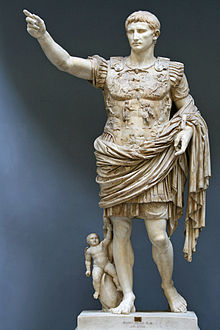
Winner and Princeps

Winner and Princeps


While he almost certainly began with a basic idea of what he wanted to do, the realization of that conception would involve much trial and error, and the process would be accompanied by the first real national propaganda campaign in history.  He realized, unlike any before him, that in the public and political sphere image was everything, that the reality could be more easily ignored and accepted if it looked like something else.  The reality was to be a military autocracy; the image was to be the Republic restored.  And it actually worked.  His creation, the Principate, would maintain a stable and prosperous empire for the next two hundred and fifty years and allow a declining Rome to stagger on for another century or so.


The basic problem was to maintain control of the military (which was finally fully professionalized), without looking like a military dictator, and he needed to find Republican precedents for all his arrangements.  He also needed to give the hitherto ruling elites, the Senatorial class, a real role to play in the new government without surrendering the ultimate power in the state.  This was tricky business.


The campaign began in January of 27 BC when with great fanfare he gave up all his illegal powers, declaring the restoration of the Republic.  The Senate, in part cowed by the obvious loyalty of the army to the son of Caesar, in part grateful and supportive of establishing a stable government, then proceeded in the following years to vote all those powers back to him.  He realized early on that continually holding one of the two annual consulships – the supreme office that provided imperium, the power to command troops – would not work.  Not only was this contrary to old Republican tradition and reminiscent of the years of the Revolution, but it also limited the ultimate political prize and administrative training ground that the consulship provided to the Senate.  Instead, by votes of the citizen assembly and the Senate he accumulated and exercised all the powers associated with the consulship and other state offices without actually having to hold any of them, thus being freed from the limited tenure of the actual office.  He subsequently held the consulship only on special occasions.  There was no office of emperor.  He was ostensibly a private citizen, but one possessing a vast amount of power.

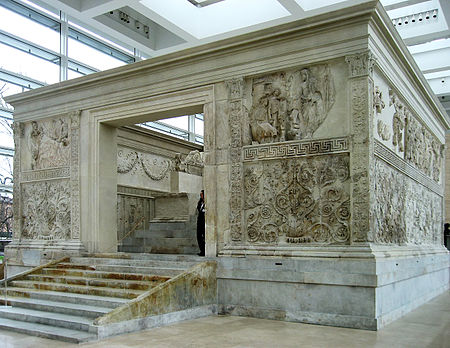
Augustan propaganda: the Altar of Peace

Augustan propaganda: the Altar of Peace

Augustan propaganda: the Deeds of the Divine Augustus

Augustan propaganda: the Deeds of the Divine Augustus


The major support of his authority was a special grant of proconsular imperium over certain provinces designated as “imperial”: initially the Gauls, the Spains and Syria.  These would be governed by legates chosen by him, while the remaining provinces, designated as “senatorial,” would be governed as they were in the Republic, by Senators who had just completed their terms as consuls or praetors (the imperium-granting office just below the consulship).  He also had the authority to interfere in the senatorial provinces if necessary and to move provinces from one category to the other.


This arrangement provided a way to control the army without actually being a supreme commander, which would be very un-Republican and redolent of the civil wars.  The imperial provinces were precisely those where the bulk of the military was stationed, thus providing Octavian with indirect command of the legions.  Grants of proconsular authority dated back to the early days of the Republic, but the only precedents for proconsular power on this scale were found in the Revolution and thus not very good.  But it could not be avoided: he absolutely required “legal” control of the military or Rome would slide back into civil strife.  Consequently, the confirmation of this power, first for ten years and then for life, was done quietly.  Incidentally, governance of the imperial provinces was generally of a higher quality than in the senatorial.


The other significant power granted him for life was the tribunician authority, which provided him all the powers wielded by the tribunes of the people.  These powers were really not that important to him, but the grant was very significant in terms of image.  The tribunate was an ancient office, created back in the fifth century BC, during the political struggles between the commoners, Plebians, and the aristocrats, Patricians.  The original mandate of the ten tribunes was to defend Plebians from hostile actions of the Patricians, and consequently Octavian could showcase this authority to demonstrate his position as a defender of the Roman people.


Supplementing his legal powers was his unmatchable auctoritas.  Auctoritas, “influence,” came with dignitas, “prestige,” the quality associated with an individual who had served Rome in some capacity.  In the grand days of the early and middle Republic it was dignitas that Senators competed for, rather than wealth and power, though dignitas did bring a form of power with its accompanying auctoritas.  (Yes, for almost four hundred years the majority of the Roman Senate actually thought first of Rome rather than themselves.)  The man (or men) recognized to be covered with the most dignitas would be styled princeps senatus, the First or Dean of the Senate.  Prestige of course brings political influence in any system, but for the Romans it was a much more real and compelling power.  And Octavian, who had literally saved the Roman state and restored order and prosperity, had a measure of dignitas unparalleled in Roman history.  He had become the princeps romani, the First Citizen of Rome.  Romans would listen to his advice.


Rome had become a military based autocracy, but there was no actual office of autocrat, no emperor, inasmuch as that would hardly look republican.  There was instead a Princeps and thus the early empire (27 BC – 235 AD) is known as the Principate.  Octavian took the more impressive name of Augustus and became in effect the second founder of Rome and its first emperor.  To the Roman people he was Princeps, to the army he was Imperator and to the provincials he was king and the center of the imperial cult of Roma et Augustus.  In the year 2 BC, acting on the proposal of Valerius Messalla, who had fought against him at Philippi, the Senate named Augustus pater patriae, the father of his country.

Pater Patriae

Pater Patriae


The Roman people were delighted with the Principate.  There was peace and growing prosperity, and in any case libertas, the Roman concept of freedom, had for them never meant any political participation beyond attending assemblies and voting according to Senatorial advice.  The Equestrians, the traditionally apolitical business interests, were of course more concerned with stability and prosperity than forms of government.


It was the Senatorial families, the former ruling elite, that were Augustus’ real concern as a potential source of trouble.  So he made them partners in the new order, both to give them something to do and to reconcile them to the Principate.  He actual had no choice: he could not govern the empire without the pool of administrative talent that was the Senate.  They were of course junior partners, but while the Princeps was the ultimate power, the Senate administered the state and through its ex-officials the empire.  They could still compete for offices and honors, for dignitas, but now in the shadow of the Princeps, who worked to keep that shadow as small as possible.  He showed the Senate respect and listened to its advice, and with imperial patronage he aided the political careers of members of the old families, especially those who had been against him.  And the whole thing looked like the Republic.  In fact, Rome was still in theory a constitutional state, inasmuch as it was the Senate, representing the Roman people, that voted the Princeps his power.  Image is everything.


Augustus succeeded in his establishment of a military dictatorship for a number of reasons.  The Roman world was tired of instability and war; they had just emerged from a century of struggle and two recent civil wars.  There was no one left alive who knew the Republic as anything but disorder and strife.  There were no rivals left.  The Senatorial oligarchy had been drained, and all the powerful men were now loyal to Augustus.  And there was the Principate.  Anyone with any intelligence knew the restoration of the Republic was a sham and that Augustus was the absolute ruler of Rome, but the Senate had no choice but to accept it.  The legions were completely devoted to the son of the now divine Julius Caesar, so that while there might be conspiracies, there could be no real threat to the Princeps.  Besides, he gave them a real role in the governance of the state and left them with all the trappings of power, while he maintained a low profile.  He made it as easy as he could for the former rulers of Rome to swallow the bitter pill of autocracy.


Finally, he lived long enough, dying on 19 August 14 AD at the age of 76.  Some forty years of power had allowed him not only to construct the Principate but also to wean it from dependency on his guiding hand.  Power passed more or less smoothly to his adopted son Tiberius.


There were of course weaknesses in the structure of the Principate.  It was after all an autocracy and thus faced the age old problem: what do you do when you get a bad autocrat?  Augustus hoped that each Princeps would select and train the best candidate and gradually associate him in power, but autocracies almost inevitably become dynastic, even in the Democratic People’s Republic of Korea.  This was virtually guaranteed in the case of the Principate since for the foreseeable future the Princps must be a Julian in order to secure the loyalty of the army.


The other problem was that the autocracy was based on the military, thus presenting the danger that the army would sooner or later involve itself in the making and breaking of emperors.  The remarkable thing about the Principate is that it took so long for the legions to actually do this.  When Nero, the last Julio-Claudian, died in 68 AD, several army commanders converged on Rome, and after a brief and limited conflict Titus Flavius Vespasianus became Princeps in 69 AD, establishing a new dynasty, the Flavians.  The legions then retired to their camps and did not get directly involved in the political arena again until the death of Lucius Aurelius Commodus in 192 AD.  There was another brief but more widespread civil war to select the next ruler, Lucius Septimius Severus, in 193 AD.  The army was subsequently favored but not pampered by the Severans and remained loyal to the empire.  It is only with the outbreak of the Anarchy (235-285 AD) that the military loses that sense of duty and becomes corrupted and interested only in itself and thus a major force in the ultimate collapse of the empire.


Augustus probably foresaw these problems, but what else could he do?  In the last century before Christ the Roman Republic was irretrievably dead, and the only option was an autocracy.  And the only real base of power for that autocracy was the military.  Given the circumstances and the evolution of Rome in the last century of the Republic, a military dictatorship had become unavoidable.  But it is hard to see anyone else who could have come even close to facilitating that transition and preserving Rome’s future as well as Gaius Julius Caesar Octavianus.  Few men have made history on that scale.

Stuff from Way Back #25: Athens in Vietnam

(This is a fairly long piece about a war most people have never heard of, but there is a wonderful lesson of history here.  For more on the sophists see Stuff from Way Back #20.  The dates are BC.)


“Now we can see it clearly – like the light at the end of a tunnel.”

General Henri Navarre

commander of the French forces at Dien Bien Phu

History can often be hauntingly familiar, even across the 2500 year divide that separates classical Athens from America in the second half of the twentieth century.  A case in point is the catastrophic Peloponnesian War (431-404) between the Athenian Empire and the Spartan controlled Peloponnesian League, a conflict that to a great extent ruined the Greek world.


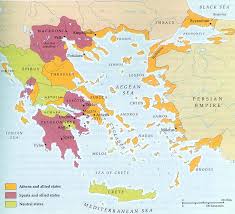
The Athenian Empire was naval based, taking in virtually all the island and coastal city-states of the Aegean, and constituted a wealthy trading block.  Though progressive and inclined to support democratic governments, Athens nevertheless maintained tight control over her “allies,” taxing them to pay for her powerful fleet (and the beautiful buildings upon the Acropolis).  Encompassing most of the rest of the Greek states, the so-called Peloponnesian League was land based and included most of the Peloponnesus and central Greece.  It was dominated, but not absolutely controlled by Sparta, which supplied the semi-professional core of the huge army, some 35,000 heavy infantry, that the League could field.  Sparta was the most reactionary state in Greece, and her small citizen body of perhaps 8000 was supported by an immense number of unfree serfs (helots).  Semi-socialist and nominally democratic, Spartan society was essentially authoritarian, and she favored oligarchic governments.

A divided Greece

A divided Greece

Athens began the war with immense advantages.  Her control of the sea was virtually absolute, which meant that the enemy was going to have a hell of time just getting at her and her allies.  The completion of the long walls linking the city with the port of Piraeus had turned Athens into a kind of artificial island, rendering her immune to the traditional strategy of laying waste the enemy’s territory and forcing them to come out and fight.  Offensively, the navy provided the Athenians with a big edge in rapid troop deployment and threatened the Peloponnesians with surprise raids on their coastal areas.  Athens also had unprecedented economic resources from her imperial income and her trade and went into the conflict with something unheard of in Greece: a  financial  reserve.  And finally there was the open and democratic nature of Athenian society, which had already made her preeminent in human resources, out-producing other cities in leadership, talent and imagination.


The Peloponnesians had but a single advantage over the Athenians – they were overwhelmingly powerful on land.  In every other respect they were hurting.  Any fleet they might scrape together would be dramatically outnumbered and out-rowed (the main pool of skilled rowers was within the Athenian empire), and the alliance was financially unprepared to launch and maintain many more ships.  And under the leadership of the Spartans, who did not even use coined money, that financial picture was not likely to change in the near future.  A further big disadvantage for the Peloponnesians: Spartan leadership.  A system geared to the status quo and limited mental horizons only rarely produces leaders of more than plodding ability, and Sparta’s traditional insularity and policy-bending paranoia about the helots might also be expected to hamper the war effort.  But blinding many to these serious weaknesses was the centuries old Spartan reputation as the alpha male of Greece, and there was widespread belief that ships and money and newfangled ideas would not save Athens from the juggernaut of the Spartan led Peloponnesian levy.


Pericles, the Athenian leader, knew better, and he intended to fight a new kind of war, one for which only Athens was in any way prepared – a war of attrition.  He was concerned simply with the preservation of Athenian interests, not the utter defeat of Sparta, which meant that Athens could achieve her victory by remaining on the defensive.  This he proposed to do by evacuating the population to the Athens-Piraeus fortress and temporarily abandoning Attica, the territory controlled by the city, whenever the Peloponnesians invaded.  Supplied from the sea, Athens could theoretically hold out indefinitely, while the fleet conducted raids on the enemy coasts to remind them of the price of war.  Pericles figured that after a few years of spending their summers in Attica and accomplishing nothing most of the Peloponnesians would lose whatever little interest they had in the first place, and the war would fizzle to an end.
Pericles aka "Old Squill Head"

Pericles aka “Old Squill Head”

Would the plan have worked?  Probably.  In the first several years of the war the Peloponnesian levy ravaged Attica and absolutely nothing happened.  Meanwhile, the Athenian fleet conducted hit and run operations against the coastal towns of the Peloponnesus, and it is hard to see how Sparta could sustain interest, especially among her already unenthusiastic allies, in a war that was making no real headway and bringing Athenian raids down on their territory.  Athens had even survived the devastating “plague” of 430 (probably epidemic typhus or cholera), which had carried off as much as a quarter of the city’s population.


But we will never know, because in 429 Pericles died from the contagion, and without his restraining hand Athens’ strength, her democracy, gradually became her downfall.  The cautious defensive strategy steadily evolved into an offensive one, and the goal of the war became the defeat of Sparta and the expansion of the empire.  This would have been dangerous enough, but the democracy itself began to undermine the war effort.  The traditional political leadership had been provided by the annually elected board of ten “generals,” so called because they were the men who actually led Athenian forces if needed; Pericles had been reelected to the board for thirty years.  The war now produced a new kind of politician, the demagogues, men of mostly limited abilities who wielded power not by holding office but by manipulating the citizen assembly, which in the unlimited democracy of Athens was the ultimate seat of power and could not be challenged.  They rode to  power on their rhetorical abilities and by advocating a war of conquest.  This led to a growing number of bad decisions and ill-considered strategies and created threatening divisions in Athenian society, as the increasingly radical democracy struggled to manage a people becoming intoxicated with their own power.


The first phase of the conflict, from 431 to 421, saw a steady departure from Pericles’ defensive strategy after his death.  In 425 the Athenians almost accidentally captured a unit of Spartans, which lead to peace overtures from Sparta, but the Athenians went on a roll and launched a land campaign in central Greece, a complete reversal of Pericles’ policy.  It was a disastrous failure and was followed by the loss of Amphipolis, an utterly vital city on the north Aegean shore.  Athens was ready for peace.


The Peace of Nicias, signed in 421, had about as much chance of success as the Munich agreement of AD 1938, and in 418 an Athenian supported coalition in the Peloponnesus was defeated by Sparta.  Meanwhile, a war-weary Athens was becoming more and more divided.  The older generation in particular was getting fed up, while the younger was increasingly enthusiastic for more military adventures.  The hawks got the upper hand, and in 415 a huge force was sent to Sicily to attack Syracuse and seize the entire island, an act of incredible imperial hubris.  Primarily because of divided leadership, a result of the political situation at home, the expedition failed, and in 413 it and a large relief force were essentially annihilated.  The Spartans decided to reopen the war and invaded Attica that same year, beginning the second phase of the war, from 413 to 404.


All hell broke loose for Athens.  In 412 her allies began revolting in droves, and even worse, Sparta signed an alliance with the Persia Empire, which meant money for a Peloponnesian fleet, which meant in turn a spread of the revolt and a threat to the security of Athens itself.  Back home extremist conservatives launched a coup in 411, setting up a narrow oligarchy of 400 and driving the Athenians to the brink of a civil war.  Athens was now at war with virtually everyone in the Greek world, including herself, but the people were not about to give in.  The democracy was restored in 410, and by 407 the Athenian position in the Aegean had been almost fully restored.  But the Athenians seemed bent on self-destruction, and in the next several years they turned down several peace offers from Sparta.  In 405 they lost their last fleet and were forced to surrender in 404, losing all their possessions, their walls and even their democratic government.


The Athenian democracy had failed.  Despite an immense superiority in resources and talent Athens had found herself unable to put an end to the war and after twenty-seven years of struggle had lost everything.  How could this happen?  For Thucydides, the Athenian historian of the war, the answer is clear.  The way of life fostered by the democracy was a source of powerful forces, but it took a capable leader to control and direct these forces, to restrain the people and channel their energies towards realistic ends.  Pericles was of course this kind of leader, able and patriotic, and Athens’ misfortune was that after his death the democracy found no one who combined these two qualities.  The prosecution of the war, the foreign policy of the state became more and more a reflection of internal politics, as Athens became the prey of the demagogues.  Time and again the Athenians passed up opportunities to end the conflict as winners in order to try instead for a vastly greater victory.  And time and again these attempts to grasp more were ruined not by the strength of the enemy, but by the Athenians themselves, as the political feuding created dangerous cracks in the democracy.  This domestic disunity was bad enough, leading ultimately to oligarchic revolution, but the cracks also showed themselves in the conduct of the war, in divided leadership of campaigns, inadequate support of expeditions and sudden reversals of policy.

Thucydides

Thucydides

I am inclined to agree with Thucydides.  Athens in the second half of the fifth century was simply under too much stress and faced with too many temptations to survive without the restraining hand of a leader like Pericles.  And it was clearly a question only of guidance, for the democracy – the common people who voted every important policy decision – constantly showed itself to be perhaps the most aware and able body politic in history.  It was after all Athens that lost the war, not Sparta that won it.  Their own worst enemy, the Athenians bounced back again and again after each new disaster, revealing the nature of the human resources shaped by a democratic society.   The Athenians and their experiences in the Peloponnesian War are a powerful testament to both the weaknesses and strengths of democratic government.


While suffering the political difficulties, the Athenian democracy also underwent during the war a moral crisis, which was both cause and result of the political trials.  This was the period when the radical sophists, extremist political thinkers, were attacking the democracy and its egalitarian notions.  Instead of the people they would see as rulers those who were by nature suited to rule – the “superior men” – and in place of the democracy they would have a narrow oligarchy.  Well, after the disasters of the latter part of the war people began to listen to these characters.  Reasonable and moderate men were losing faith in the democracy and becoming more attentive to these characters at the other end of the political spectrum.  Germany in the twenties and thirties saw a similar development, as moderate middle class Germans reacted to the perceived failures of the Weimar government and the threat from the left by paying greater heed to the far right.


The ideas of these sophists on the nature of justice – that might made right – fit perfectly with the growing will to power and empire among the Athenians.  As the war continued the means slowly became the end for the Athenian people, as demagogic factionalism and the temptations of power combined to drive them to extremes.  Pericles’ simple defense of the empire was forgotten, and victory gradually became instead the grasping of more, the expansion of power and the total defeat of Sparta.  Rather than what they might bring, success and power themselves became the real goal of the Athenians.  At the same time the continuation of the war produced among the Athenians a growing sense of frustration because of their seeming inability to bring it to an end.  When they were losing, the quality and strength of their national character compelled them to fight their way back, and when they were winning, that same character seduced them into reaching for more.  Athens had the power and the resources to carry on the war, even after a disaster like Sicily, but she could not stop it.  And this frustration further aggravated the problem, driving the Athenian people to seek even more urgently that light at the end of the tunnel, that final victory that would solve all their problems.  It might be fair to label the response of Athens to this frustration, her continued and amplified operations of war, as acts of collective hysteria.  This is the tragedy of a people being destroyed by their own greatness.


All of these things – the political turmoil, the frustrations, the national hysteria – were accompanied, perhaps inevitably, by a steady moral disintegration.  As the war dragged on there was a growing loss of respect for authority and the moral traditions of the community, indications of a loss of faith in the society as a whole.  The war certainly contributed to this moral breakdown, especially through the psychic conditions – the uncertainties, the alternating hopes and fears, the frustrations – it imposed on the Athenians, but the far more important cause was sophism.  Part of the impact of sophistic skepticism was the general erosion of accepted tradition and its authority.  If, as the sophists said, man-made law is all relative anyway, why necessarily accept that of your fathers?  Their values and standards of behavior may not be pertinent to your situation, and perhaps you should look instead to your own definitions.  This of course can be mighty dangerous for the social fabric.


Finally, there is an aspect of the Athenian moral crisis that should be familiar to late twentieth century America – the development of something like a generation gap.  Athenian society during the Peloponnesian War gave rise to what appears to be the first serious challenge of one generation by another in history.  As with America in the sixties it was precisely the young, primarily young aristocrats, who were the focal point of the moral crisis in Athens, although their reaction was hardly one of protesting the war and using controlled substances.  In fact it was generally the younger generation who were in favor of greater imperialist adventures.  But Athenian youth of the period of the Peloponnesian War were like many young Americans of the Vietnam era in that the morality of their fathers, the inherited ethos of the society, was not necessarily valid for them.  The extent of this challenge should not be exaggerated, being apparently essentially limited to aristocratic youth, but it did exist.


A generation gap had never occurred before this for the simple reason that only now had the ascendancy of the state and the individual so undermined the strength of the family that the ties binding one generation to the next had been loosened.  With the stage thus set by the general social development of the Greek state conditions particular to Athens then prompted the generational challenge.  First of all there was the democracy, which itself involved a certain rejection of tradition.  The egalitarianism that was fundamental to democratic society eroded the authority of parents, of the previous generation, by stressing the importance of the individual and the equality of all.  As an eighteen year old Athenian male, you are a full political person, with a vote in the assembly equal to that of your father, and in the assembly you might even become more influential than he.  So why should you then obey him when the two of you differ back at home?  Political freedom is not conducive to the passive acceptance of traditional authority.


Nor is an emphasis on reason, which only naturally tends to devalue authority based on tradition, and the growing respect for reason in fifth century Athens was causing many to question and sometimes reject traditional values.  The focus of this was of course the sophists, whose rationalism was especially zeroed in on an attack on tradition.  It was not just their hostility to tradition, but also the simple fact that they existed, breaking the monopoly parents had held in the education of the younger generation.  It is hardly surprising that the Baby Boom generation that was the first to seriously challenge traditional American values was also the first to go to college in massive numbers.  Reason and doubt are deadly to knowledge based only on faith and acceptance.


The final factor contributing to this generational phenomenon was the social and political failure of the democracy during the war and the loss of faith in the established order that it incurred.  We need only to look five decades into our own past to see the effect of such a failure on the young of society.


(An additional note: included in the ranks of the neocons, who played an instrumental role in leading the United States into its pointless and costly war with Iraq, are at least two classical historians, and it is said that Thucydides’ history of the Peloponnesian War is a sort of bible for them.  Apparently they neglected to read the chapters on the Sicilian expedition.)

Worst Legislator Who Actually Has a Brain Award

(This piece is self-indulgent and motivated solely by disgust. Next week I will endeavor to do something of interest to all.)


There would appear to be few members of the United States Congress for whom the good of the country is their primary concern. Rather, being reelected comes first, which means soliciting huge amounts of money, which is hardly likely to be handed over without some promise of a payback in the form of legislation. This is tacit and apparently acceptable corruption. Adding to the abysmal quality of our legislators is the recent appearance of Republican extremists, such as Sen. Ted Cruz, who are willing to threaten the welfare of the nation if they do not get their way. There are also growing numbers of anti-science ignoramuses, such as Rep. Paul Broun, who wish to make legislative decisions on the basis of beliefs plainly contradicted by fact. That men like Cruz and Broun are complete buffoons does not seem to bother their constituents, perhaps because they represent southern states.

 
There are indeed many disgusting individuals in Congress who seem to be doing their best to injure the country, whether from self-interest, extremist ideology or simple stupidity, but my pick for the Worst Legislator Who Actually Has a Brain Award is Rep. Ileana Ros-Lehtinen of Florida’s 27th congressional district, which includes Dade county. She is an American of Cuban extraction, who has served in the House of Representatives continuously since 1989. She is best known as Israel’s woman in Congress, a significant distinction given that most all of Congress is inclined to give the Jewish state unqualified support, but she is also an enthusiastic supporter of the security state that America is turning into.

Israeli agent

Israeli agent

 
Ros-Lehtinen’s legislative activities on the domestic front suggest a person who might be comfortable with the Stalin administration. It must be said, however, that her positions on social legislation are not extremist, but rather simply conservative. She supported the Defense of Marriage Act, an implicit anti-gay stance, but later became a champion of gay rights, presumably because her eldest child turned out to be transgender. (There seems to be a lot of this going around among conservatives who discover they have gay or lesbian children.) She singlehandedly scuttled the International Protecting Girls by Preventing Child Marriage Act, concerned that funds might be used for abortions. She opposes stem cell research and any estate tax and supports drilling in the Arctic National Wild Life Refuge. She supported the disastrous Bush tax cuts and opposes the Peace Corps, although it is not at all clear why.

 
These are standard conservative positions, and while they are increasingly out of step with the majority of Americans, they are not extreme or particularly detrimental to the country. The same cannot be said for her positions regarding the emerging security state. She supported the Military Commissions Act, which was created to provide a replacement for the Combatant Status Review Tribunals, which were declared unconstitutional by the Supreme Court. Besides circumventing the Geneva Convention this act was so worded that an American citizen could be denied habeas corpus, for which it was also declared unconstitutional. She has advocated that the Patriot Act, which was passed by an intimidated Congress in response to a (bogus) state of war, become permanent. This would make what were presumably temporary and extreme measures, to wit, dramatic increases in the power of the Presidency and the security services, permanent fixtures of the federal government. That legal scholars have seriously questioned the constitutionality of many of the provisions of the Patriot Act is apparently unimportant. One is reminded of the emergency Enabling Act of 1933, which also gave the executive enhanced power and became permanent, establishing the basis for the dictatorship of Adolf Hitler.

 
In the area of foreign policy Ros-Lehtinen is, in my opinion, seriously misguided and is injuring American interests abroad. She of course voted for the utter catastrophe that was the Iraq war, but then again, virtually everyone did, abandoning rationality for the satisfaction of revenge – against anyone. Whether the target was actually culpable was unimportant, as Ros-Lehtinen boldly declared: “Whether or not there is a direct link to the World Trade Center does not mean that Iraq is not meritorious of shedding blood. The common link is that they hate America.” Now, that is a reasoned policy. Of course, no hawk can ignore domestic politics, and having declared that harsher penalties should be imposed on Libya, she balked at the NATO airstrikes, presumably because they were initiated by a Democratic President: “I am concerned that the President has yet to clearly define for the American people what vital United States security interests he believes are currently at stake in Libya.” It seems there is no problem that President Bush failed to do this in the case of Iraq.

 
Born in Cuba and living in south Florida, Ros-Lehtinen is understandably, if not rationally, an extremist when it comes to the communist left-over in the Caribbean. The half century embargo of Cuba is probably the most obviously failed policy ever implemented by the United State. It has not brought about regime change, and indeed communist Cuba has already survived the Soviet Union by a quarter century. The major impact has been the impoverishment of the island and the complete absence of the sort of interaction that might soften or even change the regime. Inasmuch as Cuba is a threat to no one, and certainly not the United States, continued support of this failed embargo can only be understood in terms of emotion and revenge. Ros-Lehtinen is Cuban and represents a district that is packed with Cubans, many old enough to have fled when the revolution took place. In fact, it would seem that the continuation of this now silly embargo is due to the fact that as a Presidential candidate, if you oppose it, you lose south Florida, and if you lose south Florida, you lose Florida, and if you lose Florida, you lose the election. This may not be true, but politicians think it is.

 
When Obama dared to shake the hand of Raúl Castro at the Nelson Mandela funeral, Ros-Lehtinen exploded with rage, ranting about exchanging greetings with this bloody dictator. Well, Castro is indeed a dictator, there are political prisoners in his jails and Cubans enjoy very few freedoms, but the guy is a lightweight on the authoritarian stage. I have not heard her or other anti-Castro zealots complain about China, which is at least nominally communist and certainly more bloody. They still have a gulag, they have shot people in the streets and they are methodically turning Tibet into a Chinese province, yet the policy here is engagement. Incidentally, in their fulsome praise of Mandela American politicians and media had virtually nothing to say about Mandela’s close relationship with Castro and Arafat.

 
Ros-Lehtinen has of course worked against every attempt to end the embargo and open a dialogue with the Cuban government and tried to block President Carter’s visit to Cuba in 2002. This is of course all stupid but hardly radical, but she has clearly revealed her extremism. She defended Veletin Hernández, who was convicted of murdering a Cuban who advocated talking to Cuba, and she worked to obtain a pardon for Orlando Bosch, who was convicted of terrorism and is suspected of complicity in the bombing of a Cuban airliner that killed 73 people. She has publically advocated assassinating Fidel Castro and apparently anyone else she deems an oppressor. Most rational people would consider defending convicted murderers and supporting the assassination of foreign heads of state to be extremist.

 
But it is Ros-Lehtinen’s unqualified support for the state of Israel that seems most inimical to American interests and is certainly for me the most disgusting part of her political activity. She has authored a seemingly endless stream of bills seeking to tie the United States financially and militarily even more closely to Israel and impose more restrictions on the Palestinians. Any criticism of Israel, even if rooted in established American policy, will bring an immediate condemnation from her. When the State Department expressed concern about growing Israeli settlement activity in Palestine, she demanded that the administration stop such attacks on our ally, even though the United States has opposed the settlements for decades and they are blatant violations of well-established international law.

 
She opposes American support for the Palestinian Authority and any agency that works with the Palestinians, even if the work is simply humanitarian aid. The Palestinian Authority certainly has its problems, but it is the recognized government of Palestine and the only authority that can engage in negotiations with Israel (pointless though they may be). The fifty year old United Nations Relief and Works Agency for Palestine Refugees in the Near East has been frequently accused of malfeasance, generally by Israel and its supporters, who oppose any public discussion of the conditions in the occupied territories, but many of the accusations have been shown to be groundless. In any case, while there are likely problems associated with UNRWA’s operations, most of its work has been manifestly humanitarian. She has also attempted to deny American funds to any UN agency that recognizes Palestine as a state, no matter how important that organization’s efforts are in helping distressed people. A major source of her campaign financing comes from Irving Moskowitz, a notorious supporter of the settlement program and annexation of East Jerusalem and the West Bank.

Irving the Bag Man

Irving the Bag Man

 
Regardless of how one estimates the value of Israel as a US ally, Ros-Lehtinen is clearly an extremist when it comes to the Israelis. She has defended Israel when it violates international law (not that international covenants mean anything to America anymore), but more seriously, she has rushed to Israel’s defense even when it is blatantly opposing established American policy, embarrassing us and undermining our own national interests. While most politicians are terrified of angering Israel and its American organizations, this crosses the line into anti-Americanism, of putting the interests of a foreign state above our own.

 
One wonders why. As a radical opponent of the Castro regime, you would think she would feel some sympathy for the Palestinians, who under the Israeli occupation are suffering a more oppressive regime than even the Cubans. Is it Moskowitz’s money? Is it her Jewish constituents? Is it some deep-seated hatred of the Palestinians? What could bring her to be essentially the agent of the Israeli government in Congress? Who knows? Congress is filled with a lot of strange and loathsome people.

Stuff from All the Way Back: Tribalism


Tribalism in one form or another has been the bane of humanity, a curse that predates agriculture and civilization yet remains a major cause of human misery millennia later.  It ultimately revolves around fear of the other, the stranger, the unknown, and it is rooted in ignorance and supported by the conforming pressures of the group.  It provides a mechanism for directing anger and hatred away from the group and justifies violence against others.  It allows one to engage in and even be rewarded for behaviors deemed immoral within the bounds of the tribe.  It plays to the worst aspects of the human psyche.


In its earliest incarnation tribalism’s defining bond was kinship, and the group’s particular identity, what separated the tribe from the rest of the world, was based on blood.  The tribe was perceived, with real justification, as an extended family, an idea buttressed by the general recourse to marriage within the group.  With the advent of agriculture and settled communities the idea of kinship persisted as the defining bond, though now supplemented by a sense of locality: “This is our place.”  The birth of urban civilization and the territorial state undermined traditional tribalism by creating communities too large to understand in terms of kinship, though kinship groups in the form of wealthy families could still compete for control.


Imagined kinship was one solution for tribalism in an urban setting.  The polis (“city-state”) society of classical Greece excelled in this.  Because of the extreme competitiveness and narcissism of the Greeks, each polis wished to assert its unique identity in a sea of Greekness, and one result of this was to see the polis community as an extended family.  Consequently, every polis understood its populace to be descended form a common ancestor, who was the founder of the state, and thus was created a kind of urban tribalism based on a largely imagined kinship.  And one unfortunate result of this competitiveness and tribalism was the endless inter-city warfare that ultimately destroyed classical society.


The emergence of the nation state allowed a sort of tribalism on a grand scale – “my country right or wrong” – but this stretches the meaning of the word a bit too far.  No, tribalism on the grand scale is facilitated by religion, specifically the Abrahamic religions.  A (theoretically) unchangeable system of absolute beliefs and values granted and defended by an infallible deity certainly provides an environment conducive to the sort of group mentality traditionally associated with primitive tribalism.  That the religion supplies a unique and absolute understanding of the world and god and behavior makes the non-believer the “other” in a way simple differences in custom and language never could.  Those outside the group are not simply different in their behaviors; they are completely wrong, since they have no knowledge of the actual truth and the real god.  From this it is a short step to educating them, even forcibly, or considering them to be the enemy, who should perhaps be destroyed.


Thus a quite real tribalism that has no need of kinship ties and involves millions.  And with it, holy war and violence involving whole populations.  Jews against idol worshipping pagans, Christians against pagans and Muslims, Muslims against infidels and even within the separate faiths, Catholics against Protestants, and Sunnis against Shiites.  The south Slavs are a wonderful example of religion-based tribalism taken to the extreme.  The Croats and Serbs have common ancestors and constitute an ethnic group, they speak a common language (though using different scripts), and apart from religion enjoy a more or less common culture.  But the Croats are Catholic and the Serbs are Orthodox, and this has meant centuries of hatred and violence and a tribalism that cannot now be escaped, despite the waning influence of religion in Europe.


And real clan/ethnic-based tribalism continues to haunt the developing world, especially Africa and the more remote regions of south Asia, where the existing states are unable to replace tribal loyalties with allegiance to as greater political entity.  Neither Hutus nor Tutsis are Ruwandans; they are Hutus and Tutsis.  Or more recently, the people of the new state of South Sudan are not Sudanese; they are Dinka, Toposa, Shilluk, Bari or anyone of the some sixty ethnic groups that make up the population.  The Dinka and Nuer are now headlining in a growing civil war.


There is, however, a new tribalism available to those who seek the sense of belonging and group strength and want an “other” to vilify but lack a kinship/ethnic/religious group of their own.  This tribalism is moreover generally harmless and requires group-think and irrationality only on special occasions.  I speak of sports fandom.  Well, it is not completely new: the chariot races of Rome and Byzantium produced specific groups of fans, who might resort to violence, especially in Constantinople, where there was frequently city-wide rioting between the fan factions.  There is still some violence associated with sports tribalism, particularly among soccer fans, but this modern tribalism is essentially harmless.

Totem of the Forty-Niner Tribe

Totem of the Forty-Niner Tribe


My personal tribe is that of the San Francisco Forty-Niners, a professional American football team, and membership allows me to enjoy most of the characteristics associated with the more traditional varieties.  First, I am part of this tribe for the same reason that most people throughout history have found themselves in a certain tribe: I was born into it.  In fact, not only was I born in San Francisco but in the same year that the team was, which establishes an even stronger bond.

A proud member of the tribe

A proud member of the tribe


As with virtually all tribal organizations, display is of extreme importance, especially during ceremonial occasions, such as pre-game tailgating.  The tribe has its own colors and emblems, which serve to identify a member when he is in the general population.  They may be proudly shown, whether on clothing or the walls of the home or wherever.  For the central event of the tribe, the game, the body and hair might serve as mechanisms for tribal display.  Some, like myself, will even have the tribal totem tattooed on the body.


The game is the core ceremony of the tribe and Sunday is the sacred day of all National Football League tribes.  American football is particularly well suited to serve as a basis for tribalism since the game itself revolves around ritual warfare.  The players are the elite warriors of the tribe, seeking to bring glory to the tribe and gain honor by humiliating the outsider, the other.  In a great choreographed dance of sham battle they struggle to penetrate the defenses of the enemy and seize his territory by “taking it to the house.”  The ritual killing of the enemy leader, “sacking the quarterback,” is a particular moment of glory.  From the sidelines of the conflict the elders dispatch stratagems to the team, while the gods, the owners, look down from their well-stocked metaphorical mountaintops.

Chief Elder performs a ritual dance in the holy-of-holies

Chief Elder performs a ritual dance in the holy-of-holies

Our leading warrior

Our leading warrior

Last game in our ancient house

Last game in our ancient house


The home stadium, “our house,” is of course the central locale for tribal celebration, but tribe members scattered across the continent gather at local shrines, the sports bars.  There they can display ceremonial dress and tribal totems and generally give voice to the glories and superiority of their clan, all while drinking beer, the soma of all football-based tribes.  It is a time for ritualistic behaviors, such as the universal gesture of exultation and tribal bonding, slapping the upraised hand of a fellow celebrant.  Knowing they are my brothers in the tribe, I have hand-slapped strangers whom I would attempt to avoid on the street. There are of course prayers and chants, which, as in traditional tribalism, need not have anything to do with reality: “We’re number one!” or “Road to the Superbowl!’  The origins of some of these ritual practices, like the barking and bone waving of the Cleveland Browns tribe, are known only to tribe members.


When your tribe is winning, there is exultation, affirmations of joy – “Yes!” – and hand-bonding.  The ritual taunting increases and you remind your enemies of the epic heroes and great deeds of your tribe, in my case immortals such as Joe Montana and Jerry Rice and of course the “Catch,” known to all to mark the beginning of the Forty-Niner Era.  Should your people be facing defeat there are mechanisms to cope.  There is the comfort of the group, your tribal mates, who know and share your grief and join in the ritualistic chanting: “We’re still number one!”  You explain the “stab in the back,” the incompetent officials and bad penalty calls that unfairly doomed your cause.  You always stand with your tribe.

Tribal Immortals

Tribal Immortals

The  Catch

The Catch


Meanwhile, my tribe, triumphant in the bitter cold of Green Bay, travels this Sunday to New Orleans to crush the Saints and listen to the lamentations of their women.  Unless we’re stabbed in the back.

Stuff from Way Back #1 Redux: Happy New Year, Q. Fulvius Nobilior

(A slightly different version of this piece was published more than two years ago, my first Stuff from Way Back.  It is perhaps my favorite anecdote from antiquity.  I am reposting it for the New Year and because I am a bit short of time.  It makes an excellent New Year’s Eve party anecdote, at least before everyone is gasolinoed.  Happy New Year, though I expect it will just see our country slide further into silliness and stupidity.)


Ever wonder why the year begins on January 1?  Probably not.  It is the sort of thing that is such an established facet of life that it never occurs to one to ask why:  “Because that’s when the calendar begins,” which is of course not much of an explanation.  That’s akin to saying because the previous year ends on December 31.  But consider: why should we begin our year in the middle of the winter and on a day that has absolutely no significance, except that somehow it has become the first day of the year.  Why not on a day that has some significance in nature, such as the equinoxes and solstices.  Or considering the importance of agriculture, why not in the spring, when life returns, or fall, when the harvest is in?


In fact, in antiquity states typically began their calendar years in the spring or in the fall with the harvest.  So, what happened?  Well, it’s because of the Romans and an otherwise relatively trivial event in their history.  It begins with the defeat of Hannibal.


Part of Rome’s booty in the Second Punic War (218-201 BC) was the Mediterranean coast of Spain, formerly territory of the now defunct Carthaginian empire.  The Romans of course had no intention of allowing this area to go free, but neither were they moved to any campaign of conquest in the Iberian peninsula.  Italian capital and manpower were exhausted by  the long and costly struggle against Carthage,  and the first half of the second century BC was filled with major conflicts in the Greek east.  The result was that the Roman occupation of Spain was haphazard and slow, driven by the desire to exploit the natural resources and to protect the coastal communities from the natives of the interior.


The Roman Senate was loathe to create provinces; they had to be administered and garrisoned, which was expensive.  Nevertheless, there were in Spain no potential client kingdoms ready at hand, and consequently the Spanish possessions were organized into two provinces in 197 BC.  But poor Roman administration led in that same year to the first serious insurrection, and crushing it triggered the First Celtiberian War (181-179 BC).  Relative peace then lasted until the outbreak of the Lusitanian War (154-138 BC), during which occurred also the Second Celtiberian War (153-151 BC) and the Third Celtiberian (or Numantine) War (143-133 BC).  Thus it was that three quarters of a century of cruel and bloody counterinsurgency warfare were necessary to pacify the peninsula, and the job was not actually completed until the reign of Augustus, the first emperor, at the end of the first century BC.  The Spanish provinces then went on to become the most peaceful and Romanized in the empire.


When in late 154 BC a number of Celtiberian tribes, encouraged by the Lusitanians, revolted, Rome appointed Q. Fulvius Nobilior commander of four legions about to be sent to quell the revolt.  Nobilior had just been elected consul, one of the two annual magistrates who were the executive heads of the Roman state.  The consulship, like the subordinate praetorship, conferred upon its holder imperium, the superior form of official power, one element of which was the all-important power to command troops.  The consuls (and to a lesser degree the praetors) were thus Rome’s generals.


The consuls and most of the other important magistrates began their terms of office on  the Ides of Martius, that is, March 15, which consequently placed the beginning of the Roman civil year at roughly the vernal equinox (March 21) and the beginning of the seasonal year.  The Senate was anxious to get Nobilior to Spain as early as possible in order to extend his campaigning season, but until he actually took office some three months hence the consul-elect had no authority to command troops.  Preeminently pragmatic, the Romans solved the problem and avoided any constitutional crisis by simply moving the beginning of the civil year, and thus Nobilior’s term, to the Kalends of Januarius, that is January 1.


When the new year began had never been of much importance in the generally sloppy and conflicting calendars of the ancient Mediterranean, and the Romans, seeing no compelling reason to move the beginning of the civil year back again, left it on 1 January.  (Coincidentally, Januarius was named after the god Janus, who as the god of gateways and transitions looked both ways, making the month of January very apt as the first of the year.)  This day was thus enshrined as the beginning of the year in the Julian calendar, which was passed on to Europe and much of the rest of the world.  Because of the Roman Senate and an obscure Iberian war, the vast majority of the human race celebrates New Year’s in the middle of the winter.


Reconstruction of Numantia's fortifications

Reconstruction of Numantia’s fortifications

Ruins of Numantia

Ruins of Numantia

Incidentally, in August Nobilior’s army was ambushed by the Belli and Arevaci on its way to capture the city of Numantia in north central Spain and lost 6000 men, and it was only saved from complete annihilation by his Roman cavalry.  He never did take the city and was replaced the following year.  The war went on.