How Dare Those Wogs Bomb Us?

The Boston marathon terror bombings have revealed again the extensive – and typically negative – role American media plays in such attacks.  Regardless of the extent of the damage, regardless of the real impact of the event and inevitably regardless of any sense of perspective the media outlets, especially the television news channels, play any attack for all its worth, indulging in an orgy of strained and meaningless coverage and righteous indignation.  To be sure, this sort of thing also happens when students are massacred, especially children, but the attention only comes when the casualty list is long and fades without any action taken by government.

Nothing obliterates all other news in America like a “terrorist” attack.  More than a week later and with the bombers killed or captured CNN was still devoting all its airtime to this single issue; even ESPN and the NFL channel bumped their programming for a day or two to talk about the incident.  This meant seeing the bombing videos over and over and over and being treated to increasingly vapid and uninformative interviews.  And everyone felt obliged to put their own touch on the story: CNN of course trucked out the heavies, Blitzer, Cooper and Gupta, while my local media scored a couple of New Mexico runners who had been at the marathon.  The unending expressions of grief and outrage could hardly fail to become unconvincing.  Does Wolf Blitzer actually pray for the victims in the news, as he says he does?

The down side of all this media fawning is of course that we are in effect rewarding the terrorist scum with seemingly endless air time and vastly exaggerating the impact and importance of their petty (in the great scheme of things) murders.  This is the dramatic overreaction that accompanies any attack involving an apparent foreign enemy, though the perpetrators themselves might actually be Americans.  Reason and perspective fly out the window, and the deaths of four or five people become a national tragedy, even though such would be a slow day for murder in many American cities.  The suggested message is clear: we can slaughter dozens of our own neighbors, but you foreigners watch out.  And murdering on behalf of some weirdo notion of Islam means “foreigner,” even if the criminals are Americans.  A clear sign of this distinction: donations to the Boston victims have reached $14 million, while those for the victims of the Texas fertilizer explosion, which killed fourteen, wounded hundreds and devastated an entire town, are up to only $1 million.

As Europe has observed, our rage and retaliation in the wake of such acts seems way out of proportion to the damage actually done.  Granted, two skyscrapers obliterated and some 3000 people dead is serious business, but the reaction was two essentially pointless wars and several hundred thousand Iraqis and Afghanis dead, not to mention the squandering of American lives and treasure.  Worse, 9/11 was our Reichstag moment, beginning an ongoing assault on American civil liberties and accepted international law, which has only escalated under the Obama administration.  The Patriot Act, unread by those who voted for it and containing clearly unconstitutional provisions, was a product of fear, ignorance and pressure from the country’s security apparatuses.  To be sure, it falls short of the 1933 Enabling Act that formed the foundation of Hitler’s power, but it has tremendously increased the power of the executive, particularly in the areas of domestic surveillance and detention and waging war independent of Congress.

The Brothers Tsarnaev: Tamerlan, we hardly knew ya.

The Brothers Tsarnaev: Tamerlan, we hardly knew ya.

This time the governmental response has been far more measured, perhaps because the casualties were so limited and the perpetrators were so quickly dealt with, but Rep. Peter King, a man who is as blatantly anti-Muslim as one can be and still hold office, is already calling for increased surveillance of the already over-surveilled American Muslim community.  And of course the petty beings who inhabit Congress are carping about who is to blame and making demands for a level of security that could only be achieved by the complete abnegation of the Constitution.  In contrast the Middleton school massacre has resulted in absolutely no action, even though an incredible 90% of Americans support better gun control.  The jihadist lobby obviously lacks the clout of the NRA.

“National security” has always been the clarion call of political oppression, and now the threat of “terrorism” has allowed for a never ending crisis justifying a never ending period of emergency measures and war.  The definition of these two terms is also deliberately left vague.  In the most obvious meaning of the term there has not been a serious threat to our national security since the Japanese Empire and the USSR, and even terrorists with nuclear weapons could not really threaten the destruction of the state.  Now, however, blowing up a single American raises the issue of national security as readily as an invading army heading for our shores, so long as that individual is blown up by a Muslim or a foreigner.  I seem to recall that Timothy McVeigh did not elicit cries of national security.  Nor was he generally called a terrorist, though destroying innocents to make a point is the typical understanding of terrorism.  You simply must be acting for a foreign cause, which in the American mind means Islam.

There is of course in all this a huge element of hypocrisy and double standards.  Presumably every national/ethnic group considers its own people more valuable than others, but with its superior technology the west was able to take the “wog” idea to extremes: “Human life is cheap for them.”  Well, we may plead self-defense as we assassinate people around the world, but the “just wogs” attitude is perfectly clear in our disregard for the innocents we are killing daily.  Because of the staggering amount of secrecy – they only acknowledge the drone strikes because an exploding missile is difficult to cover up – accurate numbers are difficult to obtain, but even allowing for the most conservative figures we are on the average slaughtering with each strike far more innocents than the Chechin brothers did.  But of course they killed Americans.  The President and his spooks are just killing wogs, who probably intended to hurt us anyway.

My poor country.  What happened to us?

Stuff from Way Back #16: Moses and the Exodus (screenplay by King Josiah)

(The Preface of my novel mentioned that the Exodus is now in serious doubt.  Here is a fuller presentation of the arguments.)

Nothing is known about the historical Moses, and even his existence is now seriously doubted.  The stories about him found in Philo, Jospehus and the Midrash and Talmud have long been recognized as secondary and unhistorical, and our sole “primary” source for the leader of the Exodus is the Old Testament, which is itself derivative.  The first five books of the Bible, called the Pentateuch or Torah, are manifestly not historical documents, but rather the final version of a tradition that constantly revised stories handed down through perhaps thirty generations.  Like Homer’s Iliad, most of the Old Testament is oral history that was subsequently written down, though unlike the Iliad and the Odyssey, whose texts were thus frozen, the books of the Bible continued to be revised and edited.

Biblical scholars have discerned four major “authors” or strands interwoven in the text of the Pentateuch: the Yahwist, the Elohist, the Priestly and the Deuteronomist; and these sources were themselves assembled and edited into the finished product by a group of compilers, collectively known as the Redactor.  The oldest of these sources, the Yahwist, is dated to the tenth century BC, already two to three centuries after the putative date of the Exodus, and the editing of the texts continued into the sixth and fifth centuries BC and later; even as late as the time of Jesus there still existed no accepted canon for the Hebrew texts that made up the Biblical tradition.  And to this day the tiny Jewish community of Samaritans, the survivors of the northern Jewish state of Israel, possesses a Torah different from that of mainstream Judaism, the product of the southern state of Judah.

The books of the Pentateuch, once ascribed to Moses himself, almost certainly contain no real history.  They comprise instead collections of folk tales, wisdom and cultural information gradually assembled over the centuries into the often incoherent and inconsistent narrative that has come to be accepted as the early history of Israel.   Oral tradition is notoriously unreliable as a mechanism for preserving an historical narrative, since whatever the accuracy of the original account that account will inevitably be modified with each subsequent telling, as old material is forgotten or reshaped by the bard’s own environment.  As such, the facts and history were very malleable.  All the major figures of the Patriarchal period, such as Abraham, were most probably local heroes or cult figures, whose stories were modified and woven into the developing tapestry of a Hebrew national history as those localities came under the control of the west Semitic tribes that had accepted Yahweh.  A few, like Joseph, might be vague reflections of actual historical characters, but none of the exploits attributed to these figures can be accepted as historical fact.  Further, these stories were constantly revised by later editors, who reworked them according to the ideas, institutions and events contemporary to their own environments.  The figure of Moses’ brother, Aaron, for example, was added to the Exodus story much later by the Priestly source to emphasize the dignity and importance of the priesthood, which was frequently at odds with the prophets, who traced their line back to Moses.

A prominent problem with oral history is that the fish will always get bigger with each retelling.  Exodus and Numbers, for example, record that there were 600,000 men following Moses; that would make the Hebrew force more than half the estimated population of New Kingdom Egypt.  But the exaggerations and physical impossibilities recorded in the Biblical narrative are, ironically, not that serious a problem.  The supernatural will naturally and obviously permeate an account of an ancient people redefining their relationship with their deity, and the Bible is after all considered by believers to be divinely inspired.  This has led many to examine the miracles, such as the plagues sent by Yahweh, in terms of natural phenomenon that have been exaggerated and distorted by oral transmission.  This approach has worked well in many instances – the Nile did occasionally turn red and did produce plagues of frogs – and not so well in others – the death of the Egyptian first born can hardly be explained in rational terms.  But this can all be discarded by the non-believer, who need not buy into the alleged miracles.

Obvious mythic stories may also be identified without undermining the basic fact of the flight from Egypt.  For example, the tale of the important infant being set adrift in a basket on a river and then rescued to fulfill his destiny was a common one in antiquity: Romulus and Remus were floated on the Tiber and Sargon of Akkad on the Euphrates.  The same may be said of passages that conflict with the nature of Egyptian society.  The Pharaoh, as an example, was a god incarnate, and even the more humanized god king of the New Kingdom was not about to give audiences to the unimportant, especially not despised Bedouins.  The foreigners erecting Pharaoh’s buildings is the Delta were for the most part not chattel slaves but conscript labor, and there is little reason to believe that the Egyptians, who built border forts in the east to keep not just invading armies but also Canaanite migrants out of the Delta, would dispatch an army after a clutch of them leaving Egypt.  And it is even harder to understand – without divine intervention – how they were able to escape Pharaoh’s professional troops.

None of these contradictions and exaggerations, typical of oral tradition, need injure the historicity of some sort of Exodus, any more than the Iliad, Odyssey and Aeneid negate the fact that Troy actually was sacked by Greeks.  That there is an Exodus story in fact suggests a real event, since such epic tales were rarely, if ever, made from whole cloth, and partly for this reason Biblical scholars who have otherwise dismissed the Torah as ahistorical accept the Exodus, despite a complete lack of non-Biblical evidence.  (There is the victory stele of Merneptah, erected in 1207 BC, which in a list of enemies smashed in Canaan names “Israel,” using glyphs that generally indicate a nomadic people rather than a place.  This is the earliest appearance of the term Israel in an historical context, but exactly who these people are is completely unclear, and in any case nothing is said of their origins.)

The lack of any mention of the Exodus by one of the most serious record-keeping societies in pre-modern history might of course be attributed to the vagaries of time and destruction or to its insignificance in the affairs of Egypt.  But the archaeological record – or the lack of it – is more difficult to explain away, especially when the remains support an alternate history.  For the Exodus itself there are two archaeological difficulties.  First, while there are indeed royal granaries in Tjeku, almost universally accepted as the site of the Biblical Pithom, they date to a period later than the thirteenth century BC.  This problem might be dealt with, though unconvincingly, by pushing the date of the Exodus forward or assuming another location for Pithom, but the second difficulty admits to no apparent solution.  According to the Bible, before moving into Canaan the Hebrews sojourned at Kadesh (or Kadesh-barnea or Enmishpat), which is now identified with Ain el-Qudeirat, a substantial oasis in northern Sinai, on the Egyptian side of the frontier with modern Israel.  There are pottery remains from the Middle Bronze Age, far too early for dating the Exodus, and there are a series of forts, erected by the united Monarchy and Judah and dating from the tenth to the sixth centuries BC.  There are no remains from the centuries in which the Exodus might be dated and no signs of a substantial group of people settling in the oasis.

The real Moses?

The real Moses?

More compelling, however, are the results of four decades of excavation in the West Bank, the heart of ancient Judah and Samaria.  Scholars have long considered the Biblical account of the Conquest inadequate: how could a ragged group of refugees with their families in tow so easily conquer central Palestine and establish a strong and viable state and the dominance of Yahwism in less than a generation?   There were also already suspicions about the towns allegedly conquered by Joshua and company, and it is now accepted that most of them were later insertions in the narrative.  Many, like Jericho, simply did not exist at the time of the Conquest, and many places supposedly destroyed by the newcomers in fact fell during the Catastrophe, which changed the face of the eastern Mediterranean a century later.  More ominous, the towns given to the tribe of Judah by Joshua are identical to the frontier towns of seventh century BC Judah, and indeed, the campaigns of Joshua make more sense in the later environment, specifically the reign of King Josiah (639-609 BC) of Judah, than five hundred years earlier.

What the modern archaeological surveys have revealed is the essential lack of any evidence for the historical narrative presented in Joshua, Judges, Samuel and the earlier parts of Kings.  Instead, the pattern of the settlements in the highlands of Judea and Samaria show three successive waves of settlement from the east: first in the period 3500-2200 BC, then 2000-1550 BC and finally 1150-900 BC.  The intervals between these periods witnessed dramatic collapses of population with most of the settlement sites being deserted.  The material cultures of these settlements are roughly similar and, hardly surprising, on a much smaller and cruder scale than depicted in the Bible or actually found in the Canaanite towns in the western lowlands.  Even the largest villages contained only a few hundred people and had no public buildings of any sort and virtually no luxury items.  Little evidence of serious record keeping and even cult activities has been found and certainly no evidence of Yahwism.

The most likely understanding of this archaeological landscape makes the Hebrews indigenous to the region, a conclusion that dovetails with the absence of any evidence for the Exodus account.  The settlers appear to be primarily pastoralists from the Jordan valley and beyond, and in fact the earliest remains of each incursion are in the eastern fringes of the highlands and reveal dwellings arranged in oval patterns, certainly reflections of the oval arrangement of tents in a Bedouin encampment.  While local climate change during these two and half millennia may have played some small role, the real impetus behind the changes in population was the condition of the cities and villages in the coastal plain.  Pure animal husbandry requires some contact with farming villages in order to acquire certain goods, such as metal tools, and grain to supplement the meat and dairy diet.  If this is not available from traditional farmers, the pastoralists themselves must become more seriously involved in agriculture, which will ultimately lead to more sedentary communities and permanent settlements.  Once the grain surpluses and trading networks revive, old nomadic traditions and the agriculturally unrewarding nature of the highlands drive the populations back to pastoralism, and settlements begin to vanish.  This sort of relationship between farmer and Bedouin has been documented from antiquity to the present.

The settlement and de-settlement patterns in Judea and Samaria do indeed appear to match the history of the higher cultures to the west.  The second interval of settled population collapse (1550-1150 BC) occurred during the period of Egyptian rule, when agriculture flourished and the surpluses allowed highland settlements to be abandoned in favor of pastoralism.  When that stability and security, and consequently the trading network, vanished in the Catastrophe of the twelfth century BC, a final wave of settlement building resulted, producing some 250 sites.  Because the Catastrophe had vaporized the Hittite Empire to the north and turned Egypt into a weakling, until the approach of the Neo-Assyrian Empire in the ninth century BC there was no imperial power looming over Palestine, and tiny communities in the central highlands were able to develop and coalesce into an actual state – Israel.  Or perhaps two states – Israel and Judah – since the Biblical account of a single state fracturing into two cannot be trusted.

Thus, the people who became the Hebrews were indigenous to Palestine; they were in fact Canaanites.  So, from where comes the story of the Exodus and the Conquest?  Given the identity between the towns associated with Joshua and those with King Josiah and the recognition that Judges is part of what is called the Deuteronomist History, compiled in the time of Josiah, one can surmise that the epic tales of early Israel were fabricated in the late seventh century BC to support and in a sense sanctify the policies of Josiah, who might be identified as a latter day Joshua.  This was also the time of the Twenty-sixth (Saite) Dynasty, the last gasp of Egyptian power, when for a final time the Pharaohs nosed into Palestine.  This resurgent Egypt, a reminder of the glorious days of the Eighteenth and Nineteenth Dynasties, put the Two Lands back into the big picture being assembled in Jerusalem, allowing old tales of desert wanderings, forgotten conflicts and migrations in and out of the Delta to be woven into a new narrative of Hebrew origins useful to Josiah and his associates in their plans to “recreate” a unified and purified Israel.
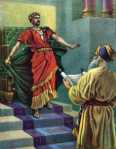
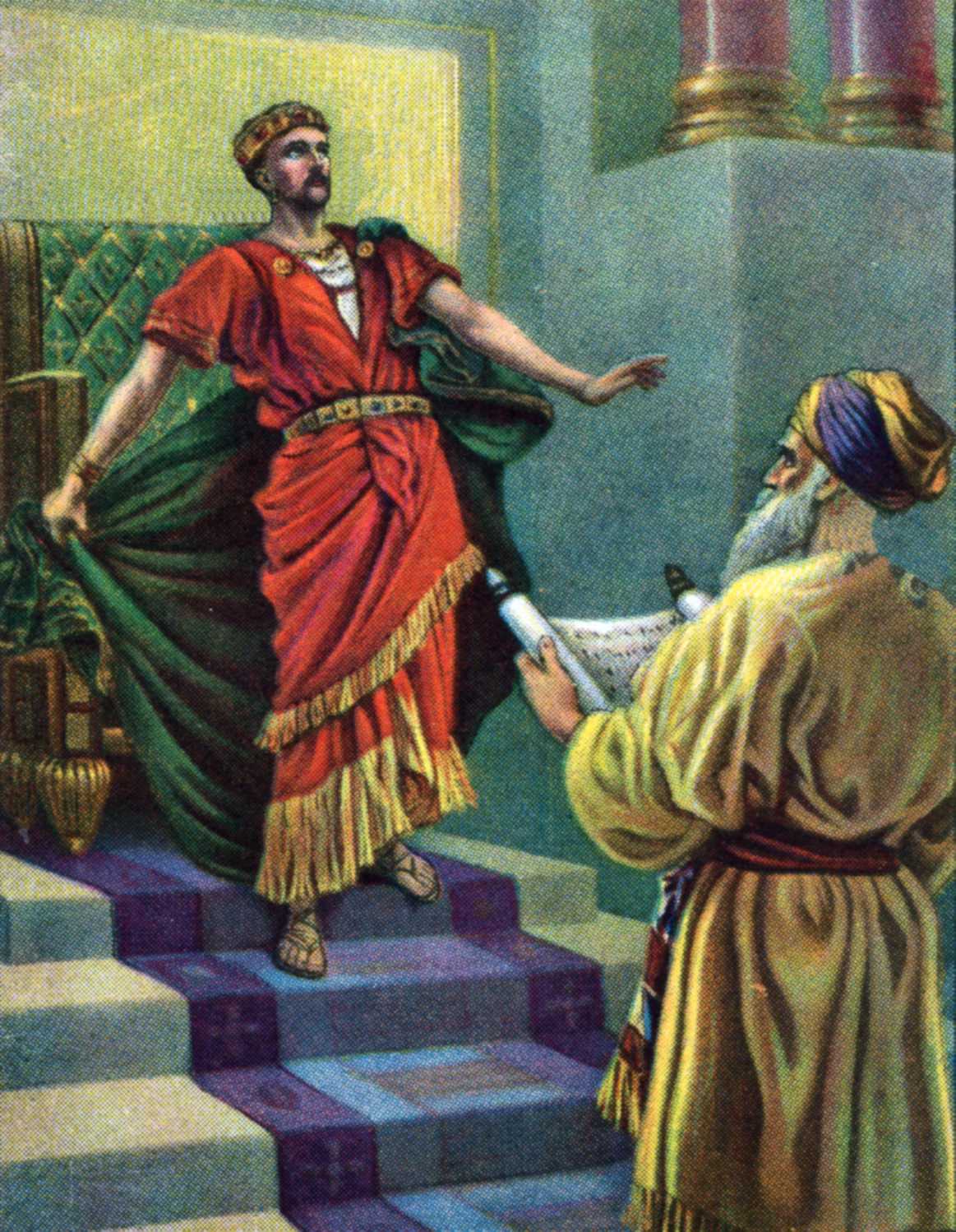
King Josiah gets the first reviews.

King Josiah gets the first reviews.

Details found in the Torah in fact fit the seventh century BC far better than the thirteenth.  The kings of the Saite Dynasty were indeed erecting new buildings in the Delta, including Pithom, the Egyptian names in the Joseph story were more popular at this time and in Exodus the unnamed (!) Pharaoh seems to see Palestine as a threat rather than part of the Egyptian empire.  To the east, Kadesh, so prominent in the Exodus, is now the site of a Judean fort, and Edom, whose king refuses the Hebrews passage, only became a state in the seventh century.  It may be that these late details cover an ancient story of departure from Egypt, but they certainly show that the material was being rewritten and do add to the evidence for a seventh century origin for the Exodus and Conquest.

That the Old Testament is a sacred text for millions of Hebrews, Christians and Muslims ought not to obscure this historical reality of its composition and nature.  The early books of the Bible are clearly not history, and the details in them simply cannot bear the weight of the conclusions that have been laid upon them.  Trying, for example, to locate Mt. Sinai is an utterly futile exercise, since all the textual clues date from a later age that itself had not the vaguest idea where Sinai was, and the very existence of the mountain is now doubted by most scholars.  Most important, the god portrayed in the Pentateuch is a historical mishmash, revealing elements of the primitive henotheistic tribal deity of the age of Moses, the institutionalized national god of the states of Israel and Judah and the more perfectly monotheistic universal lord of the later prophets.  From this hodgepodge of stories and images of god the believers, ancient and modern, (and Hollywood) have taken what they will, inevitably creating a Moses and an Exodus that reflect the society and values of the interpreter, rather than what might conceivably have actually existed some three thousand years ago.  Moses and his god are a work in progress, constantly being reinvented, from the time of King Josiah to that of Cecil B. De Mille.

Stuff from Way Back #15: These Christians Are Really Annoying

(Three weeks ago I posted a piece on Albert Göring, who was being considered for inclusion in the Israeli Righteous Among the Nations for his work in rescuing Jews. Apparently he did not make it, presumably because of a rumor of a Jewish father, which would make him ineligible, and Israel avoids the embarrassment of having Reichsmarschall Göring’s brother among the honored.)

The Roman persecution of Christians is a well-known episode in the history of the religion, but inasmuch as these events occurred almost two millennia ago, there is no longer a Roman Empire and the Church was the winner, one might expect that some distortion has crept into the popular narrative. And it has, primarily because few people have any real knowledge of the Empire beyond what Christianity and Hollywood have suggested and even fewer understand the nature of traditional Roman religion. As a result a key fact has been lost: so long as you observed Roman tradition the state did not give a damn what gods you worshipped (at least until the state became Christian).

At first of course Rome did not even notice the new cult. Those with any knowledge of Judaea assumed it was yet another Jewish heresy, doomed to disappear, as in fact the sect of Christian Jews did. As the adherents of the new faith spread and multiplied, it was popular dislike that first caught the attention of the authorities. Like the Jews, Christians were monotheists, compelled by their beliefs to deny the existence of other gods, and they were doing this in a society that was completely polytheist. Polytheist societies are generally tolerant when it comes to religion, even in states with a religious establishment supporting a divinely connected kingship, as in the Sumerian city-states and Egypt. Inasmuch as deities were typically personifications of natural phenomenon, it was easy to identify gods across cultural lines, and in any case no one (excepting perhaps Akhenaten) was about to deny the existence of other gods and certainly not resort to violence in order to teach others a lesson.

Into this world come the Christians, telling their neighbors that the gods of their fathers do not exist and that they are wasting their time worshipping idols. Of course the Jews had been doing this for quite a while, but apart from small communities in some of the cities of the Empire, they were essentially a phenomenon localized in Judaea, and in any case they did not proselytize. Early Christians were in fact confused with Jews, but as their numbers grew, people realized this was something new – and very annoying. And if modern evangelicals are any indication, these early Christians likely often displayed a holier-than-thou attitude; they had the good news after all.

There was also a feeling that for all their professed love these people actually hated mankind. The first generation or so of Christians believed that the Christ would be returning soon, perhaps in their lifetimes, and there was consequently talk of what would happen then. And if Revelations is the guide, it would be unmitigated horror, suffering and death for non-believers, which was of course virtually all of humanity. There were also rumors of strange and disgusting rites, such as incest and cannibalism, the sort of things that are said of the despised and alien throughout history. Natural disasters and unexplained misfortunes were blamed on them. The Christians were strangers in a strange land and initially played the same role of the “other” that the Jews would play in medieval and modern Europe.

Capping it all off was the growing suspicion that they were disloyal as well as obnoxious. The traditional religion of Greece and Rome was primarily civic in nature, concerned with the cohesion and well-being of the community, and as such, it was closely connected to the idea of the state. The sacrifices and rituals were communal, designed to keep the community in the right relationship with heaven, and in the case of Rome this led to the emergence of priesthoods, such as the Pontifex Maximus, that were actually state offices. The holders of these positions were not “priests” in the familiar sense of the word, that is, representatives of a centralized church, as the priests of the temple of Amon-Re or the Catholic Church. Their job was not to intercede for or counsel the individual, but to conduct the rituals necessary for the survival and prosperity of the community.

As a result, honoring Jupiter Best and Greatest and his colleagues was more of a social act than a religious one, declaring ones good standing as a member of the community. If the worshipper had other more personal concerns regarding heaven, he would turn to gods more pertinent to his situation, especially traditional local deities among the provincials. As with most things, Rome had always had a laissez faire attitude regarding non-Roman religions, so long as there was no threat to public order and morals, such as led the Senate to ban certain Bacchanalian rites in 186 BC. She was even ready to tolerate an extremely intolerant religion, Judaism, because it was essentially local and no threat to the state. Nevertheless, denying the existence of the Olympic gods was in fact directly assaulting one of the foundations of the state and endangering the well-being of the society.

Even so, Christianity might have gone unnoticed were it not for the fact that they quickly became almost universally unpopular, even hated, and their vociferous rejection of the Roman gods struck people as disloyal. Constantly claiming that their god was their only true “king” and master also did not sit well in an autocratic society, and the ideas of their founder/prophet regarding the poor and the rich were absolutely revolutionary in a world always dominated by the propertied classes. So, there was in fact public disorder in the form of anti-Christian riots, which the authorities were compelled to deal with. All the evidence indicates that the Roman government was completely aware of the essentially innocent nature of the new religion, but Roman officials were hardly likely to defend an unpopular minority in the face of overwhelming public displeasure.

Apart from their refusal to pay even lip service to the imperial cults, there was actually a legal problem for the new church. Since the time of Augustus (27 BC-AD 14), the first emperor, new clubs and associations were prohibited unless they were specifically granted imperial approval. The reason was clear: private associations could easily harbor conspiracies against the state (as they did during the collapse of the Republic), and autocrats tend to be very sensitive about this issue. And here was a new and offensive cult spreading throughout the cities of the Empire.
As it happened, the Empire was mellow about the whole issue, and generally confronted the issue only when it could not be avoided because of public clamor. This was certainly the case under Trajan (98-117), who when asked what to do with Christians by his governor in Bithynia, Pliny the Younger, instructed him not to search them out but only act when it was unavoidable. The typical procedure was to require the Christian to make a token sacrifice, a pinch of incense, to an imperial cult, generally that of Roma et Augustus. For the authorities this was far more a pledge of allegiance than a religious act; perform this one act and you would get your “ticket,” your libellus, and could go home and worship whatever gods you pleased. Of course, for a Christian this was apostasy, and though many took the plunge, many did not, which baffled the Romans, who could not fathom such religious fanaticism.

Decius: "Smoke 'em"

Decius: “Smoke ’em”

The result of all this was that violence against Christians was for two centuries limited to popular outbursts, such as blaming Christians for the fire in 64 (encouraged by Nero), and the odd official currying favor with the locals. Not until the third century was there an actual persecution in the sense of the central government taking Empire-wide action against the religion, and this would come during the Anarchy (235-285), a fifty year long civil war that essentially killed the Empire, even though it would stagger on for another century or so. During his short reign Decius (249-251) required that all Christians be put to the test and imprisoned if they refused, and this was repeated, with more severe penalties, by Valerian (253-60) in 257-258. Both of these men were ruling during a period of widespread instability coupled with serious barbarian invasions and internal military revolts and were desperately attempting to restore loyalty to the state. An obvious target was the Christian community, which was now highly organized and blatant in its rejection of the state religion, which now included deified emperors.

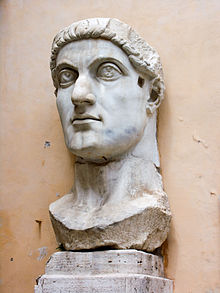
Diocletian (285-305) ended the Anarchy, but the Empire would never again come close to the stability and economic well-being it enjoyed before 235, and the history of the Late Empire was one of military autocracy alternating with periods of civil war. In 304 Diocletian launched the last anti-Christian crusade, destroying churches and sacred books and imprisoning priests, but it ended with his abdication the following year and seems to have petered out because of lack of popular support. His ultimate successor, Constantine the Great (305-337), legalized Christianity with the Edicts of Toleration (311-313), and with his conversion it became the official religion of the Roman Empire.

Valerian: "Crush 'em"

Valerian: “Crush ’em”

And then the real persecutions begin, as the government implements a continuous policy of crushing polytheism and eliminating the pagani (“rural folk”), so called because the old cults hung on the longest in the rural areas. Unlike those carried out against the Christians this persecution was moved by nothing other than simple religious intolerance.

Diocletian: "Eat 'em"

Diocletian: “Eat ’em”

In the end Christians themselves would slaughter tens of thousands more Christians than the Roman Empire ever did.

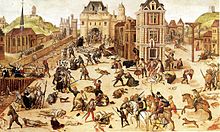
Paris 1572 - Christians killing Christians

Paris 1572 – Christians killing Christians

Stuff from Way Back #14: The New God on the Block

(In keeping with the season I present a brief historical (leaving any deities out of it) understanding of exactly why Christianity was so damn successful.  Next week I will deal with the other question: what exactly was the reaction of the Roman government and why, a topic that has been seriously distorted because, well, the Empire no longer exists and Christianity does.)

Christianity is clearly a fusion of east and west, being a sort of religious hybrid produced by the intersection of Hebrew monotheism and the Greek mystery cult brought on by several hundred years of Greek control of Palestine. To some degree it is also a mix of oriental mysticism and Greek rationalism, inasmuch as the basic beliefs were later influenced by Stoicism and neo-Platonism. In essence, the Jews supplied the idea of the sole, ethical creator god, disconnected from the natural world, while the Greeks, through their mystery religion, contributed the notion of the dying and resurrected god. Paul and his associates made the new religion palatable for the world outside Judaea by stripping it of unappealing Jewish ritual, such as circumcision and dietary laws, and Greek rationalism then proceeded to refine the understanding of the godhead.

First of all, Christianity shared the ideas that had made the mystery cults so popular in Greece and later the Roman Empire. Traditional Greek and Roman religion was essentially civic in nature, primarily serving the community and devoid of any personal or inspirational quality. The mystery religion, which came in a variety of specific cults, did not deny the traditional gods but rather focused in on a single or tiny group of deities, providing the worshipper with a more personal and intimate relationship with divinity. The cults also involved emotional initiations and revealed knowledge, known only to the initiates, who gained in the cult at least a measure of equality with their richer and more powerful brethren. Christianity had no secrets but it rested on revealed knowledge and also offered a sense of special community within its ranks. Most all the mystery cults revolved around the central figure of a god or human who either literally or figuratively dies and is resurrected, thus providing an analogue of hope for the worshipper facing the inevitability of death. Further, the cults promised some reward, initially in this life, but by the end of the fifth century BC evidence appears suggesting the idea of judgment and reward in another life.

Christianity offered all these things but was something more than just another mystery religion. The Christian god was not just some Olympic retread, but the god of love, completely absorbed in those he had created. His death and resurrection was not simply some mythic event that had nothing to do with humanity beyond providing a message of hope. Rather, he became human and died specifically for humanity, a divine sacrifice that reveals an entirely novel concept of god. He was the god of all – rich, poor, slaves, free, men, women – something that was not always true of polytheist deities; for example, Mithraism, far and away the most popular cult in the Empire, was open only to men. And Christianity (at least until a powerful church emerged) cost nothing but commitment, while the polytheist religions required sometimes costly sacrifices, such as the bathing in bull’s blood incumbent on Mithraists.

Above all, this new god may have been open to everyone, but he definitely had a bias towards the poor and downtrodden. The rich and powerful had always had the edge in spiritual affairs, whether in the quality of their gifts or in outright control of the mechanisms of the religion. For the first time in history there was a god who favored the meek and chided the wealthy, and of course the vast majority of the in habitants of the Empire fit into the former category. This must have made for immense drawing power.

The religion also quickly developed the primitive ideas of judgment in the mystery cults into a full-blown system of reward and punishment in the next life and firmly rooted the judgment in the moral code inherited from Judaism. Obviously, promise of a better life in the next world is going to turn the heads of those whose life in this one is not that great, and while Christianity is born into an imperial society that constituted one of the more comfortable periods in history, in a few centuries life in the Roman Empire was going to become very unpleasant for most of its subjects. Now, the reward and punishment was based on the observance of a fairly strict ethical code, which might be expected to turn away potential converts. Most of us can get through life without committing homicide or adultery, but the thought crimes are very tough; “Thou shall not covet thy neighbor’s wife” is after all a rule even Jimmy Carter violated. But most people want a moral structure provided for them, and the basic rules provided by Christianity struck a favorable chord precisely because they were good rules. The Ten Commandments are the Ten Commandments because they proclaim the basic laws absolutely necessary for a stable society.

So the demanding moral code was likely also an attraction of the new religion, which was offering reward in the afterlife for behavior that virtually all normal humans consider good and proper. On the other hand, not even a Mother Teresa could keep all these rules all the time, and what made the whole system feasible for the average Joe was the loophole: forgiveness. Were it not for the mechanism of contrition and forgiveness, the new religion would be making impossible demands and simply not work.

Extremely important in the triumph of Christianity is the simple fact that it happened in history. The core event of the religion, the death and resurrection of the god, did not take place in some distant mythic past, as in the mystery cults, but right there in the Roman province of Judaea during the reign of Tiberius (14-37). The first apostles of the new god had actually been there, first hand witnesses of the essential events of the religion. They heard the sermons and saw the miracles and the crucifiction, and some claimed experience of the resurrection itself. This gave the religion an impetus unmatched by the old belief systems.

Additionally, though it may have played something of a negative role in the spread, the exclusiveness of the monotheistic religion certainly helped preserve it intact. Syncretism, the identifying and combining of gods across cultural lines, was an inevitable component of polytheism and produced religious hybrids, such as the cult of Isis and Serapis. This simply could not happen to Christianity – at least in any serious way – because there were no other gods. This would produce a religious fanaticism unknown in antiquity outside the Hebrews, and that fanaticism presumably helped a bit. These were people who were willing to die for their god, and that kind of commitment surely had to impress potential adherents.

Finally, there is the element of coincidence: the charismatic preacher was born at the height of the Roman Empire.  Without this huge area of political stability and easy communications the new religion would very likely not have been anything more than another eastern cult.  Two centruies earlier Rome was only beginning to nose into the eastern Mediterranean, and it is not all clear that the new religion, which would be perceived as a heresy by the Jews, would have survived the religiously reactionary Hasmonean kingdom.  Two centuries later and the religion would almost certainly not have the time to spread and develop its infrastructure before the western Empire collapsed.  It might survive in the east, but the conversion of the barbarian tribes becomes more problematic, and what would the history of the west be like without the Church to carry civilization through the Dark Ages?

"In hoc signo, Baby!"

“In hoc signo, Baby!”

Such are the reasons for the initial survival and spread of Christianity, but the final triumph and emergence of the new creed as the exclusive religion of the western world owed less to its nature than to political developments. Because of popular hostility and ultimately government obstruction (tune in next week), by the beginning of the fourth century Christians constituted perhaps only ten percent of the population, but for seemingly cynical political reasons Constantine the Great (sole emperor 324-337) embraced the religion. One might question the conviction of Constantine, who converted only on his deathbed, but the imperial family became Christian, and after Constantine every emperor but one (Julian the Apostate) was a member of the faith, thus making Christianity a powerful force in the government of the Empire. With the power of the sate behind it Christianity began a rapid expansion, as polytheists were subject to greater and greater persecution.

The collapse of the western Empire in the fifth century guaranteed the complete supremacy of Christianity, as the Church, now the only surviving governing structure in the west, emerged as a kind of international corporation manipulating the emerging barbarian kingdoms. The conversion of the Germanic tribes, especially the
Franks, resulted in a new warrior Christianity, which spelled doom for the surviving polytheists of Europe. The Prince of Peace had finally triumphed, albeit with a sword in his hand.

Ten Years Ago On a Lone Dark Night Someone Got Killed…

(On the occasion of the ten year anniversary of our invasion of Iraq I am posting an updated version of a piece written in December 2011 when the President announced the “end” of the war.)

On 19 March 2003 the United States bombed the Presidential Palace in Baghdad, beginning an eight year war in Iraq. Those eight years came at a stiff price. 4486 American military personnel were killed and 30,327 were wounded, 500 of them amputees, and it is estimated that some 20,000 veterans of the war now suffer some sort of psychological problem. 1487 coalition troops died, along with 281 media and aid workers; 10,569 were wounded. The war cost us about $1.7 trillion, and we are still paying, despite the fact that Iraq is now producing more oil than Iran. The war quickly eliminated the world-wide support for America in the wake of 9/11, fomented more anti-American feelings in the Muslim world, blew our reputation for moral behavior and distracted the US from serious operations against al-Qaeda.

evil

evil

The price for the Iraqis was much greater. The butcher’s bill is very hard to calculate, but while the media now regularly tosses off 100,000 dead, a variety of investigating NGOs has set that as the absolute minimum, suggesting 600,000 as more realistic; some estimates exceed a million. And they continue to die, as the expended depleted uranium ordinance and other toxins of modern war produce birth defects and cancers. Almost two million people fled the country, and a million internal refugees were produced. What little infrastructure the country possessed under Sadam was utterly destroyed, and it appears that the Sunni dictator has simply been replaced by a Shiite one. Meanwhile, all those billions in aid from the US flow into the pockets of the increasingly autocratic Prime Minister Nouri al-Maliki and his completely corrupt government apparatus. Even their very country is falling apart, as the north has emerged as a more or less independent Kurdistan.

And what do we all get in return for this massive expenditure by the American and Iraqi people?

incompetent

incompetent

It is clear now, as it was to many then, that Saddam was absolutely no threat to anyone except his own people, and rather than “protecting” America the conflict has only exacerbated the terrorist problem and immensely strengthened the position of Iran. Iraq, once a bulwark against Iran (remember Rumsfeld shaking hands with Saddam?) is under its emerging Shia dictatorship already falling rapidly under Iranian influence. Only two states in the region have refused to go along with the Arab League and condemn the bloody Syrian government: Iran and Iraq. Indeed, Iranian aid to the Syrian government appears to be moving through Iraq. Under the guise of a program of reconciliation Baghdad is even releasing prisoners accused or convicted of murdering Americans, and as the economic frosting on this ineptly baked cake, it is primarily non-American companies that are signing up to exploit Iraqi resources, should that ever be possible.

Meanwhile, American diplomatic personnel will be hiding out in the biggest and most heavily fortified embassy on the planet, a target so protected that even American journalists are not allowed to see it. Bereft of troops, we will be hiring 5000 mercenaries to protect these people, further enhancing our wonderful image in the region. We get to look like an imperial power and pay mightily without enjoying any of the benefits associated with such a status. And outside the walls of Fortress America, euphemistically called the Green Zone, the life of the average Iraqi is, unbelievably, worse than it was under Sadam.

We got nothing out of the war. (Well, if you are Haliburton or Blackwater Mercenaries or the armaments industry, you actually got plenty, and the Pentagon certainly had a grand time.) Perhaps we learned something from this mistaken adventure? Not likely.

traitor

traitor

We promptly repeated the whole thing in Afghanistan. Trashing the Taliban for harboring our enemies was fine, but then, as if Iraq had never happened, we determined to create a democracy among people who have not a clue as to what that or nationhood means. The ill-advised and ineptly conducted war of aggression against Iraq appears almost sensible compared to our current hemorrhaging of lives and money for an unbelievably corrupt and ineffective government of an area that is even less of a country than the one time Ottoman province.

Even now, that blatant and shameless cheerleader for the war, the national media, is hypocritically discussing the mistakes of the war while saying virtually nothing of its own disgusting role. Perhaps as a measure of their ignorance and certainly of their arrogance, the neo-con architects of the war are unrepentant. Donald Rumsfield, who should be in prison for criminal incompetence as Secretary of Defense, at least had the good grace to resign and disappear. Dick Cheney, another of those hawks who somehow never found the time to serve (“I had other priorities in the 60s than military service”) and who appears to have been a prime mover in launching the war, even now claims it was justified, though he seems unable to say exactly why. (Perhaps I am biased: his wife put me on an academic black list of “Americans behaving badly.”) Paul Wolfowitz, recognized as the major architect of this stupid policy, continues to defend it, though Richard Pearle, another neo-con mover of the war, now denies he had any serious role, which is simply laughable. (Perhaps I am biased again: in a recent interview he responded to questions about the war by stating that looking back on history does not teach us anything. So much for my profession – and his intelligence or honesty.) These are the bozos who implemented a disastrous and dishonest foreign policy, yet they all still prosper, unlike the 4500 dead American soldiers and the entire country of Iraq.

traitor and idiot

traitor and idiot

So, happy anniversary. The date should be remembered, because this is when American seriously began to shed its historic image as the good guy, the protector of the weak and defender of freedom, the foe of brutality and torture. And in Afghanistan, Pakistan, Yemen, Somali and god knows where else the beat goes on.

our democrat in Baghdad

our democrat in Baghdad

Stuff from Way Back #13: They Were All Good Samaritans

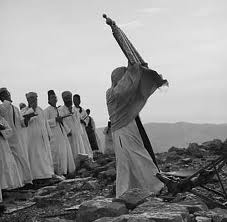
Mount Gerizim

Mount Gerizim

Christians are familiar with the story of the good Samaritan (Luke 10:25-37), the clear implication of which is that most Samaritans were not good. Indeed, the Old Testament is invariably hostile to these people, who once constituted the inhabitants of Samaria, the northern half of the original Jewish kingdom. When the kingdom split in two, Samaria became known as Israel, while the southern area, centered on Jerusalem, took the name Judah. According to the Bible, Israel was a hotbed of polytheism and idol worship, in contrast to the ever pious Judah, and when Israel was overrun by the Assyrians in 732 BC, it was considered no great loss to the Chosen People. In fact, Samaritan refugees poured south, swelling the population of Judah, and a short time later King Hezekiah invited surviving Samaritans (the Assyrians were not exactly mellow in their occupation of foreign lands) to join the true Jewish state. Thus did the number of Samaritans shrink to a handful of loathesome characters by the time Jesus.

Well, as in a growing number of cases, archaeology has shown the Old Testament to be wrong, so wrong in fact that only deliberate falsification can explain the discrepancies. On the one hand, if there ever actually was an “empire” under David and Solomon, it consisted only of a few crude hilltop forts, and there is zero evidence outside the Bible itself that there ever was a Temple of Solomon. On the other hand, excavation on the summit of Mount Gerizim, near Nablus (ancient Shechem), has revealed a large enclosure (315 by 321 feet) dating to the sixth or fifth century BC. Huge deposits of animal bones and numerous inscriptions and artifacts clearly mark this as a sanctuary of Yahweh, flourishing at a time when any temple in Jerusalem would have been a small, simple building. This Samaritan temple was destroyed in 128 BC by the Hasmonean Jewish king John Hyrcanus, but the mountain remained sacred to the Samaritan sect of Judaism.

It would appear that until its destruction Gerizim, already a holy spot for Abraham, Jacob and Moses, was the actual center of Judaism, at least in terms of antiquity, magnificence and numbers of pilgrims. Archaeology had already revealed that most of what the Bible says about the state of Israel is blatantly false and clearly self-serving for Judah, and the discoveries on Gerizim reveal just how far the smear campaign against Samaria went and how much history was consciously distorted by the Jerusalem priests editing the Testament. The surviving Samaritan Torah in fact tells a very different story from the accepted Jewish canon, one suggesting that Judah was the real backwater of Judaism. But the survivors get to write the history.

So already in antiquity the Samaritan Jews were ill-treated, and time has not been kind to them, primarily because of their own doctrine: the Lord told them, “None of you may settle outside the promised land.” Consequently, while the Jews escaped various conquerors and catastrophes by spreading across the Middle East and Europe, the Samaritans were ground away by a variety of occupiers, especially the Byzantine and Turkish empires. And a traditional ban on intermarriage with others certainly did not help. The result was that by 1918 there were precisely 146 of them, but with the importation in 2004 of five Jewish women from the Ukraine and Siberia the group has since grown to about 700. Incredibly conservative, the Samaritans practice a sort of Judaism that essentially disappeared with the destruction of the Second Temple by the Romans, actually sacrificing hundreds of animals on Mount Gerizim to celebrate Passover.

We will never know how Judaism might have developed had the Assyrians not occupied Israel, but since the Samaritans were apparently in the majority, Shechem might have taken the place of Jerusalem as the epicenter of the religion. Certainly, all these discoveries have vividly demonstrated the utter unreliability of the Old Testament as an historical source, and in fact excavations in the West Bank (the only positive aspect of the modern Israeli occupation) and Jordan are undermining the historicity of the core event of the Torah and indeed Jewish belief – the Exodus. All the emerging archaeological evidence supports the idea that the people who became the Hebrews were indigenous to the area, a positive supplement to the complete absence of any inscriptional (the Egyptians were fanatic record keepers) or archaeological evidence that a group of proto-Jews came out of Egypt in the late second millennium. More and more Moses and company appear to be have been manufactured, like the slanders against Samaria.

Samaritans

Samaritans

And the amazing thing is that on the basis of these stories – at least in theory – a modern Jewish state was carved out of territory belonging to other people for the last two millennia. It apparently helps to have more than a billion Christians believing in your stories.

Ironies from Israel #4: The Embarrassing Benefactor

Well, this is not exactly an irony from Israel but rather an irony from the Third Reich that has put Israel in an ironic position.

Israel has a circle of honor for those who rescued Jews from the clutches of the Third Reich, whether it be one or thousands. Nominations are sent to a department of the Yad Vashem Holocaust memorial (built on land confiscated from Palestinian families, we must not forget), where the cases are checked and researched and then passed to a committee of ten Holocaust survivors, which makes the final decision. 24,356 people from forty-seven countries, five hundred of them Germans, have been so honored as the “Righteous Among the Nations.”

On the face of it, the case now facing the committee should be extremely simple. The candidate aided several dozen Jews and non-Jews in escaping from the Reich and set up Swiss bank accounts to help the exiles. On a number of occasions before the war he saved individual Jews from assault by Nazi thugs, and as an executive with the vast Skoda works in Czechoslovakia he aided resistance fighters and supported anti-German sabotage. He once took a truck to the Theresienstadt concentration camp and demanded workers for the Skoda factories, then driving them to a woods where they were released. All these activities are documented by witnesses, most especially the people (or their children) he helped to survive.

The only problem: the man’s name is Albert Göring.

Yes, the man in question was Reichsmarschall Hermann Göring’s little known younger brother. He was an apolitical engineer and a dapper womanizer, but despite his family connections he was also anti-Nazi and despised Hitler. Rather than turn a blind eye, however, he used those connections to rescue people from the system in which his brother was the number two man.

He obviously fits the bill for the honor of being a member of the Righteous Among the Nations, but his name is Göring, which might be a bit difficult for Israel to accept. But there is a way out. There is a rumor that Albert was actually the child of his mother and the family doctor, who was a Jew. This would give the Israelis an opportunity to avoid what might be an embarrassment in proclaiming a Göring one of the Righteous Among the Nations, since only non-Jews are eligible for the honor. There is, however, absolutely no evidence for this claim of a Jewish father, and even the Reichsmarschall would have had some difficulty protecting his brother had the Reich suspected Albert of carrying Jewish blood.

Confirmation of Albert Göring’s role in rescuing Jews would be a victory of truth over image, but unfortunately, Israel, more than most states, has allowed the image of its past to be built upon serious distortions of the truth, beginning with “A land without a people for a people without a land.” This must have been a baffling proclamation for the millions of Palestinians already living in the “land without a people.” Closer to the subject of this essay, missing from the list of the Swedish Righteous is the name Folke Bernadotte, who saved at least 1600 Jews (among tens of thousands of others) near the end of the war. But as a mediator during the Arab-Israeli conflicts of 1947-1948 Bernadotte earned the ire of the extremist Stern Gang, and in 1948 he was assassinated on the orders of its leaders, one of whom, Yitzhak Shamir, was later Prime Minister of Israel. Clearly, it would be awkward to encourage public review of Bernadotte’s life.

With Jews, Czech resistance fighters and others defending him Albert Göring was completely cleared by the allies, but out of loyalty to his family he refused to change his name, and even a talented engineer could not find work in Germany with the name Göring. He died a poor man in 1966, his deeds unknown to the world until an Australian writer published an account in 2009.

Stuff from (Not So) Way Back #12: Toasting the Devil – The Tusculum Papacy

When it comes to less than decorous behavior by the Papacy, the Renaissance immediately comes to mind, but in fact the most embarrassing age for the Church came much earlier, during the tenth and eleventh centuries. These years mark the absolute rock bottom for the institution and are to some degree a reflection of the abysmal state of European society in general. The earlier part of this period, roughly the first half of the tenth century, is so wretched that it has been given a formal name, the saeculum obscurum – the dark (or ignoble) age, and has also been referred to as the Pornocracy and the Rule of the Harlots.

The saeculum began with the elevation of Sergius III (904-911) and ended with the deposition of John XII (955-964), who was in fact the grandson of Sergius’ alleged lover, Marozia. There were twelve Popes during this time, all of them either members of or dominated by the powerful Theophylacti family of Tusculum (hence the Tusculum Papacy 904-1058), and particularly active were Theodora, wife of Theophylactus I, and her daughter Marozia. John X (914-928) was the alleged lover of Theodora and was supposedly killed by an outraged Marozia, whose son, allegedly by Sergius, became John XI (931-935) and whose grandson became John XII. The half century after the last of the Pornocracy Popes was dominated by another Roman family, the Crescenti, but the Theophylacti were back with Benedict VIII (1012-1024), formally known as Theophylactus II. He was succeeded by his brother, who as a lay person had to be ordained a bishop before becoming John XIX (1024-1032) and who may have been murdered by the Roman mob. He was followed by his nephew, who was elevated as Benedict IX (1032-1044, 1045, 1047-1048).

Benedict IX is a truly memorable Pope, having had the unique experience of holding the office three times. Installed in 1032, he was driven out of Rome in 1044 by his enemies, who put Sylvester III (1044-1045) on the throne of St. Peter. He returned in 1045, but was convinced to sell the Papacy, only to change his mind and seize the office again in 1047 and be deposed and excommunicated a year later. In an age of dissolute Popes he nevertheless managed to stand out; he was believed to hold orgies in the Lateran Palace and was the first Pope thought to be homosexual. On the other hand, John XII, who was Benedict’s granduncle, had set the bar very high. He was accused, among other things, of turning the Lateran into a brothel, murdering his confessor, calling upon demons when gambling and toasting the health of the devil at the altar.

The current Vatican scandals – pedophilia, homosexual prostitutes for priests, political infighting, a corrupt bank – would hardly be noticed during the Tusculum Papacy, but salvation was at hand for the Church. The Tusculum Papacy came to an end in 1058 with the accession of Nicholas II, one of whose supporters was the reformer Hildebrand of Sovana. In 1073 Hildebrand became Pope Gregory VII (1073-1085) and began an age of reform, freeing the Papacy from the Roman nobility by empowering the College of Cardinals as the electors of the Pope and beginning the long struggle to free the Church from the interference of the German Emperor and the French King.

The Silly Superpower

America certainly engages in a fair amount of behavior that most enlightened people would find stupid, but then most voters and almost all American politicians are not enlightened. This is a pity because when America does stupid stuff, like invading Iraq or providing totally unqualified support to Israel, it often involves death and destruction. Unfortunately, the most serious stupid behavior generally falls under the purview of national security, which means it will be well supported, certainly by all politicians, who do not want to look weak on defense, even if the behavior is harmful to our national interests. There are, however, some practices that are so silly that one suspects even many, perhaps most Americans would question them. Here are my favorites.
Pennies
It now costs two cents to produce a penny, which means counting mint overhead the government wasted about $58,000,000 producing pennies in 2012. That may be a drop in the bucket compared to the federal budget, but for the average American it is a hell of a lot of money and in any case it was just thrown away. The cost in lost time for businesses in transactions involving pennies is much harder to estimate, but it is almost certainly exceeds the money wasted producing them. The penny is simply a coin whose monetary value has become too low for it to be practical. And the market value of the zinc and copper in the penny makes it almost profitable to melt them down. In fact, the market value of the zinc and nickel in the nickel, which costs ten cents to produce, does make it profitable to melt them down, compelling the government to pass stronger laws prohibiting such.
So, why do we still have pennies? Tradition has something to do with it, of course; politicians are always reluctant to change a national practice that has been going on for a century or more. The sole argument for keeping them is that prices would go up if the penny disappeared. Well, in most cases that would be by one cent. The real reason for retaining this useless coin: the zinc lobby. Whenever you see any stupid measure supported by the government, look for the lobby.
Liquor Ads
Liquor ads were banned from network TV presumably because there is as belief that showing the product will cause people to buy it. This is presumably true or business would not be spending billions on television advertising, but that marketing is intended to sway the consumer to buy a specific brand. It is not clear to me how the absence of liquor ads will cut down drinking. Will people forget that booze exists? Or conversely, are there people who upon seeing an ad for whiskey will rush out and buy a bottle? Yes, cigarette consumption has declined, but I suspect that has far more to do with price, the absence of any place to light up and better awareness of the health risks.
The ban seems to be one of those ineffective feel-good, look-we’re-dealing-with the-problem measures, but grant for the moment that it works. Why then are beer and wine exempted? Because it takes longer to get drunk with a fermented beverage? In fact, beer and wine play a much bigger role in drunkenness and drunk driving, especially for young people. Real reason? The powerful beer and broadcasting lobbies, which can play upon the popular illusion that fermented drinks are somehow safer.
And how about this for extreme silliness? You can show people with beer in any situation and suggest that all normal people drink at parties and especially sporting events, but you cannot show anybody actually drinking the stuff. I suppose the idea is that some extremely stupid persons will have no idea that you actually put the stuff in your mouth.
And what about those don’t drink and drive signs on highways? Are there actually people who are not aware of the problems associated with drunk driving? Or are the signs a reminder: Oh, that’s right! I forgot!

Drinking Age
Presumably the motivation for the federal government to impose upon the states a legal drinking age of 21 was to cut down on drunk driving and teenage drinking. If so, it has been a complete failure. Three countries, including Canada, have the limit at 19, five at 20 and eight, including the US, at 21 (it varies from 18-21 in the Indian states). In every other country on the planet the age is 18 or less (if allowed at all). And consider the other countries that require one to be 21: Tajikistan, Pakistan, Oman, Qatar, Kazakhstan, the UAE and Sri Lanka. See a pattern? Most of the civilized world except America says you can drink at 18.
It is silly enough to do this inasmuch as nothing has been changed by raising the age to 21, but the utter silliness becomes apparent when you consider what you can do at (or by) 18: vote, hold most political offices, serve in the military, buy any kind of firearm except handguns, own and drive a car and marry. The message is clear and seriously stupid: at 18 you are wise enough to vote, to kill and be killed for your country, to carry firearms and generally do everything associated with adulthood, but you are not smart enough to drink for another three years. I guess Europe and most of the rest of the world produce more clever citizens than we do.
Voting
Why the hell do we vote on Tuesdays? It is hard enough to get Americans to vote – understandable given the quality of the candidates – and we make it even harder by doing it on a workday. Whose idea was that? Do it on a Saturday or Sunday and entire families can make an occasion of it. Oh, that’s right – more lower income voters would show up. Well, economics should impact this outmoded tradition since snail mail and electronic voting are immensely cheaper. The electoral college is of course another obsolete tradition, but changing that would require messing with the Constitution and no thinking person wants the bozos in Congress and state legislatures to get anywhere near that document.
Censorship
Censorship is repellent and pernicious, but most censorship on television is also silly. When it comes to the human body, America is perhaps the most uptight country outside the Muslim world, and probably not much can be done about that since it is so ingrained in this society that some parts of the body must always be hidden. Yet sex sells and is consequently everywhere, leading to as fair amount of silliness. On network television you can show all the sex you want in all its varieties so long as you never show a breast or genitals. OK, you can show the breasts of women in primitive tribes. A woman nursing a baby is apparently offensive and disgusting but little animations depicting the use of feminine hygiene products are not.
The height of censorship silliness: pixilating the finger of anyone flipping a bird on film. Everyone above the age of five knows exactly what is being done, yet somehow an extended middle finger is acceptable if it is pixilated. This is akin to bleeping expletives. Everyone, including most children, knows what is being said and automatically thinks of the censored word. So what is the point?
All of this underscores the proposition that in politics appearance is far more important than reality.

Stuff from Way Back #11: Exactly Why the Greeks Were Great

(I have no more completed Moses chapters; there were enough “likes” that I will persevere.  My apologies for posting the ancient Olympics piece twice.  If you like the following, read my Greek history Dare To Struggle, Dare To Win.)


It has been a traditional proposition in the West, one to which most intelligent people will pay immediate lip service, that ancient Greece was great and vitally important to the history of the human race. But why? Few, including many in classical studies, it seems, can provide any sort of substantial answer to this question. Vaguely gesturing towards the Parthenon and mentioning such things as democracy and Euripides and Plato, as most would do, barely hints at the reason for the greatness of Greece. Other cultures have after all created beauty and nurtured great intellects. Other peoples have exercised far more power over far wider areas than the Greeks. In terms of extent and longevity Roman society, which ultimately captured Greece, must certainly be deemed greater. What is it about the Greeks?
What makes the Greeks great, and uniquely so, is the discovery of the basic concepts utterly necessary to a mature society, whatever its cultural character. They are: constitutionalism, the notion that law is at the foundation of the social organization and that the people, not kings and gods, are the source of authority; rationalism, the will to doubt and to examine the universe according to logic and evidence, rather than faith and fantasy; and humanism, the conviction that man, rather than god, is at the center of things, that he is what is most important in our world. And with humanism comes a fourth idea, that of the individual, this curious notion that the individual human being has a value and a dignity quite apart from the group and the gods.
Constitutionalism has to do with the nature of authority in the community. In the pre-Greek societies of the ancient Near East the operative idea behind the kingship – and thus behind the whole concept of authority in the state – was that the power exercised by the king came from above, from the gods. With this notion, a society will never get beyond monarchy in its political development, and the kingship will likely have theocratic overtones, as is most obvious in the case of the Egyptian god-king.  What the Greeks entertained was precisely the opposite notion, that the power first wielded by their petty kings came from below, from the community, upon whose behalf, at least in theory, they ruled. This is the root idea of constitutionalism: the authority exercised by the state, whatever form the state takes, derives from the people. This concept simply did not exist in any of the oriental societies, where authority derived from heaven.
Now, this idea is hardly unique to the Greeks or to the Indo-European linguistic family to which they belong. Rather, it appears to be common to primitive and especially hunting-gathering tribal societies, in which the hunter-warrior host creates a sort of elective kingship in order to enhance its efficiency and that informal kingship tends to become hereditary, though insecurely so. The idea just seems to get lost as those societies settle and develop agriculture, and in only two places does it survive and mature to the point of influencing other societies: Greece and Italy.
The first Greek speakers certainly brought the idea with them when they entered the Balkan peninsula around 2000 BC, part of the great migration of Indo-European peoples from the north, but it could not survive in an Aegean world already dominated by the high culture of Minoan Crete. Mycenaean Greece (c. 1600 – 1200 BC) is consequently little different in its ideas and institutions from its oriental predecessors. But all this was swept away in the late thirteenth and twelfth centuries by a new Indo-European invasion, which obliterated the Hittite empire in Anatolia, tipped New Kingdom Egypt into a nose dive towards oblivion and sent another wave of Greeks, the Dorians, into the Balkans, where they vaporized Mycenaean civilization.
Greece was plunged into the Dark Age (c. 1200 – 750), but the new arrivals were free to develop their society without foreign influence. From the evidence of Homer, the later Macedonian kingship and the German tribes observed by the Romans, that society was initially made up of crude, isolated agricultural communities, each typically ruled by a chief or petty king, whose rule is based upon his control of a warrior host and is hereditary only to the extent that he who inherits can rule. The warrior aristocracy retain their tradition of assembling to hear and advise the king and most important, they understand themselves to be the source of his authority. Because of the unsettled conditions and warrior values, land has been temporarily replaced by herds and flocks and movable goods as the primary form of wealth.
As conditions stabilized and these communities grew, pressure on the king mounted, while the warrior aristocracy began to lose its heroic ideals and melt into agriculture. Land was meanwhile reemerging as the primary form of wealth, and the most important families were creating a new aristocracy, one whose power base was more familiar, the ownership of land. While the warrior aristocracy disappeared, however, their tradition of gathering to advise the king did not, and their informal assembly increasingly became a gathering of ordinary citizens.
Finally, in the close environment of the proto-polis (city-state) the new landed nobility rapidly developed a consciousness of their own power, and the poor obsolete warrior leaders began to disappear. Remember, the Greek kingship was not protected by the gods and their officials on earth, as in the Near Eastern societies, where abolishing monarchy would literally mean assaulting the natural order of things in the universe. Nor was there any strong institution or long tradition behind these rulers, as there was behind the kings of Babylon or Egypt. It appears the process was generally peaceful, as the monarchs were gradually stripped of their powers, until the office was no more than a limited tenure magistracy or disappeared altogether. At the same time, the need for the aristocrats to formulate rules for the sharing of the deposed king’s power led to more precise definitions of law and thus the development of the one-time warrior assembly into an actual legislative body.
By the middle of the eighth century the kingship has generally disappeared from Greece, which is already a tremendous achievement, since from the birth of civilization some two thousand years earlier monarchy had been the inevitable rule. Now, in the Balkan peninsula we find hundreds of little republics, possessing the basic machinery of constitutional government: each was governed by elected, limited term magistrates, and each had a citizen assembly that was the source of political authority and actually passed the laws. Of course, this political apparatus was oppressively controlled by the landed aristocracies of birth, but the fact is, it was there. And embedded in the very fabric of the young polis were the ideas that would form the essentials of constitutionalism and distinguish the matured polis.
Most important is the concept of the individual in society as “citizen” rather than “subject,” that is, the notion that the authority exercised by the state comes from below, from the people. One aspect of this bedrock concept is the universality of law, the idea that all members of the community, including the rulers, are equally subject to the law, because the community is the authority behind the law, regardless of who actually makes it. Egypt, for example, produces no law codes because it needs none; all regulations will come from heaven, through the mouth of Pharaoh. Another obvious derivative is the basic democratic idea: those in authority are in some manner responsive to the will of the citizen body, because it is from that citizen body that they derive their authority. And being incubated within the idea of man as “citizen” is the notion of man the individual.
Constitutionalism found its maturity in the Archaic Age (c. 750 – 500 BC), as the rapid growth of commerce and manufacture produced growing pressure on the old aristocracies by creating in Greek society centers of economic power that were outside their circles. At the same time the arrival of a middling class allowed the emergence of citizen armies of heavy infantry, which led almost immediately to the toppling of the birth aristocracies, as ambitious individuals rode the social discontent and new hoplite armies to power in the seventh and sixth centuries. The Age of Tyrants was over by the end of the sixth century, but it accelerated the process of moving from access to political power based on birth to access based on wealth, and thereafter the standard for the polis was one of matured constitutional government, in the form of oligarchies of wealth and democracies of various sorts.
The Archaic Age also witnessed the other world class breakthroughs, the discovery of rationalism and humanism, and it is during these centuries that the individual first walks the earth. To a great degree these towering discoveries in sixth century Ionia (the Aegean coast of Anatolia) were a matter of the right combination of things coming together in the right place at the right time. Certainly, the most important factor was the nature of the inherited Olympic religion, which the Ionian scientists ultimately spurned. The key fact here was the absence of a church, of an institutionalized religion with an ideology and a priest class to defend that ideology. This had already played an important role in Greek constitutional development, since it allowed the polis to avoid the invariable pattern found in the Near Eastern societies: the fusion or at least mutual support of the secular and religious authorities in defense of the political and intellectual status quo.
The tenets of Greek polytheism were very fluid and permitted almost complete intellectual freedom. There were no holy books or stultifying dogma and no powerful organization to enforce beliefs and threaten the thinker with the stake. “Amateurs,” like the late eighth century poet Hesiod, were consequently free to speculate on questions, such as the origins of the universe, that were normally reserved for the “professionals” of the priesthood. Organized religions have invariably slowed intellectual progress, for god requires belief without doubt, and doubt is vital to the discovery of truth.
Further, in contrast to the religions of the Near East the Greeks held that the Olympic gods did not create the universe, that men and gods were both subordinate to the fact of its existence. This permitted – and perhaps encouraged – speculation about its origins in terms other than divinities and personalities, which constitute the causative coin of mythopoeism. The world view of the Near Eastern societies was mythopoeic, or “myth-making,” a belief system in which the universe is completely animate and every natural phenomenon is the manifestation of a will or personality. Mythic thinking eschews generalization, is unconcerned with logic and consistency and cannot understand natural causation, since inanimate matter and impersonal forces simply do not exist. Like everyone else the Greeks first viewed the world mythically, but with their belief that the universe preceded the gods they had a leg up in the process of breaking free of the restraining bonds of mythic thought. And non-mythic propositions about the nature of the universe invite further examination and question because they are not protected by the sacred inviolability of myth.
A second important factor was the simple existence of the Greek cities in Ionia, where they formed a kind of east-west interface with the older oriental cultures. This not only brought access to the accumulated ideas and data of the eastern societies, but more important it also provided obvious and unavoidable cultural contrasts. You did not have to walk many miles inland from Miletus before you came upon communities that were definitely not Greek and that had far different customs, values and social organization. Fortunately, there are some who do not immediately assume these strangers must be wrong but face such a challenge by questioning the absolute validity of their own institutions, by wondering if perhaps such things are all relative after all. And thus some men were led to the first stages of skepticism, which is absolutely fundamental to scientific inquiry, for if you are content and do not doubt, there is no spur to intellectual progress. The Egyptians provide the perfect example: because of their benign and isolated environment, they immediately developed a self-satisfying, all-encompassing view of a positive and unchanging universe, in which everything was understood, and the price paid for the psychological contentment engendered by this was fifteen hundred years without progress of any kind.
Like the Egyptians and most people everywhere, the Greeks of course assumed that their ways were best, and the development of their society was accompanied by a growing conviction that Greek culture was simply better than anything the rest of the world had to offer. But one important component of this culture was the Ionian tradition of skepticism and examination, which made the Greeks, and subsequent western civilization, generally more receptive to outside ideas and less xenophobic than most. Again, in virtual cultural isolation for a millennium and a half, Egypt was so unreceptive to non-Egyptian ideas that they shattered the confidence and hope of the society when new ideas poured in as a result of the Hyksos occupation and New Kingdom imperialism.
Also because of the east-west interface, which put them on the cutting edge of the Archaic Age economic boom, the Ionian cities rapidly achieved a high level of material prosperity, which freed more men for purely intellectual pursuits. The existence of a leisure class is of course not a sufficient condition for the birth of rationalism; every civilization since Sumer had possessed a leisure class of some size, but none had produced rationalism. It is, however, a necessary condition, since men who do not have time just to think will not think new thoughts.
A final and extremely important factor was the material progress being achieved by the Greeks, especially in the sixth century. Archaic Age Greece was one of those very rare moments before the modern world when real change was apparent in a man’s lifetime, as the Greeks began to make great advances in the arts and engineering and in general mastery over the environment. Especially important in these developments were the new political hardballers, the tyrants, who could provide far more efficient government than the aristocrats ever could and who were everywhere inclined to feats of engineering.
Because of these achievements, because of the inescapable fact that life and society were not just discernibly changing, but also generally improving, the Greeks were becoming infected with a totally new idea – that of progress. For the first time in the history of the planet men were looking forward, rather than back to some golden heroic age. Every other society in the ancient Mediterranean had believed that if things were changing at all, they were only getting worse, and the Egyptians did not even have a real concept of non-periodic change and the passage of time. True, the Hebrews looked forward, but only to the arrival of a messiah; they had no concept of progress. The Greeks too had a vision of an earlier golden age, but that was now giving way to the astounding notion that things were getting better.
And these achievements were the accomplishments of men, not gods. Men were taking pride in human accomplishment and discovering that man, not god, was the most proper object of human attention, that human society and the individual human being had their own intrinsic dignity and worth. Indeed, the fact that the Olympic gods were so perfectly anthropomorphic, differing from men only in their immortality and immense power, made them completely unsuitable role models, compelling the Greeks to look to themselves for their moral values. Humanism was being born. In the mid-sixth century the Ionian scientist Xenophanes summed it all up in a single statement, one that would have been utterly impossible in any of the societies that preceded the Greeks: “The gods did not reveal to men all things from the beginning, but men, through their own search, find in the course of time that which is better.”
The result of all these factors was the birth of Greek rationalism and the real genesis of science and philosophy. The Ionian philosopher-scientists asked “why” concerning the world and its phenomena and sought to make consistent and logical generalizations about nature. And unlike any before them they did so from simple curiosity, from the plain desire to understand. The Near Eastern societies had developed a considerable body of scientific knowledge, but they had done so in the service of religion or practical needs and in a context of mythic thought. The engineering skills of the Egyptians, for example, followed upon the desire to build more elaborate temples and tombs, and the astronomical data of the Babylonians were collected in order better to read the will of the gods. And whatever the motives, the mythopoeism of these societies prevented them from turning their accumulation of data into true science. Now, for the first time in any significant numbers men were studying the world around them simply to understand it and were realizing that through such understanding the human condition could be improved.
The new skepticism was particularly focused on the religious traditions, and Ionian scientists were breaking the last mythic bonds by concentrating their attention on impersonal forces and natural causation in their examination of the cosmos. Hecataeus proclaimed the inherited Greek myths to be absurd, and Xenophanes made the astounding declaration that the gods were mere inflations of the mortal image, something most humans still cannot accept. Perhaps the most profound change was in the concept of man himself. In the religions of all the pre-classical societies man was a special creation of the gods, fashioned essentially to serve them and their designs. The Greeks now dared suggest that man was part of the animal kingdom, evolved, according to Anaximander, from lower creatures, but at the same time they boldly asserted that he did indeed occupy a special place, not because of any particular relationship with god, but because of his mind.
Constitutionalism, rationalism, humanism, the individual, these are the gifts the Greeks bear. Other societies have caught glimpses of these vital ideas, but nowhere else are they so confidently pursued and nowhere else do they have such an extensive influence beyond the society that discovered them, making classical Greece the most important society that has existed. Among the most precious, and dangerous, treasures of the human race, these ideas are the greatness of Greece