Our Desert Shepherd God

One constantly hears of the importance of the “Judeo-Christian tradition” to Western society and values.  Apparently Islam, which is clearly also part of the Abrahamic family, does not count, perhaps because it is so obviously at odds with the values touted in the West.  Yet apart from the fact that the West has been essentially Christian, with a smattering of Jews, it is not exactly clear how Judeo-Christian ideas are so important to modern society.

The two religions certainly espouse basic social values common to virtually all of humanity – homicide, theft, adultery, etc. are bad and family, compassion, charity, etc. are good – and they at least suggest that law and justice are vital to a well-organized society.  But does not the classical tradition also support all these values and do so within a context of rationalism, eliminating the need for any god?  Further, the Greco-Roman legacy lays the foundation for scientific enquiry and the democratic state, emphasizing a rule of law disconnected from any sort of faith.  The mainstream versions of the three Abrahamic religions ultimately accommodated, at least to some degree, rationalism and constitutional government, but this evolution took a very long time and segments of these faiths are still hostile to such Western notions.  Yahweh/God/Allah is manifestly not a democratic figure and has required unthinking acceptance of his words.

Inasmuch as they are rooted in faith rather than reason all religions are inherently silly to one degree or another, but the believer will of course only see the silliness in the other guy’s religion, especially if it is not Abrahamic.  There are, to be sure, differences in what might be called sophistication: god as a first principle behind the universe is more sophisticated than god as a personal savior requiring certain ethical behavior, which is in turn more sophisticated than god as nature spirit requiring offerings and ritual behavior.  But no matter how primitive or sophisticated all religions require a suspension of reason, and consequently Athena springing full grown from the brow of Zeus is inherently no more unreasonable than Jesus being born of a virgin mother or a Buddhist being reborn as a bug.  In fact, it is easier to make sense of the utterly anthropomorphic Olympic gods, who act just as humans do, than of the Abrahamic deity, who demands often strange behavior and proclaims his love of humanity while loosing all manner of evils upon us.

The many flocks of Abraham are of course generally oblivious to such considerations and display an arrogance possible only for a monotheist, dismissing poor benighted polytheists (the term “pagan” – “those of the countryside” – carries the contempt) as ignorant fools who cannot see how obviously false and man-made their gods are.  Ironically, the historical and cultural roots of the Abrahamic god, particularly in his Christian and Muslim incarnations, are quite evident, as obvious as the environmental origins of any weather god or fertility goddess.

The invisible tribal god of the people who would become the Hebrews readily betrays his local and west-Semitic character, particularly in his often bizarre prohibitions and punishments, many of which are common to other deities in
Syria-Palestine at the time.  Despite centuries of redactions the early books of the Old Testament still reveal signs of the polytheist and mythic past of the Judge of Nations, the creation of one time semi-nomadic stock herders.  This nameless desert shepherd god shares the original henotheistic nature possessed by many of his Canaanite colleagues, and only because of the understandable historical circumstances that detached him from nature and made him the sole god in the universe does he escape the scrap heap of religion to which they were ultimately consigned.  He becomes the ethical deity, but remains encrusted with the ritual and animal sacrifice of his early days.

His next incarnation comes out of the conjunction of a number of religious and historical factors that are found in Judea in the first century AD.  Because of the return of the Babylonian exiles, who had preserved his ancient character, and the successful nationalist revolt of the Maccabees, which helped stem the tide of Hellenism, Yahweh survived intact in a rapidly changing world.  The centuries old tradition of religious activists – the prophets – challenging the authority of a wealthy and corrupt priesthood allied with the state continued with the appearance of a charismatic preacher from Galilee.  As a heretic and potential revolutionary the popular Jesus would have to die, and his execution was approved by a Roman governor interested in maintaining order and keeping the propertied classes happy.

But because of the Greeks the story did not finish there, and Jesus did not simply join the line of martyrs for the Mosaic god.  The Hellenic wave that washed over Judea in the wake of Alexander brought with it a new religious form, the mystery cult, at the heart of which was a new idea of deity, the dying and resurrected god.  Jesus could thus live on, united with his divine father and divine spirit in a new version of the sole god, one more concerned with the downtrodden rather than the powerful, with forgiveness rather than punishment.  This was the Prince of Peace rather than the Lord of Hosts, Yahweh with a smiling face – and in a questionable three pack edition.

And the timing was perfect, which is of course why a new major religion emerged from this amalgam of ideas.  The Roman Empire allowed for the easy and rapid spread of the Christian god into the most distant corners of the Mediterranean and western Europe, and that Empire was packed with people ready to hear about the first truly poor man’s god, who preferred the powerless and offered a reward in the next life.  Facilitating all this was Saul/Paul of Tarsus, who striped the new creed of all the intimidating dietary and ritual practices of traditional Judaism.  The one ethical god was now available to the uncircumcised.

Some six hundred years later the third and seemingly final model of the god of Moses appeared, essentially the work of a single individual.  Growing up in the polytheist and socially retarded society of Red Sea Arabia, Mohammed did not have to create an Arabic supreme being from scratch but could draw upon the ideas of the Jews and Christians found in Medina.  Fully reflecting the primitive and semi-Bedouin environment, the resulting deity was a return to the more west-Semitic Jewish version, a Lord of Battles suitable for the constantly warring tribes.  Even more aniconic than his Hebrew predecessor, Allah was the ultimate desert shepherd god, who would carry his barbarian adherents to world power.

Yahweh/God/Allah is now worshipped by more than half the people on the planet, quite an achievement for a deity who started out as the tribal god of a tiny group of semi-nomadic herders.  And while he has undoubtedly satisfied the spiritual needs of millions upon millions of humans and has certainly inspired incredible art, he has equally clearly brought untold misery into the world.  Polytheists are almost relentlessly religiously tolerant (extremist Hindus only demonstrate what happens when you share a country with Arab Muslims), but monotheism introduced humanity to religious arrogance, holy war and baptism by the sword.  Two millennia after Christ and fifteen hundred years after Mohammed the world is still plagued with religious bigotry and violence and hostility towards rationalism.

Even worse, this is the no-fun god, enshrining the puritanical and narrow-minded attitudes of his herding and Bedouin progenitors and the uneducated and rural masses that underpin his worship.  Human sexuality, an inescapable element of our being, is suppressed and considered virtually an evil necessity, and the human body, celebrated by the high civilizations of Greece and India, has become an object of shame.  Islam carries the travesty even further, prohibiting alcohol, the chosen drug of the human race and the solace of millions, while its more extreme adherents seek to remove all the most colorful elements from the tapestry of life.  How is that sex and drink have fallen into the same category as theft and murder?

Suppose that priestly Judaism had disappeared under the impact of Hellenism or that the Galilean preacher had never appeared.  The educated elites in the classical world were already abandoning polytheism for a more unitary understanding of god, a divine principle rather than a personal savior.  How would that have played out without the intervention of Christianity and Islam?  In the midst of all its polytheist beliefs Hinduism has produced for the educated a more unitary notion of deity.  It is far too much to believe that humanity would have moved away from religion altogether, but the absence of the desert shepherd god would likely have resulted in a more pleasant history for the race.

President Obama and His Stone Cold Killers

Barack Obama’s fall from grace has been startling.  The laurel of the Nobel Peace Prize rests uneasy on the brow of a man who possesses and uses the power to kill anyone virtually anywhere on the planet, seemingly free from any oversight whatsoever.  Apart from a better command of the English language it is becoming difficult to discern any difference between Obama and his predecessor, as he carries on the post-9/11 crusade of increased domestic surveillance, violation of international law and the endless war against terrorism that supposedly justifies this behavior.

Of all his promises to dismantle the immoral, legally questionable and frequently counterproductive practices of the Bush security apparatus he has kept only one: to ban the use of torture in interrogations (and one wonders how thoroughly this is observed in the back rooms and undisclosed locations of our countless intelligence agencies).  Otherwise, Guantanamo remains open, detainees will receive military trials, more troops were sent to Afghanistan, none of the provisions of the Patriot Act have been rescinded, Israel continues to determine our policy in the Middle East, the “too-big-to-fail” banks are now even bigger and the military budget continues to grow.

In contrast to that of Bush his was to be the most transparent administration in history, when in fact it may be even more opaque.  At this very moment he is using the ever popular “executive privilege” to withhold information potentially damaging to his Attorney General, Eric Holder.  But much more telling are his efforts to plug leaks to the media.  In 1917 Congress passed the Espionage Act, which, as the name suggests, was designed to provide the government with the tools to prosecute those supplying American secrets to a foreign power, i.e., spies.  In the 95 years since then the Act has been used on nine occasions to prosecute Americans responsible for leaking classified information not to a potential enemy state but rather to the American media, and thus the American public.  The legality of this use of the law has been questioned and the issue is still not settled, but this is of course a quibble for any government interested in employing this very useful political weapon.  Of those nine instances of the Espionage Act being misused six fall under the Obama administration.

On the foreign front Obama is as oblivious to traditional international standards of behavior as was Bush.  Regard for national sovereignty (except our own) continues to erode, as we carry on drone strikes in Pakistan against their wishes and violate the air space of Iran and other countries.  Despite the objections of the Afghan government our military continues launching the night raids universally hated by the Afghanis.  We are threatening a sovereign nation, Iran, with military action because they might be enriching uranium which might be used for a bomb which might be used against Israel, if the Iranian government could possibly be that stupid and suicidal.  We have implemented economic and financial sanctions against them that would be considered tantamount to an act of war if done to us.  We have fully adopted the Israeli notion that if you think a state might be a threat at some time in the future, you are justified in attacking them, an understanding of international relations that Hitler would have delighted in.  And our chief legal authority, Attorney General Holder, has assured us that all this is completely in accordance with international law.

Then there is the drone, in the use of which Obama has made Bush seem a piker.  Of course, it is cheap, it is an effective killer and it puts no Americans in harm’s way.  More than 2300 individuals, including three American citizens, have been executed by drone launched missiles, requiring us to believe that over two thousand people were so threatening to our security that we had to kill them all.  Well, not all of them were that threatening, since the figure includes hundreds of men, women and children who just happened to be too near someone the US decided was a top terrorist.  How many dead innocents?  Who knows?  The government is reluctant to release that sort of information, and in any case we have only their word that the actual target was himself worth killing.

Now we know the President keeps a “to kill” list, but exactly how one manages to get on this list is of course classified.  Given the great job the military did in rounding up innocent Afghan farmers for a stay at Club Gitmo, one might justifiably wonder about some of these deaths by Hellfire.  Naturally, the Attorney General assures us that these “enemy combatants” must be “senior operational leaders,” who are planning an attack, cannot be captured easily and live in a country that has given us permission to assassinate its people.  This apparently does not apply to operations in Pakistan, which constantly objects to our strikes.  Or in Yemen, where lack of intelligence has lead the military/CIA to conclude from “patterns of behavior” – routines, places visited, associates, etc. – whether an individual is a terrorist who deserves to be exploded.  Could this be getting out of hand?

It is wonderful to think of murdering barbarian scum being vaporized by American technology, but the problem is that many, if not most of those having their body parts scattered across the countryside are not in fact murdering scum but rather the inevitable innocent bystanders, or “splats” as the military more honestly calls them in private.  This is hardly endearing us to the populations we ostensibly want to help and only contributes to the creation of martyrs.  Another problem, more disturbing, is that in three instances the murdering scum were American citizens, meaning that the President, in consultation with his generals and spooks, has acted as judge and executioner in the deaths of Americans.  The slopes do not get more slippery than this.

I fear for the Republic.  Domestic surveillance, both legal and questionable, has increased dramatically in the wake of the destruction of the Reichstag..I mean, Twin Towers.  American citizens can now be detained without charge for some indefinite period, and the constant cries of “secret” and “national security” make all terrorism trials problematic with regard to evidence.  Somehow the CIA, an intelligence agency once prohibited from assassinating people, has now acquired heavy weaponry and the authority to blow up individuals around the world.  The President, on very dubious grounds, seemingly now has the right to send American military forces virtually anywhere, never mind Congressional authorization.  Like the dictators we frequently work with he may now order the execution of anyone he, the military and the intelligence agencies decide upon.  And like the Japanese seventy years ago and the Israelis more recently we have adopted the concept of the “protective reaction strike,” which allows us to attack anyone we deem potentially threatening.  This used to be called a “war of aggression” and we prosecuted Germans for it not so long ago.

The Obama administration is demonstrating something more cynical historians have long believed: the prime directive of any government, be it a democracy, military dictatorship, absolute monarchy or whatever, is to defend and increase its power.  No government, even one momentarily controlled by a liberal speaking President, will ever willingly surrender power.  And unfortunately the American people are demonstrating no inclination to change this situation, if it is even possible, given the utter stranglehold the Democratic and Republican parties hold over our system.

Lost Lyrics of Julia Ward Howe

The Battle Hym of the C.I.A.

Julia Ward Howe

Mine eyes have seen the glory of the coming of the Drone:

It is trampling on the village where the terrorists are prone;

It hath loosed the Hellfire Missile and Its shards of death are sown:

Its truth is flying on.

Glory, glory, Lockheed Martin!

Glory, glory, Lockheed Martin!

Its truth is flying on.

I have seen It on the runways of a hundred U.S. camps,

They have builded It a hanger ‘mid the Afghan dews and damps;

I can read Its bombing schedule by electric powered lamps:

Its death is flying on.

Glory, glory, Lockheed Martin!

Glory, glory, Lockheed Martin!

Its death is flying on.

Foes have read a fiery gospel writ in guided tubes of steel:

“As ye have hurt our interests, so with you my bombs shall deal;

Let the Hellfire, born of Lockheed, crush the Muslim with its heel;

My bombs are flying on.”

Glory, glory, Lockheed Martin!

Glory, glory, Lockheed Martin!

Its bombs are flying on.

It has sounded forth the radar that shall find the hiding place;

It is snuffing out the lives of men in every tribal space;

As our Predator is searching, we are basking in Its grace;

Our Drone is flying on.

Glory, glory, Lockheed Martin!

Glory, glory, Lockheed Martin!

Our Drone is flying on.

In the bosom of the transports Drones were born across the sea,

With a glory in Their programs that transfigures you and me:

As They fire to make men corpses, let us die as Wall Street’s fee,

While Drones are flying on.

Glory, glory, Lockheed Martin!

Glory, glory, Lockheed Martin!

While Drones are flying on.

It is coming in the glory of the children in the grave,

It is profit for the mighty, It is heedless of the brave,

So the world shall be our footstool, and the soul of man our slave,

Our Drone is flying on.

Glory, glory, Lockheed Martin!

Glory, glory, Lockheed Martin!

Our Drone is flying on.

Our Best Ally and the USS Liberty

Liberty on June 9

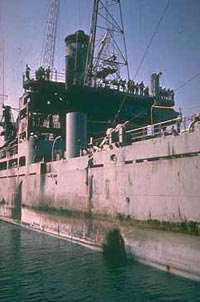
          On June 8, 1967, a perfectly clear day, the American electronic surveillance vessel USS Liberty was in international waters about 30 miles northeast of el-Arish in the Sinai Peninsula, monitoring the signals traffic of the Israelis, Arabs and Russians.  At about 2 PM the ship was attacked by Israeli Mirage and Mysteres fighters, which strafed, bombed and napalmed the Liberty, killing nine crewmen and wounding others.  Their munitions expended, the planes broke off the attack, and the Liberty radioed for help.  The nearby 6th Fleet twice scrambled fighters, but each time they were recalled within minutes, and about 30 minutes after that the Liberty was attacked by three Israeli torpedo boats, which almost sank the vessel with torpedo hits.  They then closed and strafed the vessel, including life rafts that were being launched.  According to the Israeli military, only then did they identify the ship as American and left the scene at 3:30, returning about an hour later to offer help, which the Liberty refused.  34 crewmen were dead and 174 wounded.

The Israelis immediately apologized for what they claimed was an accident, and this explanation was immediately accepted by President Lyndon Johnson and his Secretary of War, Robert McNamara.  Many others, including members of Congress and Secretary of State Dean Rusk, were appalled and believed the attack to have been deliberate.  Surviving Liberty crew were instructed never to talk about the incident under threat of court martial, and while many received decorations, all but one citation said nothing about the identity of the attacker.  Captain William McGonagle received the Medal of Honor, but rather than being awarded the decoration in the White House by the President, as is traditional, he received it from the Secretary of the Navy in an unpublicized ceremony at the Washington Naval Yard.  Stating that it was not their intention to “rule on the culpability of the attacker,” the Navy conducted a 10 day investigation, although the chief of the court, Rear Admiral Isaac Kidd, thought the probe would require at least six months.  This was by far the briefest investigation of a naval disaster in modern American history, and the fact that official letters to families of the casualties, stating it was an accident, were sent out the day before the court convened strongly suggests the investigation was a sham.  The Navy of course concluded that the attack had been an accident.  It remains the official policy of both the Israeli and American governments that it was.

Thanks, Israel!

It was not.  Despite the withholding and editing of documents and tapes, particularly by the NSA, the evidence is overwhelming.  Retired Liberty crewmen, who after all were first-hand witnesses, are adamant in their belief that the attacking Israelis knew it was an American ship.  They have pointed out that in their initial flyovers the planes were so close they could see the faces of the pilots, making it difficult to believe the pilots in turn could not see the 13 foot American flag and other identifying marks and the plainly non-Arabic sailors.  Retired members of the intelligence community have stated they knew it was deliberate and that operators on the Liberty actually overheard the Israeli pilots telling their superiors that it was an American vessel.  Vice-Admiral William Martin claimed the fighters were recalled because it was feared the attackers were Russians, an incredible proposition, and defending the Liberty could thus start a war with the USSR.  It is now known that Johnson, who lies about the affair in his autobiography, personally ordered (through McNamara) the planes recalled, unwilling to “embarrass my ally.”  25 American sailors would subsequently die because of that decision.

Attempts in the last four decades to reopen the investigation have been met with government indifference and outright hostility, even towards the aging survivors of the Liberty.  Afraid to level even the mildest criticism against Israel, virtually no American politician will accuse them of deliberately attacking an American vessel.  There is no conclusive evidence, they say, and what possible reason could Israel have to do such a thing?

If there is no “conclusive” evidence (apart from the eyewitness accounts of the sailors and statements of retired officials), it is because the government, despite the Freedom of Information Act, has refused to release box loads of documents pertaining to the attack.  Further, analysts have concluded that a number of the released audio tapes from that day have obvious gaps.  Why would Washington cover up such a blatant attack on Americans?  As the past 45 years have demonstrated, the apparent Israeli stranglehold on American domestic politics has allowed “our best ally” to do whatever she damn well pleases, even if that includes undermining US interests and constantly violating the international law and covenants we have pledged to uphold.  They have spied on us, illegally resold our military technology, interfered in our elections, detained and abused American citizens of Palestinian origin and insulted one American President after another, yet as the recent parade of Republican candidates made startlingly clear, every national candidate must kneel at the altar of Israel.

Israel has continually demonstrated that she has absolutely no concern for anything outside her own interests and is willing even to use Jews living abroad to serve her ends.  Protected by the United States, the Israelis seem to feel they can get away with any sort of behavior, continually violating the sovereignty of other countries (as we now do), maintaining an open season on Palestinian civilians, intercepting and capturing unarmed vessels in international waters and simply murdering people without apology.             This pattern of behavior certainly supports a deliberate assault on the Liberty.  But why?  There are two possible reasons.  Shortly before the attack the Israeli army had summarily executed several hundred Egyptian POWs in el-Arish (the number is disputed but not the massacre) and may well have been concerned that the Liberty, which was in the neighborhood, had gathered evidence of this war crime.  But far more likely is the planned invasion of Syria.  Washington was putting serious pressure (!) on the Israelis, who were dependent upon American resupply, to end the war, but Israel wanted to seize the Golan Heights and was massing forces for an assault on June 9.  If the US learned of this on June 8, the operation could not take place, and here was the Liberty, monitoring all the electronic traffic in the region.  Remove the Liberty and the problem disappears, as in fact happened.  At 3 AM on June 9 Syria accepted a cease fire, and though informed of this, at 7 AM the Israelis seized the Golan, which was subsequently annexed.

Our best ally indeed.

A Lost Poem by Dylan Thomas


Palestine

Dylan Thomas

Do not go gentle into Zion’s night,

The people must resist at close of day;

Rage, rage against the killing of the light.

Since wise men in their hearts know what is right,

Because their homes are ruined by soldiers they

Do not go gentle into Zion’s night.

Good men, in Palestine, crying how bright

Their land might have been and gay,

Rage, rage against the killing of the light.

Brave men, who fought and put the Jews to flight,

And learn, too late, the children have to pay,

Do not go gentle into Zion’s night.

Grave men, near death, who see with blinding sight

The U.S. has the wealth and pays the way,

Rage, rage against the killing of the light.

And you, my country, there on the feared height

Curse, cease support and shame, I prey.

Do not go gentle into Zion’s night

Rage, rage against the killing of the light.

H.R. 4133: the United States-Israel Enhanced Security Cooperation and Screw the Taxpayer Act

On May 9 the House of Representatives passed a bill that could have a dramatic impact on America’s foreign policy and will certainly cost us a lot of money, but since any news of this legislation was virtually absent from the mainstream media, very few Americans are aware of it existence.  H.R. 4133, the United States-Israel Enhanced Security Cooperation Act of 2012, was slipped through the House under a rules suspension that allowed a quick vote with virtually no debate.  The bill had bipartisan backing, being introduced by Democrats Howard Berman and Steny Hoyer and two particularly loathsome Republicans, who seem to owe their primary allegiance to Israel, Eric Cantor and Ileana Ros-Lehtinen.  (Actually, the bill had “tripartisan” backing, since the American Israel Public Affairs Committee, Tel Aviv’s powerful instrument in America, helped write it.)  The vote was 411-2, only Ron Paul (R) and John Dingell (D) voting against.  How odd that our increasingly dysfunctional and divided government could achieve virtually unanimity on a bill, one that most Americans will never hear of.

Anyone with a modicum of intelligence and honesty already knows what actions counter to our interests Israel’s stranglehold on Washington has forced upon us, but this bill represents a mind-numbing escalation of commitment to a state whose foreign and domestic policies are at odds with what this country presumes to stand for.  In essence the bill is a blank check from the American taxpayer, who will now be obliged to support Israel’s “qualitative military edge” over all its neighbors combined, of course leaving it to Israel and its Congressional supporters (which is to say, almost all of Congress) to decide exactly what that vague phrase means.  Certainly, one thing it means is that we will be sending more of our money out of the country in order to support activities of extremely questionable legality and morality.

The legislation also affirms our commitment to the “security of the State of Israel as a Jewish state.”  This is an interesting development in our “passionate attachment” (G. Washington) to Israel.  We have of course spent decades squandering our money and international credibility on an “ally” whose value to American security and interests (apart from domestic politics) is not at all clear and which continually violates the international law we are pledged to uphold and the basic values that we trumpet to the world.  But now we have pledged (for the first time in our history, I believe) to guarantee the religious/cultural nature of a foreign country.

One might legitimately ask why we should care, unless it was to criticize an oppressive government, which we cannot do anyway in the case of Israel, but more than that, what exactly does this mean?  When the Muslim minority in Israel’s citizen body becomes the majority, as it inevitably will, will the US have to intervene?  When Judea and Samaria (the West Bank) are formally incorporated into Eretz Yisrael will we have to help enforce apartheid or deport all those Palestinians?  If a majority of Israeli citizens voted to declare Israel a secular state, would we have to prop up a minority government?  And exactly what is a “Jewish state,” especially when the majority of inhabitants of the state in question do not practice Judaism?

The legislation requires the US to supply all sorts of equipment for the “defense” of Israel.  Of course, Israel has always been able to utterly smash its enemies, requiring only resupply from a compliant Uncle Sam, and the only potentially threatening neighbor whose military might be improving is Egypt, whose major supplier, America, is hardly likely to provide her an edge.  Included in the list are refueling tankers and bunker-busting bombs, which are obviously offensive weapons, unless of course your definition of defense includes preemptive strikes against other countries, which it does in the eyes of Israel – and increasingly the United States.  What are now called “preemptive strikes” were traditionally labeled “wars of aggression.”  I wonder if the Japanese attack on Pearl Harbor can be called a preemptive strike?  After all, American naval power was a threat to the continued existence of the Japanese Empire.

One particularly frightening part of the bill is the expressed desire for Israel to play an increased role in NATO, included a presence at NATO headquarters and involvement in NATO exercises.  The clear intention is that Israel ultimately become a member of NATO, thus dragging the entire European alliance into her wars and making it complicit in her continued violation of international law.  With that Israel could attack Iran or any other country with impunity, because if the victim dare fight back, the United States and the rest of NATO would be required to come to her aid.  This would be placing an assault rifle in the hands of an ill disciplined child.  But it is hard to imagine Turkey signing on to this plan, and one hopes the majority of European members would also object.  Of course, then Congress would begin looking at an actual treaty with Israel, though given the utter subservience of our politicians to Israeli interests, it would hardly be necessary.

One final slap in our face.  Washington has agreed to put up an additional $680 million (beyond the $3.1 billion we pay every year) to help Israel pay for her Iron Dome anti-missile system and the new F-35 fighter.  Israel has also requested another $168 million for security measures, while the Obama administration has asked for $99.9 million on top of that.  And to make sure poor Israel does not run out of American money the Iron Dome Support Act, introduced by Berman and the ever vigilant Ross-Lehtinen, would require our Treasury to keep shelling out the money.  And here is the joke on us: Israel has this year cut its defense budget by 5% and intends to do the same next year!  Oh, there is a second joke: the United States has absolutely no rights to the technology being developed for the Iron Dome system, which will be marketed to the world by Israel.  Perhaps we can get a special deal.

We have become a silly nation.

A Lost Poem by Rudyard Kipling

The U.S. Burden

Rudyard Kipling


Take up the U.S. burden –

Send forth the best ye breed –

Go bind your sons to exile

To serve all corporate greed;

To wait in heavy harness

In Kuwait and Kabul,

To transform Arab culture

And send Islam to school.


Take up the U.S. burden –

In patience to abide

To veil the threat of terror

And check Islamic pride;

By opaque speech, not simple,

And never quite made plain,

To seek all corporate profit

And Haliburton’s gain.


Take up the U.S. burden –

The savage wars of oil –

Fill full the maws of tankers

And make the people toil;

And when your goal is nearest

The peace the world has sought,

Watch Banks and Wall Street Folly

Bring all your hope to nought.


Take up the U.S. burden –

No tawdry rule of law,

But drones and Hellfire missiles

Shall hold them all in awe.

The news ye shall not publish,

The facts ye shall not spread,

Go send abroad your living,

And bring them back as dead!


Take up the U.S. burden –

And reap the butcher’s bill:

The blame of those ye batter,

The hate of those ye kill –

The cry of hosts ye shepherd

Unto the western light: –

“Why brought ye us from bondage,

Our loved Islamic night?”


Take up the U.S. burden –

And dare to stoop to less –

And call again on Freedom

To cloak your greediness;

By all ye cry or whisper,

By all ye leave or do,

The peoples of the planet

Shall weigh your God and you.


Take up the U.S. burden –

Have done with truthful days –

The worldwide admiration,

The European praise.

Comes now, to search your manhood

Through these new fascist years,

Hard-edged with higher wisdom,

The judgment of your peers!

We Bad: American Exceptionalism

“American exceptionalism” is a phrase dear to the hearts of all politicians but most especially Republicans, who, however, never bother to specify exactly what it means.  Presumably they are thinking of the America of the 19th century, when we were the only serious power with a fully functioning democracy and without any traditional class distinctions.  Ours was the society that rewarded hard work and cleverness and afforded the individual the greatest opportunity to improve his condition, regardless of his background.  Of course it was also a society that accepted a high level of individual violence and lagged behind western Europe in abolishing slavery and establishing mechanisms of social welfare, but it was nevertheless exceptional, as Tocqueville recognized.

But this is the now the 21st century and virtually all the industrial democracies display the characteristics that once made us exceptional.  Yet one can still speak, as the conservatives do, about an American exceptionalism.  The problem is that we are now exceptional in ways that one might be reluctant to brag about.

We are of course still the richest nation on earth, but we now lead the industrial democracies in income inequality, that is, our rich-poor gap is wider and becoming more so.  In roughly the last 30 years the income of the top 1% has increased by 275%, that of the next 19% by only 62%, the next 60% by 40% and the bottom 20% by a mere 18%.  We are #50 in income distribution, with 30.5% of all income going to the top 10%; Russia is the only European country below us in this category.

But we sure know what to do with all that wealth.  We are #1 in spending ($4271 per capita per year), #1 in military expenditure (but only #3 in military personnel), #1 in energy use (equivalent of 8.35 tons of oil per capita per year), #2 in coal use (1.06 million short tons per year; China edges us out, whereas #3 India uses only .339 million), #1 in carbon dioxide emissions (5.7 million metric tons per year), but alas, only #2 in biggest environmental footprint (the UAE is #1).

We are #1 in per capita health care expenditure ($6096) and #1 in health care expenditure as a percentage of GDP (15.4%).  Yet, for all that money we are #44 in doctors per 1000 people (2.67; little commie Cuba is #2 with 6.4), #14 in nurses and midwives per 1000 people (9.8), #77 in hospital beds per 1000 people (3.1) and #1 in obesity (30.6% of the population) but only #49 in life expectancy (78.37 years).  And this is a health care system that does not include some 30 million citizens, unlike the total population coverage present in every other industrialized democracy.  Sure, we have the best health care system in world, as conservatives like to say – if you can afford it.

We are #37 in percentage of GDP spent on education (5.7%), but that is of course a big number in dollars.  Still, we are #12 in years of adult schooling and #18 in math literacy.  On the other hand, we are #1 in teen pregnancy (22% of all 20 year old women), so they are doing something in school.

Incidentally, most Republicans like to think of the US as a “Christian” nation, even though most of the Founding Fathers were not Christian.  Well, as the teen pregnancy indicates, some of us are not engaged in very Christian behavior.  Further, we also have the #1 divorce rate (4.95 per 1000 people) and #1 incarceration rate (715 per 1000 people; #2 Russia has 584).  In 2007 we were #7 in executions (42), up in the top ten with such enlightened countries as Saudi Arabia, Pakistan and the Democratic Republic of the Congo.  Considering our firearm policies, we were only a disappointing #4 in homicides with guns.  On the other hand, we are #1 in motor vehicle deaths (15.5 per 1000 people); the death toll from 9/11 in fact represents a slow month on America’s highways.

But I suspect most Americans are completely unaware of our new exceptionalism.  They are too busy: we are after all #1 in TV viewing (28 hours per week).

(The statistics are mostly from the last decade and from the UN via nationmaster.com.)

Grass Roots on Israel

Nobel Laureate author Günter Grass has just published a short poem entitled “What Must Be Said,” in which he accuses Israel, with its undeclared stockpile of nuclear weapons and constant threat of attacking Iran, of being the real threat to peace in the Middle East.  The poem is hardly likely to enter the corpus of great literature, but in it Grass makes valid points that must in fact be made and has stirred a discussion – at least in Germany – that has been constantly avoided.

Granted, Grass has undermined his position and unnecessarily provided material for his critics by suggesting that Israel is poised to launch a nuclear strike that would destroy the Iranian people, something Tel Aviv is not likely to consider doing.  Even the ever-compliant United States would (I hope) bristle at the use of a nuclear weapon, and in any case in the highly unlikely event that Israel’s incredibly powerful conventional defenses were inadequate, the US would be obliged to step in.

Nevertheless, Grass’ basic point is certainly correct: the only Middle Eastern nation west of Pakistan possessing nuclear weapons is Israel, which has never even been asked to sign the Non-Proliferation Treaty, let alone accept inspection of its facilities.  This bit of grand hypocrisy is hardly surprising, given that America and to a lesser extent Europe have historically granted the Jewish state a blanket dispensation when it comes to accepted international law and behavior.

Critics are screaming at the barest suggestion that Iran may be the victim here, but this is perhaps not as outrageous as it first appears, certainly not from the Iranian point of view.  The West overthrew their democratically elected government in 1923, imposed the utterly ruthless Shah, occupied the country during World War II, created and supported a militarily powerful Israel and encouraged Saddam Hussein in his decade-long war against them.  And now, because of the interests of Israel and the Sunni oil barons, America has declared its (albeit reluctant) willingness to engage in a war of aggression because Iran might be working on nuclear weapons and might have one in a few years.  For all that Iran is controlled by a collection of ideological numbskulls there is at least an aura of victimhood, and certainly no rational person could ever consider imperial Israel a victim.

For the obvious reason of its Nazi past criticism of Israel is very infrequent in Germany.  (Because of domestic politics it is also very infrequent in America, but the utterings of a European author typically do not stir the interest of the self-absorbed American media.)  Clearly, the atrocities of the Third Reich neither justify bad behavior on the part of Israel nor require reasonable Germans to be silent, but as Grass predicts in the poem, any criticism of Israel will result immediately in the accusation of anti-Semitism, which is exactly what happened.

Criticizing Israel is of course no more anti-Semitic than criticizing Germany is anti-German, and Israeli citizens in fact do it every day (only to be branded “self-loathing”).  But so great is western guilt and Zionist influence that it is now generally accepted that gainsaying Israel is in fact anti-Semitic; the latest edition of Webster’s does offer as the second definition of “anti-Semitism” criticizing Israel.  So, one does so at one’s own risk.

Sundry Germans, particularly newspaper columnists, immediately jumped on Grass as an anti-Semite, especially the Jewish writer Henryk Broder, who described the novelist as “the prototype of the educated anti-Semite,” in part for labeling the appropriation of Palestinian land as a criminal act (which of course it is by established international law).  As can easily be imagined, the extreme right-wing government in Tel Aviv promptly branded Grass an unrepentant Nazi, and Interior Minister Eli Yeshai barred the author from ever entering Israel, a petty measure already taken against others, such as linguist Noam Chomsky and Nobel Peace Laureate Mairead Maquire, who dared criticize Israel.  (In 2001 there were calls, unsuccessful, to do the same to Daniel Barenboim, who had the temerity to conduct a piece by Richard Wagner; these people are off the deep end.)  To their credit even some German politicians condemned this fit of Israeli pique.

Grass has on numerous occasions demonstrated himself to be something of a jerk, but he is undeniably a world-class novelist and certainly no ignoramus.  Whether or not one agrees with his appreciation of Israel and its nuclear arsenal, he has clearly made a valid point about the danger of criticizing the Jewish state, a point most Germans apparently agree with.  And a point amply demonstrated by the reaction of Israel, which once again has chosen to erect a wall rather than confront rationally those who dare object to its actions, whether they be Palestinian farmers or German authors.

What must be said

Why have I kept silent, held back so long,

on something openly practised in

war games, at the end of which those of us

who survive will at best be footnotes?
It’s the alleged right to a first strike

that could destroy an Iranian people

subjugated by a loudmouth

and gathered in organized rallies,

because an atom bomb may be being

developed within his arc of power.

Yet why do I hesitate to name

that other land in which

for years – although kept secret –

a growing nuclear power has existed

beyond supervision or verification,

subject to no inspection of any kind?

This general silence on the facts,

before which my own silence has bowed,

seems to me a troubling, enforced lie,

leading to a likely punishment

the moment it’s broken:

the verdict “Anti-semitism” falls easily.

But now that my own country,

brought in time after time

for questioning about its own crimes,

profound and beyond compare,

has delivered yet another submarine to Israel,

(in what is purely a business transaction,

though glibly declared an act of reparation)

whose speciality consists in its ability

to direct nuclear warheads toward

an area in which not a single atom bomb

has yet been proved to exist, its feared

existence proof enough, I’ll say what must be said.

But why have I kept silent till now?

Because I thought my own origins,

tarnished by a stain that can never be removed,

meant I could not expect Israel, a land

to which I am, and always will be, attached,

to accept this open declaration of the truth.

Why only now, grown old,

and with what ink remains, do I say:

Israel’s atomic power endangers

an already fragile world peace?

Because what must be said

may be too late tomorrow;

and because – burdened enough as Germans –

we may be providing material for a crime

that is foreseeable, so that our complicity

will not be expunged by any

of the usual excuses.

And granted: I’ve broken my silence

because I’m sick of the West’s hypocrisy;

and I hope too that many may be freed

from their silence, may demand

that those responsible for the open danger

we face renounce the use of force,

may insist that the governments of

both Iran and Israel allow an international authority

free and open inspection of

the nuclear potential and capability of both.

No other course offers help

to Israelis and Palestinians alike,

to all those living side by side in enmity

in this region occupied by illusions,

and ultimately, to all of us.

Günter Grass

(Translated by Breon Mitchell)

Stuff About Way Back: An Example of Scholarly Crapola

(If anyone is still visiting this site, be aware the lack of new posts is due to a compulsion to work on something scholarly.  So, I provide you with an example of this crap, an appendix that I just completed.  This is the life blood of classical scholarship.  Why some of the Greek came through and the rest turned into gibberish and why the footnote arabic numerals become Roman numerals, I have no idea.)

APPENDIX 6: THE TOPOGRAPHY AND ARCHAEOLOGY OF MARATHON

            The plain of Marathon stretches about six miles along a slightly curving SW-NE axis, averaging about two miles in width between the heights and the sea.[i]  The tectonically active plain is bounded and well defined on the west, north and east by rocky, scrub-covered hills of schist and marble – Aphorismos (1555 ft), Kotroni (771 ft), Stavrokoraki (1043 ft) and Drakonera (794 ft) – that rise fairly abruptly and steeply.  To the southwest Mt. Agrieliki climbs to 1827 feet on extremely steep slopes, which are presently covered with small trees at the lower levels, and its eastern foot falls about a kilometer from the coast, forming the southern entrance to the plain.  A side valley containing the town of Marathona extends northwest between Kotroni and Stavrokoraki, and a smaller valley, the Avalona, runs parallel to it on the west side of Kotroni.  At the western extremity of the plain Agrieliki, Aphorismos and Kotroni form a sort of recess in which the village of Vrana is located.  Typical of coastal Greece, the plain itself consists of alluvial fans and has in the last twenty-five hundred years risen about ten feet due to sediments brought down from the interior.[ii]  Construction and the planting of trees have dramatically changed the appearance of the central and southwestern parts of the plain in just the last forty years, but inasmuch as the Greeks were able to form up their phalanx and none of the sources mentions any impediments, it may be assumed that in antiquity the plain was primarily planted in grain and there was only a scattering of trees.[iii]

Kynosoura (164 ft), a steep-sided spur of Drakonera, juts south into the sea for about a mile and a half, forming a protective weather barrier for the northern part of the bay and especially sheltering the Schoenia, a sandy beach running southwest from the promontory for two miles.  The beach rises gently to a belt of pine woods, behind which is the Great Marsh, which once covered perhaps two-thirds of the northeastern half of the plain and extended to the coast south of the Schoenia.  At the eastern fringe of the marsh, hard up against the spur that becomes the Kynosoura promontory, is a small salt lake, which drains into the sea.[iv]  There was until 1934, when it was drained, a smaller marsh, the Brexiza, in the southern entrance to the plain, but unlike the Great Marsh it is not described by Pausanias and classical remains all but prove that it did not exist in antiquity.[v]  The coast of the plain is for the most part formed of a shelving beach with shallow waters, but the southern reaches tend to be more rocky and uneven, especially when contrasted with the Schoenia.[vi]

Prominent in the middle of the plain is the Charadra, a winter torrent or arroyo that issues from the hills above Oinoe, a village northwest of Kotroni, and flows through the valley between Kotroni and Stavrokoraki, cutting two deep channels through Plasi to the sea.  Though dry most of the year, the gullies present a formidable obstacle, the banks being as high as twenty feet in places.  A smaller torrent, the Rapendosa, descends from the hills between Agrieliki and Aphorismos and disappears about a third of the way across the plain.  A torrent such as the Charadra will certainly not follow the same course for two and a half millennia, and in any case the central part of the plain appears to have risen about ten feet since antiquity, for the most part because of material brought down from the hills by these torrents.[vii]  It is thus impossible to determine exactly where the gullies ran at the time of the battle or whether they existed at all, but since neither Herodotus nor Pausanias makes any mention of this terrain feature, it is safe to say that if it did exist, it had no impact on the battle.  The plain is well watered, two fault lines producing a number of springs, the principal ones being at Oinoe, Vrana, the eastern foot of Agrieliki (“Mati”) and at Kato Souli, between the eastern base of Stavrokoraki and the Great Marsh (“Megalo Mati” or “Makaria”).  Wells are found all over the plain, providing most of the water for the region today, and Pausanias says there was fresh water flowing out of the Great Marsh.[viii]

Of the villages/demes of the Marathonian tetropolis three have been more or less securely located: Oinoe at the site of the modern village of that name, Trikorynthos at Kato Souli and Probalinthos at the eastern base of Agrieliki north of the Brexiza marsh (less securely).  The site of Marathonitself is still disputed, but the scant archaeological evidence now points to a spot near the coast amidst the channels of the Charadra.[ix]  There were in the fifth century three routes leading from Athens into the Marathon plain.  The main road, apparently suitable for carts, ran for some twenty-six miles from Athens via Pallene to the area of the Soros and then continued northeast across the plain and on to Rhamnous.  A second road led northeast from Athens to Kephisia, where it split into two paths, one passing through modern Stamata and Oinoe and on into the plain through the Avalona valley, the other heading through modern Dionysos and descending to Vrana through the gorge of the Rapendosa.  Each of these routes is a bit more than twenty-three miles long, and both become fairly rough and steep tracks through wooded areas once they enter the hills around Marathon.[x]

Rising above the southern plain, approximately a mile northeast of the foot of Agrieliki and a half mile northwest from the coast, is the Soros, a thirty foot high artificial mound that is generally accepted as the burial place of the Athenians who fell in the battle.[xi]  About four miles west of the Soros, at the site of the Marathon museum in Vrana, is a cluster of seven middle and late Helladic tumuli, and about 300 feet northeast of these lies a seventh mound, dated to the early fifth century.  Within this tomb were found the remains of one juvenile and ten adult males, leading a few scholars to conclude that this is the tomb of the Plataeans mentioned by Pausanias.[xii]  This identification is almost certainly incorrect, however.  Pausanias’ catalogue of sights at Marathon proceeds in a more or less direct line northeasterly from the Soros to the stone “stables” of the Persian horse, and placing the Plataean tomb, which is mentioned immediately after that of the Athenians, at Vrana represents a three mile detour from this route.  Further, the battle centered on the Soros, and it is difficult to see why the Plataean dead would be carried all the way to Vrana rather than being interred in the vicinity of the Athenians, where all could be conveniently visited and honored.[xiii]  The tomb contents also argue against the identification: a mix of burial styles, the presence of a boy, very poor grave gifts and a single crude inscription in Attic lettering on an unworked stone.[xiv]  It is far more likely that a low mound observed near the Soros in the nineteenth century marks the spot of the Plataean burial.[xv]

Following his notice of graves of the Athenians and Plataeans Pausanius mentions a monument to Miltiades and a trophy of white marble.[xvi]  About 650 yards north of the Soros are the foundations of a tower (“Pyrgos”), possibly medieval, which according to nineteenth century travelers incorporated large blocks of white marble, now all gone.  About a mile and a half to the northeast of these ruins, near the present church of Panagia Mesosporitissa, are the remains of another tower, also sporting ancient marble, including column drums and an Ionic capital.  The two towers are likely to mark the approximate sites of the ancient monuments from which the marble was pilfered, since in the first case Leake observed actual marble foundations and in the second the number and size of the blocks argues against being moved any great distance. That these are the remains of the Miltiades monument and the battle trophy is a tempting conclusion since the fragments indicate monuments rather than buildings or enclosures and one would expect the Miltiades memorial to be in the vicinity of the burials.[xvii]

The last battle-related item Pausanias mentions before describing the Makaria spring and the Marsh are the Persian dead, whose burial place he could not find.  He was, however, informed by the Athenians that they had been thrown into a trench, and in the nineteenth century von Eschenburg found in the area off the western edge of the Marsh huge quantities of bones (“viele Hunderte von Todten”), seemingly buried in a haphazard manner.[xviii]

The Persian fleet certainly anchored along the Schoenia.  This section of the coast was the most amenable to the mooring of ships, and the Kynosoura promontory protected the anchorage from the dangerous northeast winds.  Inasmuch as vessels were apparently beached only for protection or maintenance, the ships would have been anchored right at the water’s edge, sterns facing inland.  Assuming no more than 300 vessels and no more than thirty feet of beach space per vessel (approximately the width of a trireme with oars extended), the fleet could be moored in a single line along the Schoenia, providing for the most convenient unloading and loading and for the quickest departure.[xix]  This anchorage provided immediate access to the region of the Great Marsh and the most likely site of the Persian camp, the deme of Trikorynthos.  Herodotus does not mention a Persian camp, as he does in the case of Plataea and Mykale, but inasmuch as the area around the Schoenia could not comfortably accommodate 50,000 or more men for several days there must have been a separate encampment, at least for the army.[xx]  A camp on the plain immediately west of the marsh is possible, but the area to the north, bounded by the hills of Stavrokoraki and Drakonera and the marsh itself, offered excellent protection against attack and controlled the road to Rhamnous.  Water was more plentiful in this locale, especially from the Makaria spring, and here the marsh was apparently deeper, remaining green longer into the autumn and thus providing more fodder for the horses.[xxi]  And though it is barely evidence, Pausanias in fact identifies some excavations and marks in the hills beyond the marsh as the “stables” of Artaphernes’ horse and the marks from his tent.[xxii]

More problematic has been the location of the Greek camp.  Herodotus says that upon arriving at Marathonthe Athenians established their camp “in the precinct of Herakles,”[xxiii]  without however providing any indication where that might have been.  In his eighth Pythian ode Pindar says the games of Herakles were held “in a/the nook/corner of Marathon,” but he may simply mean that Marathon was a corner or nook of Attica.[xxiv]  In the 1930s an inscription containing regulations for games at the Herakleion was found just north of the Brexiza marsh, but even the finder of the stone, Soteriades, believed it had wandered, especially since it had been refaced.[xxv]  Further, there was some evidence that the area near the marsh had been sacred to Athena Hellotis.[xxvi]  He pointed instead to the Vrana valley, near the chapel of St. Demetrios, where he discovered what he believed to be the early 5th century remains of a sacred enclosure, which he identified as the Herakleion, noting that St. Demetrios would be an understandable successor to the pagan hero.[xxvii]  Possessing springs, providing a secure position and covering both the main road along the coast and the back roads through Kephisia, the Vrana location, which is in fact in a sort of “nook,” was subsequently accepted by many, if not most writers, as the site of the Athenian camp.[xxviii]

This all changed with the discovery in 1972 of a dedication to Herakles, this stone found incorporated in a Roman building in the area of the Brexiza marsh.  Certainly, two inscriptions regarding Herakles are very compelling, and this relatively narrow area between Agrieliki and the sea might well be described as a “nook or “corner” of Marathon.  A camp here makes military sense, and the location fits perfectly the epithet the dedicatory inscription assigns to Herakles – “at the gate” – and the statement in one of the Marathon epigrams that the Athenians were “before the gates.”[xxix]  While certainty is a commodity in very short supply at Marathon, the Athenian camp may now be fairly securely located at the southern entrance to the plain, and Herodotus’ account must be reconciled with this location.[xxx]


[i] A brief survey of the archaeology of the Marathon area and a list of the attendant literature up to 1988 can be found in Travlos 1988, 216-21.

[ii] Higgins & Higgins 1996, 33; Pritchett 1960, 156-57; see further note 7.  The sea level of the Aegean also appears to have risen about 10 feet; see Pritchett 1959, 255-56.

[iii] Nep. Milt. 5.3: arbores multis locis errant rarae; Caspari 1926, 103 (followed by How & Wells 1912, II, 112) believes the Greek center was weakened in order to accommodate trees and vines, but fear of being outflanked was a far more compelling reason; see .  The plain was relatively free of trees when observed by Frazer at the end of the nineteenth century; Frazer 1898, 433.

[iv] Woods: Aesch. Eleg. 3: Maraqw&nion a!lsoj; Paus. 1.14.5: to_ Maraqw~ni a!lsoj; marsh: Paus. 1.32.7: li&mnh ta_ polla_ e(lw&dhj.  Recent geophysical examination suggests that the marsh was once a lake and before that a lagoon, and in an unpublished study Richard Dunn concludes that in 490 it was in fact a lake.  Pausanias describes it as a “mostly marshy lake,” but that is over 600 years after the battle.  On the other hand, he describes the Persian fugitives blundering into the marsh and suffering great casualties, which seems very unlikely were it simply a lake with marshy fringes.  It is also unlikely that the channel connecting the marsh/lake to the sea was used by the Persian ships, assuming it was even navigable.  Marsh would make the mooring and unloading of the vessels more difficult, and the ease with which almost all the ships escaped makes more sense were they on the beach; see also note 16.  There is also evidence that the northern part of the shoreline was further inland and the souther further out in 490.  On the marsh and coast see Kretnz 117, 214-15 and the map 155.

[v] Soteriades 1935, 120-21; Pritchett 1960, 152-54, 1965, 83-84; Themelis 1974, 239-41; Petrakos 1995, 68-86; Hammond 1973, 186-87 believes there was a marsh in antiquity because of the powerful springs in the area and because of scholia on Pindar claiming that Athena Hellotis was so named because of the marsh at Marathon, but the rise in the sea level better explains the emergence of a marsh and the scholia are extremely vague (e0n, peri&, pro_j) on the spatial location of the marsh to Marathon, which itself could be the deme, the town or the whole tetropolis.  The stone attesting to a temenos of Athena was in fact found near the chapel of St. Demetrios, a mile and half north of the Brexisa (Vanderpool 1966b, 319-20), and the scholiast may simply be wrong, Hellotis with its double lambda deriving instead from Hellotia, a daughter of Timander.

[vi] See the admiralty chart in Hammond 1973, 218.

[vii] Burn 1966, 161-62 believes there was no Charadra in antiquity because deforestation of the surrounding hills had not yet occurred, but flashfloods in the area were already proverbial: Demon FGH 327 F 8 (= Strabo 8.6.16, Zen. 5.29, Suda s.v.): Oi0nai=oi th_n xara&dran.  In 1828 Leake (see his map in Hammond 1973, 183) observed the two torrents following roughly the same courses they do today, and Soteriades 1935, 132-33 concluded the Charadra followed the same course in antiquity.  But in the 1960s Pritchett confirmed the earlier reports of Staes that the level of the plain at the Soros had risen some ten feet, and this together with the sherd deposits around the torrent convinced him and two separate geologists that the present course of the torrent is not that of 490; a map made in 1792 in fact shows the Charadra following a different course; Pritchett 1960, 141-42, 156-57, 1969, 6.

[viii] Paus. 1.32.6; Pritchett 1965, 84-85; Petrakos 1995, 52-55.  The depth of the water table, presently as little as 23 feet near the Brexiza marsh, increases as one moves inland towards Stavrokoraki, where it is now some 65 feet; though certainty is impossible because of the tectonic activity in the area, the water table was probably higher in antiquity, before another twenty-five hundred years of alluviation.

[ix] Placing Marathon near Plasi fits the order Probalinthos – Marathon – Trykorinthos given by Strabo 9.1.22, which traces demes north along the coast.  The archaeological literature on the demes is extensive; see Travlos 1988, 220-21; the most recent and/or pertinent: Pritchett 1960, 149-52, 1965, 83-88, 1969, 1-11; Vanderpool 1966b, 319-22; Marinatos 1970a, 5-9, 1972, 6-7; Themelis 1974, 229-35, 239-42; Traill 1986, 146-48.  Petrakos 1995, 1-2 suggests that there was no village of Marathon but rather houses scattered about the plain, but such would constitute a big exception in Pausanias’ itinerary.

[x] In 1996 I could not find the head of the Oinoe trail, but did climb the Rapendosa track for about a half mile; it was extremely steep and rough.  A description of the tracks can be found in Frazer 1898, 441-42.  The excellent road observed between Stamata and Marathona by Clarke in 1801 cannot be earlier than the late fifth century; Ober 1982, 457-58.

[xi] Paus. 1.29.4, 32.3 is clearly referring to this tomb.  Schliemann 1884, 85-88 believed it to be prehistoric, but the excavations of Staes confirmed the date of 490; see esp. Staes 1893, 46-63; Hammond 1973, 172-78.  Pausanias describes only a grave (τάφς) with stone slabs (στh=λαι) inscribed with the names of the dead, which slabs G. Spyropoulos has claimed to have recently found in the villa of Herodes Atticus in the Peloponnesus.  He consequentlty suggests that it was Herodes who erected the mound when he purloined the inscriptions of the Marathon dead, which is barely possible since Pausanias would have passed through Marathon before AD 174 and Herodes died in 177; report in Αρχαιολογία Archaeology Newsroom 8 May 2009; the book mentioned in the report, Die Architektur der Villa des Herodes Atticus zu Eva/Loukou, can not be located and is perhaps classified.

[xii] Paus. 1.32.3; Marinatos 1970a, 9-28, 1970b, 155-66, 1970c, 351-66; Hammond 1973, 197-98; Burn 91-92.

[xiii] Pritchett 1985, 129.

[xiv] See esp. Welwei 1979, 101-6, who suggests these might be the remains of scouts who were surprised and killed by the Persians; Themelis 1974, 244 believes they are normal local burials despite the absence of any females.

[xv] Clarke 1818, 27-28; Leake 1841, 101; Pritchett 1985, 128.

[xvi] Paus. 1.32.4-5.


[xvii] Miltiades monument: Leake 1841, 101; trophy: Vanderpool 1966a.


[xviii] Paus. 1.32.5: o1rugma.  Von Eschenburg 1886, 10.


[xix] That the Stoa Poikile paintings (Paus. 1.15.3) show Persians fleeing into the marsh between illustrations of the battle and the fighting at the ships places the fleet at the Schoenia.  On mooring the ships see Harrison 1999, 168-71; Whitehead 1993, 95-98; Herod. 6.107.2 says the ships were “moored” or “anchored”: ta_j ne&aj o#rmize.  Herod. 6.114.1 shows a Persian ship stern-first, and the fact that the fleet got away so quickly suggests stern-first mooring.  The Brescia sarcophagus, thought to reproduce the scenes in the Stoa Poilile, shows ships moored stern-first; see Vanderpool 1966a, pl. 35.

[xx] Following a suggestion of Macan 1895, II, 244, n. 8, van der Veer 1982, 398-99 believes there was no Persian camp.

[xxi] Most modern authors place the camp around Trykorynthos, but some have it west of the marsh: Macan 1895, II, 244-45; Munro 1926, 242; Schachermeyr 1951, 18-19; Vanderpool 1966b, 323; et. al.; Shrimpton 1980, 30-31 curiously places it near the Soros.  Shrimpton 1980, 31, n. 23 argues that the pasturage available at the marsh would be dangerous to horses fed on hay and grain, but surely the Persian horse-handlers would approach this change in feeding very carefully, and in any case Trykorinthos provided easy access to water and better security after dark.  See Frazer 1898, 432 for a description of the marsh before it was drained.

[xxii] Paus. 1.32.7; Frazer 1898, 432 observed “niche-like excavations” on Stavrokoraki; Leake 1841, 96 found a “small cavern” on Drakonera.  Since the Persians are unlikely to have engaged in excavating rock, it is likely the story of the stables and tent later attached themselves to one or the other of these formations.

[xxiii] Herod. 6.108.1: e0n teme/nei+  9Hrakleo/v.

[xxv] IG i.3 3 (=SEG x.2): hερακλείο[ισι]; see Vanderpool 1942, 329-37, 1966b, 322-23, 1984.

[xxvi] See note 5.

[xxvii] Soteriades 1935.

[xxviii]  Including me: Berthold 1976-1977, 88-91; some of the others: How & Wells II, 109; Delbrück 1920, 54; Munro 1926,  241-42; Maurice 1932, 21; Pritchett 138-40; Burn 243; Hammond 189-90; Billows 208, who apparently did not get the memo on the second inscription.

[xxix]IG i.3 1015bis: ερακλεῖ…τὸμ Πυλίοις ἀνέθεκε ερακ[λ ˘ ˘ ¯ ˘ ˘ ¯ ˘]; see Marinatos 1972, 6; Kamanoudes 1978, 237-42; esp Matthaiou 2003, 190-94.  IG i.3 503/4: αἰχμὲν / στε̑σαμ πρόσθε πυλο̑ν; see Matthaiou 2003, 194-97.

[xxx] Virtually everyone now accepts the location at the entrance: e.g., Burn 1977, 90-91; van der Veer 1982, 96-97; Evans 292; Lazenby 54-56; Krentz 118-21.