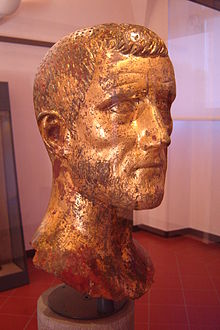
Stuff from Way Back #33: Roma, We Have a Problem

(This essay on the Anarchy follows Stuff from Way Back #32b: When Is a Republic Not a Republic?  These pieces have become much longer than I intended, and after the last in the series I will endeavor to leave these long lectures behind, not an easy task for me.)


The Anarchy, from 235 to 285, is the great watershed of the Roman Empire.  It separates the Principate from the Dominate, from an autocracy in which the Emperor was in theory a partner of the Senate and exercising the authority of the people to one in which the Emperor was a blatant oriental despot.  It separates a stable and reasonably prosperous Empire from one which had only moments of stability under a strong man and a rapidly declining economy of strangulating taxation.  It sees the replacement of the disciplined and loyal heavy infantry, whose weapons and tactics dated back to the fourth century BC, with a poorly trained rabble of light infantry and a revival of cavalry.  It ushered in a new Christian Roman Empire.

The aptly named Anarchy was essentially a fifty year long civil war, so chaotic that there is not complete agreement on who might be considered actual emperors.  I believe twenty-seven men (three in the separatist Gallo-Roman Empire) held the imperial purple long enough to be considered legitimate rulers, and of those thirteen were elevated by their own soldiers.  Two of them committed suicide, one was captured by the Persians, one died of plague, four were killed in battle and seventeen were assassinated, mostly by their soldiers or officers; only two died a natural death.  Barbarian incursions into the heart of the Empire would become commonplace, and at one point it would actually break into three separate states.  The astounding thing is that the Empire did not collapse completely.

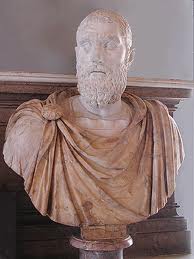
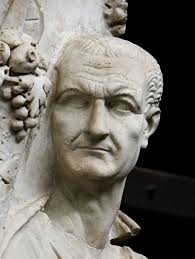
C. Julius Verus Maximinus Thrax, who had become Emperor with the assassination of the last Severan in 235, spent two years dong useful work on the Rhine and Danube, quelling revolts and carrying on a war against the Senatorial class. In 238 M. Antonius Gordianus Sempronianus, proconsul in Africa, and his like-named son were accepted by the Senate as Emperors, but without serious military support they lasted only twenty-two days.  The Senate then chose two of its members, D. Caelius Calvinus Balbinus and M. Clodius Pupienus Maximus, as co-rulers.  Maximinus had already come south to deal with the Gordians, but while unsuccessfully besieging Aquileia he was murdered by his disgruntled troops.  Shortly thereafter the Praetorians, unhappy with the Senatorial candidates, killed Balbinus and Pupienus and proclaimed M. Antonius Gordianus, grandson of the first Gordian, Emperor.
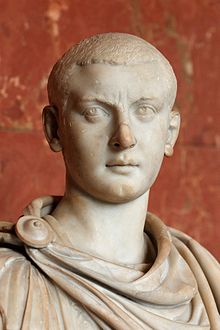
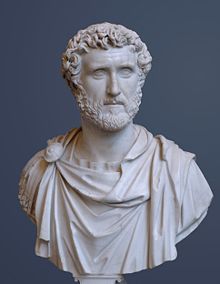
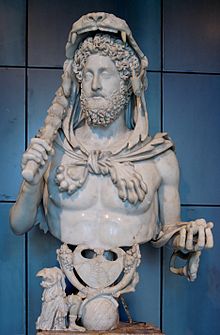
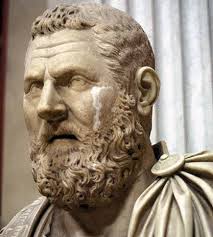
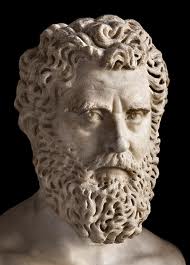
Gordian III

Gordian III

Gordian III managed to keep the job for six years, engaged in continuous warfare in the north, followed in 243 with a war against the Persians, who had begun overrunning Roman territory during the reign of Maximinus.  The campaign was successful, but Gordian’s Praetorian Prefect, who had been the real ruler of the Empire since his appointment in 241, died during the winter, and in early 244 his replacement, M. Julius Philippus Arabus, incited the troops to murder Gordian and name him Emperor.  Philip, who named his son of the same name co-Emperor in 248, was actually a responsible ruler, restoring relations with the Senate and attempting to bring stability to the Empire.  But the job required someone of Herculean energy and talent to deal with the continuous barbarian pressures in the north, the sinking economy and the ever rebellious troops, who elevated at least three pretenders during Philip’s administration.

In 248 C. Messius Quintus Decius Traianus was able to restore order among the mutinous troops on the Danube and expel the barbarian invaders, but the soldiers decided to invest Decius with the purple despite his apparently sincere protests.  Decius attempted to remain loyal to Philip, but the latter did not trust him, and in 249 both Philip’s fell in battle and Decius became Emperor.  He lasted all of two years, betrayed in battle against the Goths in 251 by his lieutenant C. Vibius Trebonianus Gallus, who became Emperor along with his son C. Vibius Afinius Gallus Veldumnianus Volusianus.  They also lasted two years, defeated in battle in 253 by M. Aemilius Aemilianus, who was chosen by his troops after a victory against the now ever present Goths.  Three months later Aemilius was murdered by his own soldiers at the approach of P. Licinius Valerianus, who had been summoned by Gallus and proclaimed Emperor by his troops upon Gallus’ death.  In eighteen years Rome had enjoyed no less than a dozen rulers.
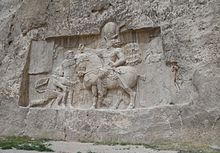
Valerian and King Shapur

Valerian and King Shapur

Valerian

Valerian

Gallienus

Gallienus

Valerian made his son P. Licinius Egantius Gallienus co-Emperor, and they immediately got about the job of restoring the frontiers.  Gallienus went to Gaul where the Franks had broken through and raided through Spain to Mauretania, and he defeated a group of Alamanni in northern Italy in 258.  He then moved to the Danube to crush a couple of usurpers, and returned to Gaul, where in 259 M. Cassianus Latinius Postumus had won the support of the legions in Germany, Spain and Britain.  Meanwhile, Valerian battled sundry barbarians around the Black Sea and Asia Minor, and with his army weakened by disease he attempted negotiations with the Persian king, Sapor, who had been pressing Syria.  The treacherous Sapor captured him, and a Roman emperor died in Persian captivity in 260.

Now it gets complicated.  Gallienus was busy in the west fighting Postumus, Sapor was again threatening Syria and one of Valerian’s generals named his two sons emperors of the east.  One was killed in battle by Gallienus’ troops and the other was executed; a third pretender was killed by his troops in 261.  Tied up in the west, Gallienus relied on the self-proclaimed king of the wealthy caravan city of Palmyra, Septimius Odenath, who in 262 defeated the Persians, only to be assassinated in 266/7.  His wife, Zenobia, took power, and with Gallienus too weak to oppose her she became ruler of all the eastern territories except Egypt and Asia Minor.

Zenobia

Zenobia

Palmyra

Palmyra

Meanwhile, in the west Postumus had solidified his position, but in 268 he was killed by his troops and M. Piavonius Victorinus became the ruler of Britain, Gaul and Spain.  Gallienus could do nothing about this and instead spent his time fighting off waves of Goths invading the Empire until the revolt of one of his generals called him back to Italy.  There in 268 he fell to a conspiracy of Illyrian officers, who resented his Hadrian-like Hellenizing and wanted an Emperor from Illyria, which had become the premier recruiting ground of the Empire and would produce numerous soldier-Emperors.

The Roman Empire had entered its most serious crisis.  It was exhausted, constantly overrun by barbarians and now divided into three parts.  But a string of three short-lived but capable Illyrian Emperors was able to put the imperial Humpty Dumpty back together again.  The conspirators chose M. Aurelius Claudius, who had risen from the ranks, and he promptly crushed an army of Alammani that had invaded Italy.  The Gallo-Roman Empire was meanwhile disintegrating, and Victorinus was killed in 270 and succeeded by C. Pius Esuvius Tetricus, who now controlled Britain and most of Gaul.  Claudius ignored him to deal with an invasion of the Aegean by some 300,000 Goths, whom he utterly crushed, earning the cognomen Gothicus, but while on his way back west to counter an incursion of Juthungi and Vandals in 270, he died of plague.  The Senate elevated Claudius’ brother, M. Aurelius Claudius Quintillus, but the troops chose his senior commander, L. Domitius Aurelianus, who had just finished off the Gothic War, and Quintillus committed suicide.

Aurelian was immediately confronted with an invasion of Vandals, which was quickly dealt with, but a coalition of Juthungi, Alammani and Marcomanni penetrated into Italy.  Fortunately for Rome, they split up to plunder and were defeated piecemeal by Aurelian, who also cleaned up a major disturbance in Rome itself.  With the Danube frontier now so porous he decided it was time to replace the old Servian wall, which had been built to protect Rome almost a half millennium earlier.  The Aurelian wall is still standing in Rome today.
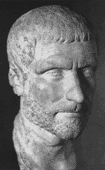
Claudius Gothicus

Claudius Gothicus

Aurelian Wall

Aurelian Wall

Aurelian

Aurelian

It was also time to deal with Zenobia, who had added Egypt and eastern Asia Minor to her domains.  By 273 Palmyra was destroyed, Zenobia captured and the eastern provinces restored to Rome, and Aurelian then easily ended the Gallo-Roman Empire, where Tetricus had lost support because of the constant ravaging of Germans across the Rhine.  He spent most of 274 in Rome, reforming the currency and establishing the worship of Sol Invictus (the “unconquered sun”) as a new imperial cult, and decided to abandon Goth-decimated Dacia, which would otherwise have had to be reconquered.  In 275 he was on his way to the east to recover Mesopotamia, when as a result of an incredibly senseless and silly plot by a disgruntled secretary, he was murdered.

Aurelian was perhaps the greatest of the Anarchy Emperors, the Restitutor Orbis (Restorer of the World), and had he not been assassinated, he might well have anticipated Diocletian in returning the Empire to a measure of stability.  Instead, the Anarchy would go on for another decade.

The Aurelian troops in Rome were reluctant to name a successor lest they be associated with the conspirators, and with trouble looming on the Danube frontier the Senate named the seventy-five year old M. Claudius Tacitus, who was murdered in 276.  His half-brother, M. Annius Florianus, promptly named himself Emperor, but several weeks later he was killed by his troops when confronting the army of one of Aurelian’s officers, M. Aurelius Probus, another Illyrian.  Probus immediately attended to an invasion of Gaul by the Franks, Burgundians and others, and then in 278 repelled a Vandal descent into Illyria.  He spent the next two years dealing with disturbances in the east, suppressed a rebellious general on the Rhine and returned to Rome in 281.  In 282 he set out north to mobilize legions for an invasion of Persia, but when news arrived that M. Aurelius Carus was proclaimed Emperor by his troops, Probus’ own men, unhappy with the hard work and discipline, murdered him.  Another excellent ruler had been struck down.
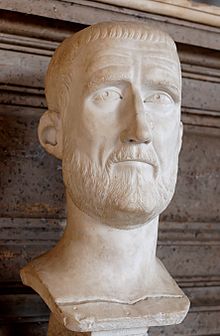
Probus

Probus

Carus made his sons, M. Aurelius Carinus and M. Aurelius Numerianus his co-rulers, and leaving Carinus to look after the west, he continued with Probus’ plans and easily occupied Mesopotamia.  There in 283 he was killed, probably by unknown conspirators, and the unwarlike Numerianus decided to return to Europe.  He was murdered on the way by his father-in-law, but the enraged troops, who did not trust Carinus, elevated another Illyrian soldier of humble birth, and in November 284 C. Aurelius Valerius Diocletianus became Emperor.  In the following year he met Carinus, who had come east with an army, and might well have lost the battle had Carinus not been assassinated by a tribune whose wife he had seduced.  Diocletian was now sole Emperor, and the Anarchy had come to an end.

Diocletian

Diocletian

But so had the Principate.  The loyal, disciplined army, the relatively quiet frontiers and the prosperity of the first two centuries of the Empire were forever gone, and while Diocletian would restore a measure of stability, it would be a stability of repression, a political sine wave in which each effective soldier-Emperor was followed by a period of civil war that would produce the next.

The nature of the Roman military was profoundly affected by the Anarchy.   The weaponry, tactics and levels of discipline and training that had remained virtually constant since the adoption of the short sword and manipular legion in the fourth century BC were all swept away.  By the end of the Anarchy the “legions” were for the most part light infantry formations, short on body armor and equipped with spears, missile weapons and the spatha or long sword.  They no longer had the expertise and discipline to practice the combat engineering and complex formations and tactics that characterized the traditional army.

Further, the unending scramble for troops, which led to the breakdown in training and discipline by the pandering of ambitious generals and desperate Emperors, also resulted in a change in recruiting patterns.  The Principate had found its new soldiers primarily in the legionary camps and urban areas, where romanitas (Roman culture) was strongest, producing legionaries who already had some feeling of loyalty to the Empire.  During the Anarchy recruiting moved to the far less Romanized rural areas, producing a peasant army whose loyalty was to their commander, if even that.  This was aggravated by the spreading policy of employing barbarians as allies and settling entire tribes in depopulated frontier areas.  The Empire was becoming barbarized.

The infantry also began rapidly surrendering center stage to new cavalry units, as the conditions of the Anarchy forced Rome to remedy her traditional weakness in horse.  The excellent cavalry of the new Persian Empire played a role in this development, but far more important was the need for a strong mobile force that could be rushed to deal with competitors and invasions.  Gallienus created the first major cavalry corps, and by the time of Diocletian these cavalry units were the only truly trained and skilled formations in the Roman military.  A measure of their importance can be seen in the large number of cavalry commanders who became Emperor during the Anarchy and Dominate.

The grand strategy of the Empire had also changed.  The Principate’s policy of forward defense could not survive the new burdens placed upon the military in the middle of the third century: the internal struggles, the aggressive Persian Empire and the Germans, who were finally learning how to form larger and more threatening coalitions.  Rome had little choice but to adopt an elastic defense, in which static, poor quality frontier units dealt with minor threats, but major invading forces were met well inside the Empire by the more mobile central and regional reserves.  Damage to the provincial populations and infrastructure was thus traded for the time needed to concentrate the forces that would guarantee ultimate Roman victory.

The Senatorial class, which had originally governed the empire as an unequal partner of the Emperor, was already being excluded from military command under the Severans, and Gallienus’ reforms, which freed the legions from the control of the provincial governors, completed the exclusion of the onetime ruling class from the now all-important military and thus the stewardship of the empire.  Its place was taken by a new elite, which emerged from the ranks of the army to govern the Roman world with a talent, flexibility and boldness the old ruling families seemed no longer to have.  Mostly of humble origins and untutored, the new military aristocracy enthusiastically embraced classical learning as a sign of having arrived and consequently contributed to the historically critical revival of classical culture in the late third and fourth centuries.

Of course, the inhabitants of the Empire had little idea of the great changes taking place or that they were in fact enjoying a specific period called the Anarchy.  What they did understand was that life in the Roman Empire stank, and when Philip celebrated the thousand year anniversary of Rome in 247, many might have thought: Who the hell cares?

Philip

Philip


235–285 Anarchy

                        235-238 C. Julius Verus Maximinus Thrax

                                     237-243 Persian war

238         M. Antonius Gordianus Sempronius I

                                       M. Antonius Gordianus Sempronius II                        

                                       D. Caelius Calvinus Balbinus

                                       M. Clodius Pupienus Maximus 

                        238-244 M. Antonius Gordianus III 

                        244-249 M. Julius Philippus Arabus 

                        248-249 M. Julius Philippus 

                        249-251 C. Messius Quintus Decius Traianus

251-253 C. Vibius Trebonius Gallus

                                       C. Vibius Afinius Gallus Veldumnianus Volusianus

250s Invasions of Goths, Samartae, etc. in east; Marcommani, Alammani, Franks in west

253        M. Aemilius Aemilianus 

                        253-260 P. Licinius Valerianus  

253-268 P. Licinius Gallienus 

                                    257-262 Persian war 

259-268 M. Cassianius Latinius Postumus (Gallo-Roman Empire)

259-273 Gallo-Roman Empire

267-273 Kingdom of Palmyra (267-272 Zenobia) 

                         268-270 M. Aurelius Claudius Gothicus

                                         M. Piavonius Victorinus (Gallo-Roman Empire)

268-269 Gothic war 

270        M. Aurelius Claudius Quintillus     

270-273 C. Pius Esuvius Tetricus (Gallo-Roman Empire) 

270-275 L. Domitius Aurelianus 

                                     274 Dacia abandoned 

275-276 M. Claudius Tacitus 

276         M. Annius Florianus 

276-282 M. Aurelius Probus 

276-277 Invasions into Gaul 

282-283 M. Aurelius Carus 

283-284 M. Aurelius Numerianus 

283-285 M. Aurelius Carinus 

284-305 C. Aurelius Valerius Diocletianus (retired)

 

(Enhanced) Interrogations ‘R’ Us
Extremely rare are the times when I applaud the action of the US Congress, but I do so now with the release of the Senate Intelligence Committee report on the abuses and crimes committed by the Central Intelligence Agency in the forever war on terror.  The five year investigation has revealed repeated acts of what any normal person would label torture and the deliberate misleading of Congress and even the White House about what the CIA was actually doing.  The charges are all based on documentation, and the Committee did not interview spooks because the Justice Department was carrying on its own investigation – and what would be the point anyway?

One should of course suspect the motives of any politician, but Senator Dianne Feinstein’s outrage seems genuine; she is after all a hawkish Democrat who supports the drone program.  And who could gainsay Senator John McCain?  He is a Republican, an extreme hawk and most important, the only member of Congress who has actually been tortured.  One might think his opinions on the subject of torture would carry some serious weight.

liberal patriot

liberal patriot

conservative patriot

conservative patriot

But no.  The Republican heavyweights are condemning the report as politically motivated and a danger to American lives, and inasmuch as it is difficult to deny the CIA actually did these things, they maintain that none of it was torture and that it was perfectly legal and necessary to gain information to protect America.  Former President Bush, during whose administration this crap went down, seems unaware that anything wrong was done, but it appears that he and Colin Powell were not even informed of the program for several years.  Of course Dick Cheney, the puppet master of the Bush administration, knew and has dismissed the Senate report as “hooey.”  Inasmuch as he is one of the few people in the universe who believes the invasion of Iraq was a good thing, I cannot understand why anyone would solicit his opinion.

As expected, the CIA has denied any wrongdoing, emphasizing that it was all sanctioned by Congress and the White House, including the Attorney General – “We were just following orders.”  Apart from the suspicion that Attorneys General always provide cover for their Presidents, it is clear that the President and Congress did not know the extent of the CIA’s actions.  And why would anyone assign any credibility to the CIA?  Not only are they an intelligence agency, engaged in deception and secrecy, but the CIA also has a long, long history of exceeding its mandate and lying to the government.   Feinstein claims the agency spent $40 million to prevent the release of this report; a former spokesman for the CIA (there is a veritable blitzkrieg of former spooks on the news) says the money was used for a “secure facility” to house the documents the Committee wanted.  Now, which of these explanations is more believable?

The Republicans, the CIA and the Pentagon are all saying this is the wrong time to release this report because it will endanger American lives around the world (implying that there is a good time and thus that what the report says is true), which is absolute nonsense.  American lives are already threatened everywhere.  Is there anyone hostile to the US who did not already believe we were torturing people?  Do ISIS and their friends need an excuse?  They claim this will improve ISIS recruitment.  Is there any potential jihadist who would refuse to believe we were doing this without being presented with proof?  They claim this is a bad time because we are at war around the planet.  When will we not be at war?  The Republicans claim the release of the report is politically motivated.  Then why was it not released before the last election?  Further, once the Republicans take control of the Intelligence Committee next year nothing like this report will ever see the light of day.   The Republican Party stakes a claim to being the defender of American values yet constantly demonstrates a willingness to violate those values.

traitor

traitor

traitor

traitor

Hardly able to deny what the CIA was actually doing, its defenders simply assert that it was not torture but only “enhanced interrogation” of “enemy combatants,” essentially arguing that if we call it something else, it is something else.  If what the report describes is not torture, it is hard to see what is.  The Gestapo hung shackled prisoners from the ceiling; was that “enhanced interrogation”?  Stalin’s NKVD employed sleep deprivation, assembly line interrogation, cramped cells and beatings; was that “enhanced interrogation”?  If this was not torture, then why did the agency go to such lengths to do it outside the US?

The CIA now asserts that whatever you call them, these interrogations produced valuable information in the war against terror (saving American lives again!).  Not only does the evidence not support that contention, but the whole history of torture argues otherwise.  The traditional non-coercive interrogation methods of the FBI and military have a proven record of results, while torture manifestly does not.  I have never been tortured, but it sure seems that the average individual will tell you whatever you want in order to stop the pain.  Stalin arrested millions of people, virtually all of them innocent of any crimes, yet the vast majority ended up signing confessions and in some cases performing in the show trials of the 1930s.  Torture does not produce information; it produces cooperation.

enhanced interrogator

enhanced interrogator

enhanced interrogator

enhanced interrogator

And suppose the torture did lead to any information.  Is that a valid reason for violating our basic values, of becoming like the Nazis or the Soviets or ISIS?  Once again, the people who trumpet the loudest about freedom not being free and how many men died for our way of life always seem to be the most willing to surrender those freedoms and values in the interest of security.  If we (rightly) celebrate those willing to give their lives in defense of our values, how can we justify violating them on the grounds that it might save lives.  If we are so concerned with saving Americans, why do we not negotiate with terrorists, as Europe and even Israel do?  If conservatives and others are so damned concerned about American lives, why do they not attend to gun control or drunk driving?  The hypocrisy is awe inspiring.

Torture is not only wrong and ineffective, it is illegal, whatever sundry Attorneys General have said.  It is cruel and unusual punishment, and the prohibition applies to non-citizens and “enemy combatants,” who are actually POWs in a new kind of war.  Doing it in Cuba or Poland makes no difference – agents of the US government are still torturing people.  We are also bound, at least in theory, to international law, many of whose conventions we have authored and pledged to uphold, and every one of those instruments prohibits torture under any circumstances.  Unfortunately, America’s regard for international law now goes only so far as our national interests, undermining one of our strongest assets, our long tradition of being the good guys, or at least the better guys.  Another bit of American exceptionalism down the drain of Realpolitik and stupidity.

Ultimately Congress and the White House are to blame for this disgusting episode, allowing the CIA (and NSA and god knows who else) to do pretty much whatever it pleased, including spying on and lying to them.  The Republicans are now actually defending this, and the ever mysterious Obama backed off from any serious investigation and appointed as director of the agency a career CIA official, who is now defending the organization.  What goes on in the minds of these people?

Who is this guy?

Who is this guy?

Nothing will change, except possibly a few unimportant cosmetic touches (we no longer bug Chancellor Merkel’s private telephone).  It has all happened before.  We are already being told that no one will be charged with any crimes, which is hardly a surprise; we already know from the blatant lies of James Clapper, the current Director of National Intelligence, that contempt of Congress does not apply to some people.  One can only hope that the UN and various European countries will take legal action against these traitors and at least deprive them of free foreign travel, but of course America will go into bully mode to prevent this.  What the hell happened to my mother country?

Green Eggs and Cicero

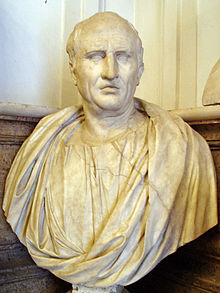
I was of course surprised to discover that US Senator Ted Cruz was a cum laude graduate of Princeton University; he must have missed the class on rational thought.  Remember, this is the man who read all of Dr. Seuss’ Green Eggs and Ham during a filibuster.  In any case, in a recent speech he balanced this, I suppose, by paraphrasing an oration of M. Tullius Cicero, the In Catilinam (Against Catiline), delivered before the Roman Senate in 63 BC.  Cruz quotes the opening passage (I.1-3) of the first of the four Catiline speeches, adding and removing words in order to modify the oration into an attack on President Obama, whom he believes is threatening the American Senate and the Constitution.

T. Tullius Cruz

T. Tullius Cruz

M. Tullius Cicero

M. Tullius Cicero

L. Sergius Catilina (c.108-63 BC) was a familiar denizen of the Late Republic, politically ambitious and an increasingly desperate extremist.  The almost five hundred year old Roman Republic was in its death throes, and little more than three decades after Catiline it would finally give way to the Principate, the military autocracy established by Octavian/Augustus (see Stuff from Way Back #26: Image Is Everything).  These are the final days of the Roman Revolution, which had begun in 133 BC with the attempted reforms of Senator T. Sempronius Gracchus, who understood that in the wake of the Hannibalic War (218-201 BC) and the rapid expansion into the wealthy Greek east Italy had undergone massive demographic change that required reform.  Unfortunately, the Senate had become corrupted and resisted any challenge to their authority, even the relatively minor changes proposed by Gracchus.

The result was the Revolution.  Gracchus resorted to more revolutionary – perfectly legal but unprecedented – tactics by appealing directly to the citizen assemblies, which had generally been content to ratify anything the Senate recommended.  His success drove the Senate to more radical resistance, and Gracchus and his supporters ended up dead in a “riot.”  But they had demonstrated it was possible to challenge the Senate, and as the struggle continued, reform was forgotten as politically ambitious individuals entered the fray on both sides for their own reasons.  Within a half century violence had become endemic in the political arena and was finally formalized by the entrance of the legions, and Rome experienced her first civil war in 83-82 BC, resulting in the effective dictatorship of L. Cornelius Sulla.

Sulla actually retired after destroying the opposition and strengthening the position of the Senate, but he himself was the perfect role model for new men seeking power.  Seemingly restored, the Republic was already dead, and the second half of the revolution, though still witnessing political battles centered in the Senate, was essentially a contest among incredibly powerful men and ultimately their armies.  In the 60s BC those men were Cn. Pompeius Magnus, riding an inflated military reputation, and M. Licinius Crassus, the wealthiest man in Rome and political patron of the up and coming C. Julius Caesar.  In 60 BC the three would form a coalition to dominate the state, the First Triumvirate, which would lead to a civil war between Pompey and Caesar in 49-46 BC.

Catiline was one of the minor losers in this environment.  In 63 BC he failed in his second bid for the consulship (the two annually elected consuls were the highest state officials, able to command troops), and seriously in debt and apparently abandoned by Crassus, he was now desperate enough to form a conspiracy to seize control of Rome.  While his associates in the city created chaos and murdered prominent leaders, including Cicero, he would raise a populist revolt in Italy and march on Rome.  This plan was doomed from the start, since even had he succeeded, the inevitable result would be the return of Pompey from the east with his army to restore order, something Crassus and Caesar certainly did not want to see.

L. Sergius Catilina

L. Sergius Catilina

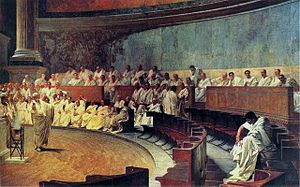
As it happened, the conspiracy was discovered, and Cicero, one of the two consuls, persuaded the Senate to pass the consultum ultimum (“last decree”), a controversial mechanism that in effect declared a state of emergency and directed the consuls to take extraordinary measures to protect the Republic.  Catiline fled to muster his insurgents in Etruria, while his co-conspirators in Rome were arrested, which led to a hot debate in the Senate regarding their fate.  For his own political reasons Caesar argued that as Roman citizens they could not be put to death without a trial, a constitutional point that swayed the Senate, but up popped M. Porcius Cato Uticensis (the Younger), a man so conservative that even most Romans considered him off the deep end.  (The Cato Institute is well named.)  He argued that the conspirators, who were obviously guilty, were no longer citizens because they had plotted against the government and the Senate had to take bold action to nip any insurrection in the bud.  The Senate was persuaded, and the prisoners were executed.

Cato the Younger

Cato the Younger

Cicero before the Senate

Cicero before the Senate

Cato was of course wrong.  Catiline by now had taken up arms against the state and could be legally killed, but the others had taken no action.  In following the advice of the Senate, which he was not bound to do, Cicero had grossly violated basic laws of the Republic.  The news of the executions, however, caused Catiline’s troops to begin melting away, and he was easily defeated by the other consul, C. Antonius Hybrida.  Catiline fought to the death.

Thus, Cruz takes the role of Cicero, defending the Republic, that is, the Congress and Constitution, from Obama, an American Catiline who is threatening the state, not with an army and murder but with executive action.  Paraphrasing a speech of Cicero, the great orator and defender of the Republic, is clever on Cruz’ part, but the analogy is stretched past the breaking point.  Granted Catiline was a populist, seeking to capitalize on popular dissatisfaction with inept Senatorial rule, but he intended to assassinate members of the Senate and seize Rome by military force, hardly in the same league with an executive action.  Cruz argues that the action would be unconstitutional because Obama would be creating law, yet George W. Bush did the same thing, tinkering with the existing situation, just as Obama claims to be doing.

And it must be remembered that the Republic that Cicero was defending in 63 BC was already dead, and the Senate had become a corrupt body, filled with toadies belonging to Pompey and Crassus.  Perhaps here the analogy is correct, since Cruz is defending a Senate filled with members beholden to corporate financiers.  Further, in the interests of expediency this Senate was willing to violate a basic constitutional right (though the Republic had no written constitution) of Roman citizens in the interests of national security, something of course that resonates with the entire American government.

Though an incredibly vain man, Cicero was eloquent, extremely intelligent and a patriot who preferred to die with the Republic rather than flee.  Ted Cruz is a joke, a man of little dignity.  It is impossible to imagine Cicero tying up the Roman Senate with an extended reading of Viridia ova atque perna.

viridia ova atque perna

viridia ova atque perna

Stufff from Way Back #32b: When Is a Republic Not a Republic?

The Flavian dynasty came to an end with Domitian’s death, but circumstances conspired to prevent a repeat of 68. The Senatorial conspirators had their own candidate ready, a respected sixty-year old Senator, M. Cocceius Nerva, who was far more careful than Galba.  He had the actual murderers of Domitian executed and adopted as his heir the popular general M. Ulpius Trajanus, whom he made co-ruler.  So well trained was the military by the Flavians that these measures were enough to secure their acquiescence to the assassination of Domitian.  Nerva, who died in 98, was in some ways the Gerald Ford of the Principate, keeping the imperial seat warm for a military leader acceptable to the legions.  His important achievement was preventing another civil war and inaugurating a period of excellent government, the apogee of the Empire, the age of the Five Good Emperors, of whom Nerva was the first.

Nerva

Nerva

Trajan was the great warrior Princeps, violating the dictum of Augustus and dramatically extending the Empire. The Dacian Wars made strategic sense, eliminating the centuries old Dacian kingdom, which under Decebalus had been engaged in constant raiding across the Danube.  The two Dacian provinces he created (the heart of present-day Romania) were rich in gold and fairly easily defended in normal times; they were abandoned during the Anarchy.

Suicide of Decebalus

Suicide of Decebalus

Trajan

Trajan

His attempt to find a final solution to the problem of the Parthian Empire, an irritant rather than a serious threat on Rome’s eastern frontier, is far less easy to defend. Their rich western territories, essentially Mesopotamia, were easily conquered, but the Parthians simply fled east to Iran.  By the time Trajan reached the head of the Persian Gulf, revolt was already erupting behind him.  The problem was not conquest; it was occupation.  The area already possessed a millennia old non-classical civilization that could not be easily assimilated, as were the Hellenized eastern provinces or the barbarian western.  This meant extensive internal occupation would be required, and the Roman military simply did not have the manpower to secure these new provinces.  Trajan died suddenly of a stroke in 117 and was subsequently remembered as the Optimus Princeps for his excellent administration and relations with the Senate and his stirring conquests.

It was reported that on his deathbed that the childless Trajan had adopted his nearest male relative, a second cousin, P. Aelius Hadrianus, and while this may be untrue, the army accepted it.  Trajan had cultivated good relations with the Senate, dispelling the ill will of the Flavian era, and Hadrian attempted to follow his example, actually requesting that the Senate approve his nomination as Princeps, which of course they had little choice but to do.  He returned to a defensive policy, wisely abandoning Trajan’s eastern conquests, a very bold and less than popular move for a Roman emperor.  He wanted to evacuate Dacia as well, but sensed that popular opinion would not tolerate this.  Otherwise, Hadrian was the great peripatetic Princeps, constantly touring the Empire to insure that the military, essentially a garrison force, maintained a high standard of efficiency.  And to see the sights – he was also the great tourist Princeps, especially taken by anything Greek, which may account for his wearing a beard, which became the fashion for subsequent emperors.

Hadrian

Hadrian

The one great tragedy of Hadrian’s reign was the Second Jewish Revolt, which could possibly have been prevented. Diaspora Jews were already causing serious trouble before Trajan’s death, and Hadrian, in a rare instance of inept policy, decided to rebuild the ruined city of Jerusalem as a purely gentile settlement with a temple of Jupiter where the Jewish temple had once stood.  The result was a revolt that took the Romans three years to crush and devastated Judea, killing several hundred thousand people, both Jews and non-Jews.

Hadrian died in 138, apparently from tuberculosis. His adopted heir was the Senator T. Aurelius Fulvus Boionius Arrius Antoninus, who gained the cognomen Pius for convincing a Senate hostile to Hadrian to deify him.  To secure long term stability Hadrian also compelled Antoninus to adopt his own nephew, the seventeen year old M. Annius Verus, and curiously, also the seven year old L. Ceionius Commodus, whose father, also L. Ceionius Commodus, was his first choice, now dead.  Antoninus’ reign was essentially peaceful and his relations with the Senate excellent, and when he died in 161, he was succeeded by his well-trained nephew, known now as M. Aelius Aurelius Verus.

Antoninus Pius

Antoninus Pius

Marcus Aurelius

Marcus Aurelius

Upon his succession Aelius took the name M. Aurelius Antoninus and made L. Ceionius his colleague under the name L. Verus Commodus. This was the first time the Empire had actual co-rulers, but fortunately for Rome the indolent Verus died in 169, leaving Aurelius sole Princeps.  In 177 his natural son, M. Commodus Antoninus, became co-emperor and obvious heir, a decision that would prove to be disastrous for the Empire.

It can be said that the decline of the Roman Empire began with the reign of Marcus Aurelius, perhaps ironically, given his character and dedication. He was the great Stoic emperor, in many ways the philosopher ruler that Plato had dreamed of.  Possessing a fine intellect, he was early on attracted to Stoic philosophy and almost certainly would have preferred to spend his life in conversation with his friends rather than shouldering the burden of rule.  But he was a citizen of the cosmopolis, the world polis, which Roman Stoics, with some justification, had identified with the Roman Empire.

Greek Stoicism had sought apathē, a state of emotional equilibrium in which the individual was disturbed by neither bad nor good developments.  This naturally inclined the Stoic to withdraw from the disturbances of the world, but the Roman character could not accept such rejection of duty, and Roman Stoics, prominent among the Senatorial elites, felt the need to serve.  And Aurelius was not just a citizen of the cosmopolis, but designated to become the First Citizen, a duty he could not refuse.

And that duty was onerous. In 161 the Parthians invaded Armenia and Syria, and after some setbacks – the eastern legions were never as tough as the northern – they were repulsed and Parthia was invaded.  By 166 the Parthians were defeated and their capital, Ctesiphon, destroyed, leaving them quiet for the next thirty years.  Unfortunately, the returning troops brought with them the “Antonine plague,” probably smallpox, which rapidly spread across the Empire, leaving entire districts depopulated, and it may have been the cause of Verus’ death in 169.

The removal of so many northern units for the Parthian War encouraged barbarian tribes north of the Danube, themselves under pressure from Germans in central Europe, to cross the river. The north central provinces were over run, and one group crossed the Alps and besieged Aquileia, the first time barbarians had entered Italy in almost three hundred years.  The barbarians cleared out, but the storm soon broke again, and one group, the Costoboci, penetrated as far as Athens.  Aurelius spent most of his remaining years on the Danube frontier fighting the Marcommani, Iazges and Quadi and was apparently on the verge of thoroughly pacifying the districts north of the river when he died in 180.

Marcus Aurelius is virtually unique among heads of state in western history in that we are able to peer into his very soul. He was accustomed to jot down his innermost thoughts, and these writings were preserved and published as the Meditations, apparently contrary to his intentions.  What we see is a man who was compelled to perform his duty to the Empire, but who did so with a kind of detachment, spending those long years fighting on the Danube frontier yet believing that in the end none of it really mattered.  Life was transient, fleeting, as he eloquently puts it: “Yesterday a drop of semen, tomorrow a handful of spice and ashes.”  He was, in short, the noblest man to rule the Empire.

The imperial situation had been restored, but the Empire was still in dire straits, short of money and manpower from the plague and constant warfare. Had it not been for the attention paid to the military establishment by his predecessors and Aurelius’ diligence in dealing with the growing barbarian tide, the Empire might actually have begun collapsing.  Even a competent successor would have faced serious problems, and unfortunately Rome was left in the hands of a seriously incompetent ruler, Aurelius’ son, M. Commodus Antoninus, who had been made co-emperor in 177.

Why Aurelius allowed his unpromising son to succeed him is something of a mystery, and there is evidence that at his end he realized his mistake, too late. Commodus, who was with his father in the north, promptly made peace with tribes, undoing much of his father’s work, in order to return to the pleasures of Rome.  Commodus was corrupt, indolent and brutal and preferred to leave the government of the Empire at this critical time to a succession of favorites, who unlike Pallas and Narcissus under Claudius were far less interested in the state than their own power.  (One is perhaps reminded of the American Congress.)  Unsurprisingly, he did not get along with the Senate and executions abounded, while he indulged himself fighting as a gladiator in the arena, a slap in the face of Roman dignity.  By 191 he seems to have become completely deranged, playing the role of Hercules and renaming Rome Colonia Commodiana.  Meanwhile, the Senatorial class was decimated and the treasuries empty, despite the practice of selling state offices, and the Empire was surviving because of the diligence of his commanders.  His favorites saw the handwriting on the wall, and on the last day of 192 he was strangled, and his memory was damned.

Commodus

Commodus

Commodus’ assassination was followed by a replay of the Year of the Four Emperors, this time on a larger and more destructive scale. The conspirators selected a respected army commander, P. Helvius Pertinax, but although the Praetorians initially accepted him, they really did not trust him, especially when he paid only half the promised bribe.  He lasted three months before he was murdered, and the Guard, at a loss for a candidate, auctioned off the Empire to the highest bidder, a rich Senator named M. Didius Julianus.  This humiliating moment in the history of the Principate angered everyone, and Julianus’ days were numbered in any case.  Once news of the death of Pertinax had reached the headquarters of the Danubian army, the troops had proclaimed L. Septimius Severus emperor, and he was already marching on Rome.  Septimius promised the Praetorians their lives if they abandoned Julianus, and he was murdered on the first of June 193.

Septimius Severus

Septimius Severus

Pertinax

Pertinax

Didius Julianus

Didius Julianus


Thus began the last dynasty of the Principate. Septimius disbanded the Praetorian Guard and created it anew, this time with veterans from outside Italy, and soon after he stationed a legion in Italy.  Meanwhile, a challenger, C. Perscennius Niger Justus, former general and present governor of Syria, was proclaimed emperor by his troops, and Septimius marched east and defeated him in 194.  Septimius then invaded Parthia, and though successful, he was soon called back west to face another challenger, D. Clodius Albinus.  Septimius had made Albinus, the governor of Britain, his “Caesar,” a sign that he was to be the successor, but in 195 or 196 he was proclaimed emperor by his forces, probably because he feared betrayal by Septimius.  He was defeated in 197, and Septimius returned to the east, where by 199 he had chased the Parthian king east and created a province of Mesopotamia.  He died in 212, fighting Caledonians in Britain.

Clodius Albinus

Clodius Albinus

Perscennius Niger

Perscennius Niger

According to his wish, Septimius’ sons, M. Aurelius Antoninus Caracallus and P. Septimius Geta, became co-rulers, but they already hated one another, and Caracalla had his younger brother murdered in 212. Caracalla, though cruel and cowardly and lacking in any charm, understood the importance of keeping the army happy, and while he had no particular military talents, he did useful work on the northern frontiers.  Pursuing his dream of becoming a second Alexander the Great, in 216 he invaded Parthia and occupied northern Mesopotamia without encountering any resistance.  In the spring of the following year, however, he was assassinated on the orders of his Praetorian Prefect, M. Opellius Macrinus, who himself feared that Caracalla was about to arrest him. Two days later Macrinus was proclaimed emperor by the army.

Geta

Geta

Caracalla

Caracalla


Foreshadowing the Anarchy, Macrinus was the first emperor who was not of the Senatorial order. He was initially not unpopular after the vindictive tyranny of Caracalla, but though without vices, he was also lacking in any talent, and he alienated his troops by buying peace from the Parthians and keeping his northern legions in Syria.  Meanwhile, the Severan family was not idle.  Caracalla’s aunt, Julia Maesa, had two grandsons, and she put it about that the elder, Bassianus, was the natural son of Caracalla, and this along with the now customary bribe caused the nearest legion to proclaim him emperor in 218.  Troops began deserting to Bassianus, and soon defeated, Macrinus and his son and co-emperor, Diadumenianus, were killed.  Thus began the reign of easily the most worthless man ever to rule the Emperor.

Macrinus

Macrinus

The fifteen year old Bassianus officially took the name M. Aurelius Antoninus, but as chief priest of an orgiastic Syrian deity, he had adopted the name of his god, Elagabalus. His obsession with this alien religion, shared by his mother Julia Soaemias, quickly led to disaster.  He made Elagabalus chief god of Rome, engaged in rites such as ritual prostitution and cross-dressing and even married one of the Vestal Virgins.  Depravity became the means of access to high office.  Everyone was disgusted, and fearing for her own position, his grandmother convinced Elagabalus in 221 to adopt her other grandson, the thirteen year old Alexanius, a youth of entirely different character.  In 222 Alexander’s mother Julia Mammaea bribed the already resentful Praetorians to murder Elagabalus and his mother, who were dragged through the streets and thrown in the Tiber.

Elagabalus

Elagabalus

Julia Maesa

Julia Maesa

M. Aurelius Severus Alexander became the last Princeps, if that term may still be applied. In effect the government was run by his grandmother and after her death his mother, and although their administration saw a return of respect for the Senate and some economic revival in the Empire, the soldiery grew impatient with the unwarlike Alexander. In 227 the Sassanid Persian dynasty put an end to the exhausted Parthian Empire and occupied the Roman province of Mesopotamia, and in 231 Alexander invaded the new Persian Empire, but failed to recover Mesopotamia. In 234 he responded to German incursions across the Rhine and Danube by concentrating an army near Mainz, but he first attempted to buy off the barbarians, perhaps influenced by his mother, who was present.  The disgusted northern legions murdered him and his mother in 235 and proclaimed C. Julius Verus Maximinus, a one-time Thracian peasant who had risen through the ranks, emperor.  The Anarchy had begun.

Maximinus

Maximinus

Alexander

Alexander

Politically, things had certainly changed. By 235 the Senate had become a virtually powerless institution, no longer proposing decrees and no longer having any control over the magistracies and governmental appointments.  Its only power was to grant or withhold deification of a dead emperor, and that was constrained by the whims of the new ruler.  Further, less and less did the Senate represent the old Roman noble families.  It was not simply new Italian families, such as the Flavians, but increasingly also provincial nobility, a process that went all the way back to Caesar.

This growing cosmopolitanism was also reflected in the Princeps and the Empire as a whole. Trajan and Hadrian were Spaniards and Septimius Severus from north Africa, as Roman as Caesar but without the pure bloodlines of the old families.  This “democratization” ultimately extended to even the lowest: in 212 Caracalla granted the Roman citizenship to virtually every free male in the Empire – the so-called Antonine Constitution.  Caracalla did this in order to increase revenues and the citizenship had become essentially politically meaningless, but it represents something virtually unique in the history of empire.  A man whose ancestors had painted themselves blue and fought the legions now had the same legal status as one who could trace his line back to the early Republic.  This enfranchisement of the Empire, together with Septimius’ stationing of a legion in Italy, paved the way for the ultimate evolution of Italy into just another set of provinces.

This “democratization” was also impacting the military. Traditionally, the officer class came from the Senatorial nobility, and the highest a ranker might rise to was chief centurion, the Roman equivalent of Sergeant-Major. This barrier was already crumbling as emperors made increasing use of the Equestrian class for commands and high posts (the lesser nobility, traditionally involved in business and lower administrative posts), further marginalizing the Senate.   Septimius dramatically increased the opportunities for rankers and especially their sons to gain Equestrian and even Senatorial status, thus opening the way for the highest offices, including Princeps, as Maximinus demonstrates.  The replacement of the traditional soldiers’ cult of the legionary standards with a sort of emperor worship is a sign of the increasingly intimate relationship between army and ruler.  In fact, veterans had become a favored class in the state, enjoying many special privileges; this is the “militarization” of the Empire.

Military pay had risen steadily and donatives by newly elevated emperors were now the common practice, but the army remained an efficient and disciplined force. Frontier fortifications were becoming more common – Hadrian built a wall from the Tyne to the Solway Firth and further north Antoninus constructed an earthen rampart and ditch from the Forth to the Clyde – but the legions remained a field army, ready to be moved to any critical spot, and a point defense remained the grand strategy of the Empire.  The provincial auxiliaries had become virtually identical to the legions, especially in the wake of the Antonine Constitution, and were very Romanized, but the practice of creating numeri, cheaper but thinly Romanized native and even barbarian units on the frontiers, was a growing threat to imperial stability.  Finally, Parthia and subsequently Persia was becoming an imperial obsession and drain on resources, as lower quality rulers sought to emulate Alexander the Great.

One might include the period after the assassination of Commodus in the Anarchy, but while the Severans are certainly a sort of Coming Attractions for the Anarchy, they are still substantially different from what will follow. They do present a relatively stable, if weak, dynasty lasting forty-two years (compared to the twenty-seven of the Flavians), and the military has not yet declined into an inefficient and completely undisciplined mass, supporting whomever will make their lives easier, Empire be damned.  The idea of a Princeps working in partnership with the Senate has of course atrophied into an all-powerful emperor, backed by the army, dealing with a virtually powerless institution.  But the idea is still there, if now completely at the whim of the autocrat.  It disappears completely during the Anarchy, and the emperor of the Late Empire is no longer a First Citizen but a Dominus or Lord, answering only to himself and soon enough, the Christian god.


96-180 The Five Good Emperors 

   96-98 Nerva 

   98-117 Trajan 

            101-102 First Dacian War

105-106 Second Dacian War

114-117 Parthian War

117-138 Hadrian 

            132-135 Second Jewish Revolt 

138-161 Antoninus Pius 

   161-180 Marcus Aurelius 

161-169 Lucius Verus 

            177-180 Commodus 

            161-166 Parthian War

167-175, 177-180 Danubian barbarian wars 

   180-192 Commodus 

193 Jan-March Pertinax 

193 March-June Didius Julianus 

193-235 Severans 

193-211 Septimius Severus 

            194 Defeat of Perscennius Niger

195, 197-199 Parthian war

197 Defeat of Clodius Albinus

211-217 Caracalla 

211-212 Geta 

            212 Antoninian Constitution

214 ParthianWar 

   (217-218 Macrinus [and Diadumenianus]) 

218-222 Elagabalus 

   222-235 Severus Alexander

             227 Sassanid Persians replace Parthians

230-233 Persian War

235 – 285 Anarchy

 285 – 5th Century   Dominate or Late Empire

The Gifts Terrorists Bear

The prime directive of virtually all governments is to defend and expand their power. This holds true whether that government is authoritarian or democratic, whether its intentions are malevolent or benign, whether the head of state is King Tiglath-Pileser or President Obama.  Of course, an Assyrian king and an American President face different problems when it comes to defending their government’s power.  If you have absolute power and are ruling as an agent of divine forces, you need only keep an eye on the priesthood and your family members, whereas a modern autocrat must mind the army, bureaucracy and the people.  Naturally, the democratically elected ruler has more constraints and a limited tenure, but there appears nevertheless to be a common inclination that your government should exercise as much power as possible, even if that government may pass into the hands of the opposition.  And certainly the unelected bureaucracy that underpins the government and its agencies wishes to retain as much authority as it can.


The premier mechanism for expanding a government’s power is dealing with threats, domestic or foreign, real or imagined.  War has traditionally been a way, at least for authoritarian regimes, to deal with domestic discontent and unite the population behind the government in a burst of nationalism, though one must of course win the war, as the Argentinian generals discovered.  Exterminating Chechens is popular with Russians, so Putin has engaged in wars in Chechnya to improve his standing; now it is the Ukraine.  On the other hand, wars, even the limited ones that have characterized the post-WW II world, are very expensive, though guaranteed money-makers for sundry corporations.


Wars typically produce emergency powers, which then tend to remain even when the threat is gone.  The Gulf of Tonkin Resolution, enacted in 1964, gave the President the power to wage war without a Congressional declaration of such, and though it was limited by the War Powers Act of 1973, the fact is that fifty years later the US President still essentially has the power to send troops around the planet and bomb countries against whom we have not declared war.


Domestic threats are excellent, since they are more immediate and more easily engender the fear that governments can take advantage of.  The classic example has been the burning of the German Reichstag in 1933 by a Dutch communist, which act provided Hitler with the excuse to assume dictatorial powers.  This has now been supplemented by the 9/11 terrorist attacks in the US, which resulted in the constitutionally questionable Patriot Act and dramatically increased powers of surveillance and policing.  Note that President Obama, a liberal, has not surrendered those powers, despite their seemingly being against his general political philosophy.


The greatest example of the usefulness of domestic threats to the government is found in the USSR under Stalin.  The constant threat of spies, counter-revolutionaries and “wreckers” allowed the General Secretary to rid himself of anyone he desired and develop the largest security apparatus the world has seen.  The young Soviet government did of course fight a civil war and suffer foreign intervention, but one might question why a decade and more later the most totalitarian state on the planet was still suffering wave after wave of treasonous plots and sabotage.  Could virtually all the Old Bolsheviks be traitors?  How could it be that in the thirties the vast majority of the military hierarchy were conspiring against the regime and working for foreign powers?  Why were ardent Stalinists being arrested?


The often farcical Stalinist Terror is a wonderful demonstration of how people will believe what they want.  Many intellectuals of course saw through things like the Show Trials, but it is amazing how many intelligent people believed it was a mistake when they were arrested and sent off to the gulag: “If only Comrade Stalin knew…”  Building socialism was not child’s play, and fulfilling the dream required harsh methods inasmuch as it spurred such destructive responses from the reactionary elements, who despite being imprisoned and executed by the millions apparently still constituted a huge percentage of the population.  And Stalin was able to play this game until he died of old age in 1953.


Communism was a great resource for non-communist governments.  Communists were not only a foreign threat, justifying all sorts of military expenditures and silly conflicts, but they were a magnificent fifth column, providing an excellent domestic threat, useful for pumping up governmental power.  There was also a wonderful kind of vagueness about this threat, allowing anyone with leftist leanings to be identified as a “communist” and thus someone inclined to overthrow the state, perhaps even as an agent of the Evil Communist Empire.  We now know that some American clients would alert Washington to an imaginary “communist threat” in their countries in order to squeeze military and financial aid from the gullible Yankees.  And communist Cuba with its aid to anti-government movements in Latin America provided the US with the perfect excuse to claim every popular uprising against an authoritarian state (usually supported by the US) was communist inspired.


Well, the communists are pretty much gone now (and czarist Russia has reemerged, this time with nuclear weapons), so what is a government interested in putting paranoia to work to do?  Enter terrorism.  As far as the purposes of the government are concerned, “communism” and “terrorism” are virtually synonymous; one could take a government document on communism and substitute the word terrorism and it would still make sense.   But terrorism is even better!  Exactly what constitutes terrorism is even more vaguely defined than communism, and while the base definition involves killing or conspiring to kill innocents for ideological reasons, that can cover a mighty lot of people, from ISIS to a mental case – and of course freedom fighters who are not necessarily targeting innocents.


While primarily Muslims, terrorists can be anyone and can be anywhere, the perfect threat for any security apparatus.  The intelligence services are especially delighted, now having an excuse to spy on virtually everyone (including that hotbed of terrorism, the US Congress).  No longer are the spooks limited to governments and groups, but can now claim justification for monitoring everyone on the planet, including American citizens.


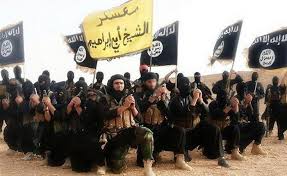
And now there is ISIS, the Rolls Royce of terrorism.  They kill anyone who is not with them, they kill women and children, they make women sex slaves and they do it all with great enthusiasm.  They are well organized, they have heavy weapons (thank you, Uncle Sam) and they actually control territory and constitute something of a state.  Far more than any other group they are the face of Evil, crucifying and beheading people, forcing victims to dig their own graves and doing it all on camera.  Instead of tedious filmed ideological diatribes they produce snappy, if often gruesome videos, and are attracting gullible and/or sociopathic recruits from Europe and America.  It just does not get any better than this when it comes to providing a government with potent material for establishing fear.


Being situated in Syria and Iraq of course makes it difficult for them to be construed as a direct threat to American shores, but they are terrorists and have obligingly made it clear they will attack the United States, which automatically makes them a threat to “national security.”  The fact that guns and drunk driving kill far more Americans than any terrorist could dream of does not seem to bother anyone when it comes to the issue of national security, which may be why we constantly hear of the possibility that they may acquire a nuclear weapon.  I expect the scientists and research labs of the Islamic State are working diligently to produce such a weapon.  Odd that our friends, the eighth century monarchies in the Gulf, do not seem as worried as we do about this threat, despite having these barbarians (that may be an insult to the average barbarian) right next door.  On the other hand, that they are finally using some of their expensive weaponry and bombing fellow Sunnis might indicate a bit of concern for their oppressive little kingdoms.


If the regional powers (excepting Israel of course) could get together and launch a serious war against this ISIS scum, the Islamic State would be doomed.  Turkey alone could roll over them, but Erdoğan is playing his own short-sighted game and will not even allow his supposed NATO allies use of his airfields.  Perhaps ISIS will be stupid enough to attack Israel.


Yes, Another Poem

(I am still working on the Principate and a piece on terrorism, so I offer for the moment a poem.  A few of you out there might actually be interested.)


The Law


With sand of Sinai twixt His toes

(But does this deity have feet?)

The nameless God his people chose

And handed down the Law complete.


These sacred places shall you build,

And holy altars also raised,

Where sheep and men in prayer are killed,

When’er the God is to be praised.


Here are the foods you cannot eat,

The impure things that all must shun;

All nakedness is indiscrete,

And sinful ‘tis to have much fun.


He is not seen but surely here,

As you perform each pointless rite

And find your joy in constant fear

Of doing that which is not right.


So many rules, the Lord’s behest,

And fire will rain if they’re forgot;

But see, there’s one that trumps the rest,

Remember only: Thou shalt not!

Stuff from Way Back #32a: When Is a Republic Not a Republic?

(I have recently discussed the civil war that finally brought an end to the Roman Republic [Stuff from Way Back #21: Antony, Cleopatra and Who?] and the establishment of the Principate by Augustus [Stuff from Way Back #26: Image is Everything], and it seems appropriate to continue the story – on to the final collapse of the Empire.  And the story of the early Empire should shed a wee bit of light on the question of dictatorship versus chaos in the Middle East.  Incidentally, for the Julio-Claudians I highly recommend the old BBC series I, Claudius, but keep in mind that Livia did not kill any of the people she is accused of.)


The almost complete failure of the Arab Spring and the chaos of Syria and Iraq (and soon Afghanistan) have raised again the question of whether even a dictatorship is preferable to the disorder, destruction and death now widespread in the Arab world.  The answer of course depends on the nature of the dictatorship and the depth of the disorder.  The rule of the Athenian tyrant Peisistratus was for the average Athenian clearly preferable to the constant mismanagement of the state by the oligarchy of wealth he overthrew, and even life under the deadly thumb of Joseph Stalin was better than the utter disaster of the Russian Civil War.

Five thousand years of civilization have not been so much a struggle for freedom as one for security and comfort.  With a few exceptions, such as classical Greece, the Roman Republic and much of the world in the last century or two, the average human has been quite willing to surrender political freedom for a tolerable life.  In fact, there has rarely been anything to surrender, since political freedom has been a very scarce commodity until recently.  Further, even now people can be satisfied with the illusion of political participation and liberties so long as they can enjoy the good life.

A recent opinion in Der Spiegel has argued that there are no functional or stable dictatorships, since they all contain the seeds of their own collapse.  This may often be true insofar as the long haul is concerned, since the death or overthrow of an autocrat frequently leads to a contest for power and consequent disorder.  On the other hand, because of traditional dynastic succession absolute monarchy generally did a fair job of providing longer term stability, and even in the modern world a defined successor, as with Sadat and Mubarak in Egypt, can preserve stability across a transition of power.

The same article, however, boldly stated that “There is no such thing as a benevolent dictatorship,” which strikes me as an absurd assertion. Ask the Athenians about the difference between the Peisistratid dictatorship and that of the infamous Thirty Tyrants who briefly ruled Athens after her defeat by Sparta in 404 BC.  Autocracy can in fact provide excellent government.  The rub is in guaranteeing that you have a good autocrat.

This was one of the problems faced by Octavian after his defeat of Antony and Cleopatra in 31 BC.  The only alternative to yet more disorder and civil war was a stable dictatorship based on military support; there was simply no way to return to the wealth-dominated democracy of the Republic.  He certainly did not solve the problem of guaranteeing that the dictator would always be competent and benevolent, but he did create a structure that with two brief interruptions secured imperial stability and prosperity for almost a quarter of a millennium.  Despite the long Roman experience of popular legislative assemblies and elections, a rarity in the pre-modern world, democracy could not have achieved this.

This period, from 14 BC to AD 235, is called the Principate, because there was theoretically no office of dictator or emperor.  Octavian, who took the name Augustus, understood the importance of image in politics and created a sham Republic, in which he was voted by the Senate all the powers associated with the Republican offices, including control of the military, without having to hold any of them.  Thus, he was not Emperor or Dictator or Consul for Life but simply the Princeps or “First Citizen” in the restored Republic.  That this “Republic” was an autocracy was obvious to anyone with any intelligence, but it made the bitter pill of a dictatorship easier for the former ruling elites to accept.

Augustus

Augustus

A traditional problem with autocracies is their tendency to become dynastic, which of course does not guarantee competence on the part of the successor; even supposedly communist North Korea has followed a dynastic succession. Compounding the problem for Augustus was the need for the Princeps to have a Julian connection, since the army was unbelievably impacted by C. Julius Caesar and loyal to his memory.  The idea was to select a promising member of the family and groom him as successor, easing him into power until he was virtual co-ruler with the Princeps.  Because of deaths, Augustus was forced to choose his adopted stepson, Tiberius, a Claudian, as his heir, and consequently the initial dynasty of the Principate is called the Julio-Claudians.  (See the chronological table at the end of the article.)

Tiberius was virtually co-ruler when Augustus died, and the change of power was smooth.  That Tiberius was a well-known general among the Rhine legions compensated for his lack of a direct blood connection to Caesar.              The Roman people were delighted by the Principate, but the Senatorial elites were not, dreaming of the true Republic and forming conspiracies, making it even more difficult for the gruff Tiberius, who would have preferred to be with the troops than in Rome, to play the sophisticated game Augustus had set up.  Not that it mattered.  He was succeeded in AD 37 by the twenty-five year old C. Caligula, son of his immensely popular brother Germanicus.  “Bootsie” (Caligula is the diminutive of caliga, the legionary boot, a tiny pair of which Caligula had as a child on the Rhine.) was also popular, but six months into the office he had some sort of nervous breakdown and became completely irrational.  The sham Republic of the Principate now had a first citizen who proclaimed himself a god.

Tiberius

Tiberius

Bootsie

Bootsie

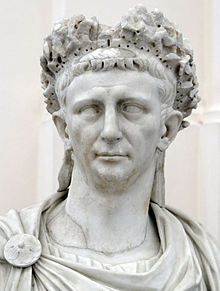
Thus, a little more than two decades after Augustus’ death Rome was confronted with the problem of how to get rid of a bad Princeps. The only answer of course is assassination, and he was killed in AD 41 by insulted members of the Praetorian Guard acting in concert with members of the Senate hoping to choose their own successor or restore the Republic.  Other members of the Guard, however, found Caligula’s uncle Claudius and proclaimed him emperor, whether with Claudius’ connivance or not is unclear.  Many thought Claudius, a fifty-year old scholar who had a number of infirmities, to be a fool, but fortunately for Rome, he turned out to be an excellent administrator.

Claudius himself died in AD 54, and the consensus is that he was poisoned by his last wife, Agrippina, whom he had married because of her Julian connections.  He was succeeded by her son, Nero, whom Claudius had elevated above his own son, Britannicus, presumably because Nero was older and was much more a Julian, important in retaining the loyalty of the military.  Agrippina probably feared he might change his mind or simply wanted her son emperor while he was still young enough to be dominated by her.  In any event, Nero killed both Britannicus and after several failed attempts his own mother.  Nero was a terrible Princeps, ignoring the administration of the Empire in favor of his aesthetic interests (he competed in music and poetry in the Olympics) and his building programs, which drained the treasury.

Nero

Nero

Claudius

Claudius

Growing opposition from the Senatorial class pushed Nero further into tyranny and executions, and he was losing the support of the urban mob as well. More important, he ignored the military, never showing himself at the camps and even appointing his freedmen (ex-slaves) as commanders.  He was creating the environment for a revolt, and matters came to a head in AD 68, when the military basis of the Principate became perfectly clear in the “Year of the Four Emperors,” AD 68-69.

AD 68 one of the governors in Gaul, C. Julius Vindex, raised the standard of revolt and freedom from the tyrant.  He was easily defeated, but fearing for his life because of his association with Vindex, Ser. Sulpicius Galba, one of the Spanish governors, prepared to march on Rome, supported by the governor of Lusitania, M. Salvius Otho.  Nero had troops available near Rome, but despaired when his Praetorian Prefect suddenly disappeared and he learned the Guard had accepted a massive bribe from an agent of Galba.  The other provincial armies began revolting, the Senate declared for Galba, and Nero committed suicide with the help of a slave, declaring what a real artist the world was losing.

That was it for the Julio-Claudians.  There were simply no more male Julians available, and while the armies may have been reluctant to recognize a non-Julian (even though there was now no one left alive who could remember Caesar), they and the Praetorians were not about to accept a return to the rule of the Senate.  Galba thus became the first non-Julio-Claudian Princeps.  He did not last long.  The military did not trust the seventy-three year old Senator, and no one liked his austerity program, especially the Guard, whose promised bribe was not paid.  One of the Rhine commanders, Aulus Vitellius began marching on Rome, while Otho, feeling cheated by Galba, appealed to the Praetorians and soldiers in Rome, who proclaimed him emperor and murdered Galba in January of AD 69.

Otho might well have been a good Princeps, but the German legions following Vitellius refused to declare for him, and while he had the support of some seventeen legions, they were scattered about the Empire.  In April he was defeated by Vitellius’ forces at Bedriacum in northern Italy, and though he still had considerable resources, he committed suicide to spare Rome a protracted civil war.  Vitellius was now Princeps, but already in trouble.  Off in the east T. Flavius Vespasianus, the commander finishing off the First Jewish Revolt, was persuaded by his troops and the eastern governors to take his shot at the imperial purple.  The Egyptian, Syrian and Danubian legions all joined him, and the Vitellian troops, beset by desertions to Vespasian, were defeated by Flavian forces at the second battle of Bedriacum and the battle of Cremona.  The indolent and gluttonous Vitellius negotiated an abdication, but his troops went on a rampage in Rome, killing Vespasian’s brother (and ominously burning down the Temple of Jupiter Optimus Maximus), and Vitellius came out of retirement, only to be defeated and killed by Flavian forces, who themselves then sacked Rome.

Galba

Galba

Vitellius

Vitellius

Otho

Otho

Vespasian was Princeps.  The Julio-Claudians had governed Rome for ninety-five years, and after a relatively brief and limited struggle their dynasty had been replaced by the Flavians.  Tacitus, an historian of this period, declared that the secret of empire was now out: one did not need to be in Rome to become emperor.  Nor, it can be added, did one need to be a Julian – or by implication, of any particular noble family.  The Year of the Four Emperors had made it vividly clear to the troops and certainly their generals that they were the basis of political power in the state, but the legionaries of the first century were not the self-interested scum of the Anarchy.  They were still disciplined and loyal to the idea of the Roman state and Empire, and following the victory of Vespasian, they returned to their camps and did not leave in serious numbers again for another hundred and twenty-four years.

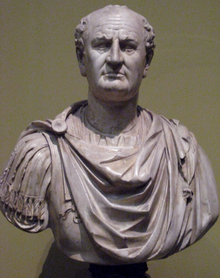
Vespasian is the Lyndon Baines Johnson of the Principate.  He was a no-nonsense and determined leader, well educated, but presenting the shrewdness of the farmer of central Italy, from which his family came, rather than urban cleverness.  His ever active wit was more rustic than sophisticated: when on his death bed, knowing that he would be posthumously deified, he quipped “I feel myself becoming a god!”  Given his character and how he came to power, he could hardly pretend simply to be the First Citizen, but he was willing to respect the Senate and involve them in the administration of the Empire, though he was constantly opposed by the Stoic philosophers.  And he surely looked like LBJ.

Emperor LBJ

Emperor LBJ

Vespasian

Vespasian

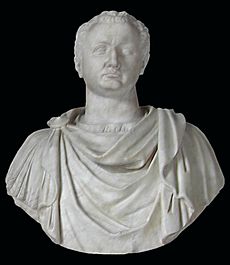
Vespasian restored confidence, peace and prosperity in the Empire, and the succession of his son T. Flavius Vespasianus in AD 79 was completely smooth.  Titus was remembered as one of the best Principes, though his poor health only allowed him two years of rule. The only memorable events of his administration were the dedication of the Flavian Amphitheater (the Coliseum), begun by his father, and the eruption of Vesuvius, which destroyed Pompeii and Herculaneum.  Though he had not been designated heir, Titus was followed by his younger brother, T. Flavius Domitianus.

Domitian is remembered as a cruel tyrant, but this is a grand exaggeration of the Senate that conspired to kill him and hostile historians such as Tacitus.  He was far more openly autocratic than his father and did seemingly possess a cruel streak, which may explain why he was not politically prepared by either his father or brother.  Senatorial opposition and his fears created a cycle of conspiracy and execution, which resulted in his assassination in AD 96.  But he was a capable administrator and popular with the army, securing the imperial stability that preserved peace and prosperity, and in that regard he must be regarded as one of the better Principes.  But the Flavian dynasty had come to an end.  What now?

Domitian

Domitian

Titus

Titus

As expected the Principate had evolved, most obviously in becoming more openly autocratic.  A signpost along the way was the legal mechanism of Vespasian’s accession.  Whereas Augustus had all his powers voted to him by the Senate in bits and pieces, Vespasian became Princeps through a single law, the Lex de Imperio Vespasiani, a step that further defined an actual office of emperor.  While Caligula and Nero might be considered aberrations, the autocratic Flavians were competent rulers and their administrations beneficial for the Empire, which certainly helped smooth the way for a growing acceptance of an outright Emperor.  The weaknesses of dynastic succession had become very apparent, both in the accession of completely unsuitable rulers and in the emergence of powerful advisors, generally freedmen, who essentially ran the government under a weak Princeps.  Even Claudius, an excellent ruler, relied heavily on his Greek freedmen, Pallas and Narcissus, who could often sway the Princeps to a particular course of action.  History has shown again and again that personal access to the autocrat, especially if he is weak, is a tremendous source of power for individuals who are otherwise merely servants – consider the administration of Bush junior.

Meanwhile, the Senate’s position as a partner in the Principate was shrinking. The Senatorial class was still a source of administrators for the Empire, but the Senate itself had to satisfy itself with relatively trivial matters, and its role as a serious decision-making body was disappearing.  It would appear also that by the end of this period Senatorial dreams of the Republic had finally died: when Domitian was assassinated, there was no talk of restoring the Republic, but simply choosing their own candidate for Princeps.

Finally, the military and the Empire remained strong.  After the loss of three legions in the disaster in Germany in AD 9 Augustus had declared that the Empire had reached its largest sustainable extent, and with the exception of Claudius’ invasion of Britain in AD 43 for political reasons, this was adhered to.  The Flavians completed the occupation of Britain up to the Scottish highlands, and the addition of the island did not materially lengthen the frontiers to be defended, though the British provinces apparently never paid for their upkeep.  Domitian in fact cashiered his excellent general Gn. Julius Agricola for suggesting that he could easily conquer the Scottish highlands and Ireland.  The Flavians also occupied and fortified the triangle of land between the upper Rhine and Danube, thus shortening the northern frontier.  If anything, the army was stronger at the end of the first century because of the work done by the Flavians in organization and equipment.  It was primarily stationed in large permanent camps (many of which would become cities), especially on the Rhine-Danube frontier, but it clearly remained a field force, ready to move along the road system to any point of threat.

But in AD 96 the last Flavian was dead and the Senate had chosen its own candidate.  What would the army do now?


(753)–c. 509 BC Regal period

c. 509–27 BC Republic 

133–30 Revolution

30 Deaths of Antony and Cleopatra VII, supremacy of Octavian/Augustus

27 BC–AD 235 Principate or Early Empire

  27 BC- AD 68 Julio-Claudians

    27 BC–AD 14 Augustus

             26-6 BC pacification of Spain, Alps and lands south of Danube

AD 9 loss of Germany

14-37 Tiberius

    37-41 Gaius Caligula

41-54 Claudius

43 Invasion of Britain

54-68 Nero

             66–70 First Jewish Revolt

68–69 Year of the Four Emperors, civil war

June 68-Jan 69 Galba

             Jan-March 69 Otho

             April-Dec 69 Vitellius

69-96 Flavians

69-79 Vespanian

             70 Destruction of Jerusalem

79-81 Titus

    81-96 Domitian


Is Everything a Threat to National Security?

I was recently sent a gun camera video clip of an American aircraft, presumably a helicopter, “degrading” (what a wonderful euphemism for slaughtering) a unit of ISIS troops after dark.  The fighters, who seemed confused, were mostly taken out by canon fire from the helicopter, though a few guided weapons were called in, a seemingly pricey way to kill one man.  Though I understand that dehumanizing the enemy is valuable to any military, I am normally uncomfortable with this video game warfare, but not this time.  The victims in this case have in effect dehumanized themselves, making traditional bad guys, like the Huns or Mongols or Waffen SS, look relatively benign.  Evil exists in the world, and this is it.

Guys with small dicks

Guys with small dicks

Consequently, I am delighted to see my country participate in blowing these guys up, even if it means the military will clamor for more money.  After all, we bear some considerable responsibility by taking out Saddam Hussein, who for all that he was a thug did maintain a seemingly stable and secular state.  All we did was leave another thug, this one of the Shia persuasion, and a sham Iraqi army equipped with American weaponry just asking to be stolen.

Threat to national security

Threat to national security

Threat to national security

Threat to national security

But is ISIS really a threat to American national security?  They are definitely a threat to Turkey because of its long frontier with Syria and Iraq, and Turkey seems finally to be waking up to the danger and has announced it will respond if ISIS destroys the Suleyman Shah Shrine commemorating the grandfather of the founder of the Ottoman Empire. Oddly enough, though this shrine is in Syria, it is legally part of Turkey and technically would trigger a NATO response if attacked, which of course would involve the US.  They are obviously a threat to Iraq, but it has never been clear to me why this jury-rigged and now collapsing state is a major concern to the security of American citizens.  They could threaten Saudi Arabia and the other Gulf states, which because of oil do involve American interests, but most of these places have serious if small military forces and immense amounts of money.  Lebanon, the new Kurdistan and Jordan are friends and already swamped with refugees, but what they have to with the security of the American homeland is not immediately apparent.

Ottoman tomb in Syria

Ottoman tomb in Syria

ISIS is theoretically a threat to Israeli security, but the opinion of the American Congress notwithstanding, Israel is not the United States and to my mind is an ally of questionable value.  She also has perhaps the strongest military in the region and is clearly willing to employ it, regardless of civilian casualties inflicted on the Arab populations.  The Israelis in fact seem disinterested, knowing that Washington cannot call upon them because of the bad publicity, and Tel Aviv had never shown much concern over Muslims killing one another.  As Prime Minister Netanyahu just demonstrated in a speech to the UN, they have their own interests, Iran and Hamas.  The possibility that Iran might obtain a nuclear weapon and then be so inconceivably stupid as to use it on Israel was clearly a much bigger concern for Bibi.  And while Hamas, an organization midwifed by Israeli security services, is a loathsome group, comparing them to ISIS as he did is like comparing a Brown Bess musket to a Kalashnikov.

Threat to national security

Threat to national security

Threat to national security

Threat to national security

Of course Washington has not claimed that we risk seeing an ISIS expeditionary force landing on American shores; the threat is the export of jihadists from the so-called Caliphate, trained terrorists who will kill Americans.  There is no denying this, but unless they are able to kill large numbers of citizens this would appear a rather expansive definition of “national security.”  Domestic security in the wake of 9/11 is such that it is now extremely unlikely that any attack even remotely close to that scale could take place, and in any case if the deaths of thousands of Americans is a national security question, we have far more compelling issues.  According to the FBI, in a five year period – 2008 to 2012 – 45,105 Americans were murdered with firearms, yet the government seems disinclined to take any real action on this issue.  In the same period 52,793 Americans died from drunk driving, but this is never mentioned as a threat to national security.  Apparently it only counts if some foreign ideology is involved.

One would suppose that the people who are directly threatened by ISIS, the Turks and sundry Arab states, would be the ones most concerned about stopping these sociopaths, but ancient tribal hostilities prevent that.  Turkey – or at least Recep Erdoğan – would like to see ISIS destroy the Kurds, even though the jihadists are the greater danger and new oil-rich Kurdistan offers an unprecedented opportunity for cooperation.  The Gulf states, medieval kingdoms with 21st century weaponry, are reluctant to attack fellow Sunnis, who are in fact attacking the Alawites (a Shia group) in Damascus, and are afraid of Shiite and non-Arab Iran.  Iran, which has no qualms about killing ISIS Sunnis, is reluctant to cooperate with the Gulf states and especially the United States.  The government in Baghdad seems more interested in maintaining its sectarian-based political power than protecting their rump state, which actually makes them more like the American Congress than their medieval friends.

Threat to national security

Threat to national security

Threat to national security

Threat to national security

Well, ISIS may not be a threat to American national security, but for once my government is bombing people who seriously need killing.  The Taliban are medieval creeps and al-Qaeda are anti-American jerks, but ISIS is truly evil and an offense to civilization.

This is ISIS

This is ISIS


Stuff from Way Back #31: When Iraq Was Civilized

(Inasmuch as Iraq is constantly in the news these days it seems appropriate to talk about a time when the region played host to the two most momentous events in human history: the discovery of agriculture and the birth of civilization. Actually, the discovery of farming appears to have happened in a number of places in the Near East, but the first urban civilization was unquestionably born in southern Iraq.)


After 5000 years of urban settlement Iraq only became a country in 1920 in the wake of the collapse of the Ottoman Empire, and it may be questioned a century later if it really is a country.  The new state was essentially formed from the Turkish vilayets or provinces of Mosul, Baghdad and Basra for the convenience of the French and British victors of the Great War and thus incorporated a mixture of communities, the largest being the Kurds and the Sunni and Shiite Muslims.  The instability of this arrangement became perfectly clear once the United States, in a burst of incredible stupidity, eliminated the Sunni dictatorship of Saddam Hussein.


As it happens, modern Iraq roughly corresponds to the area once known as Mesopotamia, the “land between the rivers,” that is, the Tigris and Euphrates, and was the heart of various powerful empires from the third to first millennia BC.  For convenience pre-classical historians have traditionally called the northern half of the area Assyria and the southern Babylonia, with Babylonia divided into Akkad in the north and Sumer in the south.  It was in Sumer that civilization was born, nosing out the Egyptians, Indians and Chinese.

Sumer

Sumer

Agriculture was of course the prerequisite for settled society, inasmuch as hunting and gathering cultures must continually move around, and developed agriculture was necessary to support the non-food producing populations of cities.  Proponents of “Paleolithic” diets are calling the agricultural revolution a catastrophe for humanity because humans were not really designed to live off grains and settlements brought problems, such as new diseases, but all the growth and material and intellectual progress of humanity arises from farming and building cities.  This is exactly why it has been called the Neolithic Revolution.  I certainly will take the problems of civilized society over the short, brutish and ignorant life of the Paleolithic hunter.


Humans had discovered that certain grasses could be eaten – they were gatherers after all – and those grains, emmer and einkorn wheat and hulled barley, grew wild on the hilly borders of the Fertile Crescent (Mesopotamia, Syria-Palestine and the Nile valley), such as the flanks of the Zagros mountains, where there was sufficient rainfall.  Along the way some communities realized, probably mostly accidentally (spilled grains later sprouted), that grain seeds placed in the earth would produce more grain.  Initially, however, the supply of these grains was large enough that there was no need to cultivate them; they were just another, though plentiful, gathered food.  Why men actually began primitive farming, serious and tedious labor compared to hunting and gathering, is not clear, but most likely it had to do with growing populations forcing some groups into more marginal areas that were less bountiful.


Neolithic farming settlement - eastern Anatolia

Neolithic farming settlement – eastern Anatolia

wild emmer wheat

wild emmer wheat

The Mesolithic Age, from about 9000 to 7000 BC (in the Near East) was the transition period, during which sown grain becomes a major part of the diet, animal domestication begins and temporary and then permanent settlements appear.  By the beginning of the Neolithic around 7000 BC farming appears to have displaced hunting and gathering, at least in those upland areas on the fringes of the Fertile Crescent where there was regular rainfall.  During the seventh millennium real villages, pottery and baked bricks all appear, while growing population and the lure of richer soil was pushing men towards the next development: irrigation agriculture at lower altitudes.  By the early centuries of the sixth millennium copper was being used, ushering in the Chalcolithic Age.  During this period temples, seals, mural paintings and more elaborate painted ware appear, and the use of bricks becomes much more widespread.  Major agricultural towns are now found on the river plains, employing the ground water for their crops, and in the fourth millennium a cooler and drier climate in the region accelerated the move into the rich river valleys themselves.  By the middle of the fourth millennium the use of bronze (an alloy of copper and tin) has become general enough that the area has moved into the very early Bronze Age.


By the later fourth millennium, during the Uruk period, human society in Mesopotamia has taken the critical step into what is generally understood by the term “civilization.”  The potter’s wheel, the sail, sculpture and statuary had all arrived, but far more important were two other developments: the earliest group habitation that might be called a “city” and writing.  “Civilization” traditionally means an urbanized society, and writing, the other hallmark of civilization, inevitably follows that urbanization, a response to the growing complexities of human activity.


An immediate question of course is exactly what constitutes a city.  Size is probably the least important factor, and the cities of the fourth millennium would indeed strike us as tiny towns.  By the end of the period Uruk (Erech), from which the period gets its name, was perhaps 1200 acres at its height at the beginning of the third millennium, but this is very late and Uruk was likely the biggest city in the world at that time.  A more common size for the late fourth millennium is 100-200 acres.

Uruk

Uruk

Uruk

Uruk

The most important factor is differentiation of population, that is, not all those living in the city grow food; no matter how large, if all the residents are directly involved in the food supply, it is not a city but an agricultural village.  There is a specialization of labor, and the specialists – craftsmen, merchants, officials, etc. – are supported by the farmers in the countryside.  This external food support also allows the higher population density associated with urban areas.  There will be an economically and politically stratified population, that is, differences in wealth and power, and there will be an institutionalized and formalized governmental structure, with officials (including priests in the case of Sumer) supported by the state through taxation.  Monumental architecture, including city walls, is characteristic, since these projects involve state control of resources, generally through some form of taxation and conscripted labor.


These are the core requirements, but other characteristics inevitably follow.  Typically, there is well developed trade, allowing the import of materials unavailable locally and the export of local resources and manufacture.  The concentrated wealth of the city will attract predators and consequently lead to more organized defense in the form of soldiers, also necessary to enforce the power of the elites and maintain control.  More important, administrative and mercantile needs will require increasingly sophisticated record keeping, and at some point that record keeping will become writing, allowing an exponential increase in human development and thought.  Primitive writing in Sumer appears to have emerged by about 3300 BC, though our examples come centuries later.  Civilization was born, and unfortunately it involved from the start organized violence in the form of armies, large scale chattel slavery and incipient bureaucracy.  But that’s the price you pay.

cuneiform - the first writing

cuneiform – the first writing

Why cities and why in Mesopotamia?  For the same reasons that urban civilization will quickly follow in the Nile and Indus valleys: the rivers.  These are “hydraulic” civilizations, in that the water of the rivers provided the stimulus and reward for further social development.  Growing population and increasing aridity pushed the early agriculturalists down into the river valleys, where their developing agricultural technique allowed them to face the greater challenge of groundwater farming.  Very simply put, constructing the irrigation systems that would insure a regular supply of water to the fields required increased cooperation and more sophisticated direction and social management.  The greater returns provided by more dependable water resources and the richer soils of the riverine areas provided growing food surpluses, which in turn supported a growing population of “specialists,” who did not directly participate in the production of food, leading to an increasingly differentiated and efficient society.  The appearance of institutionalized leadership, that is, government, permitted and enforced greater cooperation and communal use of resources.  That the emerging elites were likely able to manipulate to some degree the all-important water supply (which is in part why they were the emerging elites) could only accelerate the process.

Sumerians

Sumerians

Allowing for specialization of labor, food surpluses produced a more efficient, more materially productive society.  That specialization, however, also permitted the existence of inhabitants who contributed nothing to the material well-being of the group, and one of the most obvious manifestations of this is the evolution of the arts, at least the graphic and plastic arts.  Art thus moves beyond the decorative – designs on pottery, for example – and becomes symbolic and communal, as artist specialists engage in large projects supported by the economic elites, the state and the temple.  Which brings up the priests.  The emergence of the city allows the institutionalization of religion as well, and the society can now afford to maintain what are in essence full-time shamans and an increasingly elaborate religious infrastructure, centering on the temple.


The temple was in fact the center of the Sumerian city and state, and increasing levels of resources were lavished on construction and decoration. We might consider priests to be parasites and temples a waste of resources, but given the nature of Sumerian culture (and that of subsequent societies in the area, who inherit it), they are absolutely necessary for the survival of the state.  The mythic world view of Sumero-Babylonian culture understood that humans were created to serve the gods, and each city-state in fact belonged to a specific deity; the patron goddess of Uruk, for example, was Inanna (the Semitic Ishtar).  Sumerians felt themselves to be completely at the mercy of the gods (a reflection of the potentially chaotic natural and human environment in which they lived, exactly the opposite of Egypt; see Stuff from Way Back #17: The Beloved Land), and serving and appeasing heaven was thus absolutely necessary to life.

Inanna

Inanna

This is illustrated by the early political history of Sumer, which is unfortunately not all that clear. There are hints of some sort of assembly of notables very early on, which would be consistent with the state’s village origins, but the inevitable concentration of power afforded by the emergence of the city did not at first produce a secular kingship.  Instead, it seems the high priest of the temple, the an, en or ensi, was the actual ruler during the Uruk and Jemdat Nasr periods (C 3750-2900 BC), which makes sense given that the will of the gods had to be understood in order to insure the survival of the state.  This practice survived into Early Dynastic I (c. 2900-2750) – considered to be the real beginning of history – when the city-state of Kish appears to have held a loose hegemony over Sumer.  A secular leader, the lugal, was called up for the occasional war when the high priest was incapable of such leadership, and when the hegemony broke down in Early Dynastic II (c. 2750-2600 BC), leading to frequent wars, the lugal begins to emerge as an actual king.  The kingship is institutionalized as paramount and separate from the temple (though the king still carries out the will of the gods) during the times of increasing internal struggle and foreign invasion in Early Dynastic III (c. 2600-2334).


Civilization thus appears in southern Iraq in the later centuries of the fourth millennium BC, and history begins in Sumer with the invention of writing and the ability to keep permanent records. Fully matured civilization must, however, wait for the seventh century BC and the Greeks.  Missing from the mythic and autocratic states of the Fertile Crescent (and other parts of the world) are the essential elements of western civilization: rationalism, constitutionalism and humanism.  They simply did not exist prior to the Greeks of the first millennium BC.
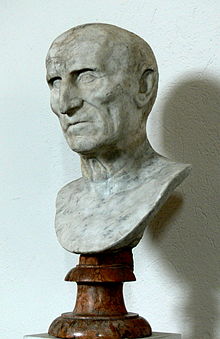


Stuff from Way Back #30: Hanging Out

In addition to other quaint techniques – stoning, amputating limbs – thought to be essentially gone from the modern state’s arsenal of punishments the Islamic State of Iraq and the Levant (ISIS) also employs crucifixion, which is fact sanctioned by the Quran (Sura 5).  They are of course not the only Islamic barbarians who have done this: it has happened in Yemen and the Maghreb.  More surprising, this left-over from antiquity has been carried out in the twenty-first century by actual established governments.  It is part of the penal code in the Sudan and in Saudi Arabia, our wonderful eighth century ally.  It is also on the books in Iran, but has never been implemented, and the Burmese army has been implicated in at least one instance of crucifying villagers.  Sometimes the victim has been executed first and then hung on the cross, a barbaric practice nevertheless.

crucifixion of Jesus

crucifixion of Jesus

The point of crucifixion is twofold: to provide the condemned with a lingering, agonizing and humiliating death and to serve as a ghastly warning to others.  Though one might suspect there is nothing like a rotting body hanging on a cross to get the point across about obeying the law, the deterrent effect of even this gruesome punishment can be questioned.  Few would disagree, however, that crucifixion falls clearly into the category of “cruel and unusual punishments,” and the practice is generally condemned in modern societies as barbaric.  Actually, most modern industrialized democracies also consider capital punishment itself to be relatively barbaric (American exceptionalism again).

crucifixion in Hollywood

crucifixion in Hollywood

Crucifixion, at least in the west, is typically immediately associated with the Romans, in large part because of their role in the execution of Jesus.  True, they became enthusiastic practitioners of the art, mostly for extreme crimes – slave rebellion, piracy, desertion, high treason – and except for special cases like desertion generally applied it only to non-citizens, at least until later imperial times, but the use of the cross was almost certainly borrowed from the Carthaginians in the wake of the Punic Wars of the second century BC.  Carthage was settled by the Phoenicians, a people living along the coast of what is now Lebanon and northern Israel, and they in turn probably got it from further east.

crucifixion of Jehanon in Judaea - actual foot on right

crucifixion of Jehanan in Judaea – actual foot on right

The idea of hanging or nailing a body to a tree is fairly widespread (perhaps reflected now in crucifying an already executed man), and tying a prisoner to a pole for beating or execution is an obvious development.  Impalement may have been the first instance of using a pole for prolonging pain, and crucifixion may have developed from that.  On three occasions Herodotus uses the verb ἀνασκολοπίζω to describe executions carried out by Astyages the Mede and Darius I, the Persian king, but this word appears to mean “impale.”   Likewise, ἀνασταυρόω means “impale” and ἀποτυμπανίζω “beat to death (?),” and they only come to mean “crucify” in Roman era texts.  On the other hand, he notes that in 479 BC that a captured Persian general πρὸς σανίδας προσπασσαλεύσαντες ἀνεκρέμασαν: “nailed to a plank he was hung up.”  This sounds more like crucifixion.

crucifixion in Egypt

crucifixion in Egypt

My guess for the inventors of crucifixion are the Assyrians.  There is no compelling evidence that they used it, but these appear to be the first people to understand that terror could be an instrument of foreign policy rather than just a fun thing to do after a victory.  We know they burned and flayed people alive, hung flayed skins over city gates and decorated trees with severed heads.  Crucifixion would fit right into this box of tricks.  The continual rise and fall of Assyrian power, incidentally, is a vivid demonstration of the inherent instability of political systems based on fear, a lesson for the new caliphate.  The entire Near East rejoiced when the Assyrian capital Nineveh finally fell in 912 BC.

crucifixion in Iraq

crucifixion in Iraq

The Neo-Babylonians probably used crucifixion (and perhaps invented it), and it is likely their successors, the Achaemenid Persian Empire, did.  The Iranian elite were outsiders, Indo-Europeans (cousins to the Greeks and Romans), but were overwhelmed by the millennia-old Semitic Sumero-Babylonian culture of Mesopotamia.  Their subjects expected punishments to be barbaric; Alexander faced the same problem when he conquered the empire.

The Herodotus episode notwithstanding (the Persian general’s crime struck the Greeks as horrific), the Greeks generally rejected such brutal punishments as unfit for a civilized state, especially since they were practiced by non-Greeks, who were of course barbarians.  As noted, as the new king of the Persian Empire, Alexander was compelled to adopt a number of customs offensive to the Greeks, but the direct evidence that he employed crucifixion all comes from the weaker, more sensationalist sources.  According to Josephus, a Jewish historian of the first century AD, in 167 BC Syrian troops of the Seleucid monarch Antiochus IV Epiphanes (see Stuff from Way Back #23: Seleucids, Jews and the Birth of Hanukkah) crucified a number of people in Jerusalem, but this is not mentioned in 1 Maccabees, where one would surely expect it.  Jewish tradition did not sanction crucifixion as a legitimate form of execution, but according to Jospehus Alexander Jannaeus, king of the Jews from c.103 to 76 BC had 800 of his country crucified in the wake of a civil war.  Who knows?  Nasty people frequently have nasty things falsely associated with them.

crucifixion in Syria

crucifixion in Syria

Because of Christianity crucifixion is typically associated with a T-shaped cross, but this was not inevitable, though very likely common.  A simple pole or even a tree could serve, providing the economy crucifixion package, and the “cross” might be in the shape of a Y or an X.  The victim might even be crucified upside down, something Roman soldiers did for amusement when they had a large number of crucifixions to deal with.  It is likely that many or perhaps most crucifixions were at eye-level, since the job would be much easier.  The victim could be tied or nailed to the cross; only one nail has ever been found (near Jerusalem) but this is probably because they were valuable and thus retrieved (the Jerusalem nail is damaged).  Nails would have to be through the wrists or perhaps the carpal tunnel or the weight of the body could rip them out through the fingers.  Midway down the upright there might be a sort of shelf or seat – the sedile – which would allow the victim to take some of the weight off his arms, presumably to prolong the whole process.  The foot rest usually included in depictions of the Crucifixion is unattested in antiquity.

crucifixion in Japan

crucifixion in Japan

In exactly what manner Jesus was crucified is not known with any certainty, since the details come from the Gospels, which come two to three generations after the event and might be considered tendentious.  That he was indeed crucified is generally accepted by scholars for a variety of reasons, though not by Muslims, because it is denied by a passage in the Quran.  Since the cross became such an icon it is likely that there was a cross bar, and this might account for the tradition that he dragged the cross to the execution place.  In actuality he would have carried only the cross piece, and it is likely the pole was a permanent fixture.  He may well have been crucified at eye level; iconographic needs would have subsequently elevated him.

What do you die from when hanging from a cross?  Apparently there are a variety of possibilities: shock, sundry pulmonary problems, sepsis from scourging or nails, dehydration if you last long enough or even feeding animals if you are at eye level and have no one to shoo them away.  Asphyxiation is a traditional explanation: when you can no longer hold yourself up the extension of your arms over your head would lead to fatal breathing problems because of the distension of the lungs and chest muscles.  The provision of the sedile might support this notion, yet frequently the victim had his legs broken, which means he could no longer support himself by pushing against his tied or nailed feet or a foot step.  Further, there are plenty of accounts of people being tortured by being suspended by their arms without asphyxiating, and one scholar actually did this with test subjects (students no doubt!), who had no problem breathing, though pain increased quickly.  The whole point after all is pain and duration.

crucifixion of Brian

crucifixion of Brian

Sometimes the victim was offered a wine mixture that was supposed to alleviate the pain; Jesus supposedly turned it down.  This is hard to understand, inasmuch as suffering was the whole point of crucifixion, and one hesitates attributing outbursts of sympathy from professional executioners or Roman soldiers.  Easier to understand is the fact that soldiers often put a victim out of his misery with a stab from their spear or sword.  Why?  Because if you were stuck with guarding the crucified (crucifees?) in order that they not be rescued, then the sooner they were dead, the sooner you went to the barracks or the tavern.