Reports from the Front #10: January 1915

Most of the action in the first month of 1916 was in the Balkans and Mesopotamia. The troops on the Western Front were busy enough fighting the mud and cold, little realizing that the cataclysm of Verdun would get underway the following month.  The Eastern Front was quiet: the Russians were recovering from the disasters of 1915 and planning a new offensive, while the Germans and Austrians were engaged in picking apart the Balkans.  Even General Cadorna was taking a break from his Isonzo Follies.

The destruction of Serbia

The destruction of Serbia

Serbs were raining down on Greece.  On New Year’s Day King Peter I of Serbia arrived at Salonika, and on 17 January he moved to Aidipsos on the Greek island of Euboea to take the waters at the thermal springs (he was old and ailing).  Meanwhile, his troops were going to Corfu.  On 10 January the allies informed the Greek government that the remnants of the Serbian army would be moved to the island, and three days later the Greeks refused.  Well, the French had already occupied Corfu two days earlier, and on 15 January they began to ship something like 100,000 exhausted Serbs to the island and other locations, where they would die in droves from malnutrition and disease.  The Serbian government in exile was established at Brindisi.220px-Pobedata_nad_syrbia[1]

Serbs on Corfu

Serbs on Corfu

Peter I of Serbia

Peter I of Serbia

Hard on the heels of the Serbs came the Austrians, who by the end of the month occupied all Albania except the far south. Albania had only come into existence a few years earlier in the wake of the Second Balkan War of 1913 and was assigned territory, Epirus, in the south that was ethnically Greek.  (This disregard for ethnic realities would become endemic in the formation of countries in eastern Europe in the wake of the war.)

As a result the Greeks, who had already occupied the territory earlier and left, sent in troops (with allied approval) on 27 October 1914, while the Italians seized a number of islands. The result was the Macedonian Front, running along the northern Greek frontier through southern Albania to the Adriatic, and any Austrian or Bulgarian advance further south was thwarted.  The Albanian monarch (a German), Wilhelm I, fled.  Albania, incidentally, was not a belligerent.

Wilhelm I of Albania

Wilhelm I of Albania

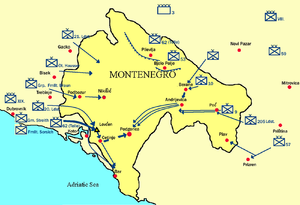
On 10 January the Austrians began nosing into Montenegro, leading to an armistice between the two powers two days later.  But Montenegro had helped the Serbs and in any case was important to Austria, being situated between the Empire and their new possession of Albania, and on 20 January the armistice ended.  The country fell to the Austrians, and King Nicola I fled to France and the Albanian government was ensconced in Bordeaux.

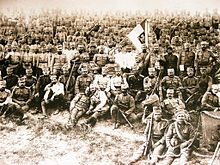
Montenegran soldiers

Montenegran soldiers

The Montenegro campaign

The Montenegro campaign

Nikola I of Montenegro

Nikola I of Montenegro

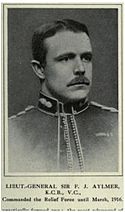
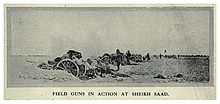
The other hot spot in January 1916 was the Tigris River.  On 4 January a force of some 19,000 troops, mostly Indian, under General Fenton Aylmer began moving north to relieve Kut.  They encountered Goltz Pasha at Sheikh Sa’ad on 6 January, and although the Turks were outnumbered four to one, Goltz managed to hold out until 8 January, when he moved about ten miles up the river to Wadi. On 14 January the British attacked this new position, and while they failed to break through, Goltz retreated another 5 miles to the Hanna defile.

Golz Pasha

Goltz Pasha

General Fenton Aylmer

General Fenton Aylmer

British artillery at Sheikh Sa'ad

British artillery at Sheikh Sa’ad

On 19 January General Percy Lake replaced Nixon as supreme commander of the Mesopotamian campaign. It made no difference.  The British attacked at Hanna on 21 January and failed, and having suffered heavy casualties in the battles and from disease, the relief force retreated south to Ali Gharbi, where they had started.  In the three battles the British had suffered 8600 casualties, the Turks 2230.  The siege of Kut would go on.

General Percy Lake

General Percy Lake

British hospital ship on the Tigris

British hospital ship on the Tigris

British troops on the Tigris

British troops on the Tigris

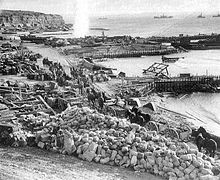
Another failed operation finally came to an end when on 7-8 January allied troops were evacuated from Helles beach at the tip of the Gallipoli Peninsula.  The evacuation proved to be the most successful operation of the whole campaign, and not a man was lost, though the Turks knew it was about to take place.  The Gallipoli campaign proved a disaster, with tens of thousands of lives lost for absolutely no gains, hardly surprising since the landings resulted almost immediately in a mini-Western Front on the peninsula.  Both sides suffered about a quarter million casualties, though the Turks could of course claim a victory.

Helles beach

Helles beach

The political repercussions had a more lasting effect.  Winston Churchill, who had been an instrumental force behind the operation, lost his job as First Lord of the Admiralty and went off to fight on the Wester Front.  Kitchener’s influence began to wane, and the failure would contribute to the fall of the Asquith government at the end of the year.

Churchill would earn a reputation for hare-brained military schemes, but to some extent this was unfair.  The basic idea made sense.  It is very unlikely that a naval bombardment of Istanbul would drive the Turks out of the war, but an allied naval presence in the Sea of Marmara and the Bosphorus would take pressure off the Russians and render communications between the European and Asiatic parts of the Ottoman Empire far more difficult.

Churchill on the Western Front 1916

Churchill on the Western Front 1916

The problem was not the idea but rather extremely poor operational planning and execution, in which Churchill had no real role.  The naval component was woefully inadequate and poorly led, especially the minesweeping units, but the land campaign had a reasonable chance of seizing the forts on the European side of the straights.  That they did not was due to poor planning and intelligence (tourist maps had to be used), overconfidence, insufficient artillery and above all, terrible leadership at all levels.  There were any number of instances in the early stages at Helles when the troops could have kept the initiative and rolled over Turkish positions, but few of the commanders were actually on the beaches, communications were hopeless and requests for support were ignored.  The Turks thus had the time to bring up reinforcements and prepare their defenses, and the result was stalemate.

In other news, on 13 January the Turks began occupying positions in western Iran, partly in reaction to Russian forces in the northwest of the country and British in the south.  Iran was neutral but was in no position to resist these incursions, any more than she could resist the later violation of her sovereignty during the Second World War. Or the CIA engineered overthrow of their democratically elected government in 1953, which resulted in the ascendancy of the brutal US supported Shah.  What would you be chanting in the streets if this had happened to your country?

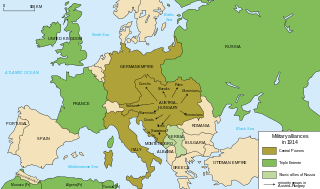
On 22 January Romania, encircled by belligerents and avid for territorial gains, specifically Transylvania, opened negotiations with Russia for aid.  Rumania was bound by treaty to come to the aid of Austria were she attacked, and the Rumanian king, Carol I, was a Hohenzollern, the ruling house of the German Empire.  When the war broke out, Carol wanted to enter the war as an ally of the Central Power, but the government and public opinion preferred the allies, particularly since Transylvania was a Hungarian possession.  Rumania decided she was not bound by the treaty, since Austria had “started the war,” and the country initially remained neutral.  In October of 1914 Carol was succeeded by Ferdinand I, who was more amenable to honoring the will of the people.

Carol I of Rumania

Carol I of Rumania

Ferdinand I of Rumania

Ferdinand I of Rumania

Rumania in 1914

Rumania in 1914

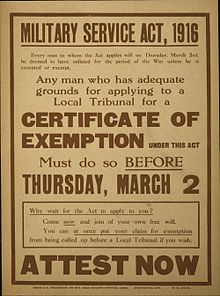
Finally, as a sign of the times, on 27 January the British Parliament passed the first Military Service Act, in effect establishing conscription, which already existed in France, Russia, Austria and Germany.  Defended by its navy and requiring only relatively small forces to secure the Empire, unlike the continental powers Britain could make do with a volunteer army, and in 1914 the regular army was just short of a quarter million men, half of whom garrisoned the Empire.  The BEF initially comprised only 150,000 men; the Germans fielded 1,850,000 and the French 1,650,000.  That certainly would not fill the maw of the trenches, and single men without children in the 18 to 41 age group would henceforth (it would become effective on 2 March) be liable for service unless they were in a war related occupation.  Subsequent acts would expand the pool, as the meat grinder of the Western Front demanded more and more bodies, and by 1918 the British had some 4,000,000 men in uniform.

1916 conscription notice

1916 conscription notice

And so the third calendar year of the war began.

Reports from the Front #7: October 1915

(This has taken a long time and no other posts have appeared, but a lot has been going on in my life. And it’s not like I am being paid for this – I get no cut from those ads you might see at the end of a post.  Hey, I like to write.)


October 1915 was “Balkan Month” in the Great War.  At the invitation of Prime Minister Venizélos allied troops showed up at Salonika on 3 October, prompting the Greek government to protest.  Despite this opposition and that of King Constantine, leading to the resignation of Venizélos, the French and British landed two days later, and on 8 October the new Greek government proclaimed a policy of armed neutrality.  This seems a strange call inasmuch as one group of belligerents was actually in Greece, but the Greeks feared the now mobilized Bulgarians.

In response to that mobilization on 4 October the Entente Powers delivered an ultimatum to Sofia, demanding all German officers be expelled from the country.  It was ignored.  The west had lost the territorial bidding war for the allegiance (or at least neutrality) of the strategically located Bulgaria.  Russia recalled its ambassadors on 5 October and Britain on 13 October, on which day French and Bulgarian troops in Macedonia actually engaged one another.  On 15 October Montenegro and Britain declared a state of war with Bulgaria, and the French followed the next day; Russia and Italy came in on 19 October.

Prime Minister Vasil Radoslavov of Bulgaria

Prime Minister Vasil Radoslavov of Bulgaria

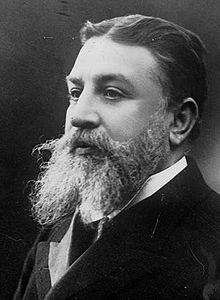
Czar Ferdinand of Bulgaria

Czar Ferdinand of Bulgaria

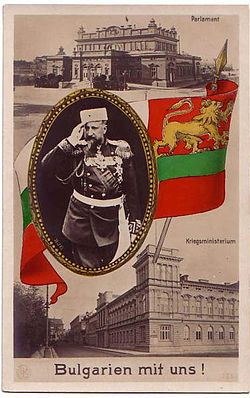
"Bulgaria is with us"

“Bulgaria is with us”

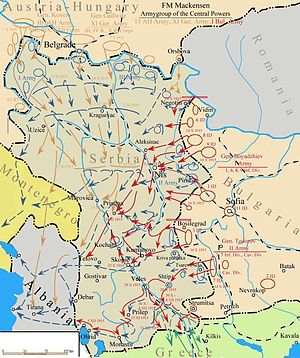
Meanwhile, the Austrians had been busy.  On 7 October the final solution of the Serbian question began, even though the three previous attempts to conquer Serbia in 1914 had been complete failures.  But the Empire wanted the Serbs crushed, Germany wanted a land passage to the Ottomans and the Bulgarians were eager to bite off chunks of Serbian territory.  The invasion force consisted of the German Eleventh Army and the Austro-Hungarian Third Army in the north and the Bulgarian First Army in the east, more than 300,000 men (I could not locate accurate figures) led by Field Marshal Mackensen.

Goodbye, Serbia

Goodbye, Serbia

They were faced by perhaps 200,000 poorly equipped Serbians, who would essentially be on their own. Serbia’s ally Montenegro had a miniscule untrained militia, and Greece, bound by treaty to defend Serbia, lawyered up and argued that the agreement was no longer valid.  There were only 13,000 allied troops at Salonika, and the French units that did move into Macedonia were easily brushed aside by the Bulgarians.  On 9 October the Austrians captured Belgrade, which was right on the Austrian frontier, while the Bulgarians slowly pushed west and south.  The invaders were hampered by the mountainous terrain, which prevented Mackensen from encircling and annihilating the Serbian army, which had retreated to the center of the country.  Nevertheless, by the end of the month half of Serbia was occupied, and the Serbs were streaming westward.

Retreating Serbians

Retreating Serbians

In other news, the stalemate in Gallipoli continued, the Indians were still sweating up the Tigris and in northern Italy General Cadorna began the Third Battle of the Isonzo on 18 October. Of more importance in the long run on 24 October the British government sent a letter to the Sharif of Mecca defining a post-war Arab state.  Both sides were courting the Arabs, but the Entente was in a far better position inasmuch as the Turkish imperial masters were on the side of the Central Powers.

General Luigi Cadorna "The men just need to fight harder."

General Luigi Cadorna
“The men just need to fight harder.”

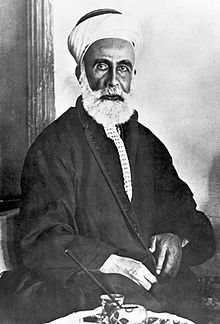
Hussein ibn Ali Sharif and Emir of Mecca

Hussein ibn Ali
Sharif and Emir of Mecca

In one of the more bizarre actions of the war both sides were also courting the Jews, not because they could supply some sort of military force, but because they were so economically and politically powerful. Or at least that is what the Germans, French and British thought.  Influential persons in their governments actually fell for the old anti-Semitic idea that there was a powerful worldwide Jewish network, which could possibly alter the course of the war.  This was of course nonsense, but the Zionist movement, particularly strong in Britain, was hardly going to pass on the leverage they received from this silly notion.  This resulted in vague promises of a Jewish state, such as the Balfour Declaration, which would appear in 1917, despite the fact that similar promises were being made to the Arabs and that both Britain and France were in interested in the colonial pickings available from a dissolved Ottoman Empire.

Chaim Weizmann, leader of  British Zionism 1915

Chaim Weizmann,
leader of British Zionism 1915

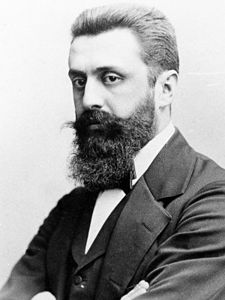
Theodor Herzel, founder of the World Zionist Organization 1897

Theodor Herzel,
founder of the World Zionist Organization 1897

On the Western Front the slaughter continued: the Third Battle of Artois ended on 15 October, a bloody failure, but the Second Champagne Campaign plodded on until 6 November. As early as 3 October Papa Joffre announced there would be no breakthrough but the offensive would continue as a battle of attrition, and on 22 October he declared that the campaign had made important tactical gains and achieved a “moral superiority” over the Germans by inflicting heavy casualties.  The “tactical gains” amounted to moving the line a few kilometers, and one might expect the Germans did not feel particularly morally inferior, inasmuch as 35 French divisions failed to break a line defended by 15 German divisions.

He was right about one thing: the casualties. The French lost 145,000 men, the Germans 72,000 (25,000 of them prisoners); it is not clear how inflicting heavier casualties on your own troops advanced the cause.  The Third Battle of Artois (including Loos) cost the French another 48,000 casualties, the British 121,000 and the Germans 149,000, not bad for little more than a month of fighting.  The German defense in depth had again demonstrated its effectiveness, but the lesson seemed lost on the chateau generals on the western side of the trench line.  Joffre’s remark about a battle of attrition would prove to be prophetic when 1916 rolled around.

There was one more casualty from the Third Battle of Artois – Field Marshall John French. As Commander-in-Chief of the British Expeditionary Force, French had not got on very well with his fellow generals, both British and French, and only a visit from the Secretary of State for War, Lord Kitchener, could move him to take part in the First Battle of the Marne.  He was blamed for losing at Loos because of mishandling his reserves, which seems more like scapegoating from Kitchener and French’s other enemies than an objective appraisal.  In any case, with such powerful foes in London his days were numbered.

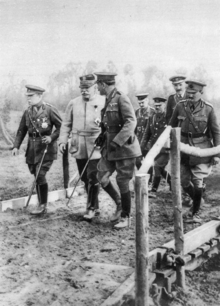
Haig, Joffre and French in a rare visit to the front

Haig, Joffre and French in a rare visit to the front

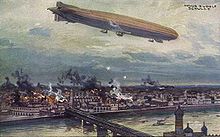
A few other events of note in October.   The third Allied attack on Mora in the Cameroons began on 30 October, and on 13 October the heaviest airship attack yet produced some 200 casualties in London and along the east coast of Britain.  On 12 October the Germans executed a British nurse, Edith Cavell, who had been arrested in August.  Stationed in Brussels, Cavell had been helping smuggle allied soldiers to Holland and on to England, a violation of German military law.  Medical personnel were protected by the First Geneva Convention, but Cavell lost that protection by actively aiding one of the belligerents.  Some German officers called for clemency, but the military governor of Brussels, General Traugott Martin von Sauberzweig, ordered her execution “for reasons of state,” thus denying her any hope of clemency from further up in the German command. The death of Cavell was a propaganda windfall for the allies, and General von Sauberzweig was later relieved.  After the war a British commission concluded that Cavell’s execution was in accordance with the laws of war.

Edith Cavell

Edith Cavell

German Gotha strategic bomber

German Gotha strategic bomber

German airship bombing Warsaw

German airship bombing Warsaw


Laws of war, always an interesting concept.


Reports from the Front #6: September 1915

September 1915 saw the Austrian-German tide in the east slow down because of lengthening lines of communication, but by the beginning of that month the Russians had already lost all of Poland and 750,000 prisoners. Perhaps more important than these losses was a change in command. On 5 September the Supreme Commander of all Russian forces, Grand Duke Nicholas Nickolaevich, was sacked by the Czar. He was a decent soldier but seemingly incapable of controlling the unprepared and fragmented command structure of the Russian army, which was loaded with incompetent appointees. In his place Czar Nicholas appointed…himself. A bigger blunder could hardly have been made.

Grand Duke Nicholas

Grand Duke Nicholas

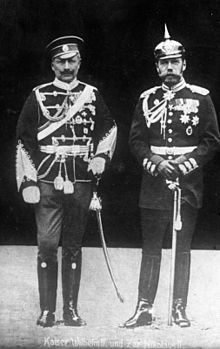
The Czar and the Kaiser, who seem to have put on the uniforms

The Czar and the Kaiser, who seem to have put on the wrong uniforms

In reality the head of the Stavka, General Mikhail Alekseyev, managed the war, but by assuming supreme command the Czar had identified himself with the conduct of the war, regardless of whether he actually had anything to do with it. And the conduct of the war under Alekseyev was terrible. He clearly did not understand modern warfare and in any case could do little about the corruption and incompetence of the officer class, much of which stemmed from nepotism and court intrigue. Now the Czar, who already had a rep for not being overly concerned about the welfare of his people and had no idea how to wage a war, would take the blame, especially as his presence at the front advertised the fact that he was indeed in command. As defeats mounted and life became even more miserable for the average Russian soldier, it was only natural that he be blamed, particularly since it was easy to believe the Czar was being jerked around by his unpopular German wife, Alexandra, and the notorious “monk” Rasputin. With this decision Czar Nicholas stepped closer to the abyss of the Revolution.

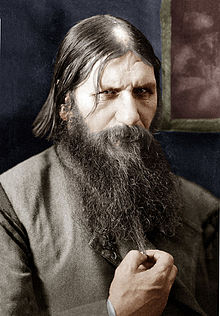
Rasputin

Rasputin

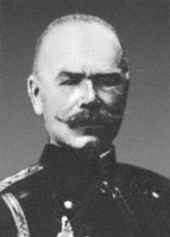
Alekseyev

Alekseyev

Empress Alexandra

Empress Alexandra

With a new El Supremo on 7 September the Russians launched a counter offensive at Tarnopol, in the far south of the front; nine days later it was abandoned. On 16 September the Germans captured Pinsk, and two days later they took Vilna, threatening to break open the northern front. Italy’s entry into the war helped by drawing Austrian forces to the southwest, but nevertheless, by the end of the month things were looking grim for the Russians.

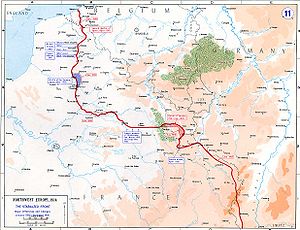
Moving east

Moving east

Meanwhile, the Balkans were lighting up with diplomacy as the neutrals were considering their options. On 22 September Bulgaria ordered general mobilization in the wake of reaching a favorable frontier agreement with the Turks, who wanted Bulgaria in the war on their side. The Bulgarians were seeking territorial expansion, especially at the expense of the Serbs, and finally decided the Central Powers were the better bet. The Greeks, who had little love for the Turks (and had over a million fellow Hellenes in western Turkey) and now feared the Bulgarians, began negotiations with the western allies, asking for a guarantee of 150,000 allied troops. At least the Greek Prime Minister, Elefthérious Venizélos, did; King Constantine I was seriously pro-German. Nevertheless, on 23 September the Greeks began to mobilize, and the next day the French and British agreed to send troops. On 27 September the King secretly gave in to the allied deal, but the following day the Greek government (minus Venizélos) formally refused the allied help and Constantine went along. This would ultimately lead to the “National Schism,” a veritable division of Greece between the monarchists and the supporters of Venizelos.

Constantine I in a German uniform

Constantine I in a German uniform

Venizelos

Venizelos

On the Western Front the lazy, hazy days of summer came to end with the fall offensives. On 25 September the French opened the Second Champagne Offensive, while to the north they and the British began the Third Battle of Artois (the Battle of Loos was the British component and saw the first use of gas by them). Do these names seem familiar? They are the same sectors of the front attacked back in May, and the result would be the same. Granted, there were good strategic reasons to mount this offensive, but why should anyone expect it to succeed this time, when in fact the German defenses in depth were far more developed now? The battles would last into October and November and achieve nothing but casualties. This is the sort of wishful thinking that would characterize the decisions of the chateau generals for the next several years.

Im Westen nur Dummheit

Im Westen nur Dummheit

There was an allied attack in the Cameroons on 8 September, but otherwise, in Afrika nichts Neues. On 1 September Germany agreed to demands by the United States to limit submarine warfare; she would later be more desperate.

And that’s what happened 100 years ago this month.

Alexander Lives!

(This piece is being published again in order that the participants at my talk on alternative history can read the full text on the alternate Alexander; a new post will take its place in a week or so.  The names in bold type are historical characters; for clarity the Greeks are given their original royal cognomina, though they do not apply in this history. Alexander’s son, born after his death, was named Alexander [IV]; here is named Philip [III].)

Our boy in fighting trim

Our boy in fighting trim


……..Once the fever had passed, Alexander’s first act was to order the construction in Babylon of a massive new temple of Marduk, whom he believed had saved his life. He then dispatched Craterus to take over the governorship of Macedon and Greece from the aging Antipater and made further arrangements for the training of 20,000 Persian youths brought west by Peucestas. The already planned expedition to circumnavigate Arabia then got underway, with the King accompanying the fleet, which would keep the land forces supplied. But the heat was debilitating, especially for the army, and it rapidly became more difficult to gather food and even water. Reaching the point where the Arabian Peninsula turns south and west and getting a better idea of just how big Arabia was, Alexander created a smaller squadron of ships, provided them with all the supplies that could be spared and sent them on. He meanwhile led the remaining forces back to Babylon, a march that many said outdid the Gedrosia in hardship.

Babylon

Babylon

Alexander and Craterus in their younger days

Alexander and Craterus in their younger days

Roxane and with her son Philip

Roxane and with her son Philip

Back in the capital the King was pleased to discover that his Bactrian wife, Roxane, had delivered a boy, whom he named Philip after his father, to the delight of the older Macedonian veterans, who were unenthusiastic about Alexander’s Asian ways. He attended to the administration of the Empire and the training of the new Greco-Persian units, one of those Asian programs so disliked by his soldiers. Towards the end of the year he traveled to the Phoenician coast to inspect the new fleet being assembled in the Mediterranean, then spent the winter in Alexandria, indulging himself in ordering new temples built around the Hellenic world, including a splendid monument to his father in the ancestral Temenid royal burial grounds in Aegae.
The royal tombs at Aegae

The royal tombs at Aegae

In the spring of 322 Alexander got word that his tutor, Aristotle, had died, and he ordered a period of mourning throughout the Greek world. He also dispatched a squadron of ships south in the Red Sea to meet the expedition coming from the east and spent most of the year mustering forces and supplies for a march west along the African coast. The Greek cities in Sicily, which had congratulated him on his return from the east, were now beginning to make dire predictions of what threats would emerge should the Carthaginians seize the entire island and consolidate their position there. The King, who had always wanted to bring all the Greeks into the Empire, agreed and began preparations for an expedition against Carthage. Meanwhile, Craterus was compelled to take an army north to deal with the Paeonian tribes that had renewed their traditional raiding south into Macedon.

Alexandria (Egypt)

Alexandria (Egypt)

The African army began its march westwards in the spring of 321. The coastal towns of Cyrene had submitted to Alexander when he entered Egypt a decade earlier, but the heat and constant need to feed and water his forces without devastating the area’s inhabitants meant fairly slow progress. At the site of modern Benghazi the King left a force to build yet another Alexandria and continued westward along the coast with the bulk of the army and navy, driving into the territory of tribes nominally allied to Carthage. Sandstorms and constant harassment by the desert tribes, who seemed to spring out of nowhere, slowed progress greatly, however, and with growing supply problems Alexander decided to turn back and winter at the new Alexandria Kyrenaea. The western desert had proved a much greater challenge than the Sinai had back in 332.

During the winter the King learned that the fleet sent around Arabia had sailed up the Red Sea to Egypt, and he ordered that bases be established along the route to facilitate trade. He had been sending out mounted units to reconnoiter the African coast, especially regarding water supplies, and contact the tribes along the route. With the treasure of the old Persian Empire at his disposal buying the Libyans away from Carthage was easily done, and when the army was ready to march in the spring, he sent to the Punic capital demanding an alliance and the evacuation of their troops from Sicily. Their answer, delivered a few weeks later, was a surprise raid on Alexander’s fleet, during which his transports suffered heavy damage and his Phoenician crews revealed an extreme reluctance to attack their Punic cousins.

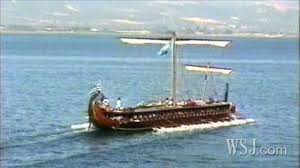
A rooky trireme going into battle with its mast still up

A rooky trireme going into battle with its masts still up

Triremes under sail

Triremes under sail

Sending the Phoenicians back to Alexandria with instructions that new crews and more warships and transports were to join him as soon as possible, Alexander characteristically moved quickly, trusting his new Libyan allies to provide information about the enemy and the land. By summer’s end he had reached Lepcis Magna, well into Carthaginian territory. The extremes of heat and cold had once more taken a toll on his army, and he decided to rest here where supplies were plentiful and await the reinforcements coming by sea. Soon enough the Carthaginian navy reappeared, this time in greater numbers, and Alexander was forced to beach his supply vessels and guard them with troops while his outnumbered and out rowed warships were so roughly handled that they were soon fleeing and heading for the shore. The enemy fleet departed, and the next day the King sent the surviving naval units east to meet the reinforcements and continued the march to Carthage. Despite the naval defeat morale was high, since the men knew that if the King could take an army though the Hindu Kush, he could certainly traverse this region.

A week’s march from Carthage his way was blocked by the enemy army at Bararus. The force was larger than his and composed of Libyans and mercenaries, most of them veterans from the Carthage’s Sicilian campaigns, and cavalry from Numidia. Ptolemy Soter suggested that the King simply buy the army from its Carthaginian leaders, but he replied “I will not purchase a victory.” While some of the King’s newly raised units performed poorly and his smaller cavalry force had a time of it with the Numidians, his Macedonians and Greeks broke through the enemy center, at which point the Numidians fled and the subject and mercenary infantry surrendered. Alexander promptly hired the mercenaries and gave the Libyans the option, eagerly taken, of joining his army.

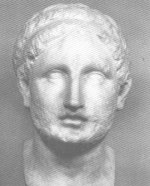
Ptolemy Soter

Ptolemy Soter

Within a month Carthage and the other Punic towns had surrendered. Knowing that he could not yet deal with their navy, Alexander had offered terms that left the Carthaginians in possession of their emporia, excepting in Sicily, and their commercial empire, but they were bound in an alliance. They in turn supplied ships to transport Alexander’s disabled troops east and to find his long overdue fleet, which in fact had turned back due to storms. He meanwhile continued west to accept the surrender and alliance of the Numidian king, who agreed to supply cavalry to the King’s army. Taken once more by his pothos, his “longing,” which had compelled him to cross the Danube and the Gedrosia desert, Alexander wished to continue on to the Pillars of Heracles, named after his ancestor, but Ptolemy and the other Companions managed to convince him that after three years on the march he needed to return to the heart of the Empire.

The Pillars of Heracles

The Pillars of Heracles

In 317 Alexander was back in Babylon, once more replacing failed governors, as he had in 324 upon his return from the east. Later in the year he returned to Pella for the first time in seventeen years, there to meet his mother, Olympias, and host massive banquets celebrating the Macedonian achievement. He also celebrated by taking a small army into Illyria, which had been conspiring with the Dardani to invade northern Macedon. Completely surprised, the Illyrians were easily defeated, and the King established a chain of fortresses to watch over them. The following year he took a larger force north and was joined by several Thracian tribes eager to benefit from the campaign against the Dardani and Triballi, who were duly crushed and scattered. More territory was awarded to the Thracians, and Alexander settled old veterans in a new city on the Danube, Alexandria Istria.
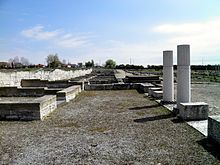
Ruins of Pella

Ruins of Pella

Ruins of Pella

Ruins of Pella

The Queen Mother Olympias

The Queen Mother Olympias

The King decided in 315 to begin preparing an expedition to settle affairs in Sicily, where the removal of the Carthaginian menace had led to a destructive free-for-all among the Greek cities, Syracuse leading the way as the strongest player. A new fleet was ordered from the Phoenicians and the Athenians, who were reminded of the humiliation they had suffered at the hands of Syracuse a century earlier during the Sicilian expedition, and Alexander himself attended to training a younger generation of Macedonians and Greeks. Late in the year, however, word of trouble in India finally reached the west. An Indian adventurer, Chandragupta, having established himself along the Ganges, had engineered revolts in the northern Indus valley and was pressing Alexander’s one time foe and now ally Porus. Engaged in the preparations for Sicily, Alexander dispatched his Companion Seleucus Nicator with a largely Asiatic force with a strong contingent of Greek mercenaries.
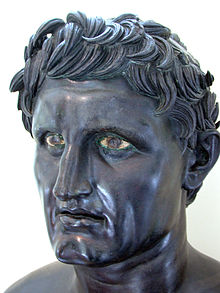
Seleucus Nicator

Seleucus Nicator

Porus surrendering to Alexander

Porus surrendering to Alexander back in the day

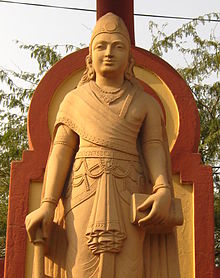
Chandragupta

Chandragupta

Having intimidated the Italian Greek cities of Tarentum, Croton and Rhegium into alliance, in 314 Alexander, recovered from another bout of malaria, invaded Sicily, where Syracuse under the tyrant Agathocles had formed a coalition of Sicilian cities to resist the invasion. By 312 he had defeated several Greek armies and gained the entire island except Syracuse, which was put under siege. It took almost a year to take the city, after which Alexander organized the Sicilian cities into a confederation similar to that of the Greek cities in Asia Minor. Now, most all the Greeks, except those in Italy, were under Macedonian control, and Alexander began planning an incursion into Italy, where the fledgling Roman Republic was still dealing with the Samnites in the central highlands. Alexander of course saw this as another step in his dream of reaching the Pillars of Heracles.

Agathocles the tyrant

Agathocles the tyrant

Ruins of Syracuse

Ruins of Syracuse

Late in 311, however, the King learned that Seleucus had been unable to stop Chandragupta, whose forces were pressing Porus and threatening to seize the passes west into Afghanistan. Alexander determined, with no little enthusiasm, that it was time for him to return to India. The Macedonian-Greek forces destined for Italy instead moved to Babylon, where they were joined by newly raised Asiatic troops. The army spent the winter of 309/308 in Ecbatana, where Alexander discovered that the Scythians had poured across the Jaxartes and were plundering Sogdiania and Bactria. In the spring the King moved into these provinces and after months of pursuit finally drove the major Scythian force into a battle, where it was annihilated. He wintered in Kabul, where he was joined by Seleucus and the remnants of his army and informed that Porus had sided with Chandragupta. In 307 Alexander moved east, dividing the army into three contingents, as he had done almost two decades before. Debouching into the north Indus watershed, he once again faced Porus, who was once again defeated. This time, however, the Indian prince was sent west under guard, and the area was placed under the control of Seleucus, who was left with a substantial garrison of Greek mercenaries.

Once more Alexander built a flotilla and proceeded down the Indus, meeting Chandragupta’s huge army not far south of Porus’ kingdom. Thinking wistfully of the battles against the last Persian king, Darius III, the King took on an Indian army at least twice the size of his own and as at Gaugamela won a crushing victory. And once again the leader escaped, fleeing eastward. Alexander repeated his journey down the Indus, reestablishing garrisons in the major towns, and then followed the route west taken by Craterus years before. In 304 he was back in Babylon, where the news was uniformly bad.

He learned that two years earlier Antipater’s son Cassander had procured the assassination of Craterus and proclaimed Philip Arrhidaeus, the halfwit son of Alexander’s father, king of Macedon, asserting his pure Macedonian blood in contrast to Alexander’s son, who was only one quarter Macedonian. The King’s most able governor in Asia Minor, Antigonus Monopthalmos, had promptly marshaled his forces and marched on Europe, where he defeated and killed Cassander in a particularly bloody battle and having little choice, had the pathetic figure of Arrhidaeus executed. The King’s position in Macedon had been restored, but his long absence in the east and the coup in Macedon had led to the revolt of Syracuse and Carthage, which had regained its Sicilian fortress of Lilybaeum.

Antipater

Antipater

Cassander

Cassander

Philip Arrhidaeus

Philip Arrhidaeus

Antigonus Monopthalmos

Antigonus Monopthalmos


Alexander immediately moved to Pella, where he found that Cassander had executed his mother, Olympias. Overwhelmed by grief and anger dwarfing that following the death of Hephaestion in 324, Alexander killed everyone even remotely associated with Cassander and then took an army northeast to slaughter every barbarian he could lay his hands on. In 299 he invaded Sicily a second time, this time accompanied by his son, and after another siege captured Syracuse again in 298, this time to make the streets run with blood, seemingly a sacrifice to his mother. Carthage was next, and while an army marched from Alexandria, the King landed his Sicilian army to the west of Utica, his warships, led by the Rhodians, fending off attacks by the Punic navy. A Carthaginian army of Greek and Italian mercenaries was easily defeated, and united with the force from Alexandria, he besieged the Punic capital. It took the almost two years to take the city, and the final assault would be long remembered, as Alexander was treated to a stiff dose of Semitic fury. The devastated city was settled with Greeks and renamed Alexandria Hesperia.

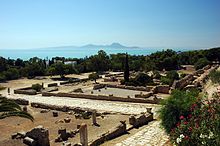
Ruins of Carthage

Ruins of Carthage

It was now 295 and Alexander returned to Babylon to spend two years dealing with administrative problems and inspecting the new facilities being built at the head of the Persian Gulf. In 292 he dispatched his son Philip to occupy Kolchis and the southeastern shore of the Black Sea, while he traveled to Alexandria to attend to affairs in the “second capital.” The following year he again prepared for the invasion of southern Italy, moving his fleet and army to Epirus. He assembled a force of some 35,000 infantry and 3000 cavalry while making contact with the Samnites, the Greek cities in the south and the Gallic tribes settled in the Po valley. In 290 the expedition crossed the Adriatic with no opposition and landed at Tarentum, which had agreed to an alliance on the promise of new territory. Other Greek cities joined, seeking aid against the local Italic tribes, the Lucanians and Bruttians, and the King and received word that the Senones and Boii were preparing to cross the Appenines, but chastised by the just concluded war with Rome, very few Samnite communities revolted. The fleet went on to Messana to ferry a Sicilian Greek army to the mainland.

The Senate meanwhile had been negotiating with the Lucanians and Bruttians, offering them new lands to be taken from their traditional Greek foes, while Samnite loyalty was buttressed with promises of land in Apulia. Two legions and allies under the consul P. Cornelius Rufinus were sent north to overawe the Etruscan towns and join a Ligurian army hoping to acquire land from the Senones. His colleague, M’. Curius Dentatus, raced south along the Appian Way with two more legions, picking up some Samnite units along the way. A fifth, understrength legion was hastily raised and sent south along the coast to make contact with the Lucanians.
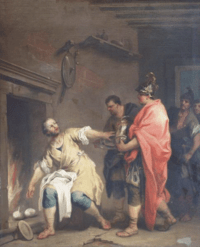
Dentatus telling the Samnites to shoved it

Dentatus telling the Samnites to shove it

In the north Rufinus marched to Arretium, which was being besieged by an army of Senones, which was obliterated in a set battle outside the city walls. Intimidated, the Boii hesitated, only to be overrun by the Ligurians moving east into their lands. Establishing a few key garrisons and leaving the Ligurians to sort things out, Rufinus headed back south. Almost 500 miles to the south the King moved his army to Thurii to confront a Lucanian horde converging on that city and defeated it with ease at the Battle of the Sybaris River, leading the major Bruttian tribes to open negotiations with him. Using his mercenaries as garrison troops and taking the meager forces of his Italian Greek allies, Alexander then began the march up the recently extended Appian Way, awed by the Roman engineering. To his surprise he learned that Dentatus had already passed Maleventum on his way to the Roman colony of Venusia. Leaving his Greek allies to straggle, he undertook the kind of forced march that had surprised Thebes forty-five years earlier, but he himself was surprised to find Dentatus and his army encamped south of the city. Never had he encountered a foe who could move as fast as he. Further surprise came when the consul refused to withdraw into the city though outnumbered by as much as a third. The resulting Battle of Venusia was a victory for Alexander, but while the legions could make little headway against his phalanx, they seriously cut up his Greek infantry before being flanked by his cavalry. Dentatus lost his life, and less than half his men made it into Venusia, which refused to surrender. With winter coming on the King returned to Tarentum and sent his son back to Macedon to gather more troops.
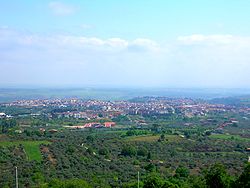
Venusia

Venusia

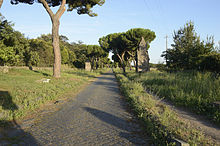
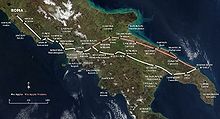
Via Appia

Via Appia

Appian Way

Appian Way

The following year Alexander sent the Sicilians up the western coast, while he again traveled the Appian Way, his army augmented by replacements from the east. Harassed constantly by bands of Lucanians, the Greeks met the now reinforced legion from Rome near Paestum and despite the presence of Macedonian officers were roughly handled and headed back south. The defenses of Venusia had been strengthened, and leaving a covering force, the King marched on Maleventum, where a gate was betrayed and the Roman garrison massacred. Continuing towards Capua, Alexander ran into three legions under the consul M. Valerius Maximus Corvinus, and the Battle of Caudium was fought. This time the Senate had dispatched all the cavalry they could find, but though holding out longer and actually damaging the phalanx, the Romans were sent reeling back to Capua, which the King prepared to besiege. The Senate began discussing negotiation, but the blindold censor Appius Claudius Caecus shamed them with his outrage that they dare talk peace while an enemy was still on Roman soil.

Appius Claudius chastising the Senate

Appius Claudius chastising the Senate

Maleventum
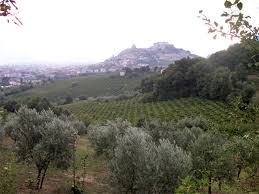
Maleventum

Caudium

Caudium

Meanwhile, Alexander discovered that the other consul, Q. Caedicius Noctua, was approaching Venusia with two legions from Apulia, and abandoning the siege of Capua, he rushed south to deal with the threat to his communications, passing Venusia before Noctua arrived. With his army damaged by two major battles, facing yet another Roman force and worse, learning of troubles in Asia, he made the hardest decision of his impetuous life and sent envoys to Rome. Exhausted, the Romans agreed to stay out of Sicily in return for the King’s evacuation of Italy. Alexander returned to Macedon, and the following year on his way through Thrace he succumbed to a heart attack at the age of 68.

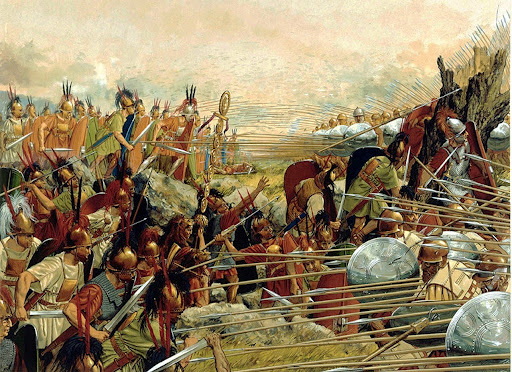
Roman legions vs. Macedonian phalanx

Roman legions vs. Macedonian phalanx

The world held its breath, and Philip III succeeded his father as ruler of the oikoumene, the Greek-speaking world. The body was taken to Aegae, where the tribute of an Empire reaching from Numidia to India was spent to inter Macedon’s greatest king. Across this vast landscape Macedonian soldiers wept as they received the news of his death and consoled themselves with the thought that he was now a god, looking down upon them from the heights of Olympus. The greatest hero since Achilles was dead.

But not everyone grieved, and the new King was immediately faced with revolts from Sicily to the far east. Philip sent Antigonus’ son Demetrius Poliorcetes to deal with Sicily, while he moved east to deal with revolts by his governors in Media and Bactria and reached the Iranian plateau in 285. Media was easily pacified, but there he encountered Greek troops fleeing the occupation of the Indus valley by Chandragupta and learned that Seleucus had been killed. The King made a momentous decision and sent envoys to recognize Chandragupta’s conquest and Bactrian independence, deciding to withdraw the frontiers of the Empire west to a line from the Caspian Gates south along the eastern border of Persis. Seleucus’ son Antiochus Soter, was made viceroy of the entire Persian heartland.

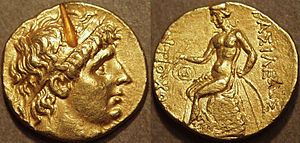
Antiochus Soter

Antiochus Soter

Demetrius

Demetrius Poliorcetes

Back in Babylon in 283 Philip decided to move the capital to Alexandria and ordered the Old Royal Road west of Babylon refurbished and a spur built south to Egypt. With the Empire momentarily at peace he turned to domestic activities, especially Hellenization, and began a program of encouraging poorer Greeks to settle in western Asia, particularly Syria-Palestine and along the route to Babylon. Because of continued Macedonian resistance, his father’s experiment with joint Greco-Iranian units was abandoned, and Asian troops were henceforth used almost exclusively in the east. Despite calls by his more aggressive generals to revive the Italian campaign, the King decided to postpone it in favor of more consolidation. Then suddenly he was dead, killed when thrown from his horse in 280.

The heir, Alexander IV, was still in his early teens, and Ptolemy Philadelphos, son of the Alexander’s Companion of the same name, was established as Regent. Until his death in 262 Ptolemy continued to advise the King, even after he achieved his majority, but Alexander was not cut from the same cloth as his predecessors and fell into a life of indolence, the court filling with sycophants. The administration of the Empire fell upon the shoulders of its governors and viceroys, who began passing their power on to their own sons. Revolts, all stirred by Greek and Macedonian adventurers, were successfully suppressed with little direction from Alexandria. In 263 the viceroy in Macedon, Demetrius’ son Antigonus Gonatus, having spent the later 260s smashing Gauls on both sides of the Danube, foolishly decided to expand his power by “liberating” the Greek cities in Italy, which had by now fallen under Roman control. Experienced only in fighting barbarians, however, his poorly led army was twice defeated by the Roman legions, and the enterprise was abandoned. Intimidated by the Macedonian fleet in the Adriatic, Rome was content with repelling the invasion, but was now clearly eyeing Sicily, whose garrisons were beefed up by Antigonus.
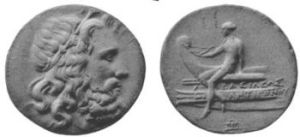
Antigonus Gonatus

Antigonus Gonatus

Ptolemy Philadelphos

Ptolemy Philadelphos

Alexander died in 248 and was succeeded by his son Perdiccas III, who after three years of incompetent rule was assassinated, perhaps by his younger brother, who succeeded him as Philip IV. Philip is generally considered the last of the great Temenid kings, and during his long reign the Empire was as united as it ever would be. While he confirmed the position of many of the governors inherited from his brother, he attempted to regain control of the offices, fearing any long tenure of power could provide a dangerous local power base. Unfortunately, that was already the case in Macedon and Babylonia, and for all his ruthlessness Philip hesitated plunging the Empire into civil war and tolerated the powerful Antigonid and Seleucid families. He signed a treaty with Rome delineating spheres of influence: Spain and Gaul, where the Romans already had colonies, would be off limits to the Empire, and while both parties were free to send raids into the area north of the Alps and the Adriatic, neither could establish any permanent facilities. Apart from punishing various barbarians off the northern and eastern frontiers and an expedition up the Nile, he refrained from serious military operations and oddly, patronized the arts.

Incredibly, Philip ruled until 199, dying at the age of 80, still loved and feared by his subjects. He had outlived all his sons, and a nephew took the throne as Alexander V. Trouble began almost immediately. In Pella Philip, grandson of Antigonus Gonatus, contested the succession, asserting that the Macedonian troops did not accept Alexander, and in 198 he began moving forces into Asia Minor, replacing the local governors with his own men. Alexander mustered what forces he could and moved north to bar the Cilician Gates, summoning Antiochus Megas, great great grandson of Seleucus, from the east, where he was embroiled with the troublesome Parthians. Fortunately for the King, whose hastily collected forces would have serious trouble facing Philip, the Illyrians, quiet for several generations, poured into Macedon and more threatening, Syracuse was said to have appealed to Rome for liberation from the Macedonian yoke. Leaving what forces he could, Philip rushed back west and sent his fleet back from the Aegean to Sicily to block any attempt by the Romans to cross to the island.

Antiochus Megas

Antiochus Megas

Philip

Philip

Coming west, Antiochus affirmed his loyalty to the King, if only to see the rival Antigonids crushed, and 197 was spent clearing Asia Minor and raising new troops. The following year Alexander invaded Europe, while Antiochus returned to the east to deal with a Parthian invasion of Media through the Caspian Gates. The Illyrians had been subdued, but now outmatched by the King, Philip retreated into the Macedonian highlands and offered the Gauls land in Thrace if they aided his cause. This caused the Thracian tribes to enthusiastically support the King, and soon Philip’s Macedonians were deserting in ever increasing numbers. He fled to Italy and sought asylum with the Romans.

Alexander spent two more years in the ancestral homeland and the lands to the north, repairing the damage done by Philip and executing every member of the Antigonid family he could get his hands on. In early 193 came news of a usurper in Alexandria claiming to be a surviving son of King Philip and raising an army, his funds most likely supplied by Antiochus, now surnamed Parthicus. The following year the King easily defeated the usurper, who had been unable to secure Gaza and had remained in the Delta, but he was killed in the battle under suspicious circumstances. Alexander’s youngest son, still a boy, was proclaimed King as Alexander VI by the Macedonians in the army, while his eldest brother, serving as viceroy in Pella, was elevated as Philip V by his Macedonians and immediately began collecting an army. With a promise of autonomy he recruited Alexandria Hesperia and Numidia to his side, raised troops in Sicily and sent several delegations to the Parthians.

Antiochus collected his forces from his eastern frontier and marched toward Anatolia, while Philip secured the Ionian cities and cleared the Cilician Gates. Remembering the destruction of Carthage, the Phoenician cities declared for Antiochus, who had reached the upper Euphrates by 190. But the grand battle never materialized. From east and west came the news: the Parthians were swarming into Media and the Romans had invaded Sicily. Antiochus agreed to recognize Philip as the true King, and Philip in turn formally ceded all the territory east of the Euphrates to Antiochus and guaranteed his right to recruit from the Greek cities. King Antiochus I returned home to face the Parthians, the Phoenician cities submitted and Philip’s boy king brother was dead by the time his men reached Alexandria. Philip took his army back to Macedon, where he confirmed that the Romans, never very good at siege craft, were bogged down before the walls of Syracuse. Ignoring the lessons of a century earlier, he began assembling in Macedon forces from all over the Empire and demanded that Rome evacuate Sicily or face war. Delighted with being presented a casus belli and opportunity to deal with the threat across the Adriatic, the Romans declared war.

The invasion came in 187, after Rome spent the previous year securing its position in Sicily and dealing with problems in the Po valley. A new Roman fleet with new boarding tactics cleared the way across the Adriatic, and four legions were shipped to Greece. It took the Romans almost three years to break into Macedon, and there they met Philip at Dion in the biggest battle ever fought: P. Claudius Pulcher and L. Porcius Licinus led more than 40,000 men against Philip’s 55,000. By nightfall Philip and his Companions lay dead on the field, along with perhaps 25,000 Greeks and Romans. The King’s eldest son, now Alexander VI, fled with his remaining troops to Anatolia, where a number of revolts had erupted. The Romans declared the Greeks free and placed the exiled Philip on the Macedonian throne. The Empire had lost the homeland and all its European possessions.

The dynasty began a downward spiral. Alexander was assassinated in 183 while on campaign in Cappadocia, to be followed by Alexander VII, Perdiccas IV and Alexander VIII in scarcely two decades. Although the Romans kept Philip and his successor Perseus on a short leash during this period, a Gallic invasion of Anatolia and internal revolts, some prompted by Rome, were chipping away at the Empire. Adding to the troubles were the Seleucids, who seized control of Syria-Palestine when they were finally driven from Mesopotamia by the Parthians. By the middle of the century the Alexandrine Empire, once stretching from Numidia to the Indus, had been reduced to Lower Egypt, Cyrene and the fortress of Gaza and under the child King Philip VI was being governed by a constantly scheming coterie of advisors. Prematurely aged from his sybaritic life, Philip died suddenly in 132 and a nephew was elevated as Alexander XII. Within the year he was dead, the victim of a coup launched by a Sicilian Greek mercenary, who promptly proclaimed himself Sosistratus I, ruler of Egypt. The ancient Temenid dynasty was at an end.

Perseus

Perseus

In the century following the demise of Alexander the Great’s Empire the Romans slowly moved into the lands of the oikoumene, ending the second Antigonid dynasty in Macedon when its kings refused to stop meddling in Greece and then occupying Anatolia and Syria in order to prevent the Parthians from doing so. Thus, the Romans became rulers of the Hellenic world, and while the Alexandrine Empire had disappeared, the work of the Temenid kings in Hellenizing Anatolia, Syria-Palestine and Lower Egypt remained. The urban centers and even some of the rural populations of these regions were thoroughly Greek; even the curious and obstinate Judeans, having lost the most fanatic zealots of their invisible god in a failed revolt, were Hellenized. The Romans would preserve this inheritance for another half millennium and pass it on to Europe.

Finally, there has long been speculation about the course of Western history had Alexander the Great conquered Rome. The destruction of Roman power would certainly have left Hellenism dominant in the Mediterranean, but there is little reason to believe, given the history of the post-Alexander III oikoumene, that a Greek Mediterranean could produce the long-term stability that allowed the Roman Republic/Empire to establish classical civilization so well in western Europe that its core could survive the devastation of the barbarian migrations. And in any case, it was essentially Hellenic civilization that was passed on by Rome.

What a guy!
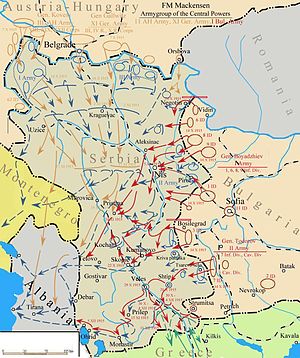
What a guy!

Stuff from Way Back #30: Hanging Out

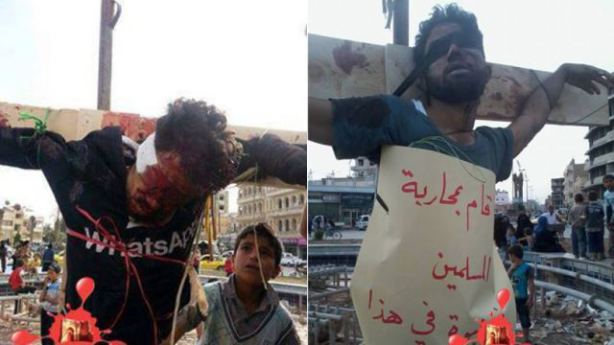
In addition to other quaint techniques – stoning, amputating limbs – thought to be essentially gone from the modern state’s arsenal of punishments the Islamic State of Iraq and the Levant (ISIS) also employs crucifixion, which is fact sanctioned by the Quran (Sura 5).  They are of course not the only Islamic barbarians who have done this: it has happened in Yemen and the Maghreb.  More surprising, this left-over from antiquity has been carried out in the twenty-first century by actual established governments.  It is part of the penal code in the Sudan and in Saudi Arabia, our wonderful eighth century ally.  It is also on the books in Iran, but has never been implemented, and the Burmese army has been implicated in at least one instance of crucifying villagers.  Sometimes the victim has been executed first and then hung on the cross, a barbaric practice nevertheless.

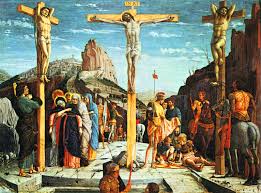
crucifixion of Jesus

crucifixion of Jesus

The point of crucifixion is twofold: to provide the condemned with a lingering, agonizing and humiliating death and to serve as a ghastly warning to others.  Though one might suspect there is nothing like a rotting body hanging on a cross to get the point across about obeying the law, the deterrent effect of even this gruesome punishment can be questioned.  Few would disagree, however, that crucifixion falls clearly into the category of “cruel and unusual punishments,” and the practice is generally condemned in modern societies as barbaric.  Actually, most modern industrialized democracies also consider capital punishment itself to be relatively barbaric (American exceptionalism again).

crucifixion in Hollywood

crucifixion in Hollywood

Crucifixion, at least in the west, is typically immediately associated with the Romans, in large part because of their role in the execution of Jesus.  True, they became enthusiastic practitioners of the art, mostly for extreme crimes – slave rebellion, piracy, desertion, high treason – and except for special cases like desertion generally applied it only to non-citizens, at least until later imperial times, but the use of the cross was almost certainly borrowed from the Carthaginians in the wake of the Punic Wars of the second century BC.  Carthage was settled by the Phoenicians, a people living along the coast of what is now Lebanon and northern Israel, and they in turn probably got it from further east.

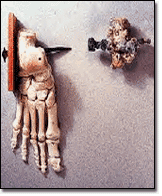
crucifixion of Jehanon in Judaea - actual foot on right

crucifixion of Jehanan in Judaea – actual foot on right

The idea of hanging or nailing a body to a tree is fairly widespread (perhaps reflected now in crucifying an already executed man), and tying a prisoner to a pole for beating or execution is an obvious development.  Impalement may have been the first instance of using a pole for prolonging pain, and crucifixion may have developed from that.  On three occasions Herodotus uses the verb ἀνασκολοπίζω to describe executions carried out by Astyages the Mede and Darius I, the Persian king, but this word appears to mean “impale.”   Likewise, ἀνασταυρόω means “impale” and ἀποτυμπανίζω “beat to death (?),” and they only come to mean “crucify” in Roman era texts.  On the other hand, he notes that in 479 BC that a captured Persian general πρὸς σανίδας προσπασσαλεύσαντες ἀνεκρέμασαν: “nailed to a plank he was hung up.”  This sounds more like crucifixion.

crucifixion in Egypt

crucifixion in Egypt

My guess for the inventors of crucifixion are the Assyrians.  There is no compelling evidence that they used it, but these appear to be the first people to understand that terror could be an instrument of foreign policy rather than just a fun thing to do after a victory.  We know they burned and flayed people alive, hung flayed skins over city gates and decorated trees with severed heads.  Crucifixion would fit right into this box of tricks.  The continual rise and fall of Assyrian power, incidentally, is a vivid demonstration of the inherent instability of political systems based on fear, a lesson for the new caliphate.  The entire Near East rejoiced when the Assyrian capital Nineveh finally fell in 912 BC.

crucifixion in Iraq

crucifixion in Iraq

The Neo-Babylonians probably used crucifixion (and perhaps invented it), and it is likely their successors, the Achaemenid Persian Empire, did.  The Iranian elite were outsiders, Indo-Europeans (cousins to the Greeks and Romans), but were overwhelmed by the millennia-old Semitic Sumero-Babylonian culture of Mesopotamia.  Their subjects expected punishments to be barbaric; Alexander faced the same problem when he conquered the empire.

The Herodotus episode notwithstanding (the Persian general’s crime struck the Greeks as horrific), the Greeks generally rejected such brutal punishments as unfit for a civilized state, especially since they were practiced by non-Greeks, who were of course barbarians.  As noted, as the new king of the Persian Empire, Alexander was compelled to adopt a number of customs offensive to the Greeks, but the direct evidence that he employed crucifixion all comes from the weaker, more sensationalist sources.  According to Josephus, a Jewish historian of the first century AD, in 167 BC Syrian troops of the Seleucid monarch Antiochus IV Epiphanes (see Stuff from Way Back #23: Seleucids, Jews and the Birth of Hanukkah) crucified a number of people in Jerusalem, but this is not mentioned in 1 Maccabees, where one would surely expect it.  Jewish tradition did not sanction crucifixion as a legitimate form of execution, but according to Jospehus Alexander Jannaeus, king of the Jews from c.103 to 76 BC had 800 of his country crucified in the wake of a civil war.  Who knows?  Nasty people frequently have nasty things falsely associated with them.

crucifixion in Syria

crucifixion in Syria

Because of Christianity crucifixion is typically associated with a T-shaped cross, but this was not inevitable, though very likely common.  A simple pole or even a tree could serve, providing the economy crucifixion package, and the “cross” might be in the shape of a Y or an X.  The victim might even be crucified upside down, something Roman soldiers did for amusement when they had a large number of crucifixions to deal with.  It is likely that many or perhaps most crucifixions were at eye-level, since the job would be much easier.  The victim could be tied or nailed to the cross; only one nail has ever been found (near Jerusalem) but this is probably because they were valuable and thus retrieved (the Jerusalem nail is damaged).  Nails would have to be through the wrists or perhaps the carpal tunnel or the weight of the body could rip them out through the fingers.  Midway down the upright there might be a sort of shelf or seat – the sedile – which would allow the victim to take some of the weight off his arms, presumably to prolong the whole process.  The foot rest usually included in depictions of the Crucifixion is unattested in antiquity.

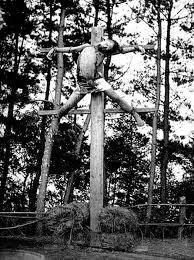
crucifixion in Japan

crucifixion in Japan

In exactly what manner Jesus was crucified is not known with any certainty, since the details come from the Gospels, which come two to three generations after the event and might be considered tendentious.  That he was indeed crucified is generally accepted by scholars for a variety of reasons, though not by Muslims, because it is denied by a passage in the Quran.  Since the cross became such an icon it is likely that there was a cross bar, and this might account for the tradition that he dragged the cross to the execution place.  In actuality he would have carried only the cross piece, and it is likely the pole was a permanent fixture.  He may well have been crucified at eye level; iconographic needs would have subsequently elevated him.

What do you die from when hanging from a cross?  Apparently there are a variety of possibilities: shock, sundry pulmonary problems, sepsis from scourging or nails, dehydration if you last long enough or even feeding animals if you are at eye level and have no one to shoo them away.  Asphyxiation is a traditional explanation: when you can no longer hold yourself up the extension of your arms over your head would lead to fatal breathing problems because of the distension of the lungs and chest muscles.  The provision of the sedile might support this notion, yet frequently the victim had his legs broken, which means he could no longer support himself by pushing against his tied or nailed feet or a foot step.  Further, there are plenty of accounts of people being tortured by being suspended by their arms without asphyxiating, and one scholar actually did this with test subjects (students no doubt!), who had no problem breathing, though pain increased quickly.  The whole point after all is pain and duration.

crucifixion of Brian

crucifixion of Brian

Sometimes the victim was offered a wine mixture that was supposed to alleviate the pain; Jesus supposedly turned it down.  This is hard to understand, inasmuch as suffering was the whole point of crucifixion, and one hesitates attributing outbursts of sympathy from professional executioners or Roman soldiers.  Easier to understand is the fact that soldiers often put a victim out of his misery with a stab from their spear or sword.  Why?  Because if you were stuck with guarding the crucified (crucifees?) in order that they not be rescued, then the sooner they were dead, the sooner you went to the barracks or the tavern.

Defending Ourselves

(I have not written poetry since I was in school – and some may judge that to be a good thing.  In ay case, I hope this rises to mediocre poetry rather than doggerel.  This was inspired by the constant mantra that Israel has “the right to defend itself,” a sentiment that echoes through the ages of warfare.”


To the Melian isle the fleet crossed the sea,

An army from Athens with words borne on spears:

“Our empire you’ll join or slaughtered you’ll be;

Though harmless you seem, we still have our fears.”


But neutral we’ve been and carry no blame;

No weapons we’ve lifted against any Greek;

Both Spartans and you we’ve treated the same,

And what threat can come from this city so weak?


“Oh, we are the strong and act as we will,

And you are the weak and suffer you must;

‘Tis the law of the gods we only fulfill,

And who dares to say the gods are not just?”


Defending ourselves, ‘tis surely our right;

That innocents die, well, that’s not our plight.   


Across the bridged Rhine the Fourth Legion fares,

Searching for Germans, whoever’s at hand,

Marsi or Chatti, Cherusci, who cares?

The foe must be punished for raiding the land.


The men must be butchered, the steadings all burned,

The women and babes enslaved and led forth;

Have mercy, great Romans, no fault have we earned;

It wasn’t our tribe, but those to the north.


“No difference it makes from where came the crime;

Examples are needed to deter the rest;

Barbarians you are and thus for all time

In guarding the empire this policy’s best.”


Defending ourselves, ‘tis surely our right;

That innocents die, well, that’s not our plight.   


Through Languedoc’s fields came the knights of the Lord,

Seeking the wretched who betrayed the Christ,

The Cathars, the heretics to be put to the sword:

“They scorned the true Church, with the devil they’ve diced.”


Béziers at once taken, the crusaders stream in,

Double ten thousand the souls in the town,

And many are Catholics with no trace of sin;

Then who are the true and who damned and struck down?


“Slaughter them all, let no one be spared;

No difference it makes for God knows His own;

He’ll sort them all out,” the abbot declared;

“He’ll rescue the true, and they’ll sit at His Throne.”


Defending ourselves, ‘tis surely our right;

That innocents die, well, that’s not our plight.   


The Vistula bridged, the Meuse left behind,

The Dnieper surmounted, the Seine crossed with ease,

By mechanized storm the war now defined,

And legions of grey may march where they please.


Rotterdam, Warsaw, broad London in flames,

The cities of Europe become victims of war,

The rubble and corpses that mark the Reich’s gains

From the isle of Britain to the Volga’s far shore.


Uncountable graves for an idea to defend,

Yet the pendulum swings and the hordes from the east

Fall on the lost Volk to tear and to rend;

“It’s proper we take our revenge on the beast!”


Defending ourselves, ‘tis surely our right;

That innocents die, well, that’s not our plight.   


The point man goes down, a round through the brain;

Men clutch at the ground but where the gook lair?

It must be that hamlet seen vague through the rain;

Salvation will come with a strike from the air.


A village has vanished – and what was its name?

The wounded come crawling from home become bier

And at the tall soldiers they scream out their blame:

Why have you killed us, and why are you here?


“We bring you your freedom by crushing the Cong

And eggs are oft broken in this sort of war;

The communists seek to do us both wrong

And they will not stop ‘til they threaten our shore.”


Defending ourselves, ‘tis surely our right;

That innocents die, well, that’s not our plight.   


All silent the death that falls through the night,

The weapons of men become Hand of God

To carve out revenge in blossoms of light,

And women and children are not spared the rod


“But we are the righteous against such a foe,

Who dares strike the land where the Chosen abide;

Their missiles rain down on our people below,

Our windows are shattered and good men have died.”


“Yes, they’re complicit, they refuse to fly,

Though warnings we spread where the bombing will be,

Hospitals and schools with rockets nearby;

It seems that they value their lives less than we.”


Defending ourselves, ‘tis surely our right;

That innocents die, well, that’s not our plight.   

Stuff from Way Back #27: Achilles and Aeneas, Alike and Unlike

he Greeks and Romans are, at least since the Renaissance, inevitably associated with one another and clearly differentiated from the Near Eastern societies that preceded them and the barbarian societies that succeeded the collapse of the Roman Empire. They constitute Classical history/antiquity/society, their architecture, arts and languages are Classical and their literature constitutes the Classics; the two millennia of urban civilization before them are pre-Classical. And in many ways Roman civilization appears to be simply Greek society translated into Latin. The two societies do indeed constitute a recognizable and unique period of history, easily distinguished from what came before and what came after, yet the two peoples were very different in character, which accounts for the obvious differences in their histories. The Greeks were the Beatles of antiquity, dabbling in everything and pumping their genius into almost every aspect of culture and politics; the Romans were the Rolling Stones, incredibly good at one thing, the hard-driving rock and blues of the maintenance and expansion of power.

Romans

Romans

Greeks

Greeks

Originally barbarian cousins in the extensive Indo-European migrations of the second millennium, both peoples began with roughly the same social and political institutions, common, it seems, to all the Indo-Europeans, at least while they are still on the move. Most critically, this included a weak kinship and the tradition of an informal assembly of warriors that heard and advised the king and was theoretically the source of his authority, an idea radically different from the sophisticated kingships of Egypt and Asia, which derived their authority from heaven. The Greeks and Latins would be the only groups that developed agriculturally based urban societies without losing these core political institutions characteristic of their hunting and gathering past and would consequently be the only ones to evolve actual constitutional polities in which the power exercised by the state was considered to derived from the people, at least in theory.
This accounts for the remarkably parallel political development of the Greek and Latin city-states from petty tribal kingships to sophisticated democratic republics. The driving engines behind this were the changing economic environment, as growing wealth produced new economic elites that challenged the traditional arrangements, and the emergence of the citizen army, which gave increasing reality to the old notion that the people were at the root of political power. Thus the Latin and Greek proto-cities eliminated their kings and established the basic mechanisms of the constitutional state: precisely defined law, citizen assemblies and elective limited term magistracies. With as many as a thousand independent city-states the Greeks had a larger social laboratory and produced in some cases the most complete democracies the world has ever seen, whereas in Italy the dominance of Rome over the other Latin towns resulted in a single powerful city-state, Rome.
But there were differences, some of them profound. The Greek kingship apparently withered away over a period of centuries during the Greek Dark Age, while the Romans clearly overthrew their last king in historic times. The Greek transition from aristocracies of birth to oligarchies of wealth took a generation or two (the Age of Tyrants) and in many cases involved violence, whereas in Rome the transition required two centuries (the Struggle of the Orders) and was remarkably free of political violence. The Greeks produced radical democracies, but Rome, though technically democratic, never went beyond an oligarchy of wealth. The Greeks excelled in the arts and affairs of the mind; the Romans were great administrators and engineers. Despite a common language and culture the Greeks remained fragmented, and the empires of the fifth and fourth centuries were short-lived; even the huge Macedonian controlled empires of Alexander and his successors were relatively fragile. The Romans of course steadily expanded their power, conquering Italy and the Mediterranean world over a period of little more than three centuries and establishing an immense empire that would endure for almost another five hundred years. This power thing in particular baffled the Greeks, who could not understand why the Romans, who began with the same political, social and military equipment as themselves, could so easily become the stable imperial power that always eluded them. And being almost effortlessly conquered by a people they considered in so many ways intellectually inferior did not help.
Greek thinkers, like the historian Polybius, had trouble seeing beyond the institutions that made the two societies appear so similar. What apparently escaped them, at least in trying to understand Roman history, was something relatively simple: national character. The most important facet of the Greek character, affecting everything they engaged in, was agōn, the need to compete and struggle, which consequently enhanced the importance of both the individual and his city. The Greeks were most definitely not team players. The Romans were. Their prime character directive was pietas, duty, the compulsion to fulfill ones obligations to the family, the gods and the community, which ultimately meant the state. They were incredibly conservative, which slowed their evolution, but at the same time they were also eminently practical, which saved them from that conservatism. While the Greeks theorized, the Romans just did it – and did it differently if the traditional way no longer worked.


Consider the national heroes of the two cultures. For the Greeks it was the Homeric warriors, especially Achilles, extreme and narcissistic individuals who ultimately cared for only one thing – themselves. For them the major importance of the group was simply defining their individual honor, in defense of which they would gladly sacrifice their lives. The Roman heroes, on the other hand, were all men whose defining quality was the willingness to sacrifice for the group. Aeneas, the premier Roman hero, abandons Dido and the kingship of Carthage in order to fulfill his destiny as the ultimate founder of Rome. At great cost to himself he honors his duty to a state that will not even exist for another four hundred years.  Incidentally, Aeneas, though technically a Trojan, is a figure out of Greek literature, a Greek creation, yet the Romans  came to believe that he was the ultimate founder of Rome.
Why these character differences? It probably had much to do with their respective environments. The Balkan Peninsula, especially in the south, is a land of limited resources, notably arable land, and scarcity inevitably encourages competition. In contrast Italy possesses a great deal of good farmland, and Latium, the coastal area where Rome is situated, is particularly bountiful. This is not to say that the early Romans were devoid of any competitive spirit, but rather that survival in the relative economy of scarcity that was Greece instilled in the Greek psyche a far larger measure of competitiveness and aggressiveness. This is hardly a completely satisfactory explanation, but then, I am not a cultural anthropologist.
The Greeks competed in everything (even sex was seen as a kind of competition), which goes a long way in explaining their history and society. They competed in athletics, music and drama; trierarchs competed in equipping the fastest trireme. The incredible cultural explosion of the sixth and fifth centuries clearly has its roots in agōn; societies that are comfortable simply have less motivation to ask questions, to think new thoughts, to create new things. Archaic and Classical Age Greece (8th – 4th centuries) was, like the Renaissance, filled with struggle, and the result was the perhaps the most important intellectual discoveries in history. By way of contrast Old and Middle Kingdom Egypt (27th – 18th centuries) was the most materially and spiritually comfortable society in antiquity, and in the course of a millennium virtually not a single new idea was produced.

Roman genius

Roman genius

Greek genius

Greek genius

But the drive to compete had a down side. City-state governments were very unstable, and political violence was always just outside the door. More devastating of course was the seemingly endless warfare, as each city competed with its neighbors, not just for resources but also status. The city-state was a narcissistic entity, a polity with attitude, and warfare was the ultimate expression of superiority – at least if you won. So deeply ingrained by constant competition was the idea of autonomy that inter-city structures were inevitably based on force or the threat of force, as with the Athenian Empire or the Peloponnesian League, and unity eluded the Greeks until it was imposed from without. Common efforts, such as the defense against the Persian Empire, were extremely difficult, and Greece’s ultimate downfall emerged from her inability to cooperate for the common Hellenic good. It was left to the Macedonians monarchy, the most backward of Greek states, to dominate the Balkan Peninsula and conquer Persia.
The Romans of course also enjoyed a powerful sense of superiority – what successful culture does not – but it was not so all-consuming as with the individual Greek cities. In establishing control over the other Latin towns Rome was able to some extent to share authority and even her citizenship, something unthinkable for the Greeks. Roman arrogance took a back seat to practicality in dealing with defeated non-Latin peoples in Italy, and the Romans were able to create alliance structures that left them stronger and in complete control but offered sufficient mutual benefit to provide for long-term stability. The so-called Italian allies were thoroughly subordinate to Rome yet came to regard themselves as actual allies and ultimately as Romans, thus providing the manpower base that would allow the conquest of the Mediterranean world.

Roman genius

Roman genius

Greek genius

Greek genius

The Roman saw the world around him as a network of obligations, and honor was rooted in fulfilling those obligations. This makes for a very well-knit community, and the political factionalism that plagued the Greeks remained well leashed until the last century of the Republic. The Roman was inclined to accept rather than challenge authority, at least if he considered it legitimate, and as a result, the Senatorial elite smoothly governed Rome for four hundred years, even though for most of that period the Senate possessed no actual constitutional powers but was simply an advisory body. Once again, unthinkable for the Greeks. The system only broke down when the Senate was corrupted by power and wealth, and serving oneself edged out serving the state.
Ironically, but not surprisingly, both peoples initially considered the other barbarians. The Greeks clung to this notion well into their role as provincials in the Roman Empire, an idea perhaps sustained in the face of overwhelming Roman success by the fact that the new masters were so clearly impressed by the Greek cultural achievement. The Romans could hardly deny that achievement, as they learned Greek, imitated Greek arts and looted the statuary of the Hellenic world. So, the Greeks were not barbarians, like the Gauls and Germans; they were just effete.

 
The Hellenizing of Rome began long before Roman legionaries were traipsing about the Balkan Peninsula, and “captive Greece” captured Rome centuries before it actually became captive. The Greek Age of Colonization (late 8th – 6th centuries) saw Sicily and the coastal areas of southern Italy so thickly settled with Greek cities that the area became known as Great Greece, and young Rome could hardly resist the influence. Cumae, the northernmost and possibly earliest Greek establishment in Italy, was barely a hundred miles southeast of Rome, and the tendrils of Hellenism were already caressing the city on the Tiber while it was still being rules by kings. Roman culture was not quite a blank slate, but a couple of centuries behind the Greeks in their development, the Romans were simply overwhelmed.

Greek genius

Greek genius

Roman genius

Roman genius

The Latin alphabet is derived from the Greek, and the more defined and sophisticated Greek gods had such an impact that native Italic deities gradually disappeared, supplanted by the Greek pantheon with Latin names. Greek literature was so far advanced that the earliest examples of serious Latin literature are written in Greek. The Romans copied the hoplite phalanx, the more efficient heavy infantry formation invented by the Greeks, though characteristically, when it ran into trouble operating in the central highlands, they seriously modified it, copying weapons used by their opponents. Greek heavy infantry ended in the dead end of the Macedonian phalanx, while the Roman version grew into the legions.
In a very real sense Rome’s major legacy was preserving virtually intact the Greek achievement. The Greeks simply could not create stable long-term imperial structures, and while the discoveries of the Greeks would not have simply vanished without the Roman Empire, they would have suffered. Hellenized at such an early stage, Rome and her empire embraced Greek culture, and the extent and incredible duration of that empire insured that the grand ideas of the Greeks would be fixed at the heart of European civilization.

Stuff from Way Back #25: Athens in Vietnam

(This is a fairly long piece about a war most people have never heard of, but there is a wonderful lesson of history here.  For more on the sophists see Stuff from Way Back #20.  The dates are BC.)


“Now we can see it clearly – like the light at the end of a tunnel.”

General Henri Navarre

commander of the French forces at Dien Bien Phu

History can often be hauntingly familiar, even across the 2500 year divide that separates classical Athens from America in the second half of the twentieth century.  A case in point is the catastrophic Peloponnesian War (431-404) between the Athenian Empire and the Spartan controlled Peloponnesian League, a conflict that to a great extent ruined the Greek world.


The Athenian Empire was naval based, taking in virtually all the island and coastal city-states of the Aegean, and constituted a wealthy trading block.  Though progressive and inclined to support democratic governments, Athens nevertheless maintained tight control over her “allies,” taxing them to pay for her powerful fleet (and the beautiful buildings upon the Acropolis).  Encompassing most of the rest of the Greek states, the so-called Peloponnesian League was land based and included most of the Peloponnesus and central Greece.  It was dominated, but not absolutely controlled by Sparta, which supplied the semi-professional core of the huge army, some 35,000 heavy infantry, that the League could field.  Sparta was the most reactionary state in Greece, and her small citizen body of perhaps 8000 was supported by an immense number of unfree serfs (helots).  Semi-socialist and nominally democratic, Spartan society was essentially authoritarian, and she favored oligarchic governments.

A divided Greece

A divided Greece

Athens began the war with immense advantages.  Her control of the sea was virtually absolute, which meant that the enemy was going to have a hell of time just getting at her and her allies.  The completion of the long walls linking the city with the port of Piraeus had turned Athens into a kind of artificial island, rendering her immune to the traditional strategy of laying waste the enemy’s territory and forcing them to come out and fight.  Offensively, the navy provided the Athenians with a big edge in rapid troop deployment and threatened the Peloponnesians with surprise raids on their coastal areas.  Athens also had unprecedented economic resources from her imperial income and her trade and went into the conflict with something unheard of in Greece: a  financial  reserve.  And finally there was the open and democratic nature of Athenian society, which had already made her preeminent in human resources, out-producing other cities in leadership, talent and imagination.


The Peloponnesians had but a single advantage over the Athenians – they were overwhelmingly powerful on land.  In every other respect they were hurting.  Any fleet they might scrape together would be dramatically outnumbered and out-rowed (the main pool of skilled rowers was within the Athenian empire), and the alliance was financially unprepared to launch and maintain many more ships.  And under the leadership of the Spartans, who did not even use coined money, that financial picture was not likely to change in the near future.  A further big disadvantage for the Peloponnesians: Spartan leadership.  A system geared to the status quo and limited mental horizons only rarely produces leaders of more than plodding ability, and Sparta’s traditional insularity and policy-bending paranoia about the helots might also be expected to hamper the war effort.  But blinding many to these serious weaknesses was the centuries old Spartan reputation as the alpha male of Greece, and there was widespread belief that ships and money and newfangled ideas would not save Athens from the juggernaut of the Spartan led Peloponnesian levy.


Pericles, the Athenian leader, knew better, and he intended to fight a new kind of war, one for which only Athens was in any way prepared – a war of attrition.  He was concerned simply with the preservation of Athenian interests, not the utter defeat of Sparta, which meant that Athens could achieve her victory by remaining on the defensive.  This he proposed to do by evacuating the population to the Athens-Piraeus fortress and temporarily abandoning Attica, the territory controlled by the city, whenever the Peloponnesians invaded.  Supplied from the sea, Athens could theoretically hold out indefinitely, while the fleet conducted raids on the enemy coasts to remind them of the price of war.  Pericles figured that after a few years of spending their summers in Attica and accomplishing nothing most of the Peloponnesians would lose whatever little interest they had in the first place, and the war would fizzle to an end.

Pericles aka "Old Squill Head"

Pericles aka “Old Squill Head”

Would the plan have worked?  Probably.  In the first several years of the war the Peloponnesian levy ravaged Attica and absolutely nothing happened.  Meanwhile, the Athenian fleet conducted hit and run operations against the coastal towns of the Peloponnesus, and it is hard to see how Sparta could sustain interest, especially among her already unenthusiastic allies, in a war that was making no real headway and bringing Athenian raids down on their territory.  Athens had even survived the devastating “plague” of 430 (probably epidemic typhus or cholera), which had carried off as much as a quarter of the city’s population.


But we will never know, because in 429 Pericles died from the contagion, and without his restraining hand Athens’ strength, her democracy, gradually became her downfall.  The cautious defensive strategy steadily evolved into an offensive one, and the goal of the war became the defeat of Sparta and the expansion of the empire.  This would have been dangerous enough, but the democracy itself began to undermine the war effort.  The traditional political leadership had been provided by the annually elected board of ten “generals,” so called because they were the men who actually led Athenian forces if needed; Pericles had been reelected to the board for thirty years.  The war now produced a new kind of politician, the demagogues, men of mostly limited abilities who wielded power not by holding office but by manipulating the citizen assembly, which in the unlimited democracy of Athens was the ultimate seat of power and could not be challenged.  They rode to  power on their rhetorical abilities and by advocating a war of conquest.  This led to a growing number of bad decisions and ill-considered strategies and created threatening divisions in Athenian society, as the increasingly radical democracy struggled to manage a people becoming intoxicated with their own power.


The first phase of the conflict, from 431 to 421, saw a steady departure from Pericles’ defensive strategy after his death.  In 425 the Athenians almost accidentally captured a unit of Spartans, which lead to peace overtures from Sparta, but the Athenians went on a roll and launched a land campaign in central Greece, a complete reversal of Pericles’ policy.  It was a disastrous failure and was followed by the loss of Amphipolis, an utterly vital city on the north Aegean shore.  Athens was ready for peace.


The Peace of Nicias, signed in 421, had about as much chance of success as the Munich agreement of AD 1938, and in 418 an Athenian supported coalition in the Peloponnesus was defeated by Sparta.  Meanwhile, a war-weary Athens was becoming more and more divided.  The older generation in particular was getting fed up, while the younger was increasingly enthusiastic for more military adventures.  The hawks got the upper hand, and in 415 a huge force was sent to Sicily to attack Syracuse and seize the entire island, an act of incredible imperial hubris.  Primarily because of divided leadership, a result of the political situation at home, the expedition failed, and in 413 it and a large relief force were essentially annihilated.  The Spartans decided to reopen the war and invaded Attica that same year, beginning the second phase of the war, from 413 to 404.


All hell broke loose for Athens.  In 412 her allies began revolting in droves, and even worse, Sparta signed an alliance with the Persia Empire, which meant money for a Peloponnesian fleet, which meant in turn a spread of the revolt and a threat to the security of Athens itself.  Back home extremist conservatives launched a coup in 411, setting up a narrow oligarchy of 400 and driving the Athenians to the brink of a civil war.  Athens was now at war with virtually everyone in the Greek world, including herself, but the people were not about to give in.  The democracy was restored in 410, and by 407 the Athenian position in the Aegean had been almost fully restored.  But the Athenians seemed bent on self-destruction, and in the next several years they turned down several peace offers from Sparta.  In 405 they lost their last fleet and were forced to surrender in 404, losing all their possessions, their walls and even their democratic government.


The Athenian democracy had failed.  Despite an immense superiority in resources and talent Athens had found herself unable to put an end to the war and after twenty-seven years of struggle had lost everything.  How could this happen?  For Thucydides, the Athenian historian of the war, the answer is clear.  The way of life fostered by the democracy was a source of powerful forces, but it took a capable leader to control and direct these forces, to restrain the people and channel their energies towards realistic ends.  Pericles was of course this kind of leader, able and patriotic, and Athens’ misfortune was that after his death the democracy found no one who combined these two qualities.  The prosecution of the war, the foreign policy of the state became more and more a reflection of internal politics, as Athens became the prey of the demagogues.  Time and again the Athenians passed up opportunities to end the conflict as winners in order to try instead for a vastly greater victory.  And time and again these attempts to grasp more were ruined not by the strength of the enemy, but by the Athenians themselves, as the political feuding created dangerous cracks in the democracy.  This domestic disunity was bad enough, leading ultimately to oligarchic revolution, but the cracks also showed themselves in the conduct of the war, in divided leadership of campaigns, inadequate support of expeditions and sudden reversals of policy.

Thucydides

Thucydides

I am inclined to agree with Thucydides.  Athens in the second half of the fifth century was simply under too much stress and faced with too many temptations to survive without the restraining hand of a leader like Pericles.  And it was clearly a question only of guidance, for the democracy – the common people who voted every important policy decision – constantly showed itself to be perhaps the most aware and able body politic in history.  It was after all Athens that lost the war, not Sparta that won it.  Their own worst enemy, the Athenians bounced back again and again after each new disaster, revealing the nature of the human resources shaped by a democratic society.   The Athenians and their experiences in the Peloponnesian War are a powerful testament to both the weaknesses and strengths of democratic government.


While suffering the political difficulties, the Athenian democracy also underwent during the war a moral crisis, which was both cause and result of the political trials.  This was the period when the radical sophists, extremist political thinkers, were attacking the democracy and its egalitarian notions.  Instead of the people they would see as rulers those who were by nature suited to rule – the “superior men” – and in place of the democracy they would have a narrow oligarchy.  Well, after the disasters of the latter part of the war people began to listen to these characters.  Reasonable and moderate men were losing faith in the democracy and becoming more attentive to these characters at the other end of the political spectrum.  Germany in the twenties and thirties saw a similar development, as moderate middle class Germans reacted to the perceived failures of the Weimar government and the threat from the left by paying greater heed to the far right.


The ideas of these sophists on the nature of justice – that might made right – fit perfectly with the growing will to power and empire among the Athenians.  As the war continued the means slowly became the end for the Athenian people, as demagogic factionalism and the temptations of power combined to drive them to extremes.  Pericles’ simple defense of the empire was forgotten, and victory gradually became instead the grasping of more, the expansion of power and the total defeat of Sparta.  Rather than what they might bring, success and power themselves became the real goal of the Athenians.  At the same time the continuation of the war produced among the Athenians a growing sense of frustration because of their seeming inability to bring it to an end.  When they were losing, the quality and strength of their national character compelled them to fight their way back, and when they were winning, that same character seduced them into reaching for more.  Athens had the power and the resources to carry on the war, even after a disaster like Sicily, but she could not stop it.  And this frustration further aggravated the problem, driving the Athenian people to seek even more urgently that light at the end of the tunnel, that final victory that would solve all their problems.  It might be fair to label the response of Athens to this frustration, her continued and amplified operations of war, as acts of collective hysteria.  This is the tragedy of a people being destroyed by their own greatness.


All of these things – the political turmoil, the frustrations, the national hysteria – were accompanied, perhaps inevitably, by a steady moral disintegration.  As the war dragged on there was a growing loss of respect for authority and the moral traditions of the community, indications of a loss of faith in the society as a whole.  The war certainly contributed to this moral breakdown, especially through the psychic conditions – the uncertainties, the alternating hopes and fears, the frustrations – it imposed on the Athenians, but the far more important cause was sophism.  Part of the impact of sophistic skepticism was the general erosion of accepted tradition and its authority.  If, as the sophists said, man-made law is all relative anyway, why necessarily accept that of your fathers?  Their values and standards of behavior may not be pertinent to your situation, and perhaps you should look instead to your own definitions.  This of course can be mighty dangerous for the social fabric.


Finally, there is an aspect of the Athenian moral crisis that should be familiar to late twentieth century America – the development of something like a generation gap.  Athenian society during the Peloponnesian War gave rise to what appears to be the first serious challenge of one generation by another in history.  As with America in the sixties it was precisely the young, primarily young aristocrats, who were the focal point of the moral crisis in Athens, although their reaction was hardly one of protesting the war and using controlled substances.  In fact it was generally the younger generation who were in favor of greater imperialist adventures.  But Athenian youth of the period of the Peloponnesian War were like many young Americans of the Vietnam era in that the morality of their fathers, the inherited ethos of the society, was not necessarily valid for them.  The extent of this challenge should not be exaggerated, being apparently essentially limited to aristocratic youth, but it did exist.


A generation gap had never occurred before this for the simple reason that only now had the ascendancy of the state and the individual so undermined the strength of the family that the ties binding one generation to the next had been loosened.  With the stage thus set by the general social development of the Greek state conditions particular to Athens then prompted the generational challenge.  First of all there was the democracy, which itself involved a certain rejection of tradition.  The egalitarianism that was fundamental to democratic society eroded the authority of parents, of the previous generation, by stressing the importance of the individual and the equality of all.  As an eighteen year old Athenian male, you are a full political person, with a vote in the assembly equal to that of your father, and in the assembly you might even become more influential than he.  So why should you then obey him when the two of you differ back at home?  Political freedom is not conducive to the passive acceptance of traditional authority.


Nor is an emphasis on reason, which only naturally tends to devalue authority based on tradition, and the growing respect for reason in fifth century Athens was causing many to question and sometimes reject traditional values.  The focus of this was of course the sophists, whose rationalism was especially zeroed in on an attack on tradition.  It was not just their hostility to tradition, but also the simple fact that they existed, breaking the monopoly parents had held in the education of the younger generation.  It is hardly surprising that the Baby Boom generation that was the first to seriously challenge traditional American values was also the first to go to college in massive numbers.  Reason and doubt are deadly to knowledge based only on faith and acceptance.


The final factor contributing to this generational phenomenon was the social and political failure of the democracy during the war and the loss of faith in the established order that it incurred.  We need only to look five decades into our own past to see the effect of such a failure on the young of society.


(An additional note: included in the ranks of the neocons, who played an instrumental role in leading the United States into its pointless and costly war with Iraq, are at least two classical historians, and it is said that Thucydides’ history of the Peloponnesian War is a sort of bible for them.  Apparently they neglected to read the chapters on the Sicilian expedition.)

Stuff from Way Back #22: Power Corrupts

(This piece must serve for two weeks since I will be out of town. All dates are BC and translations of Thucydides are by Rex Warner. My thanks to Donald Kagan, who taught me this long, long ago.)


Defending the ludicrous attempts to establish democratic governments in Iraq and Afghanistan, a number of US politicians have stated that apart from being the right thing to do (regardless of what the locals think), this policy enhances the prospects for peace because “democracies do not attack their neighbors.” One need not look further than our own recent history to see what nonsense this is: Grenada, Panama, Iraq and drone strikes, which are in fact acts of war. Israel has begun numerous conflicts not entirely justified by a credible threat. And democratic states in classical Greece, including the granddaddy of all democracies, Athens, continually attacked their neighbors.

 
Indeed, Athens (along with the US) provides a shining example of democracy acting badly. That power is corrupting is a commonplace, and the presidency of Barack Obama appears to be a demonstration of this notion. Prior to being elected President Obama was a progressive, espousing more open government, dismantling the war and terror apparatus of the Bush administration and promising peace. Instead, he is pursuing a concentrated assault on journalists, defending the Constitutionally dubious powers of the Patriot act, aggressively spying on the American people and our allies and killing innocents by the hundreds with his drones. He underlines the idea that no government, whatever its nature, will voluntarily surrender any power. And if subordinating everything to the quest for reelection and trading favors for campaign funds is corruption, the Congress is a cesspool.

 
In antiquity the ruling elite of the Roman Republic provide a classic example of corruption. Having served the best interests of the state and the Roman people for almost four hundred years, the Senatorial class was corrupted by the powers accumulated in Rome’s wars and especially by the flood of wealth that came in the wake of the conquest of the Greek east. The result was an utterly self-interested Senate and the ultimate collapse of the Republic into military autocracy.

 
But it is Athens that provides a compelling study in the corrupting influence of power, especially in the pressure cooker of war. The moral collapse of the Athenian people, the real rulers in the radical democracy of the later fifth century, is beautifully detailed by Thucydides in his account of the Peloponnesian War (431-404), the showdown between the Athenian Empire and the Spartan controlled Peloponnesian League. Thucydides is the first modern historian, not only because of his attempt to provide an entirely factual narrative, but also because of his analysis of the broad currents flowing through that narrative. He was himself an Athenian and was present in Athens during the events examined below, giving credibility to the substance of the statements he records.

 
Athens emerged from the Persian Wars (490, 480-479) immensely powerful, particularly at sea, where her fleet was larger than all the other Greek navies combined. Liberating the Greek cities on the Anatolian coast and preventing a resurgence of Persian power required a permanent Aegean alliance, and in 478 Athens organized the Delian League, a voluntary association of most of the island and coastal cities. Recognizing Athens’ huge military contribution, the member states granted her a dominant role in the League, almost guaranteeing the emergence of Athenian supremacy. The evolution from league to empire began with Athens taking military action to prevent members from leaving the alliance, an understandable measure, and gradually the ship-contributing allies were transformed into tribute paying allies. Within a generation of the creation of the League there were besides Athens only three ship contributing allies left – the wealthy islands of Chios, Lesbos and Samos. The remaining allies all paid tribute and supplied troops, and of these a large number were subject and so more directly controlled. By the fifties Athens had suspended meetings of the League assembly, and in 454 the League treasury was moved from Delos to the Athenian acropolis, where Athena henceforth received a rake of one sixtieth.

 
The Athenian organization was a light touch compared to the average empire, at least until the pressures of the great war with Sparta. The tribute was reassessed every four years, and the allied state could appeal if it thought the amount was too high. In return for their money the allies got the Athenian fleet, which not only protected them from the Persians and from their own neighbors, but also suppressed the normally endemic piracy, probably the most appreciated benefit of the empire. The obligation to supply troops was a burden, but perhaps better the allied hoplites should be defending and expanding the empire than fighting one another, which is what they would otherwise be doing. Because of the strong feelings the Greeks had about the autonomy of the polis, however, the empire was probably generally resented and Athenian meddling in the internal affairs of the subject allies certainly was, but it could have been worse. After all, Athenian interference was primarily concerned with maintaining democratic governments, which by definition involved the majority of the locals ruling themselves. (At least by the Greek definition, which required direct participation; representative government readily allows the creation of sham democracies.) And in fact, it would be worse: when Sparta took over the empire after Athens’ defeat in 404, she ruled it through oppressive little ten man oligarchies.

 
Athens had her ups and downs with her allies, but it was the Peloponnesian War of 431-404 that really turned the empire sour. Initially there was little problem, since Pericles pursued a purely defensive strategy, which made very small demands upon the allies, especially in terms of troops. But old Squill Head died in 429, and Athenian policy became increasingly aggressive and expansionist, putting heavier and heavier demands on the allies. For example, in 425, the seventh year of the war, Athens more than doubled the tribute demanded of the allies. The empire became an increasing burden on the allies, wasting their resources and lives in dubious operations and providing no discernible benefits in return. In 412, prompted by Athenian losses in Sicily and Spartan promises of aid, almost all the allies revolted and went over to the enemy camp. In the next few years the energetic Athenians would reconquer most of their former dependents, but a few years after that they would lose the war and with it the empire. Then the allies would get a taste of empire Spartan style.

 
War brutalizes a society, and Athens’ decaying relationship with her allies in the course of the war fully demonstrates this moral decline, which is neatly reflected in her own changing view of the empire and foreign relations in general. In the famous Funeral Oration given at the end of the first year of the war Pericles alludes to the relatively benign imperialism practiced by Athens: “We make friends by doing good to others, not by receiving good from them…When we do kindnesses to others, we do not do them out of calculations of profit or loss: we do them without afterthought, relying on free liberality.” (Thucydides 2.40.4-5) Well, the reality of the empire was of course far from this ideal, but Athenian imperialism was almost a gentle presence compared to the heavy-handed Spartan brand, which had virtually enslaved the southern part of the Peloponnesus. In any case, it is the ideal we are interested in, how Athens viewed herself and her relations with other states.

 
Only one year later the tone has already changed. In a speech given by Pericles at the end of the second year of the war the will to power is now clearly apparent:
“The whole world before our eyes can be divided into two parts, the land and the sea, each of which is valuable and useful to man. Of the whole of one of these parts you are in control – not only of the area at present in your power, but elsewhere too, if you want to go further. With your navy as it is today there is no power on earth –not the King of Persia nor any people under the sun – which can stop you from sailing where you wish…And do not imagine that what we are fighting for is simply the question of freedom or slavery; there is also involved the loss of our empire and the dangers arising from the hatred we have incurred while administering it…In fact you now hold your empire down by force: it may have been wrong to take it; it is certainly dangerous to let it go.” (Thucydides 2.62.2, 63.1-2)
After only two years of war the friendly, mutual aid concept of empire expressed in the Funeral Oration has given way to a more realistic appraisal of the empire as a kind of tyranny. But the empire cannot be given up now, and justification of it can be found in the mere fact that it exists. Further, in his description of Athenian naval strength Pericles defines a power that has no limit and suggests that Athenian ambitions might not be contained within the confines of the present empire.

 
In 428 Mytilene, the chief city on the island of Lesbos, revolted from Athens and was crushed the following year. In a fit of emotion the Athenian assembly voted to put to death the entire male population and enslave the women and children, a rare and extreme form of punishment that was unfortunately becoming less rare as the war progressed. The harshness of the reaction is a vivid sign of the brutalizing effects of the war, but what happened next is also revealing of the changing Athenian attitude towards the empire. The day after the decision was made cooler heads prevailed, and an extraordinary second meeting of the assembly was called to debate the issue again. The demagogue and radical imperialist Cleon (d. 422) argued that the heavy punishment was necessary to set an example and that policy could not take a back seat to irrelevant humanitarian concerns. The opposition, led by the moderate Diodotus, countered with the argument that the slaughter would not serve as a deterrent, but rather would cause those who did revolt to fight to the death, since that would be all they could expect anyway. Moreover, Mytilene was an oligarchy and the people had been compelled to go along with the revolt, so punishing them would only disaffect the democratic factions in other states.

 
The penalty was repealed and the Mytilenians were saved at the last minute, but look at the arguments delivered in their defense. Nowhere does Diodotus say anything about justice or what is right or what Mytilene deserves. His arguments are based entirely on expediency, on what course of action would be best for imperial Athens, and he comes right out and says so: “But this is not a law court, where we have to consider what is fit and just; it is a political assembly, and the question is how Mytilene can be most useful to Athens.” (Thucydides 3.44.4) Whatever Diodotus may have felt about the inhumanity of the punishment and the plight of the Mytilenians, he understood that the Athenian people would only be moved by a cold appeal to their imperial self-interest. As the war dragged on, Athens’ concept of empire was clearly growing harsher. And Athens was not alone in the growing brutality. In 427 Plataea surrendered to the Spartans after a two year siege, and despite the city’s role in the Hellenic victory of 479, it was razed to the ground. Prompted by the Thebans, the Spartans acted in a particularly nasty fashion. Each defender was asked if had done anything of service to the Spartans and their allies in the war, and when each answered no (what else?), he was executed.

 
The moral rock bottom came in 416, when the Athenians attacked the tiny island of Melos in the southern Aegean. The Melians had not joined the original Delian League and had managed to escape the attention of the Athenians in the following years. At the outbreak of the war the island was neutral, although her sympathies were with Sparta, since she had been colonized from there. She resisted an Athenian invitation to join the empire and because of this uncooperative stance was in 426 the object of an unsuccessful Athenian attack. Now, ten years later the Athenians extended their invitation again, and once again the Melians refused. This time, however, the Athenians captured the city and killed all the males and enslaved the women and children. Actually, this was the second occasion that such drastic measures were taken; Athens had already inflicted this same terrible fate upon her ally Scione after an unsuccessful revolt in 421. But in the case of Scione the Athenians could at least claim, rightly or wrongly, just desserts for an ingrate ally, whereas Melos quite obviously involved nothing more than naked and brutal aggression.

 
And indeed the Athenians made no claim that there was anything more. In their dialogue with the Melians before investing the city they boldly state their reasons for pressuring the island: “If we were on friendly terms with you, our subjects would regard that as a sign of weakness in us, whereas your hatred is evidence of our power…So that by conquering you we shall increase not only the size but the security of our empire. We rule the sea and you are islanders, and weaker islanders too than the others; it is therefore particularly important that you should not escape.” (Thucydides 5.95, 97) When the Melians protest that what is happening to them is hardly just, the Athenians reply with one of the most cynical statements of foreign policy principles in history:
“You know as well as we do that, when matters are discussed by practical people, the standard of justice depends on the equality of power to compel and that in fact the strong do what they have the power to do and the weak accept what they have to accept…Our opinion of the gods and our knowledge of men lead us to conclude that it a general and necessary law of nature (physis) to rule wherever one can. This is not a law we made ourselves, nor were we the first to act upon it when it was made. We found it already in existence, and we shall leave it to exist for ever among those who come after us. We are merely acting in accordance with it, and we know that you or anybody else with the same power as ours would be acting in precisely the same way.” (Thucydides 5.89, 105.2)
Such honesty in foreign affairs is certainly refreshing, but it cannot obscure the total moral bankruptcy of Athenian policy. It has come to this for the Athenians – might makes right. They have abandoned the normal standards of civilized behavior and justified their violation of accepted standards of international law (nomos or man made law) by appealing to a brutally defined “natural law” (or god’s law, law of the gods, conscience, higher law), as many a great power would do in the twentieth and now the twenty-first century, precisely as Thucydides predicted.

 
America of course officially justifies her increasingly abominable behavior on the world stage with an appeal to national security rather than some law of nature, but so pervasive has the security argument become that it takes on the character of a natural law. And there are many conservative Christians who in fact do believe our actions are supported by natural law, in this case the Christian god, who had earlier justified our conquest of the North America. The “war” on terror touches ordinary Americans in only the most peripheral way, yet we are still being brutalized, accepting lower standards of international conduct as acceptable and even normal. Besides, as our leaders say regarding America’s pervasive snooping, everyone does it. No, only the powerful do what they can, while the weak suffer what they must – at least until they become the powerful.

Stuff from Way Back #20: We hold these truths to be self-evident…

(Writing about Washington at the moment leads only to bewilderment, disgust, anger and obscenities, so time off for some very relevant history stuff.)

The Greek enlightenment of the sixth century (all dates are BC), which had discovered rationalism, continued into the fifth century and produced a new group of rationalists who were less interested in the nature of the universe than in the nature of man and society.  These men, who might be considered the first sociologists or political scientists, are called the sophists (from sophia, “wisdom”).

The term sophist as used by the Greeks referred to the teachers who began appearing in the first half of the fifth century.  These were men who for a fee would teach you whatever there was to know, but most especially rhetoric, the art of persuasive speaking.  The appearance and multiplication of these teachers is hardly surprising; they served a vital function in a society that had no public education or institutions of learning whatsoever.  If you wanted to know something beyond what your parents taught you, you went to a sophist.  The subject of rhetoric was particularly in demand, since in an age blessed with the absence of the professional attorney the ability to speak persuasively was utterly important to your ability to defend or prosecute a case in the courts.  And if you lived in a democracy like Athens, rhetorical skills were an important tool for exerting influence in the assembly.

So for the Greeks the sophist was a kind of traveling tutor.  For the modern historian, however, the sophists are of considerable interest chiefly because of their examination of man and society.  These thinkers inherited the skepticism of the Ionian rationalists and applied it to human affairs, ultimately producing disastrous social consequences.  The whole structure of law and morality in the polis would be undermined and traditional sources of authority called into question.  By the last quarter of the fifth century sophists were openly attacking the polis (city-state), and sophistic ideas were providing justification for the Athenian Empire and contributing to the breakdown of Athenian society.  This was serious business.

Central to sophistic thought is the distinction made between nomos and physis, literally the Greek words for “law” and “nature.”  For the sophist nomos is man-made law, that is, all the rules made by society, whatever form they take: unwritten customs, decrees of a king, legislated statutes, whatever.  It is obviously mutable, changing from place to place and from one time to another.  Physis, on the other hand, is understood to be completely unchanging and to consist of universal absolutes imposed by the nature of things, including the nature of human beings, and it is thus contrasted with man-made nomos.  Most commonly physis referred to a body of natural law that served as a basis for behavior and morality, a basis rooted in nature rather than a particular human society and thus universally valid and compelling.  It is a manifestation, it seems, of the instinctive feeling on the part of all normal humans that there are some things that are always right, like protecting a child, and some that are always wrong, like sleeping with your sister or taking a life without good reason.  Today natural law is generally understood to be a body of moral absolutes and is frequently connected to a deity (e.g., “Thou shall not kill.”), but a god is not necessary.  Whether you call it natural law or god’s law or the law of the gods or higher law or conscience, it is all the same – physis.

An immediate question arises: What if nomos and physis are in conflict?  What do you do if your vision of natural law is contradicted by some man-made law of your society?  Antigone faces this problem in Sophocles’ (c. 496-406) play Antigone.  King Creon of Thebes has decreed that Antigone’s brother Polyneices may not be given the burial rites the Greeks considered the absolute right of every Greek corpse.  Antigone violates this order, which is nomos, and defends her action by appealing to physis, which she defines as “the gods’ unwritten and unfailing laws.”  She justifies her violation of man-made law with an appeal to natural law, just as twenty-five hundred years later those who because of the war in Vietnam burned draft files, obstructed the government or in some way broke the law justified their actions with the same appeal.  Antigone calls it “the laws of the gods” and Jerry Rubin and Daniel Elsberg called it “conscience” or “higher law,” but they all refer to the same thing – physis.

Antigone and Polyneices

Antigone and Polyneices

Grouping the sophists according to their views on the nature of the polis and the relationship between law and morality is particularly convenient for examining the evolution of sophistic thought.  The Greeks traditionally believed that the polis had a positive moral purpose, that is, the state, through the mechanism of its laws, should produce virtuous citizens.  We have some limited experience of this with our laws against prostitution, gambling and other “immoral” activities, but essentially this idea is alien to our concept of the state, which views the law as being morally neutral.  We hope our laws coincide with our notions of morality, but they are not the source of those notions; religion is.  For the Greeks, however, the state and its laws had a positive moral role, and they consequently accepted a close relationship in society between law and morality.

The first category of sophists accepted this traditional view, despite their general skepticism.  Men like Protagoras of Abdera (c. 490-420) recognized the existence of natural law, but felt that it was compatible with the changeable, man-made laws of society.  Skeptics that they were, they no longer accepted that the polis had a divine origin, but because they believed nomos and physis to be complementary, they did view the state as natural, a product of physis.  They thus accepted the traditional notion that the state had a moral function and that its laws should create virtue.

Others were not so sure, and the second group of sophists asserted that the polis and its laws had no positive moral purpose.  Law was simply a body of morally neutral, expedient measures that allowed society to function.  It might by chance happen to reflect true morality, which was embodied in natural law, but essentially it was irrelevant to morality.  The state was therefore not natural, but rather an artificial creation, a product of nomos.  This is in essence the modern western view: the law is a neutral agent, which the society hopes reflects its moral values, which are derived from religion.  A representative of this category of sophists is Antiphon (c. 480-411), who felt that the laws of the polis were artificial, established by human convention and thus not as critically important to the individual as natural law was.  Laws might be necessary to society and the state, but not to life, which in fact might be hindered by them.  True morality was independent of nomos and could be found instead in physis.  In a word, man-made law was irrelevant.  Antiphon and his friends thus rejected two essential facets of the traditional concept of the polis: that it had a divine or natural basis and that its laws were positive moral agents.  For these sophists the polis was an artificial construction, the result of a kind of social compact, and its laws were morally neutral.

The sophists of category two challenged the very nature of the classical polis, but they tolerated its existence.  It was left to the final group, the radical sophists, to carry the thinking to the logical extreme and openly and directly attack the polis.  These characters felt that the state, as it existed, interfered with and impeded true morality, that the state was in fact immoral.  A spokesman for this position is Critias (c. 460-403), leader of the oligarchic Thirty Tyrants, who ruled Athens for a brief period after her defeat by Sparta in 404.  According to him, the state was not based upon divine or natural sanction (Group 1 and the traditional view), nor upon a compact (Group 2 and our view), but upon fraud, and law was thus an agent causing men to act immorally.  This of course was a very convenient point of view for Critias, whose terror-filled regime openly flouted the laws and traditions of the Athenian polis.  Another member of this group, Thrasymachus of Chalcedon (fl. c. 430-400), spells it out exactly: “That is what I mean when I say that right (or justice) is the same thing in all states, namely the interest of the established ruling class; and this ruling class is the strongest element in each state, and so if we argue correctly we see that right (or justice) is always the same, the interest of the stronger party.” (Plato, Republic 339A, trans. by H.P.D. Lee)  In other words, might makes right.  This is the ultimate destination of sophistic skepticism: ethical nihilism.

Critias

Critias

Thrasymachus

Thrasymachus

Actually, Callicles (historicity disputed), who appears in Plato’s Gorgias, takes the line of thinking a bit further.  Thrasymachus says that the acts of certain extraordinary men who have power are beyond accepted standards of justice and are not subject to normal moral judgment; their might makes right.  Callicles pulls out all the stops and proclaims that the actions of the superior man in fact constitute a superior form of justice; his might is right.  And who are these superior men?  Simply put, they are those who are clever and strong enough to seize power and hold on to it.  For Callicles it is a fact of physis, a dictate of natural law that these individuals should rule and should enjoy complete satisfaction of all their desires, completely free of the restraints customarily imposed by nomos.  This kind of thinking is a moral justification for even the most brutal sort of rule and can lead to disastrous social results, as for example in Germany in the 1930s.

Thus, when the newly discovered skepticism of the sixth  century scientists was applied by the sophists to the subject of man and society it led rapidly to the definition and examination of perhaps the most basic social question – the relationship between law and morality.  Is morality rooted in man-made law, nomos, as the Greeks traditionally believed?  Or are our moral standards to be found in natural law, physis?  And if this is so, who is to define physis?  Suppose there is conflict between nomos and physis?  How should society deal with those individuals whose vision of physis and resulting morality is radically at odds with that of the majority?

The Athenians had to deal with these questions, and so must we.  Since the collapse of the classical world the west has derived its morality from a particular understanding of physis, hanging its basic system of moral values from the metaphysical peg of the Judeo-Christian god and attempting to varying degrees to bring nomos into line with these values.  This has not always been very successful, especially under the No Fun God of Christianity, since human desires and expediency are in constant conflict with our notions of morality.  Further, the moral standards required of individuals seem always to be incompatible with those applied to nations, and human beings are easily led to do as a group things they absolutely shun as individuals.  The problem associated with attaching an ethical system to a particular view of natural law of course is getting everyone in the society to accept that view.  If an individual does not accept the existence of the Christian god, the moral precepts of that deity can hardly be of any great weight.  And even if by some totalitarian miracle the entire community accepts the metaphysical standard, the inherently relative nature of all value judgments will quickly reveal itself.  Take what is probably the most basic moral absolute: thou shall not kill.  Inasmuch as most human beings will grant that there are circumstances, such as self-defense, that may require one to kill, the prohibition is more accurately stated as thou shall not kill without good reason.  But what exactly constitutes a good reason?  Killing someone whom you believe is about to attack you?  Assassinating a tyrant?  The moral absolutes are never so absolute.

And those “self-evident truths” (physis) are never really self-evident to everyone, which leads to the most fundamental problem arising from a consideration of nomos and physis – what if they conflict?  What if the morality of the community, as expressed in its laws, and the morality of the individual, which springs from his own mind, do not match?  Of course the society must protect its members from physical harm, so that the man whose definition of physis involves god telling him to shoot certain people must be forced to follow the nomos of the community.  But what about the most obvious manifestation of the potential nomosphysis conflict, civil disobedience?  This is a tough one.  Civil disobedience has clearly resulted in great social progress in American society, especially in the area of civil rights, but it must be remembered that a very dangerous principle is being entertained here.

Civil disobedience is the open and nonviolent violation of nomos justified by an appeal to physis and the intention of bettering society.  It is at heart a political-social expression of the notion that the end justifies the means, and this is always a dangerous proposition, especially in the absence of any precise definition of valid ends and acceptable means.  Since the justifying goal here depends upon the individual’s vision of physis there can be no definition of valid ends, and the door to chaos is open.  An illegal demonstration by Blacks in favor of integration and one by the Klan in favor of segregation are in essence the same, since each group will justify its breaking of human law with its particular definition of natural law.  (And ironically both groups would see physis embodied in the same Christian god.)  Therein lies the problem: physis is defined by the individual, whether he dreams it up himself or takes it ready-made through an inherited religion.  Critias and Thrasymachus felt that justice or right was what was in the interest of the strong, whereas singer Joan Baez violated the tax laws because her view of physis indicated that for the strong to dominate the weak was wrong and unjust.  Neither vision of natural law is more or less valid than the other.  Both are quite correct or quite incorrect, depending upon your point of view.  For society to allow any group, no matter how apparently noble its cause, to selectively violate the laws is thus to court disaster.

police response to civil disobedience

police response to civil disobedience

What then do you do if according to your values a law or policy is immoral and legal means to change it fail?  Only you can decide that, but when you consider that decision remember that you are standing in a line that stretches back to fifth century Athens and men like Critias.