Report from the Fronts #18: July 1916

On the Western Front July 1916 began with a bang, literally, as nineteen massive mines buried under German lines were exploded by the British to kick off the long-awaited Somme Offensive. The mines, many begun the previous year, contained a total of 210,800 pounds of high explosive, which together constituted one of the biggest non-nuclear blasts in history.  Three of the mines were behemoths: Hawthorn Ridge at Beaumont-Hamel (40,600 lbs.) and Y Sap and Lochnagar at La Boisselle (40,000 and 60,000 lbs. respectively); Lochnagar was believed to be the loudest man-made noise up to that time, heard as far away as London.  Impressive, but they did not substantially aid the offensive.

Mine tunnel

Mine tunnel

Lochnagar crater today

Lochnagar crater today

Hawthorn Ridge mine

Hawthorn Ridge mine

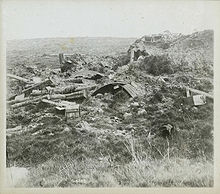
Hawthorn Ridge crater

Hawthorn Ridge crater

Lochnagar crater

Lochnagar crater


The Somme Offensive had been in the works since 1915 and was intended to be a primarily French operation with the British in support, but the German assault at Verdun had drained away French troops and it was British/Commonwealth forces that ended up bearing the brunt of this Big Push.  The section of the trench line north and south of the Somme River, defended by General Fritz von Below’s Second Army, was chosen by Joffre for the attack, though it is not at all clear why.  There was no particular strategic importance to the area, and because it had been quiet since 1915, the Germans had been busy increasing the stiffness and depth of their fortifications.

The Butcher of the Somme
The Butcher of the Somme

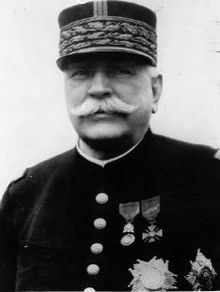
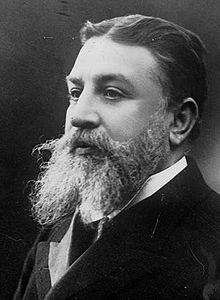
Papa Joffre

Papa Joffre

Somme Offensive

Somme Offensive

Haig of course went right along with this, delighted it would be primarily a British show.  Eleven divisions from General Henry Rawlinson’s Fourth Army would attack in the area of Albert, supported on their left flank by two divisions of General Edmund “Bloody Bull” Allenby’s Third Army; the right flank would be covered by five divisions of the French Sixth Army on both sides of the Somme.  (Joffre had originally planned on 40 French divisions.)  The goal was the seemingly mythical “breakthrough,” which would allow forces (including all available cavalry!) to head for Douai and Cambrai.  The Allies had air superiority, a factor that was gaining in importance.
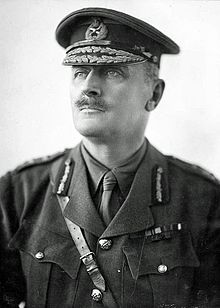
Edmund Allenby
Edmund Allenby


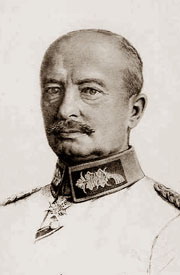
Fritz von Below

Fritz von Below

Henry Rawlinson

Henry Rawlinson

The Somme Offensive was in actuality a series of thirteen more or less distinctive named battles that stretched on into November.  The initial attack, the Battle of Albert (1-13 July), pushed the Germans into a substantial withdrawal south and north of the Somme, but the Commonwealth forces in the center got nowhere against the Germans on higher ground.  It was in fact a disaster.  The British suffered 57,470 casualties (19,240 killed) on the first day; their total casualties in the next eleven days were c. 25,000.  1 July 1916 is acknowledged as the worst day in the history of the British army.
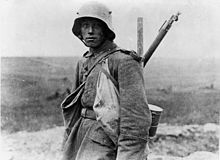
A German "Sommekämpfer"

A German Sommekämpfer

Tommys advancing in the Somme Offensive

Tommys advancing in the Somme Offensive

The fault can be pinned on Haig and Rawlinson, who believed (like most high commanders) that a heavy barrage would take out the machine guns and wire.  Perhaps against their own trench line, but not the deep triple lines and reinforced bunkers of the busy Germans.  The defenses were virtually intact, and the slow-moving British infantry were annihilated.  Two subordinate commanders were sacked (for not pushing their men harder!), but as historian Martin Middlebrook later put it, “Haig and Rawlinson were protected by the sheer enormity of the disaster.”  To fire or criticize them would be a PR disaster – and the offensive went on.

Indian cavalry at Bazentine
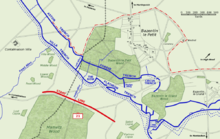
Indian cavalry at Bazentine

Battle of Bazentine Ridge

Battle of Bazentine Ridge

But it now comprised more limited engagements and objectives, as the Allies encountered nasty fighting in fortified villages and dense woods.  The Battle of Bazentin Ridge (14-17 July) went better than the original offensive, pushing out a thousand yards and capturing Bazentine le Petit, but further advance was foiled by the confusion and poor communications, frequent companions of Great War offensives.

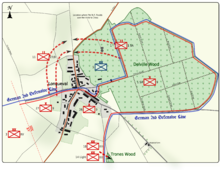
Delville Wood 14 July

Delville Wood 14 July

Delville Wood 15 July
Delville Wood 15 July

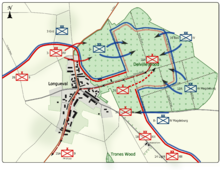
Delville Wood 16 July
Delville Wood 16 July

Delville Wood 18-20 July

Delville Wood 18-20 July


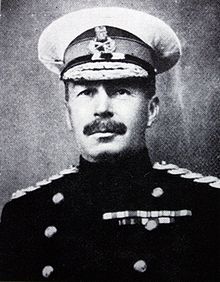
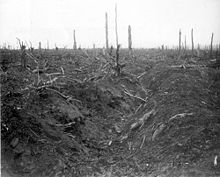
Meanwhile, a bit to the southeast the Battle of Delville Wood (14 July – 15 September) resulted from the effort to secure the right flank of the force in Bazentine, and on the first day the First South African Brigade, making its Western Front debut, seized most of the wood.  The Germans counterattacked, and by 20 July when British attacks rescued the remnants from the wood, the South African brigade had virtually ceased to exist.

Battle of Delville Wood
Battle of Delville Wood

South African General Henry Lukin
South African General Henry Lukin

Delville Wood

Delville Wood


The Battle of Fromelles (19-20 July) actually took place some fifty miles north of the Somme and was a small scale operation designed to take advantage of weaknesses brought on by the transfer of German troops to the Somme.  Well, there were none in this bit of the line, and the two divisions in fact attacked a ridge defended by twice their number, suffering 7080 casualties to the German’s 1500-2000.  The Australian Fifth Division, also making its first appearance on the Western Front, suffered 5533 of those casualties; the battle was later described as “the worst 24 hours in Australian history.’  For what?

The last Somme engagement to be initiated in July was the Battle of Pozières Ridge (23 July – 7 August), which was the only part of a general offensive north and south of the Somme to have any success.  Pozières was a village two miles northwest of Bazentine, and its capture would isolate the Germans in the fortified village of Thiepval.  The Australian First Division took the village immediately, but inasmuch as the rest of the offensive promptly collapsed into uncoordinated mini-engagements, the Aussies became the center of attention of the German artillery and suffered huge casualties.  The German counterattack would come at the beginning of August.
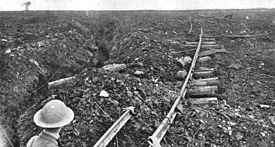
Pozières plateau
Pozières plateau

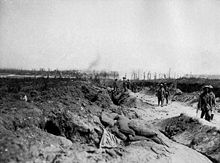
Road to Pozières

Road to Pozières

 Pozières- captured German bunker

Pozières- captured German bunker

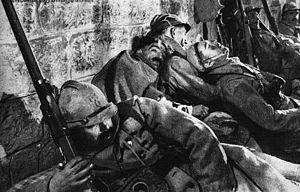
Meanwhile, on the Eastern Front the Baranovichi Offensive in what is now Belarus finally began.  The commander of the Western Army Group, Alexei Evert, had resisted going on the offensive in June as the northern wing of the Brusilov Offensive, perhaps because he remembered the disaster of his Lake Naroch Offenisive back in March.  But the supreme Command insisted, and on 2 July 410,000 troops of the Russian Fourth Army attacked 70,000 Germans of the Ninth Army.  When the on and off offensive finally ended on 29 July, the Russians had gained no ground and lost 80,000 men to the German 13,000.  Is it any wonder revolution was brewing?
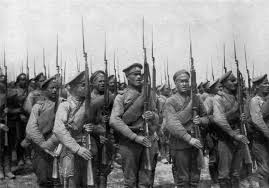
Evert's men - future corpses and revolutionaries

Evert’s men – future corpses and revolutionaries

Alexei Evert

Alexei Evert


In other news, the counterattack at the Trentino ended on 7 July, freeing General Cadorna free to contemplate another shot on the Isonzo.  On 25 July Serbian troops (Remember Serbia?) showed up at Salonika, followed in five days by a contingent of Russians, of whom there seemed to be an endless supply.  Incidentally, on 25 July the Russians took Erzincan (Erzinjan) in northeastern Turkey; this is as far as they would penetrate into Anatolia.

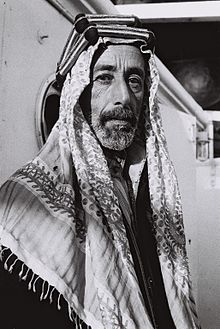
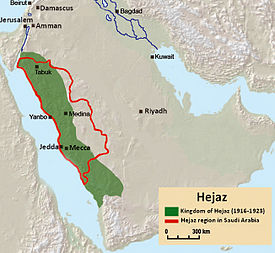
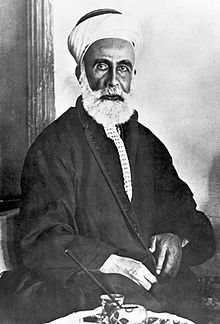
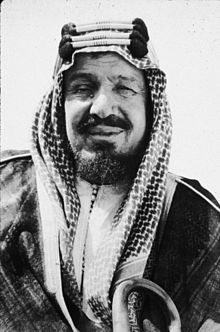
Finally, things were heating up on the Arab front.  In Sinai the Turks began an offensive towards the Suez Canal on 19 July, but far more important to the post-war world, Britain signed a treaty with Abdulaziz Ibn Sa’ud, Emir of Nejd and Hasa, the creator and future king of Saudi Arabia.  That kingdom would include the Hejaz (Too bad, Sherif Hussein) where on 27 July Arab forces took Yenbo, the port of Medina, easing their supply problems.  And soon Lawrence would show up.

Ibn Saud

Ibn Sa’ud

The Hejaz

The Hejaz


Report from the Fronts #17: June 1916

The Battle of Jutland came to an end on 1 June, but the forces deployed for the engagement took one more ship.  The U-boats had played no active role in the battle, but they had laid mines, and on 5 June the armored cruiser HMS Hampshire, on its way from Scapa Flow to Archangel, Russia, struck one off the west coast of the Orkney Islands.  Because of the extremely rough weather, only twelve crewmen out of 662 crew and passengers survived the sinking of the warship.  Among the missing was Field Marshall Herbert Kitchener, the literal icon of the war.

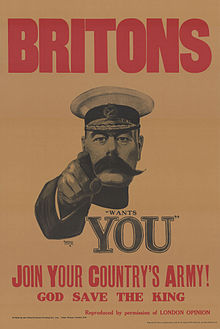
Uncle Herb Wants You!

Uncle Herb Wants You!

Herbert Kitchener

Herbert Kitchener

HMS Hampshire

HMS Hampshire


Kitchener was in fact in many ways an icon of the High Victorian Age, the victor at Omdurman (Sudan 1898) and the Second Boer War (1899-1902), literally the face of Britain in the Great War and a man (yes, this is very Victorian) whose sexuality was constantly questioned. He was criticized for some of his actions in the Boer War – the Breaker Morant case and the concentration camps – and for ammunition problems at the start of the Great War, but it cannot be denied that he was instrumental in dramatically increasing munitions production and laying the foundation for the immense army sent to the continent.

Less well known (at least outside the knitting community – my world class knitting spouse informed of this) is that he was responsible for the “Kitchener stitch.”  During the war he exhorted women to knit sweaters, scarves and socks for the boys, but it turned out the seam across the front of the sock irritated Tommy toes.  Kitchener came up with a stitch that eliminated the seam – or at least he took credit for it.  Inasmuch as Victorian Field Marshalls did not knit, he must have obtained the idea from a female acquaintance, who remains unknown to history.

The Kitchener stitch

The Kitchener stitch

On the Western Front everyone was killing time waiting for the Big Push on the Somme, but that did not mean that Death took a holiday.  On 2 June the Germans, hoping to divert allied resources from the coming offensive, initiated the Battle of Mont Sorrel in the Ypres sector.  This was a paltry affair, involving only three divisions on each side, but when it ended on 14 June, there were 8000 British/Canadian casualties and 5765 German – and no gains.

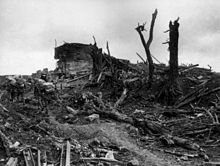
After the battle

After the battle

Battle of Mont Sorrel

Battle of Mont Sorrel

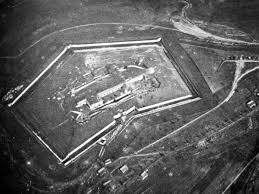
And the Blood Pump at Verdun continued, though at a relative trickle now.  On 2 June the Germans launched an offensive east of the Meuse again, beginning with an attack on Fort Vaux.  The fort was taken on 7 June, when after a subterranean battle in the galleries the garrison surrendered, having had no water for three days.  Taking the position cost the Germans 2740 casualties to 600 for the French, of which 246 were prisoners; the capture of the fort advanced the German line about 70 yards.

The essence of Verdun

The essence of Verdun

Fort Vaux

Fort Vaux

Inside Fort Faux

Inside Fort Vaux

The main offensive, covering a three mile front, began on 23 June and quickly advanced a mile, capturing Forts Thiaumont and Froidterre but failing before Fort Souville.  The Germans reached Chapelle Sainte-Fine, only a bit more than three miles from the Verdun citadel, but were thrown back to Fleury by a counterattack.  This halted the advance, and with supply problems and concern about the coming Somme offensive (the initial bombardment began on 24 June) the Germans called off the attack.  Chapelle was as close as they would ever get to Verdun.  The village of Fleury, incidentally, would change hands fifteen more times by the middle of August.

All that is left of Fleury

All that is left of Fleury

Fort Thiaumont

Fort Thiaumont


German advance from February to June

German advance from February to June


In Italy the Trentino offensive ended on 3 June, and Cadorna launched a counterattack eleven days later; it did not achieve enough to earn a name as a distinct battle. Further east, Greece was on the verge of civil war, with the pro-German royalist government in Athens and the pro-Entente Venizelist (remember him?) forces in the north.  On 3 June the liberals declared martial law in Macedonia, essentially ending any rule from Athens, and on 6 June the Allies initiated a “pacific blockade” of Greece to put pressure on the government.  On 21 June the Allies delivered a note demanding that Greek forces be demobilized and a new government formed; it was accepted and the blockaded was ended the following day.

Pro-Venizelos restaurant in Thessaloniki

Pro-Venizelos restaurant in Thessaloniki

King Constantine I and Prime Minister Venizelos in 1913

King Constantine I and Prime Minister Venizelos in 1913


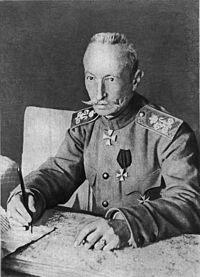
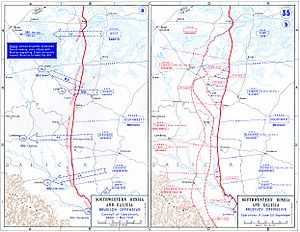
Meanwhile, to the northeast the Russians, under pressure from the Allies to draw German and Austrian troops away from Verdun and the Italian Front, began their own summer offensive. General Aleksei Brusilov, commander of the Southwestern Front, convinced the Tsar to allow an attack into Galicia, which commenced on 4 June.  The “Brusilov Offensive” sent 633,000 Russians against 467,000 Austrians and Germans along a 300 mile front, and employing limited but more accurate artillery fire and the type of shock units the Germans were using at Verdun, Brusilov immediately broke through the Austrian lines.

Alexei Evert

Alexei Evert

Aleksei Brusilov

Aleksei Brusilov

Brusilov Offensive

Brusilov Offensive

Within a week the Austrians were in headlong retreat, and Brusilov had already bagged 200,000 prisoners.  The penetration exposed his northern flank, however, and General Alexei Evert, the commander of the Western Front, just to the north, was opposed to the whole offensive and delayed moving out.  As a result, the Germans and Austrians were able to bring up new troops, and when Evert finally attacked on 18 June, he made little headway, partly because he learned nothing from Brusilov’s new tactics.  Evert was after all responsible for the disaster at Lake Naroch in March 1915.  Nevertheless, by 24 June the Russians had captured Bukovina, the southernmost part of Galicia.

June also saw more Turkish and British activity in western Persia and the merry chase after Lettow-Vorbeck continued in Africa, but the big news in June was the beginning of the Arab Revolt.  The British and French had been making big promises to Arab leaders since the war had started, hoping to stir revolts that would tie down Ottoman troops, and in early June (the date is not clear) Sharif Hussein bin Ali, fearing the Turks were about to depose him, signed up with the Allies.  As the Sharif and Emir of Mecca, Hussein could field some 50,000 troops, though they were woefully short of modern weapons.

Sharif Hussein bin Ali

Sharif Hussein bin Ali

The Hejaz

The Hejaz
On 5 June Hussein’s sons Ali (who would succeed his father as King of the Hejaz) and Faisal (who would later be King of Syria then King of Iraq) jumped the gun by attacking Medina but were easily repulsed by the Turkish garrison.  Five days later Hussein proclaimed the Hejaz independent and colorfully signaled the beginning of the Revolt by firing a shot from the Hashemite palace.  5000 of his men promptly attacked the Turkish forts in the city and on the third day captured the Ottoman Deputy Governor, who ordered his men to surrender.  Better equipped and trained than the Arabs, the 1000 Turkish troops refused, and the fighting continued into the next month.  With British naval and air support the port of Jidda was also attacked by Arab forces on 10 June and fell six days later.

Faisal (in 1933)

Faisal (in 1933)

Ali (in 1933)

Ali (in 1924)

Arab soldiers

Arab soldiers

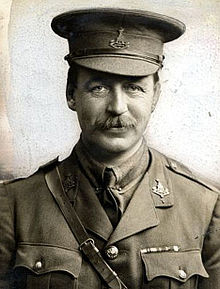
No, the most romantic figure of the Great War, T.E. Lawrence, was not yet directly involved, but the movement that would dramatically alter the face of the Middle East was underway.  Colonel Mark Sykes (of the Sykes-Picot agreement) even designed for the Arabs a flag, which would be the pattern for the national flags of most of the post-war Arab kingdoms.

Flag of the Hejaz

Flag of the Hejaz

Mark Sykes

Mark Sykes


Report from the Fronts #15: May 1916

May 1916 was a relatively quiet month, at least by Great War standards. Even the great “Blood Pump” of Verdun slowed somewhat, though that was scant comfort for the men, especially on the west bank of the Meuse, who became casualties during the weeks of back and forth.  At the beginning of the month Pétain was moved up to command of the Groupe d’armées du centre (Army Group Center), and the Second Army, defending Verdun, was given to General Robert Nivelle, who determined to recover Fort Douaumont from the Germans.  Because of the impending Somme offensive, he was limited to one division with another in reserve (pocket change by Western Front standards), and after a three day bombardment General Charles Mangin, who was later known as the Butcher (“Quoi qu’on fasse, on perd beaucoup de monde” – “Whatever you do, you lose a lot of men”), attacked on 21 May.

The Butcher

The Butcher

General Robert Nivelle

General Robert Nivelle

Fort Douamont before the war

Fort Douaumont before the war

The French captured about half the fort the first day, but reinforcements were cut off by a German counter-attack and on 24 May the thousand soldiers in the fort surrendered.  The failed assault cost the French 5,640 casualties, about half the attacking force; the Germans lost 4,500 men.  Incidentally, the German defenders of Douaumont had already suffered casualties without the French lifting a trigger finger.  On 8 May some soldiers had attempted to make coffee using flamethrower liquid for fuel, and the cooking fire spread, igniting shells and a firestorm in the fort.  Hundreds died immediately, but more tragic – and by the dark standards of the war, comic – soot covered men fleeing the fort were shot at by their fellow soldiers, who thought they were being attacked by French African troops.

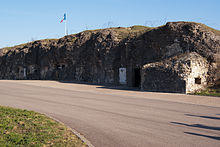
Fort Douaumont entrance today

Fort Douaumont entrance today

Inside Fort Douaumont

Inside Fort Douaumont

Inside Fort Douaumont

Inside Fort Douaumont

Fort Douamont today

Fort Douaumont today

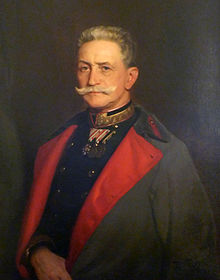
On the Italian front General Cadorna was not ready for the next installment of the Isonzo Follies, but the Austrians felt it was time for them to take a shot. Despite incredible supply difficulties because of the terrain the Austrian Chief of Staff, Franz Conrad von Hötzendorf, planned an offensive out of the Austrian-occupied Trentino, the area north of Lake Garda.  If the 11th and 3rd Austrian Armies could break the Italian line, they would be loose in the Venetian plain, only forty miles from Venice and behind the Italian forces on the Isonzo some eighty miles to the east.  And the plan actually almost worked.

General Luigi Cadorna

General Luigi Cadorna

General Franz von Hötzendorf

General Franz Conrad von Hötzendorf

Italian front

Italian front: Trentino offensive red arrows to the left

Cadorna had a quarter million troops in the area of the offensive, but Hötzendorf had managed to concentrate twice that number along a thirty mile front. Italian intelligence could hardly miss these preparations, but Cadorna was convinced, mainly by the terrain, that nothing would be going down there, and in any case his First Army commander ignored his orders to prepare deeper defenses.

Italian troops

Italian troops

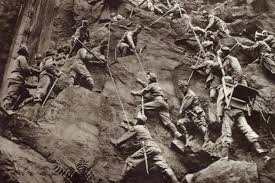
Fighting in the Alps

Fighting in the Alps

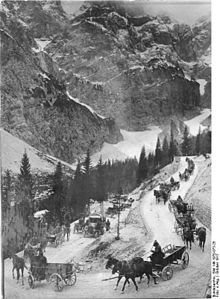
Austrian supply line

Austrian supply line

And so the Trentino Offensive (or Battle of Asiago) began on 14 May as 2000 Austrian guns opened up. The Italian center collapsed within days, and by the end of May the Austrians were six miles beyond Asiago and at the edge of the Venetian plain.  Cadorna rushed reinforcements to the area (the plain had an excellent railway grid) and the offensive was slowed by the immense logistical difficulties, but by the beginning of June the situation was definitely critical.

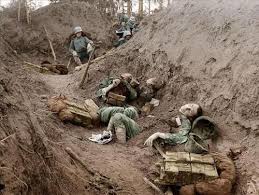
The inevitable result

The inevitable result

Fighting in the Alps

Fighting in the Alps

Asiago are after the offensive

Asiago area after the offensive

The Trentino Offensive was the only serious land engagement of May; major offensives were brewing on the Western and Eastern Fronts.  On 25 May a force from Rhodesia entered German East Africa, and both the Russians and British were occupying more territory in Persia.  By 15 May Russian forces were in northern Mesopotamia, and on 18 May a contingent of Cossacks made contact with the British on the Tigris River.

On 16 May the Second Military Service Act passed Commons and became law on the 25th; married men were no longer exempt.  The net was growing wider in order to supply the abattoir in France.

On 9 May the British and French agreed to the Sykes-Picot plan for partitioning the Ottoman Empire and on the 23rd notified the Russians, who were already on board.  Meanwhile, the Empire was about to break up on its own, as the Allies began blockading the coast of the Hejaz on 15 May.  The Turkish vilayet (province) of Hejaz comprised the western coastal area of the Arabian Peninsula south to Yemen, including the holy sites of Mecca and Medina, and was under the authority of the Sharif and Emir of Mecca, Hussein bin Ali, who had been in communication with the French and British and planned a revolt for June.
Mecca and the Kabba in 1910

Mecca and the Kaaba in 1910

Sharif

Sharif Hussein bin Ali

The Hejaz
The Hejaz

We will see.


Report from the Fronts #13: April 1916


(There seems to be some confusion as to exactly when the Battle of Lake Naroch actually ended: 30 March or 16 April or 30 April? It appears the Russian infantry offensive ended around 30 March but shelling and then the German counterattack extended perhaps to the end of April.)


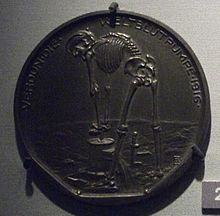
Most of the action in April 1916 took place in or concerned the east, but of course the slaughter continued at Verdun, though barely worthy of comment in a war awash in blood.  When we left the “World Blood Pump,” as German propaganda put it, Falkenhayn was of a mind to give it up, but many of his commanders were convinced the French were on the verge of collapse.  On 4 April Falkenhayn agreed to continue the offensive on both sides of the Meuse, but stipulated that if the assault on the east side did not reach the Meuse Heights, it would be ended.

The Blood Pump of Verdun

The Blood Pump of
Verdun

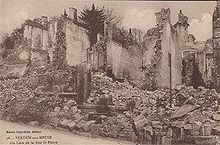
Verdun-sur-Meuse

Verdun-sur-Meuse

Verdun front at the end of March

Verdun front at the end of March

Though the idea behind the offensive was to inflict unsustainable casualties on the French, Falkenhayn was becoming increasingly concerned about his own losses.  He decided upon a more cautious advance, employing Stoẞtruppen, “storm troop” units made up of two squads of infantry and one of engineers and equipped with grenades, mortars, flame throwers and machine guns.  They would lead the way after the artillery barrage, advancing carefully and either capturing strongpoints or isolating and identifying them for the regular infantry to deal with.

This approach did reduce casualties, but it also seriously slowed the rate of advance and was opposed by many of his generals, who of course had nothing to lose.  Further, the battlegrounds had been so blasted by earlier shelling that it was difficult to find cover and construct new defenses before which the French would die in the expected counterattack.  On 20 April Konstantin Schmidt von Knobelsdorf, Chief of Staff of the 5th Army, complained to Falkenhayn that if they did not gain ground more quickly, his men would have to be pulled back to their February starting point.  Falkenhayn relented and the slaughter continued.

Konstantin von Knobelsdorf

Konstantin von Knobelsdorf

Erich von Falkenhayn

Erich von Falkenhayn

In other news from the west, German domination of the skies above the trenches, established the previous fall, ended around the beginning of April as the Allies caught up in aircraft design and manufacture.  On 14 April British planes actually bombed Adrianople and Istanbul, and though one has to doubt that much damage was done, it is a harbinger of the next war.  Nearby, the Greek government on 3 April declared that the Serbian troops on Corfu would not be permitted overland passage to Salonika, but the Allies clearly felt the war effort was more important than someone else’s national sovereignty (sound familiar?) and the Serbian Army Headquarters arrived in Salonika on 15 April.

Downed British plane in Istanbul

Downed British plane in Istanbul

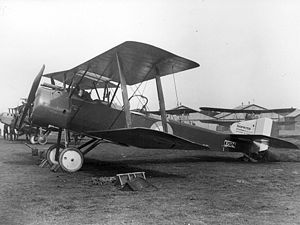
Early 1916: British Sopwith 1 1/2 Strutter

Early 1916: British Sopwith 1 1/2 Strutter

Early 1916: French Nieuport 11

Early 1916: French Nieuport 11

Early 1816: German Halberstadt DII

Early 1916: German Halberstadt DII

Of greater concern, at least for the British, on 24 April the Irish Easter Rising began.  Four days earlier a disguised German transport had attempted to deliver arms to the rebels but was sunk off the Irish coast, and Roger Casement, the Irish point man in Germany, was delivered to Ireland by a U-boat and promptly arrested.  The uprising, centered in Dublin, occurred nevertheless, much to the surprise and confusion of the general Irish population.  The rebellion was small and ill-equipped, and the British, despite the demands of the war, crushed it in less than a week, executing the leaders.  At least 485 people died, 143 of them British troops and police and 82 rebels; more than half the dead were civilians, mostly killed by the British, who used heavy weaponry.  The Irish would have to wait a bit longer for independence.

The Easter Proclamation

The Easter Proclamation

Prisoners in Dublin

Prisoners in Dublin

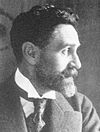
Roger Casement

Roger Casement

Sackville Street, Dublin

Sackville Street, Dublin

On 26 April Britain and Germany concluded an agreement regarding the transfer of wounded prisoners to Switzerland, a rare instance of civil behavior in a war of civilization at its most barbaric.  More important to the future, on 29 April the Allies issued the Havre Declaration, which guaranteed the existence and integrity of the Belgian Congo, far and away the most abused and exploited of the African colonies.

As a further – and far more consequential – example of European disregard for self-determination, at least for those who were not White, there is the infamous Sykes-Picot Agreement, which first raises its head in April 1916. On the 26th the French and Russian governments agreed the Turkish provinces in the Near East would after the war be divided up into spheres of influence and colonies for the Allies; the British would join on 9 May.  The Agreement involved competing claims between the French and British and of course ignored promises made to the people who actually lived in these neighborhoods, which is why the Agreement was secret, only to be revealed by the Bolsheviks in 1917.  A century later we are reaping the whirlwind of Sykes-Picot, especially in the case of the multi-ethnic non-state of Iraq.

François Georges-Picot

François Georges-Picot

Mark Sykes

Mark Sykes

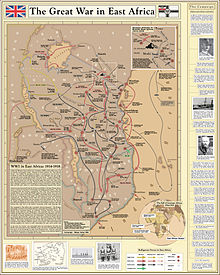
Meanwhile, in the east the Russians took the key city of Trebizond on 17 April, and to the south the British advance into German East Africa continued with the capture of Kondoa Irangi by General Jacob van Deventer on 19 April. Deventer could not proceed further because his men were exhausted from the grueling march from Moshi, during which he had lost more than 2000 horses.  The rainy season was beginning, and Deventer, waiting for Lettow-Vorbeck’s counterattack, was soon cut off from supplies, as roads and bridges were washed out.  Oh, the Portuguese got into the war by occupying a small bit of German East Africa on 11 April (take that, Kaiser Bill!).

Deventer (seated)

Jacob van Deventer (seated)

hard to see map

hard to see map


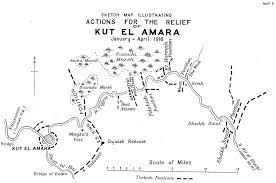
Remember Kut?  By April life was becoming very uncomfortable for General Townshend and his boys.  The Royal flying Corps was now dropping food and ammunition into the town (and the river and Turkish emplacements), the first air supply attempt in history, which proved as futile as the one a quarter century later at Stalingrad.  At the beginning of the month General George Garringe, who had replaced the fired Aylmer in March, started up the Tigris with some 30,000 troops and took Falahiya on the northern bank with heavy losses on 5 April. The next Turkish fortified position was Sannaiyat, about three miles upriver, and the British attacked on 6 April and again on the 9th.  The Turks were well entrenched and both attacks were costly failures.

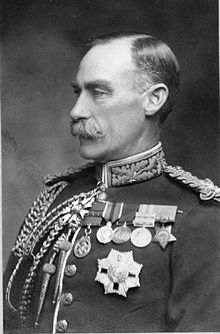
George Garringe

George Garringe

Townshend

Townshend

Saving Kut

Saving Kut

Garringe saw that taking the Sannaiyat trench line would require sapping and consequently take far too long to save the starving garrison at Kut, and he decided to cross to the southern bank.  The difficulty was that the rains had begun and the southern bank of the river was already turning into a vast swamp.  Despite this, the troops were able to seize the Bait Aissa trenches a few miles upriver from Sanniyat on 18 April, but flooding and mud prevented the British from moving any further.  Hoping that the action had drawn Turkish troops from Sanniyat, Gerringe hurried back and assaulted the position for the third time on 22 April and was repulsed.

"For the King-Emperor!"

“For the King-Emperor!”

British at Kut

British at Kut

Turkish lines at Kut

Turkish lines at Kut

There was a final desperate attempt to aid the troops in Kut.  The river steamer HMS Julnar was loaded with 250 tons of food at Basra and sent on a dash up the river on 24 April.  Before they reached the blockaded town the steersman was shot, and the steamer grounded on the bank and was captured by the Turks. On 26 April Townshend called for an armistice but negotiations, unsurprisingly, went nowhere.  T.E. Lawrence and another were sent from Cairo to attempt to bribe the Turkish commander with £2,000,000, but the Ottoman supreme commander, Enver Pasha, refused, and on the 29th the garrison surrendered.

HMS Julnar before her last journey

HMS Julnar before her last journey

HMS Julnar loading troops

HMS Julnar loading troops


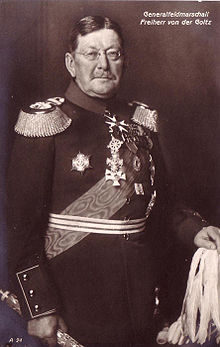
The 147 day siege and the rescue attempts had cost the British 30,000 killed and wounded and 13,000 captured; the Turks are thought to have suffered about 10,000 casualties.  Of those taken prisoner 70% of the British and 50% of the Indians died in captivity, mostly from disease.  The Turks also lost Goltz Pasha, who on 19 April died in Baghdad either from typhus or being poisoned.  General Gorringe and General Percy Lake, the other commander of the Mesopotamia army, were both sacked and replaced by General Stanley Maude, who would retrain the army and ultimately take Baghdad.

Stanley Maude

Stanley Maude

Percy Lake

Percy Lake


Golz Pasha in his Field Marshal's uniform

Golz Pasha in his Field Marshal’s uniform

General Townshend spent the rest of the war in very comfortable captivity on an island in the Sea of Marmara, an object of contempt to the men he had left behind. While it is true that Townshend wanted to retreat from Kut back in December and was overruled by General Nixon, his conduct during the siege was incompetent and contemptible.  He never expelled the 6000 inhabitants of Kut or foraged the area around the town for food stocks, and he consistently refused to attempt a break out to meet and aid the relieving forces or even launch diversionary actions to draw off Turkish defenders.  He was far more concerned about getting a promotion and caring for his dog (well, I can understand that) than his starving men, whom he never visited in the hospitals.  Unlike most of his men he survived the war, but his reputation was shattered and his military career at an end.
After the fall: Indian troops

After the fall: Indian troops

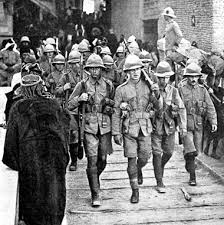
After the fall: marching into captivity

After the fall: marching into captivity

After the fall: Townshend with Kahalil Pasha

After the fall: Townshend with Kahlil Pasha

The fall of Kut was certainly a humiliation for the British, especially as it came at the hands of the Turks (Townshend wanted to surrender to Goltz), but it had little effect on the war, even in the east – the Ottomans were at the end of their supply line and could never threaten Basra. A lot of men died, but it was virtually nothing compared to the blood being spilled on the Western Front.

Reports from the Front #10: January 1915

Most of the action in the first month of 1916 was in the Balkans and Mesopotamia. The troops on the Western Front were busy enough fighting the mud and cold, little realizing that the cataclysm of Verdun would get underway the following month.  The Eastern Front was quiet: the Russians were recovering from the disasters of 1915 and planning a new offensive, while the Germans and Austrians were engaged in picking apart the Balkans.  Even General Cadorna was taking a break from his Isonzo Follies.

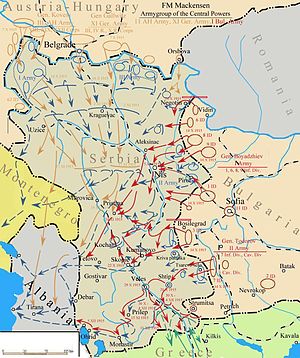
The destruction of Serbia

The destruction of Serbia

Serbs were raining down on Greece.  On New Year’s Day King Peter I of Serbia arrived at Salonika, and on 17 January he moved to Aidipsos on the Greek island of Euboea to take the waters at the thermal springs (he was old and ailing).  Meanwhile, his troops were going to Corfu.  On 10 January the allies informed the Greek government that the remnants of the Serbian army would be moved to the island, and three days later the Greeks refused.  Well, the French had already occupied Corfu two days earlier, and on 15 January they began to ship something like 100,000 exhausted Serbs to the island and other locations, where they would die in droves from malnutrition and disease.  The Serbian government in exile was established at Brindisi.220px-Pobedata_nad_syrbia[1]

Serbs on Corfu

Serbs on Corfu

Peter I of Serbia

Peter I of Serbia

Hard on the heels of the Serbs came the Austrians, who by the end of the month occupied all Albania except the far south. Albania had only come into existence a few years earlier in the wake of the Second Balkan War of 1913 and was assigned territory, Epirus, in the south that was ethnically Greek.  (This disregard for ethnic realities would become endemic in the formation of countries in eastern Europe in the wake of the war.)

As a result the Greeks, who had already occupied the territory earlier and left, sent in troops (with allied approval) on 27 October 1914, while the Italians seized a number of islands. The result was the Macedonian Front, running along the northern Greek frontier through southern Albania to the Adriatic, and any Austrian or Bulgarian advance further south was thwarted.  The Albanian monarch (a German), Wilhelm I, fled.  Albania, incidentally, was not a belligerent.

Wilhelm I of Albania

Wilhelm I of Albania

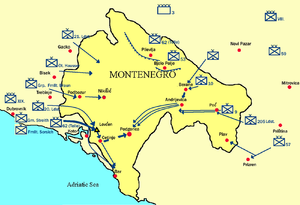
On 10 January the Austrians began nosing into Montenegro, leading to an armistice between the two powers two days later.  But Montenegro had helped the Serbs and in any case was important to Austria, being situated between the Empire and their new possession of Albania, and on 20 January the armistice ended.  The country fell to the Austrians, and King Nicola I fled to France and the Albanian government was ensconced in Bordeaux.

Montenegran soldiers

Montenegran soldiers

The Montenegro campaign

The Montenegro campaign

Nikola I of Montenegro

Nikola I of Montenegro

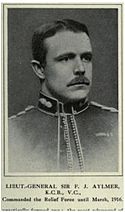
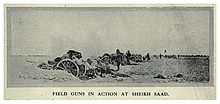
The other hot spot in January 1916 was the Tigris River.  On 4 January a force of some 19,000 troops, mostly Indian, under General Fenton Aylmer began moving north to relieve Kut.  They encountered Goltz Pasha at Sheikh Sa’ad on 6 January, and although the Turks were outnumbered four to one, Goltz managed to hold out until 8 January, when he moved about ten miles up the river to Wadi. On 14 January the British attacked this new position, and while they failed to break through, Goltz retreated another 5 miles to the Hanna defile.

Golz Pasha

Goltz Pasha

General Fenton Aylmer

General Fenton Aylmer

British artillery at Sheikh Sa'ad

British artillery at Sheikh Sa’ad

On 19 January General Percy Lake replaced Nixon as supreme commander of the Mesopotamian campaign. It made no difference.  The British attacked at Hanna on 21 January and failed, and having suffered heavy casualties in the battles and from disease, the relief force retreated south to Ali Gharbi, where they had started.  In the three battles the British had suffered 8600 casualties, the Turks 2230.  The siege of Kut would go on.

General Percy Lake

General Percy Lake

British hospital ship on the Tigris

British hospital ship on the Tigris

British troops on the Tigris

British troops on the Tigris

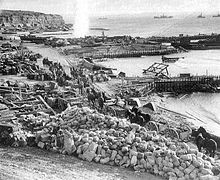
Another failed operation finally came to an end when on 7-8 January allied troops were evacuated from Helles beach at the tip of the Gallipoli Peninsula.  The evacuation proved to be the most successful operation of the whole campaign, and not a man was lost, though the Turks knew it was about to take place.  The Gallipoli campaign proved a disaster, with tens of thousands of lives lost for absolutely no gains, hardly surprising since the landings resulted almost immediately in a mini-Western Front on the peninsula.  Both sides suffered about a quarter million casualties, though the Turks could of course claim a victory.

Helles beach

Helles beach

The political repercussions had a more lasting effect.  Winston Churchill, who had been an instrumental force behind the operation, lost his job as First Lord of the Admiralty and went off to fight on the Wester Front.  Kitchener’s influence began to wane, and the failure would contribute to the fall of the Asquith government at the end of the year.

Churchill would earn a reputation for hare-brained military schemes, but to some extent this was unfair.  The basic idea made sense.  It is very unlikely that a naval bombardment of Istanbul would drive the Turks out of the war, but an allied naval presence in the Sea of Marmara and the Bosphorus would take pressure off the Russians and render communications between the European and Asiatic parts of the Ottoman Empire far more difficult.

Churchill on the Western Front 1916

Churchill on the Western Front 1916

The problem was not the idea but rather extremely poor operational planning and execution, in which Churchill had no real role.  The naval component was woefully inadequate and poorly led, especially the minesweeping units, but the land campaign had a reasonable chance of seizing the forts on the European side of the straights.  That they did not was due to poor planning and intelligence (tourist maps had to be used), overconfidence, insufficient artillery and above all, terrible leadership at all levels.  There were any number of instances in the early stages at Helles when the troops could have kept the initiative and rolled over Turkish positions, but few of the commanders were actually on the beaches, communications were hopeless and requests for support were ignored.  The Turks thus had the time to bring up reinforcements and prepare their defenses, and the result was stalemate.

In other news, on 13 January the Turks began occupying positions in western Iran, partly in reaction to Russian forces in the northwest of the country and British in the south.  Iran was neutral but was in no position to resist these incursions, any more than she could resist the later violation of her sovereignty during the Second World War. Or the CIA engineered overthrow of their democratically elected government in 1953, which resulted in the ascendancy of the brutal US supported Shah.  What would you be chanting in the streets if this had happened to your country?

On 22 January Romania, encircled by belligerents and avid for territorial gains, specifically Transylvania, opened negotiations with Russia for aid.  Rumania was bound by treaty to come to the aid of Austria were she attacked, and the Rumanian king, Carol I, was a Hohenzollern, the ruling house of the German Empire.  When the war broke out, Carol wanted to enter the war as an ally of the Central Power, but the government and public opinion preferred the allies, particularly since Transylvania was a Hungarian possession.  Rumania decided she was not bound by the treaty, since Austria had “started the war,” and the country initially remained neutral.  In October of 1914 Carol was succeeded by Ferdinand I, who was more amenable to honoring the will of the people.

Carol I of Rumania

Carol I of Rumania

Ferdinand I of Rumania

Ferdinand I of Rumania

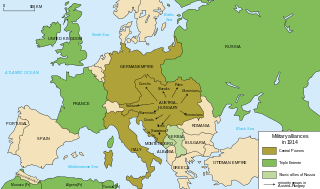
Rumania in 1914

Rumania in 1914

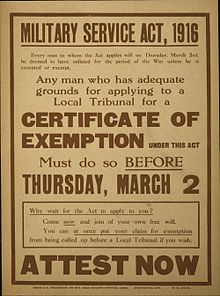
Finally, as a sign of the times, on 27 January the British Parliament passed the first Military Service Act, in effect establishing conscription, which already existed in France, Russia, Austria and Germany.  Defended by its navy and requiring only relatively small forces to secure the Empire, unlike the continental powers Britain could make do with a volunteer army, and in 1914 the regular army was just short of a quarter million men, half of whom garrisoned the Empire.  The BEF initially comprised only 150,000 men; the Germans fielded 1,850,000 and the French 1,650,000.  That certainly would not fill the maw of the trenches, and single men without children in the 18 to 41 age group would henceforth (it would become effective on 2 March) be liable for service unless they were in a war related occupation.  Subsequent acts would expand the pool, as the meat grinder of the Western Front demanded more and more bodies, and by 1918 the British had some 4,000,000 men in uniform.

1916 conscription notice

1916 conscription notice

And so the third calendar year of the war began.

Reports from the Front #9: December 1915

1915 came to an end with few significant changes made in the past year of fighting. Bulgaria was in, Serbia was out and Greece was both in and out, all of which strategically aided the Central Powers, but hardly caused any swing in the overall balance of power.  More significantly, the Russians were driven out of Poland and Galicia, but as events would demonstrate, they were far from being a spent force.  Perhaps the most significant result of a year of conflict was that hundreds of thousands of men were no longer alive or no longer in possession of all their body parts.  Governments and generals had certainly come to the conclusion that this war was not going to be easy or brief after all, but they could come up with nothing better than doing the same old same old.

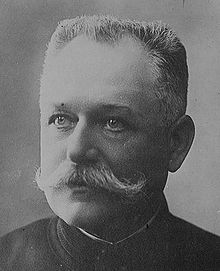
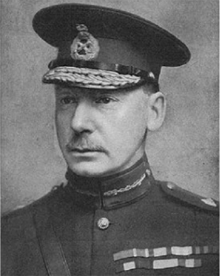
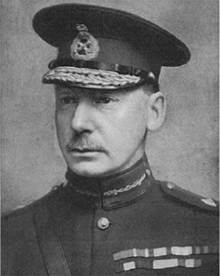
Actually, one simple “solution” was to change or at least shuffle generals.  On 3 December Joffre was made Commander in Chief of all the French armies, hardly a great development, inasmuch as his tactical inclinations were unchanged from a year of slaughter and as ponderous as his imposing physique.  Meanwhile, Sir John French, the C-in-C of the BEF, was under mounting criticism from just about everyone, including Joffre, Kitchener, Haig, Asquith and the King, who generally felt he was not an aggressive enough commander.  Rather than be sacked, he resigned on 15 December and was replaced four days later by Douglas Haig, who was sufficiently aggressive; he would become known as the ”Butcher of the Somme.”  On 22 December the Chief of the General Staff of the BEF and the Chief of the Imperial General Staff also resigned.

The Butcher of the Somme

The Butcher of the Somme

Papa Joffre

Papa Joffre

French and PM Asquith

French and PM Asquith

In the east it was withdrawal time for the allies. On 2 December the French force in Macedonia withdrew to Salonika, followed on 7 December by the British.  They then demanded that the Greek forces in Salonika leave, which on 11 December they refused to do.  It was after all their country, and they were officially a neutral, demonstrated on 14 December by an agreement with the Bulgarians to establish a neutral zone along the Greek frontier.  But they were a relatively helpless neutral: on 30 December French general Maurice Sarrail had all consuls of the Central Powers in Salonika arrested and deported.  Salonika was now a huge fortified camp, containing 150,000 allied troops, who became known as the ”Gardeners of Salonika.”

General Maurice Sarrrail

General Maurice Sarrrail

French soldiers at Salonika

French soldiers at Salonika

Further east, on 3 December the British/Indian expeditionary force retreating down the Tigris reached Kut-al-Amara, which Townshend decided to fortify. Four days later 11,000 Ottoman troops, commanded by the 72 year old Field Marshal Colmar von der Goltz, an old Turkish hand (Goltz Pasha), arrived and placed Kut and the 8000 British troops under siege.  After a month of this, including an unsuccessful Turkish assault on Christmas Eve, Townshend decided to break out and head for Basra, but he was overruled by his commander, Sir John Nixon, the senior general of the Indian Army, who thought the siege was an excellent way to tie up Ottoman forces.  It would also prove an excellent way to lose 8000 Imperial troops.

Golz Pasha

Goltz Pasha

Townshend

Townshend

Nixon

Nixon

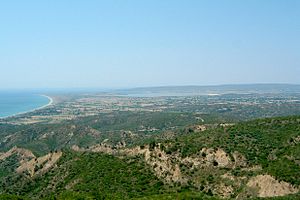
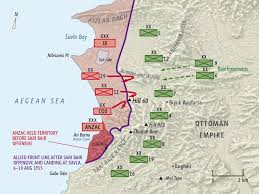
Elsewhere in the Ottoman Empire a more successful withdrawal began, when the allies finally gave up the completely stalled Gallipoli campaign.  On 19 December the evacuation of troops from Suvla Bay and Anzac Cove began and was completed without trouble the following day.  The main force at Helles would leave in January.

Bones left at Anzac Cove

Bones left at Anzac Cove

Aussies charging just before the Anzac evacuation

Aussies charging just before the Anzac evacuation

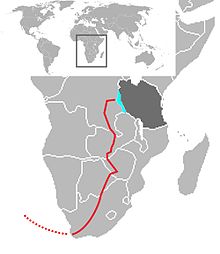
On the other hand, the East African Front was lighting up again, as the British began naval operations on Lake Tanganyika.  The gunboats Mimi and Toutou had completed their 10,000 mile journey from Britain to South Africa and overland to Tanganyika and were launched on 22 and 23 December.  On 26 December they engaged the German gunboat Kingani, which was captured and refitted by the British as the Fifi. More action would follow.

The Kingani/Fifi

The Kingani/Fifi

The epic journey of the Mimi and Toutou

The epic journey of the Mimi and Toutou

On 10 December the Fourth Battle of the Isonzo came to an end.  The Italians had suffered 49,500 casualties, the Austrians 32,100.  For nothing.  Yet, General Cadorna was not sacked, but allowed to carry on his attempts to capture Gorizia and achieve the big breakthrough that all these characters dreamed of.

Finally, a couple of diplomatic arrangements of some interest.  On 28 December two German military attachés in Washington, Captains Karl Boy-Ed and Franz von Papen were declared personae non gratae for being actively involved in espionage and sabotage (America was supplying arms to the Entente) and recalled to Germany.  Von Papen would after the war become the Chancellor of the Weimar Republic and his intrigues would help elevate Adolf Hitler to the Chancellorship.

The young von Papen

The young von Papen

Boy-Ed

Boy-Ed

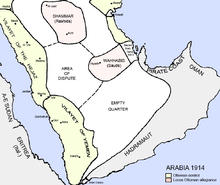
On 26 December Britain signed a treaty with Ibn Saud (or Abdulaziz), an Arab sheik who from 1902 had been extending the control of the House of Saud out from Riyadh.  His main enemy was the House of Rashid, which with Ottoman aid defeated Ibn Saud in 1904, only to be driven out two years later, along with their Turkish allies.  By 1912 Ibn Saud had conquered most of Nejd (the interior of the peninsula) and the eastern coast, becoming the Emir of Nejd and Hasa.  The Ottomans were left with control of the Hejaz, the western coast of the peninsula, where Mecca and the holy sites of Islam were.

Hussein ibn Ali Sharif and Emir of Mecca

Hussein ibn Ali
Sharif and Emir of Mecca

Ibn Saud

Ibn Saud

Arabia in 1914

Arabia in 1914

The British interest was not oil, which was not discovered in Arabia until 1938, but finding a stable ally in Arabia, who could protect British interests in the Persian Gulf and fight the Turks.  By virtue of the Treaty of Darin of 1915 Saudi Arabia became a British protectorate with delineated borders and agreed to respect British interests.  Ibn Saud did not, however, agree to keep his hands off the Hejaz, despite the fact that only two months earlier the British had made an agreement with the Sherif of Mecca.  Why should a Great Power worry about promises made to wogs?

And so 1915 came to an end.  Oh, this year there was no Christmas truce.  The generals and governments were not about to put up with that again.


Reports from the Front #8: November 1915

(This has been delayed by injured ribs and the decision to have the Whitie Comes to America dinner at my house.)


The October focus on the Balkans continued into November, during which month one of the minor powers was eliminated from the war.  On 2 November British Prime Minister Asquith declared that the independence of Serbia was an allied war aim, which was presumably an incentive for the Serbs to continue resisting, inasmuch as the country was peripheral to British interests.  If so, it could not stem the Austrian-Bulgarian flood, and by 30 November the remnants of the Serbian army were streaming into Albania.  Serbia was out of the war.

Goodbye, Serbia

Goodbye, Serbia

At the same time, more in line with the stalemate in the west the Third Battle of the Isonzo came to an end on 3 November, with 60,000 Italian and 40,000 Austrian casualties, including 20,000 dead on both sides.  But never fear, General Luigi Cadorna was not discouraged, and on 10 November he initiated the Fourth Battle of the Isonzo.  He seemed determined to outdo the big boys on the Western Front, where on 6 November the Second Battle of Champagne ended with no gains but 145,000 French and 72,500 German casualties.  German Chief of Staff Erich von Falkenhayn commented on the offensive in his memoirs: Attempts at a mass breakthrough, even with the extreme accumulation of men and material, cannot be regarded as holding out the prospects of success.

Falkenhayn

Falkenhayn


General Luigi Cadorna "The fourth time is the charm."

General Luigi Cadorna
“The fourth time is the charm.”

In the Cameroons the third attempt to capture Mora was abandoned on 4 November, but two days later the allies took Banyo.  Ever hear of either of these places?  Meanwhile, the Anglo-Indian force in Mesopotamia continued their advance up the Tigris River towards Baghdad, only to be stopped just short at Ctesiphon, the ancient capital of the Sassanian Persian Empire.  The Battle of Ctesiphon lasted from 22 to 25 November, resulting in 4600 Anglo-Indian casualties, fully 40% of the force; the victorious Turks lost perhaps 6000.  General Charles Townshend retreated down the river to Kut-al-Amara, which he began to fortify.  A disaster was in the offing.  Incidentally, a British soldier later remarked concerning Ctesiphon: “We calls it Pistupon.”

Townshend

Townshend

The great arch of Ctesiphon

The great arch of Ctesiphon

Up a lazy river

Up a lazy river

Finally, on 8 November the Entente loaned Greece £1,600,000 in an attempt to sweeten the legally questionable presence of their forces in the country.  On the last day of the month the Treaty of London, reapportioning territory in the post-war Balkans, was signed.  It would be superseded by the Versailles Treaty.

In the west the low level slaughter continued, but the chateau generals were already planning the next big push.

Reports from the Front #7: October 1915

(This has taken a long time and no other posts have appeared, but a lot has been going on in my life. And it’s not like I am being paid for this – I get no cut from those ads you might see at the end of a post.  Hey, I like to write.)


October 1915 was “Balkan Month” in the Great War.  At the invitation of Prime Minister Venizélos allied troops showed up at Salonika on 3 October, prompting the Greek government to protest.  Despite this opposition and that of King Constantine, leading to the resignation of Venizélos, the French and British landed two days later, and on 8 October the new Greek government proclaimed a policy of armed neutrality.  This seems a strange call inasmuch as one group of belligerents was actually in Greece, but the Greeks feared the now mobilized Bulgarians.

In response to that mobilization on 4 October the Entente Powers delivered an ultimatum to Sofia, demanding all German officers be expelled from the country.  It was ignored.  The west had lost the territorial bidding war for the allegiance (or at least neutrality) of the strategically located Bulgaria.  Russia recalled its ambassadors on 5 October and Britain on 13 October, on which day French and Bulgarian troops in Macedonia actually engaged one another.  On 15 October Montenegro and Britain declared a state of war with Bulgaria, and the French followed the next day; Russia and Italy came in on 19 October.

Prime Minister Vasil Radoslavov of Bulgaria

Prime Minister Vasil Radoslavov of Bulgaria

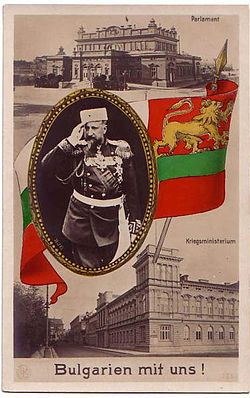
Czar Ferdinand of Bulgaria

Czar Ferdinand of Bulgaria

"Bulgaria is with us"

“Bulgaria is with us”

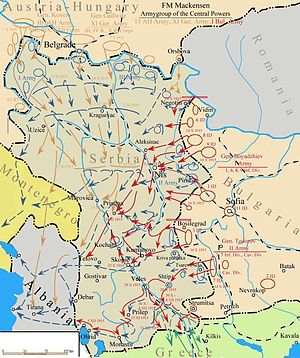
Meanwhile, the Austrians had been busy.  On 7 October the final solution of the Serbian question began, even though the three previous attempts to conquer Serbia in 1914 had been complete failures.  But the Empire wanted the Serbs crushed, Germany wanted a land passage to the Ottomans and the Bulgarians were eager to bite off chunks of Serbian territory.  The invasion force consisted of the German Eleventh Army and the Austro-Hungarian Third Army in the north and the Bulgarian First Army in the east, more than 300,000 men (I could not locate accurate figures) led by Field Marshal Mackensen.

Goodbye, Serbia

Goodbye, Serbia

They were faced by perhaps 200,000 poorly equipped Serbians, who would essentially be on their own. Serbia’s ally Montenegro had a miniscule untrained militia, and Greece, bound by treaty to defend Serbia, lawyered up and argued that the agreement was no longer valid.  There were only 13,000 allied troops at Salonika, and the French units that did move into Macedonia were easily brushed aside by the Bulgarians.  On 9 October the Austrians captured Belgrade, which was right on the Austrian frontier, while the Bulgarians slowly pushed west and south.  The invaders were hampered by the mountainous terrain, which prevented Mackensen from encircling and annihilating the Serbian army, which had retreated to the center of the country.  Nevertheless, by the end of the month half of Serbia was occupied, and the Serbs were streaming westward.

Retreating Serbians

Retreating Serbians

In other news, the stalemate in Gallipoli continued, the Indians were still sweating up the Tigris and in northern Italy General Cadorna began the Third Battle of the Isonzo on 18 October. Of more importance in the long run on 24 October the British government sent a letter to the Sharif of Mecca defining a post-war Arab state.  Both sides were courting the Arabs, but the Entente was in a far better position inasmuch as the Turkish imperial masters were on the side of the Central Powers.

General Luigi Cadorna "The men just need to fight harder."

General Luigi Cadorna
“The men just need to fight harder.”

Hussein ibn Ali Sharif and Emir of Mecca

Hussein ibn Ali
Sharif and Emir of Mecca

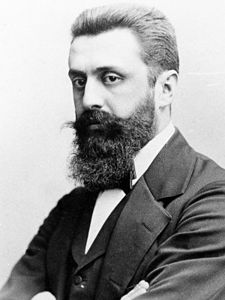
In one of the more bizarre actions of the war both sides were also courting the Jews, not because they could supply some sort of military force, but because they were so economically and politically powerful. Or at least that is what the Germans, French and British thought.  Influential persons in their governments actually fell for the old anti-Semitic idea that there was a powerful worldwide Jewish network, which could possibly alter the course of the war.  This was of course nonsense, but the Zionist movement, particularly strong in Britain, was hardly going to pass on the leverage they received from this silly notion.  This resulted in vague promises of a Jewish state, such as the Balfour Declaration, which would appear in 1917, despite the fact that similar promises were being made to the Arabs and that both Britain and France were in interested in the colonial pickings available from a dissolved Ottoman Empire.

Chaim Weizmann, leader of  British Zionism 1915

Chaim Weizmann,
leader of British Zionism 1915

Theodor Herzel, founder of the World Zionist Organization 1897

Theodor Herzel,
founder of the World Zionist Organization 1897

On the Western Front the slaughter continued: the Third Battle of Artois ended on 15 October, a bloody failure, but the Second Champagne Campaign plodded on until 6 November. As early as 3 October Papa Joffre announced there would be no breakthrough but the offensive would continue as a battle of attrition, and on 22 October he declared that the campaign had made important tactical gains and achieved a “moral superiority” over the Germans by inflicting heavy casualties.  The “tactical gains” amounted to moving the line a few kilometers, and one might expect the Germans did not feel particularly morally inferior, inasmuch as 35 French divisions failed to break a line defended by 15 German divisions.

He was right about one thing: the casualties. The French lost 145,000 men, the Germans 72,000 (25,000 of them prisoners); it is not clear how inflicting heavier casualties on your own troops advanced the cause.  The Third Battle of Artois (including Loos) cost the French another 48,000 casualties, the British 121,000 and the Germans 149,000, not bad for little more than a month of fighting.  The German defense in depth had again demonstrated its effectiveness, but the lesson seemed lost on the chateau generals on the western side of the trench line.  Joffre’s remark about a battle of attrition would prove to be prophetic when 1916 rolled around.

There was one more casualty from the Third Battle of Artois – Field Marshall John French. As Commander-in-Chief of the British Expeditionary Force, French had not got on very well with his fellow generals, both British and French, and only a visit from the Secretary of State for War, Lord Kitchener, could move him to take part in the First Battle of the Marne.  He was blamed for losing at Loos because of mishandling his reserves, which seems more like scapegoating from Kitchener and French’s other enemies than an objective appraisal.  In any case, with such powerful foes in London his days were numbered.

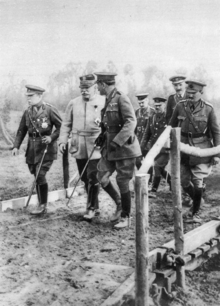
Haig, Joffre and French in a rare visit to the front

Haig, Joffre and French in a rare visit to the front

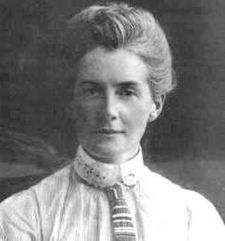
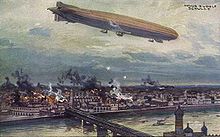
A few other events of note in October.   The third Allied attack on Mora in the Cameroons began on 30 October, and on 13 October the heaviest airship attack yet produced some 200 casualties in London and along the east coast of Britain.  On 12 October the Germans executed a British nurse, Edith Cavell, who had been arrested in August.  Stationed in Brussels, Cavell had been helping smuggle allied soldiers to Holland and on to England, a violation of German military law.  Medical personnel were protected by the First Geneva Convention, but Cavell lost that protection by actively aiding one of the belligerents.  Some German officers called for clemency, but the military governor of Brussels, General Traugott Martin von Sauberzweig, ordered her execution “for reasons of state,” thus denying her any hope of clemency from further up in the German command. The death of Cavell was a propaganda windfall for the allies, and General von Sauberzweig was later relieved.  After the war a British commission concluded that Cavell’s execution was in accordance with the laws of war.

Edith Cavell

Edith Cavell

German Gotha strategic bomber

German Gotha strategic bomber

German airship bombing Warsaw

German airship bombing Warsaw


Laws of war, always an interesting concept.


Reports from the Front #6: September 1915

September 1915 saw the Austrian-German tide in the east slow down because of lengthening lines of communication, but by the beginning of that month the Russians had already lost all of Poland and 750,000 prisoners. Perhaps more important than these losses was a change in command. On 5 September the Supreme Commander of all Russian forces, Grand Duke Nicholas Nickolaevich, was sacked by the Czar. He was a decent soldier but seemingly incapable of controlling the unprepared and fragmented command structure of the Russian army, which was loaded with incompetent appointees. In his place Czar Nicholas appointed…himself. A bigger blunder could hardly have been made.

Grand Duke Nicholas

Grand Duke Nicholas

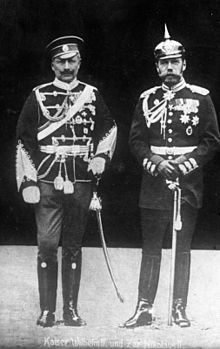
The Czar and the Kaiser, who seem to have put on the uniforms

The Czar and the Kaiser, who seem to have put on the wrong uniforms

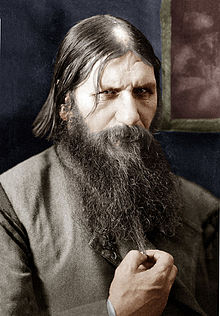
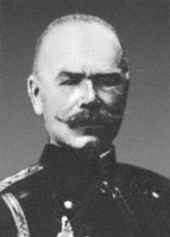
In reality the head of the Stavka, General Mikhail Alekseyev, managed the war, but by assuming supreme command the Czar had identified himself with the conduct of the war, regardless of whether he actually had anything to do with it. And the conduct of the war under Alekseyev was terrible. He clearly did not understand modern warfare and in any case could do little about the corruption and incompetence of the officer class, much of which stemmed from nepotism and court intrigue. Now the Czar, who already had a rep for not being overly concerned about the welfare of his people and had no idea how to wage a war, would take the blame, especially as his presence at the front advertised the fact that he was indeed in command. As defeats mounted and life became even more miserable for the average Russian soldier, it was only natural that he be blamed, particularly since it was easy to believe the Czar was being jerked around by his unpopular German wife, Alexandra, and the notorious “monk” Rasputin. With this decision Czar Nicholas stepped closer to the abyss of the Revolution.

Rasputin

Rasputin

Alekseyev

Alekseyev

Empress Alexandra

Empress Alexandra

With a new El Supremo on 7 September the Russians launched a counter offensive at Tarnopol, in the far south of the front; nine days later it was abandoned. On 16 September the Germans captured Pinsk, and two days later they took Vilna, threatening to break open the northern front. Italy’s entry into the war helped by drawing Austrian forces to the southwest, but nevertheless, by the end of the month things were looking grim for the Russians.

Moving east

Moving east

Meanwhile, the Balkans were lighting up with diplomacy as the neutrals were considering their options. On 22 September Bulgaria ordered general mobilization in the wake of reaching a favorable frontier agreement with the Turks, who wanted Bulgaria in the war on their side. The Bulgarians were seeking territorial expansion, especially at the expense of the Serbs, and finally decided the Central Powers were the better bet. The Greeks, who had little love for the Turks (and had over a million fellow Hellenes in western Turkey) and now feared the Bulgarians, began negotiations with the western allies, asking for a guarantee of 150,000 allied troops. At least the Greek Prime Minister, Elefthérious Venizélos, did; King Constantine I was seriously pro-German. Nevertheless, on 23 September the Greeks began to mobilize, and the next day the French and British agreed to send troops. On 27 September the King secretly gave in to the allied deal, but the following day the Greek government (minus Venizélos) formally refused the allied help and Constantine went along. This would ultimately lead to the “National Schism,” a veritable division of Greece between the monarchists and the supporters of Venizelos.

Constantine I in a German uniform

Constantine I in a German uniform

Venizelos

Venizelos

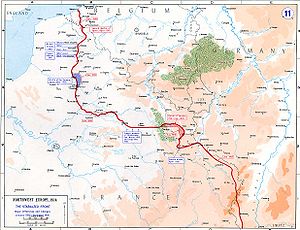
On the Western Front the lazy, hazy days of summer came to end with the fall offensives. On 25 September the French opened the Second Champagne Offensive, while to the north they and the British began the Third Battle of Artois (the Battle of Loos was the British component and saw the first use of gas by them). Do these names seem familiar? They are the same sectors of the front attacked back in May, and the result would be the same. Granted, there were good strategic reasons to mount this offensive, but why should anyone expect it to succeed this time, when in fact the German defenses in depth were far more developed now? The battles would last into October and November and achieve nothing but casualties. This is the sort of wishful thinking that would characterize the decisions of the chateau generals for the next several years.

Im Westen nur Dummheit

Im Westen nur Dummheit

There was an allied attack in the Cameroons on 8 September, but otherwise, in Afrika nichts Neues. On 1 September Germany agreed to demands by the United States to limit submarine warfare; she would later be more desperate.

And that’s what happened 100 years ago this month.

Reports from the Front #5: August 1915

August was a good time to be on the Western Front: neither side launched any serious assaults on the trench lines. It was also a good time to be on the Eastern Front, if you happened to be German or Austrian. The Gorlice-Tarnów offensive, which Falkenhayn had launched at the beginning of May, continued its rapid advance eastward, destroying Russian units all along the line. This operation was remembered by the Russians as the “Great Retreat,” but that retreat, accelerated by the Stavka (the Russian supreme headquarters) saved the army from any large encirclements, especially in the Warsaw salient. On 5 August the Central Powers took Warsaw, on 25 August Brest-Litovsk and on 26 August Byelostok. The Russians were now being squeezed out of Poland.

Poniatowski bridge (Warsaw) destroyed by the Russians

Poniatowski bridge (Warsaw) destroyed by the Russians

German cavalry enters Warsaw

German cavalry enters Warsaw

Moving east

                                      Moving east

They were not doing so well on the Turkish front either, and on 3 August they evacuated the Van district, which they had captured in May. The Turks reoccupied the area on 5 August, but the next day they faced a serious challenge hundreds of miles to the west. On 6 August the western allies reopened the Gallipoli campaign, landing two fresh divisions at Suvla Bay, just north of “Anzac cove.” The plan was for the two beachheads to unite, seize the surrounding heights before the Turks could bring up reinforcements and then cross to the east coast of the peninsula, trapping the Turkish forces to the south.

Suvla Bay

                                  Suvla Bay

Kemal in the trenches at Gallipoli - not the cigarette holder

Kemal in the trenches at Gallipoli – note the cigarette holder

Liman von Sanders

          Liman von Sanders

The allied failure at Suvla Bay

             The allied failure at Suvla Bay

The plan failed utterly, not so much because of the quick reaction of the (German) Turkish commander, Liman von Sanders, and the equally able Lieutenant Colonel Mustafa Kemal, but because of the incompetence of the British command. The Secretary of State for War, Field Marshal Herbert Kitchener (of Omdurman fame), refused to appoint a younger general and instead saddled the Suvla landing with the inexperienced and 61 year old Frederick Stopford, who was asleep when the assault began and visited the beach only once. He left the operation in the hands of his subordinates, many of whom were also lethargic, and although the two beachheads were joined, inactivity, confusion and conflicting orders prevented the troops from controlling the heights. By the middle of August the battle was essentially over, and another static trench line had been established on the peninsula. By this time there were over 500,000 allied and 300,000 Turkish troops involved in the campaign.

Aussies in a captured Turkish trench

Aussies in a captured Turkish trench

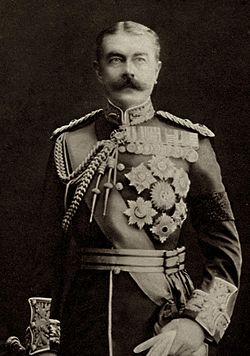
Lord Kitchener

                    Lord Kitchener

Yes, that's Kitchener

               Yes, that’s Kitchener

Off in the west 10 August saw the culmination of the Second Battle of the Isonzo, which ended like the First: little gained beyond mammoth casualties on both sides. More important, on 21 August Italy declared war on the Ottoman Empire. The Treaty of London, signed by Italy and the Triple Entente on 26 April, had lured the Italians into the war with promises of Austrian territory and a protectorate over Albania, but it also confirmed Italy’s possession of the Dodecanese Islands in the Aegean (just off the coast of Turkey) and provided that “in the event of total or partial partition of Turkey in Asia, she ought to obtain a just share of the Mediterranean region adjacent to the province of Adalia (on the south coast of Turkey)…” Diplomatic promises apart, the Italian government apparently felt that being in an actual state of war with Turkey would enhance her position when it came time to dispose of the Ottoman Empire.

Fighting on the Italian front - Austrians

    Fighting on the Italian front – Austrians

And so it was in August 1915, an excellent month for the Central Powers.